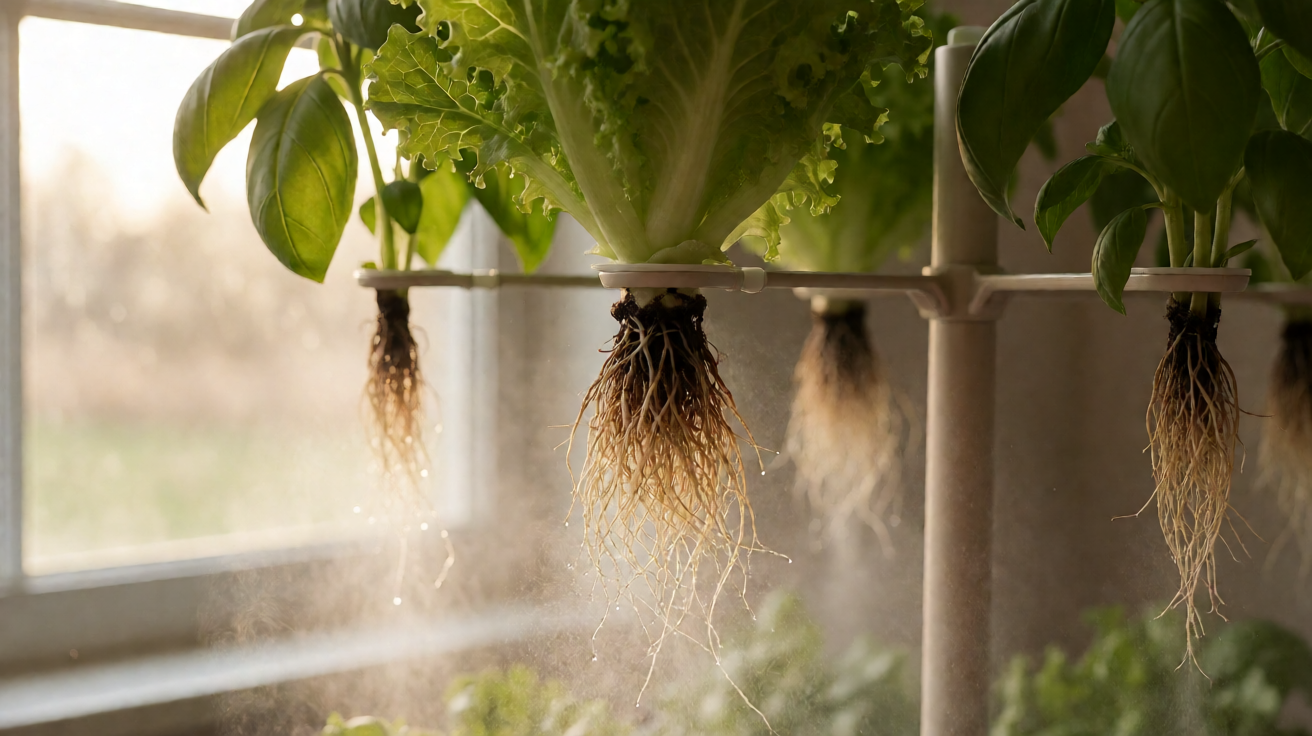

Aeroponics in low humidity is not the same system as aeroponics in a 50% RH grow tent. The reason lives in the physics of mist droplet evaporation before the droplet reaches the root. When indoor RH drops below 40%, the water loses mass between nozzle and root tip.
The root sees a smaller droplet than you set. The plant sees air drier than the room sensor reports. Two failure modes follow. Most growers meet them one at a time. The first is root tip desiccation. The second is leaf tip burn.
Most growers try to fix this by running the mister longer or shortening the mist interval. That move raises the algae count in the reservoir and gives root rot a foothold. The trade-off is the central honest-limit.
Why Low Humidity Breaks a Mist-Based Aeroponic System
A 50 micron droplet leaves a high-pressure pump nozzle at roughly 8 meters per second. In 70% RH it reaches the root tip close to 50 microns. In 30% RH it evaporates to 35 to 40 microns before landing.
The arithmetic is not subtle. Each percent of RH you drop costs droplet mass you cannot replace from the misting nozzle alone. The root sees a smaller droplet than you set, and the reservoir sees the same volume leaving as the mister logged.
For the root, the result is a delivery shortfall. The mist cycle ran on schedule, but the dose that landed was undersized. The plant registers this as drought at the root tip even though the reservoir is full and the misting cycle timer is correct.
Brown tips appear first on the youngest, fastest-growing roots because those carry the highest water demand per unit length. That is also where the root chamber’s dissolved oxygen demand peaks, so the root suffocates and dehydrates in the same band inside an aeroponic system.
For the leaf, the result is a transpiration spike. Stomata open wider in dry air to pull more water through the vascular system, pulling harder against a root tip that is already drying. The leaf edge browns first. This is a hydraulics problem.
The two failure modes share a cause but land on different parts of the plant. Naming them is the first step. The next step is choosing which RH band keeps both modes at bay. For nozzle clogging diagnostics, see aeroponics troubleshooting common problems.
The RH Bands Lettuce, Basil, and Mint Actually Tolerate
Lettuce and basil hold acceptable root and leaf health between 45 and 65% RH at canopy height in an aeroponic system. Below 45% RH, leaf transpiration outpaces root delivery. Below 35% RH, leaf edge burn appears within 7 to 14 days on a tuned mist cycle.
Below 25% RH, root tip browning appears within 5 to 10 days because the mist cycle cannot replace droplet evaporation fast enough. Tomato, cucumber, and pepper tolerate a wider leaf band (40 to 70% RH) but need tighter root-zone humidity.
Microgreens tolerate the upper end of the dry-air spectrum better than lettuce because of the smaller root mass and shorter cycle. They still need a mist droplet size above 30 microns in the misting chamber.
The same 30% RH room that browns lettuce leaf edges in 10 days will yellow tomato flowers and abort fruit set in 5 days. The transpiration load per root tip is higher in tomato because of the larger leaf surface per unit of root mass.
Measure RH at canopy height, not at the floor. The misting chamber sits lower in most tower garden systems and reads 10 to 15% higher than the leaves experience. A sensor at canopy height matches the leaf transpiration number. The aeroponics glossary of misting system terms covers probe placement.
Reservoir Temperature: The Hidden Variable in the Root Chamber
A 22 C room with a running mister will drift the reservoir toward 24 C within 4 to 6 hours. The drift comes from pump heat, ambient radiation on the reservoir walls, and droplet evaporation that lands back in the sump.
Root-zone temperature matters because dissolved oxygen falls as water warms. At 18 C, water holds about 9.1 mg/L of dissolved oxygen. At 24 C, it holds 8.2 mg/L. That 10% drop is the difference between a root mass that respires actively and one that slowly suffocates.
In an aeroponic system the root is exposed to air between mist cycles, which recovers some of that deficit, but the exposure window is short.
The target band for an indoor aeroponic reservoir is 18 to 22 C root zone at the outlet, with 20 C as the operating sweet spot. The 18 to 22 C root zone band is the reference the mist droplet size and misting duration targets are sized against.
Holding the reservoir in that band buys you two things at once: enough dissolved oxygen for the root mass, and slow enough pathogen growth that you do not fight algae bloom every week. Active cooling is the most reliable method.
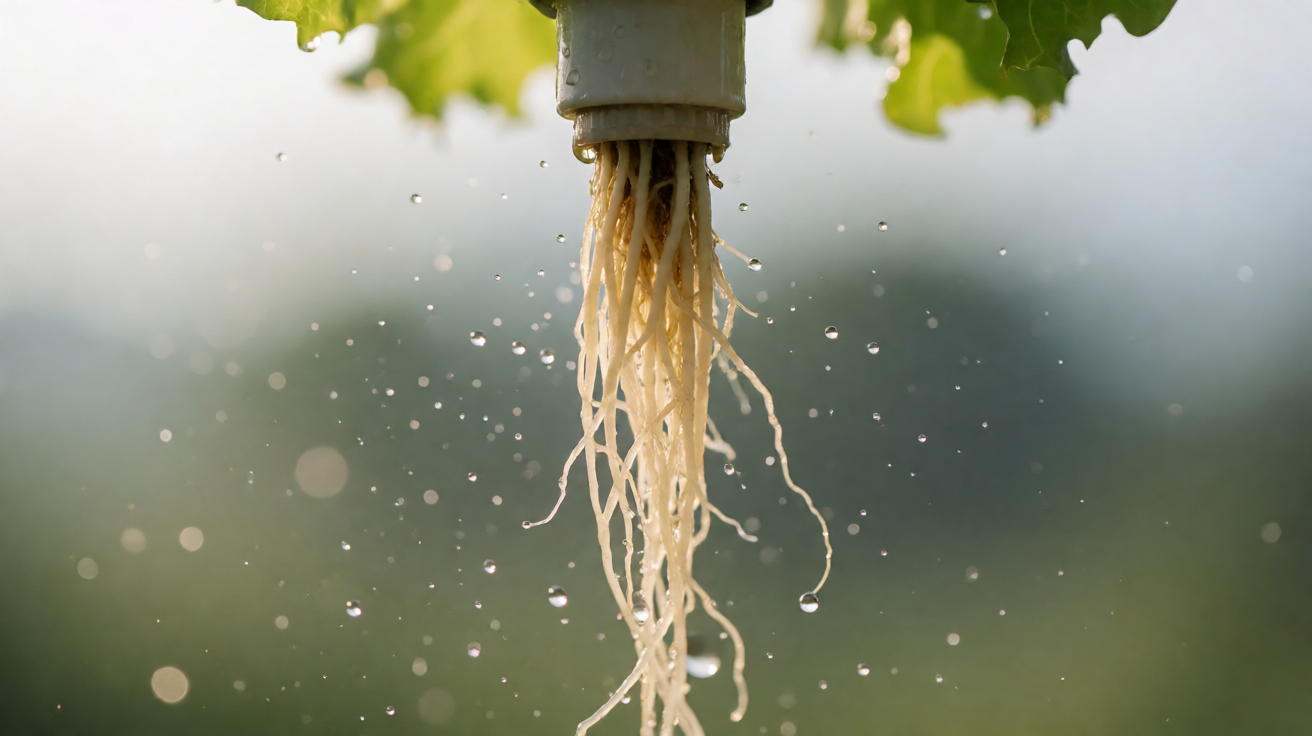
Passive cooling helps but does not hold the band under sustained mist runtime in a 26 C+ room. If your room temperature is already above 24 C, passive cooling alone will not reach 18 to 22 C at the outlet.
For reservoir sizing, chiller selection, and the specific temperature-by-crop table, see aeroponics reservoir guide. The water savings of mist aeroponics over Dutch bucket and Kratky passive systems is one reason growers pick aeroponics for vertical farming in dry rooms.
Misting Frequency vs. Misting Duration in Dry Air
Misting frequency is the number of mist cycles per hour. Misting duration is how many seconds the pump runs each cycle. The two are independent levers. In low humidity, frequency is almost always better than duration, because the root needs repeated wetting.
A typical lettuce aeroponic cycle at 60% RH is 3 seconds on every 5 minutes (36 cycles per hour). At 30% RH, raising the duration to 5 seconds per cycle gives the root 60% more water but does not change how fast the next droplet evaporates.
Raising the misting frequency to 3 seconds on every 3 minutes (20 cycles per hour) gives the root four times as many wetting events per hour. The misting cycle timer on the high-pressure pump stays the simplest way to set this in any aeroponic system.
Each event arrives before the previous one has fully evaporated. The frequency-first rule has one ceiling: the algae line. The reservoir biofilm uses the same mist cycles the roots use. Push frequency high enough and greening starts within 3 days.
The band where both survive is narrower than most growers expect. For cycle-by-cycle tuning of a low-pressure diaphragm pump versus a high-pressure pump, see aeroponics maintenance guide. That page covers nozzle maintenance and the mechanical side of cycle tuning inside the aeroponic system.
The Algae Line in the Reservoir: Why Misting More Can Make Things Worse
Algae in an aeroponic reservoir is a symptom that the mist cycle feeds the biofilm faster than dissolved oxygen can suppress it. The line where algae blooms crosses into a problem is around 50 cycles per hour for a 20 L reservoir at 24 C.
Above it, the reservoir greens within 3 to 5 days and root rot prevention in aeroponics becomes the dominant task. Nozzle clogging from biofilm is usually the first signal that the line has been crossed.
The honest-limit here is that you cannot mist your way out of low humidity. Every extra cycle you add to save the roots feeds the algae the same dose. The trade-off is real and has no bypass.
The first lever that holds the algae line down is reservoir cooling. Holding 20 C instead of 24 C slows algae growth enough to run 5 to 10 more cycles per hour without crossing bloom. The second lever is light exclusion.
For the apartment-specific version of this trade-off (small reservoirs, ambient light, no chiller), see aeroponics in an apartment. The algae dynamics are similar but the lever set is smaller for a tower garden or AeroGarden clone.
Nozzle clogging and nozzle maintenance cycles accelerate when algae colonize the misting chamber, which is the maintenance signal that the line has been crossed. The NFT comparison, DWC comparison, and Kratky comparison pages cover the passive-system side of the same trade-off.
A 10-Day Recovery Window for Existing Root Damage
If the root tips are already brown, the question is whether new white tips will appear in the next 10 to 14 days. They will, if you raise canopy RH into 45 to 55%, hold the reservoir at 20 C, and stop increasing mist frequency.
Day 1 through 3: raise RH. Add a humidifier sized to the room volume, not to the misting chamber. Target 45 to 55% RH at canopy height. Do not push past 60% RH; above that, you trade leaf transpiration deficit for fungal pressure.
Photograph the roots at the same time each day so you can see new white tips when they appear at the cap of the root mass inside the aeroponic system.
Day 4 through 7: hold reservoir at 20 C. Active cooling is preferred; if you do not have a chiller, swap a frozen bottle into the sump every 6 hours. Keep the mist cycle at its current frequency and duration; do not raise either during recovery.
The goal is to stop the deficit, not to chase it. A cutting may still show transplant shock during this window; that is normal even in a well-tuned aeroponic system. Sterile environment discipline keeps recovery from introducing a new pathogen.
Day 8 through 14: confirm recovery. New white root tips appear first at the cap of the root mass, not at the damaged tip. If you see white tips by day 14, the plant has recovered in this aeroponic system inside the misting chamber.
If you do not, the damage was deeper than leaf-level and the plant is unlikely to recover on the same root mass. Remove and restart from a fresh clone or cutting placed in a clean net pot with a neoprene cloning collar and neoprene collar.
For setup-level changes that prevent this from repeating (sealed chamber sizing, intake humidity), see aeroponics apartment setup guide. That page covers the room, not the recovery; root pruning and net pot hygiene get their own treatment on the maintenance page.
When Low Humidity Cannot Be Compensated by an Aeroponic System
Aeroponics in low humidity fails predictably when the room crosses two thresholds at once. The first threshold is RH below 25% sustained for more than 48 hours. Under that band, even ultrasonic foggers at maximum output cannot keep up.
The second threshold is leaf crops (lettuce, basil, mint) in any room that crosses 30% RH for more than a week. The leaf edge burn becomes irreversible past day 10 even after you raise RH inside the aeroponic system.
When you cross either threshold, the right answer is to change the environment, not the mist cycle. A sealed grow chamber with its own humidity controller holds the RH band the roots and leaves actually need, independent of the room you happen to be in.
A move to a different room in the same house, or a different season in the same room, does not solve the problem because the source of the dry air is still present. Tower garden and AeroGarden-style sealed enclosures are the practical answer below 25% RH.
This page covers mist-based aeroponic systems running in indoor RH below 40%; the boundary with the hydroponics cluster is that NFT, DWC, and Kratky passive systems tolerate dry air better because the root is always submerged. Mist droplet evaporation is not part of their delivery chain.
For those systems, the trade-offs live in the aeroponics versus hydroponics comparison page. Nozzle clogging and ultrasonic fogger limits remain specific to mist aeroponics. Vertical farming in dry rooms is the practical reason aeroponics gets picked over Dutch bucket when humidity control is tight.
Turn That PDF Into a Spreadsheet in Minutes
You've seen how to do it manually — now let the tool handle the heavy lifting. Upload your bank statement and get Excel, CSV, or QBO in a few clicks.
Try It Free