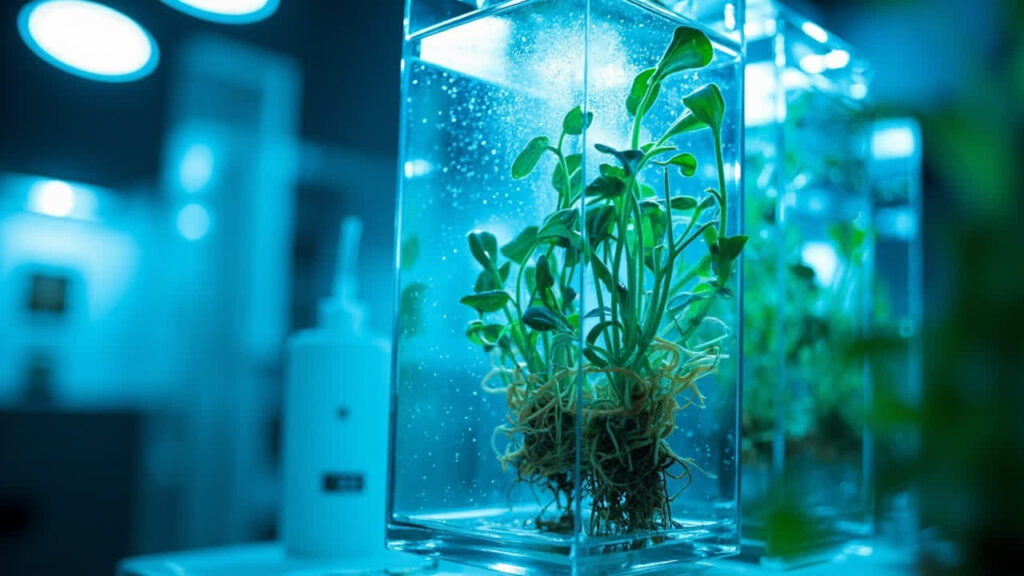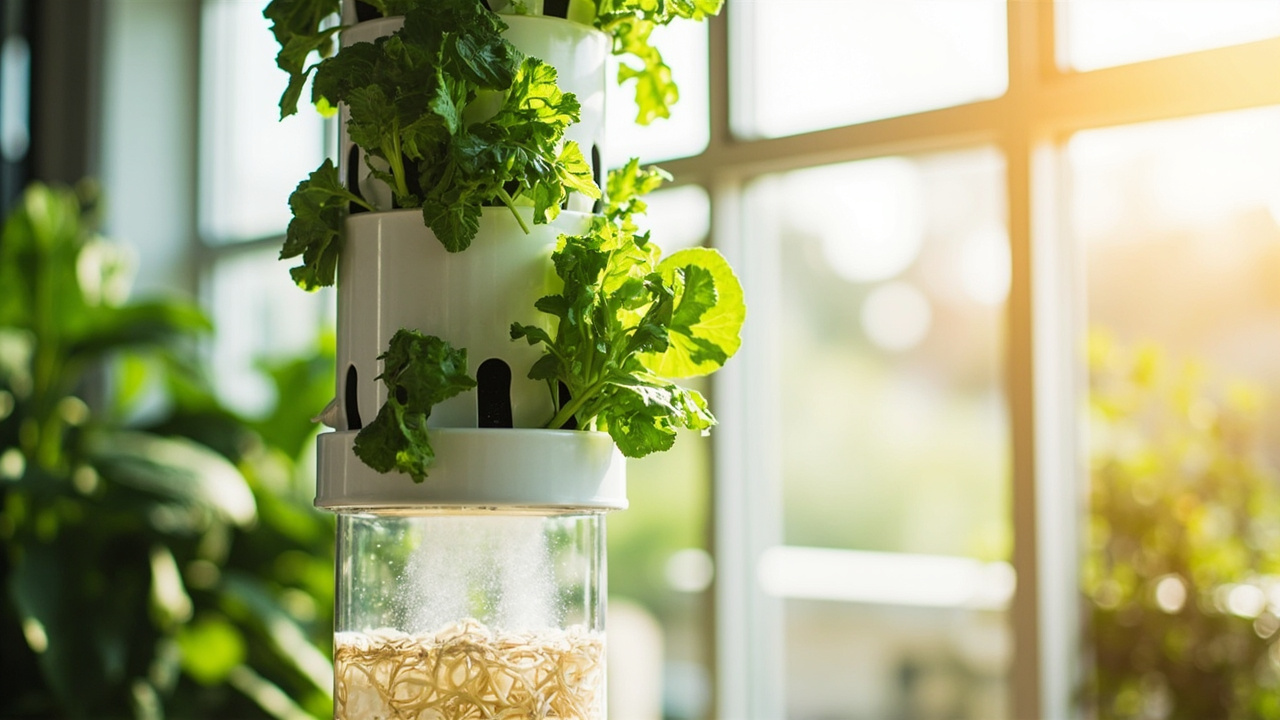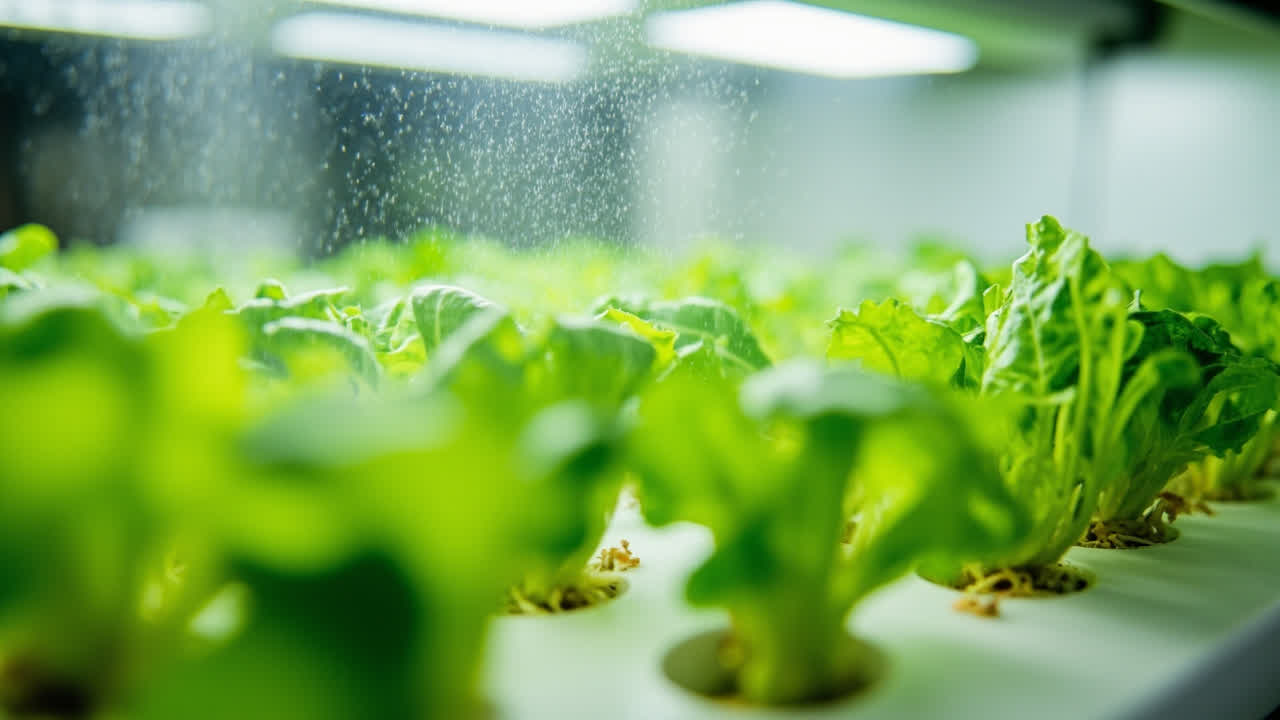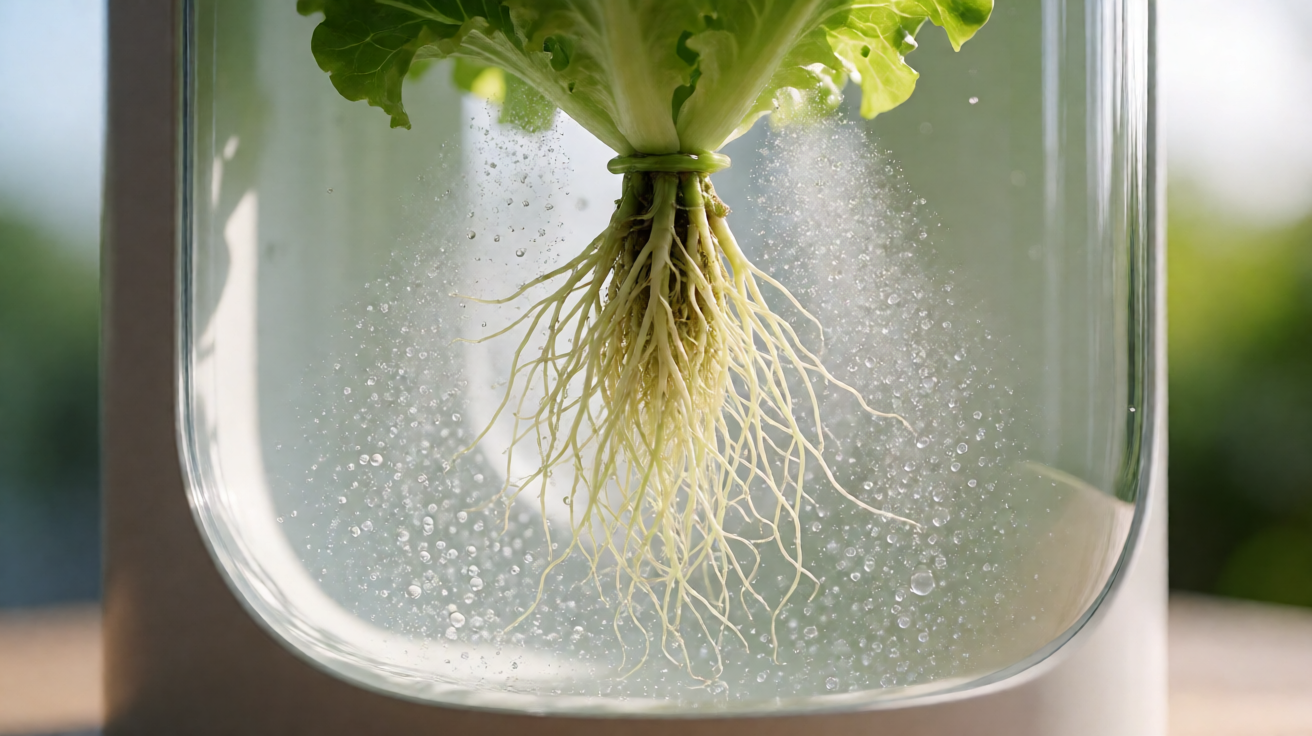

An aeroponics glossary starts where most reading does: with the mist itself, and with what that mist actually does to a root in a chamber that has no soil in it. Aeroponics is a soilless growing method that delivers nutrients as a fine mist directly to bare roots, suspended in air inside a sealed or semi-sealed misting chamber. The method is older than the consumer market makes it look: the NASA Advanced Plant Habitat work and 1990s propagation research both used aeroponic delivery before “AeroGarden” appeared on a kitchen counter.
Two things set aeroponics apart from its soilless siblings. In hydroponics, roots sit in a nutrient solution, or in a film of solution that flows past them. In aeroponics, roots never sit in standing water: they hang in air and receive water only as mist. In fogponics, the mist droplet size drops below 20 microns and behaves more like a cool fog than a spray. Aeroponics proper sits between fogponics and conventional hydroponics on the droplet-size axis, and that single axis decides most of the system’s cost, complexity, and growth rate.
What Aeroponics Actually Means (and What It Does Not)
Aeroponics is a soilless method in which roots hang in a dark or shaded chamber and receive nutrients as an intermittent mist produced by nozzles or foggers. The method relies on gravity-fed drainage: mist condenses on the root, runs off, and returns to a reservoir below.
Aeroponic system refers to the assembled hardware: a reservoir, a high-pressure pump or low-pressure diaphragm pump, a misting chamber with misting nozzles or ultrasonic foggers, a misting cycle timer, and the cloning collars or net pots that hold the plants in place.
Two adjacent terms frequently appear alongside aeroponics. Misting chamber names the dark enclosure where roots hang and the mist lands. Root chamber is often used interchangeably: “root chamber” emphasizes the root biology and the root mass, while “misting chamber” emphasizes the air handling and droplet size.
What aeroponics is not: it is not drip irrigation, not NFT, not deep-water culture (DWC), not Kratky, and not a Dutch bucket. The absence of any growing medium between the root and the air is the differentiator. The closest neighbors are the NFT comparison, DWC comparison, and Kratky comparison points, which this glossary touches only in passing. If a guide mentions “the roots sit in the solution,” it is hydroponic, not aeroponic. For a side-by-side reference, the aeroponics vs hydroponics comparison lays the same droplet-size and dissolved-oxygen points out across the two methods.
The Root Chamber and the Mist Envelope
The root chamber is the enclosed volume that holds the root mass while it hangs in air. In commercial systems the chamber is opaque to block light, because light exclusion reduces algae on the root surface and limits biofilm on the chamber walls. The chamber needs a drain at the lowest point so condensed mist returns to the reservoir.
Misting frequency is the cadence at which the pump turns on and off. Common consumer settings cycle the misting cycle on for 3 to 5 minutes, then off for 3 to 5 minutes. Lettuce, basil, mint, and microgreens tolerate this cadence well, and a steady routine matters more than a fixed schedule because watering frequency in mist form tracks transpiration, not the calendar.
Misting duration is the length of each individual “on” cycle, while frequency is the interval between cycles. A misting cycle timer is usually set for both. The mistake most first-time builders make is to set duration too high, drowning the root in standing mist and triggering the very root rot in aeroponics the method is meant to prevent.
Root-zone temperature names the air temperature inside the chamber, not the nutrient reservoir temperature. The 18 to 22 C root zone is the canonical healthy range (about 64 to 72 F). Above 25 C the root tips begin to brown within 48 to 72 hours; below 15 C growth slows sharply, and transpiration out of the leaves drops in lockstep. Soil roots rarely hit these numbers; the aeroponic method holds them every hour.
Pumps, Pressure, and Droplet Size
The high-pressure pump produces mist with droplet sizes in the 20 to 80 micron range. These pumps run at 80 to 120 psi and require stainless-steel misting nozzles to survive the cycle. They are expensive ($300 to $1,200) and loud enough that most growers isolate them in a closet or a foam-lined box.
The low-pressure diaphragm pump is the consumer-grade default. It runs at 40 to 60 psi and produces 80 to 150 micron droplets. The larger droplets fall on the root more like a spray than a mist, which is fine for lettuce and basil but reduces nutrient uptake efficiency in crops that benefit from finer coverage. A $30 to $60 diaphragm pump sits behind most AeroGarden-class units.
The ultrasonic fogger is a disc-shaped transducer that vibrates at about 1.65 MHz and pushes mist droplet size down to 1 to 10 microns, technically fogponics rather than aeroponics. Foggers are cheap ($10 to $30 per disc) but they clog fast in nutrient solutions. Nozzle clogging and nozzle maintenance are the two most common failure modes: a clogged disc is the most frequent cause of root-zone dry-downs, and the discipline of soaking nozzles in vinegar every 4 to 6 weeks is what separates a working fogger from a dead one.
Misting nozzle is the brass or plastic orifice that breaks the pressurized stream into droplets. Nozzles wear out in hard-water areas; service intervals run 4 to 6 months, sometimes 2 to 3 months in areas with high mineral content. A worn nozzle starts producing streaks and dribbles rather than a true mist. Most troubleshooting guides cover this exact failure pattern, and the DIY tower garden build walks through the nozzle swap in person.
The 50 micron droplet is the canonical midpoint of aeroponic droplet sizing. Finer than 20 microns and the droplet starts behaving like a gas, dispersing before it reaches the root mass. Coarser than 100 microns and it falls more like a light rain than a mist, reducing uptake efficiency. Soil cultivation has no comparable axis; the entire method turns on this single dial.
Misting Cycles, Timers, and Sterility
The misting cycle timer is the controller that schedules the pump’s on and off cycles. Consumer units use a simple digital intervalometer. Commercial and high-end DIY systems use a controller with a pH and EC sensor input that throttles the cycle based on the root’s actual uptake rate. A $25 intervalometer works fine for lettuce; a $300 controller earns its keep only when the system runs continuously for fruiting crops.
Dissolved oxygen is the amount of oxygen available to the root in the mist itself and in any condensed water on the root surface. Aeroponic mist carries higher dissolved oxygen than DWC solution because the droplet is constantly exposed to atmospheric pressure. The number itself (typically 8 to 10 mg/L at 20 C) is rarely measured by hobbyists; growers infer dissolved oxygen from root whiteness, branching density, and root pruning schedule.
The sterile environment in an aeroponic system is a working concept, not a true sterile lab. Roots are exposed to whatever air enters the chamber, so the operational definition is “low enough pathogen load that the root outgrows it.” That means clean reservoir water, clean cloning collars, and a chamber that stays dark. The same pathogen control principles that drive the weekly aeroponic maintenance schedule cover the cleaning routine that keeps the sterile envelope intact.
Misting frequency and misting duration are the two parameters a reader adjusts most often. The pair sets the duty cycle: a 5-minute-on, 5-minute-off cycle is a 50 percent duty cycle; a 30-second-on, 5-minute-off cycle is a 9 percent duty cycle. Lower duty cycles favour clones and cuttings; higher duty cycles favour mature leafy crops.
Collars, Net Pots, and Clones
The cloning collar is a foam or rubber ring that sits in the chamber lid and holds the plant’s stem at the point where the leaves emerge above the chamber and the roots hang below. A properly sized collar seals light out of the chamber at the stem.
The neoprene collar is the most common consumer version of the cloning collar, named for the neoprene rubber it is cut from. Neoprene resists the constant moisture better than open-cell foam and is easier to clean between cycles. Expect to replace one every 6 to 12 months.
A net pot is a slotted plastic pot that holds the plant in systems where a small amount of growing medium is used (perlite, clay pebbles). In a true aeroponic system the net pot is the anchor, not the rooting zone. The root mass grows through the slots and hangs into the chamber. Net pots are useful for transitions where a small amount of anchoring medium reduces transplant shock.
A clone in aeroponics is a cutting taken from a mother plant and rooted in the misting chamber without ever touching soil. A cutting is the same piece of plant tissue; a “clone” implies a genetic copy intended for a defined grow cycle, while a “cutting” can be a single-stem rooting experiment. Both go into the chamber through the same cloning collar. Lettuce, basil, mint, and microgreens are the easiest first clone sets, each one rooting within 7 to 14 days on a 5-minute misting cycle.
Transplant shock describes the root damage that occurs when a plant is moved between systems. Aeroponic-to-aeroponic transplants show almost no shock if the cloning collars match. Aeroponic-to-soil transplants show 3 to 7 days of slowed growth as the roots reorganize. The shock is much higher than the inverse (soil to aeroponic), so any guide that suggests starting in soil fights the method’s natural advantage. The best-plants-for-aeroponics reference notes which cultivars transplant cleanly.
Root pruning is the intentional trimming of older, browning roots to redirect energy to fresh white root mass. Aeroponic systems accumulate root mass faster than soil systems. Most guides suggest a light root pruning every 6 to 8 weeks.
Reservoir, Root Rot, and Water Savings
The reservoir is the container that holds the nutrient solution below the chamber. In consumer builds the reservoir is the bucket the misting chamber sits on. The reservoir needs a lid to block light and algae growth, plus an access port for pH adjustment and topping off. EC and pH swings are faster in small reservoirs. A drip tray under the bucket adds a redundant drainage path in case the chamber drain ever clogs, which matters once misting runs 24/7.
Root rot prevention in aeroponics looks paradoxical at first: how can a root rot when there is no standing water? The answer is that biofilm forms on the chamber wall where mist condenses, and the biofilm hosts the Pythium and Phytophthora species. Prevention is chamber cleaning every 2 to 4 weeks, sterile cloning collars, and reservoir flushes. The failure pattern is consistent with what is described in how aeroponics lets you grow food without any soil.
Dissolved oxygen returns to the system at the reservoir, where the same nutrient solution sits for hours or days. A reservoir at 25 C holds less dissolved oxygen than one at 18 C, and stale warm reservoir water is the most common cause of root browning in the lower third of the chamber. At 20 C, a healthy reservoir sits around 8 mg/L dissolved oxygen; at 28 C it drops below 6 mg/L. The sunlight-warmed midday swing is the cause behind most mystery root-tip discoloring.
The headline water savings claim for aeroponics is roughly 90 percent less water than soil and 50 to 70 percent less than NFT, from transpiration recovery and mist condensation: mist that does not get absorbed by the root mass condenses on the chamber wall, drains back to the reservoir, and re-enters the cycle.
System Profiles: Tower Garden, AeroGarden, and Beyond
The Tower Garden is a vertical aeroponic tower sold primarily for residential and educational use, with a 20-plant and a 28-plant residential model and a commercial 28-plant and 52-plant variant. The tower design stacks cloning collars around a central PVC body and uses a low-pressure diaphragm pump at the base. The branded tower is built around a specific pump, controller, and nutrient recipe, which makes it the easiest entry point but also the most expensive on a per-plant basis.
The AeroGarden is a countertop unit, typically 3 to 9 plant slots, built around an ultrasonic fogger or a small diaphragm pump depending on the model. AeroGarden-branded seed kits are calibrated to the unit’s pump and lighting cycle, and the units run on a fixed misting cycle timer with no adjustability on most consumer models. The AeroGarden is a closed appliance; the Tower Garden is closer to a kit. Both are aeroponic in the broad sense, but the design constraints differ enough that a guide written for one does not transfer perfectly to the other.
Vertical farming as a term covers any system that grows in stacked layers rather than horizontal rows. Aeroponic towers are one common form factor, but NFT racks and DWC racks also count. Aeroponic vertical farming typically posts the highest yield per square foot of any method, but the cost per square foot is also the highest.
The hardware and the method are not the same thing. A reader who buys a tower and a reader who builds a bucket both run aeroponic systems, with the same vocabulary, the same rules, and the same failure modes. The right way to read any guide in this cluster, whether it is the beginners guide, the comparison, the troubleshooting walk-through, the maintenance schedule, the best plants list, or the DIY tower build, is to keep this glossary open in another tab.
Turn PDF Bank Statements Into Workable Spreadsheets
Your bank statement is a mess of numbers, but your books shouldn't be. Use our converter to get Excel, CSV, or QBO files — ready for QuickBooks.
Try It Free Now