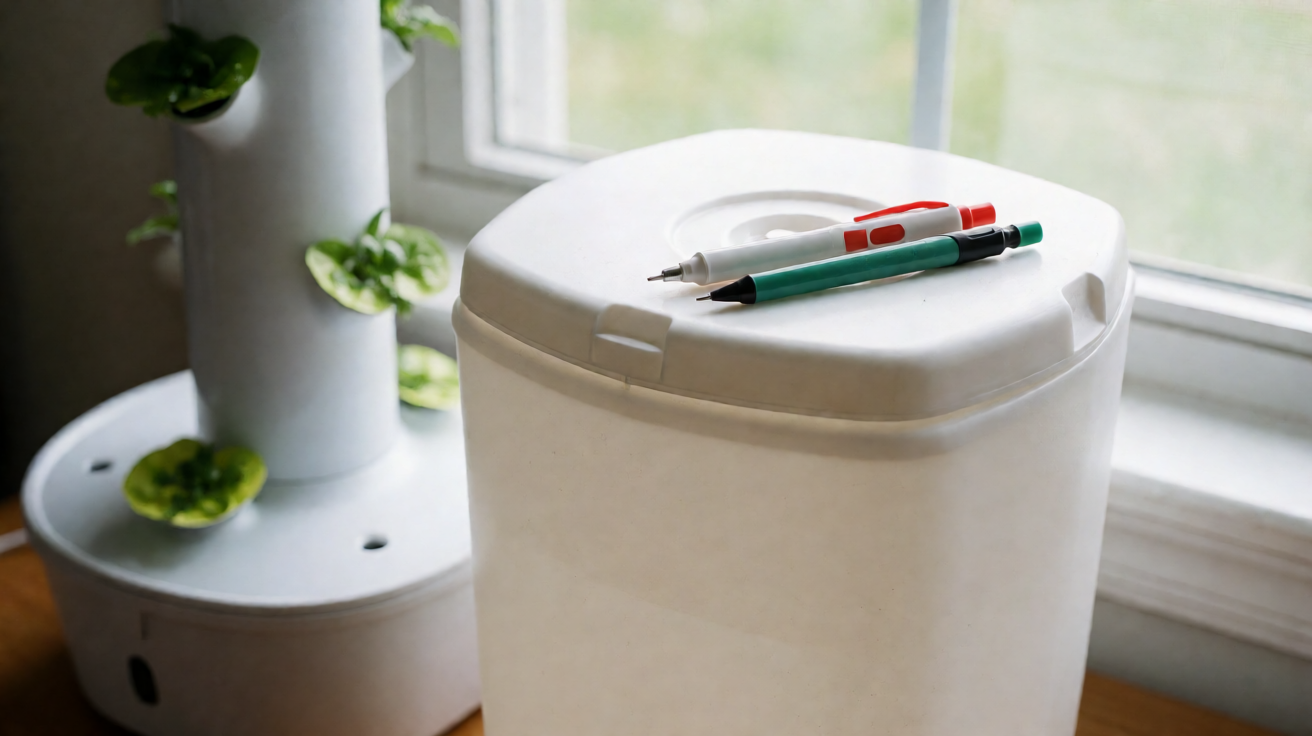

An aeroponic reservoir is more than a water tank. It is the nutrient environment the misting nozzles draw from, and the three things the reader has to keep in range (EC, pH, and temperature) decide whether the root mass stays white and fuzzy or turns brown and slimy.
Most growers treat the reservoir as a passive container. The reservoir is the system’s metabolism. EC drift, pH creep, and temperature rise are the three signals that tell a careful reader the mist cycle is fine and the plants are about to stall.
One honest limit up front: a reservoir cannot fix a clogged misting nozzle or a hot root chamber. It is one of three controls (reservoir, root chamber, mist cycle) the reader has to keep in balance.
Reservoir Size and Capacity
Pick a reservoir that holds at least 7 to 14 days of water for the aeroponic system. A home tower garden of 20 to 40 sites uses roughly 1 to 2 gallons per day through transpiration and mist evaporation, so a 15 to 25 gallon reservoir covers a week between refills.
A desktop AeroGarden uses 2 to 4 gallons and runs on a 5 to 7 day refill rhythm. Picking a smaller reservoir tightens the maintenance window without saving money on water or nutrients.
Reserve at least 20 percent headroom in the reservoir. Filling to the brim leaves no room for displacement when the pump is running and increases the risk of an overflow when the system refills. A 20 gallon reservoir should be filled to 16 gallons at the operating mark.
The reservoir material matters for cleanliness and dissolved oxygen. Food-grade HDPE plastic (opaque white or black) is the standard pick because it blocks light, holds no off-gassing, and cleans easily. Stainless steel works for commercial builds but costs more. Clear plastic is the worst pick because light feeds algae in the nutrient solution.
Mixing the Nutrient Solution
Mix the aeroponic nutrient solution at 1.2 to 1.8 mS/cm EC for leafy crops like lettuce, basil, mint, and microgreens. Fruiting crops like tomatoes and peppers want 2.0 to 2.6 mS/cm but they also need a larger root chamber, so they are not the entry-level choice for a new system.
Target 5.5 to 6.5 pH for the reservoir. Below 5.2, iron and manganese lock out and the leaves yellow between the veins. Above 6.8, calcium and phosphorus lock out and the new growth distorts. The middle of the band, 5.8 to 6.2, is the easiest place to hold a stable mist system.
Use a two-part nutrient (calcium nitrate separate from the sulfates and phosphates) so the calcium does not precipitate in the concentrate. Most commercial aeroponic nutrients are sold as A and B bottles; mix them into the reservoir separately with a stir between, never concentrate them in the same shot.
Add the nutrients to a half-filled reservoir and top up with water to the operating mark. Stir the solution for 30 seconds after each addition so the EC and pH probes read the mixed value, not the local value at the addition point.
Reservoir Temperature and Dissolved Oxygen
Hold the reservoir at 18 to 22 C. Cold water holds more dissolved oxygen; warm water holds less. Above 24 C, the dissolved oxygen drops by roughly 1 mg/L per 2 C rise, which is enough to push a marginal aeroponic system over the edge into root rot.
Drop the reservoir temperature with a cheap aquarium chiller if the room runs hot in summer. A 50 to 100 watt chiller covers most home reservoirs and pays for itself in the first crop by preventing a single root rot event by preventing a single root rot event.
Insulate the reservoir with a foam wrap or a reflective jacket. A dark reservoir sitting in a 28 C room will hit 26 C in the water by mid-afternoon, which is the threshold for slow dissolved oxygen loss and stalled growth.
For high-pressure aeroponic systems, drop the reservoir to 18 C and the system can run a longer misting cycle without heat stress. For low-pressure diaphragm pump systems, the reservoir temperature matters less because the system already runs cooler, but the rule is the same: cooler water holds more oxygen.
EC and pH Drift Over a 7-Day Cycle
EC drifts up over a 7-day cycle as the plants drink water and leave salts behind. Expect 0.3 to 0.6 mS/cm drift in a 5-day-old reservoir if no top-up is added. Top up with plain water (not nutrient solution) to bring the EC back to the target band.
pH drifts up as the plant roots release basic ions. Expect 0.3 to 0.8 pH units of drift in a 7-day cycle. Adjust with a dilute pH-down solution (phosphoric acid based) in 1 mL increments, stir, wait 10 minutes, then re-measure.
Check EC and pH every 2 to 3 days in a small reservoir, every 3 to 5 days in a 20+ gallon reservoir. A digital EC and pH pen pair costs $30 to $60 and lasts for years with proper storage. A weekly check is not enough; the drift is faster than the eye can read the leaves.
Replace the full reservoir every 7 to 14 days, even if the EC and pH are still in band. The solution accumulates organic acids and root exudates that change the balance even when the meter numbers look fine. A full swap is the cheapest reset the system has.
Sterile Environment, Cleaning, and Algae
Keep the reservoir in a sterile environment by blocking light and cleaning every 7 to 14 days. Algae on the inside of the reservoir is the most common violation. Algae uses the same nutrients the plants need, and algae death at the end of a cycle releases a nutrient pulse that throws the EC off for the next crop.
Empty the reservoir, scrub the inside with a soft brush and dilute hydrogen peroxide (1:100 ratio), and rinse twice with clean water before refilling. Do not use bleach on a food-crop reservoir; the residual chlorine damages the root mass even at low concentrations.
UV sterilizers on the recirculation line keep microbial counts down between cleanings. A 9 watt in-line UV covers most home reservoirs; the maintenance guide covers the swap schedule in detail and is a one-time $40 to $80 install. The UV is not a substitute for cleaning, but it slows the regrowth between swaps.
Cover the reservoir with a lid. The lid blocks light, reduces evaporation, and keeps debris out of the nutrient solution. A simple opaque plastic lid with a hole for the pump intake is enough; commercial reservoirs ship with lids for this reason.
Water Savings and the Aeroponic Reservoir
The aeroponic reservoir is the heart of the water savings story. A soil garden uses 30 to 50 gallons per week for a 4 by 4 foot bed. A aeroponic system of the same crop footprint uses 7 to 15 gallons per week because the mist delivery is targeted to the roots and the runoff is captured for reuse.
Top up the reservoir with plain water between full swaps. Top-up water is 60 to 80 percent of the weekly demand in a typical system. Adding nutrient solution every time the level drops drives the EC past the target band within 3 to 4 days.
Capture the water savings in a log. Note the reservoir level at refill, the date, and the EC and pH before and after. The log is the single best way to spot a leak in the system, a clogged misting nozzle that is dumping mist onto the floor, or a plant that is suddenly drinking much more or less than its neighbors.
This page covers the reservoir. The root chamber and the misting cycle are the other two controls the reader has to balance, and they are covered on the aeroponics Pillar and the troubleshooting page. Keep all three in range, and the aeroponic system will run for years with the same reservoir.
Quick Reference: Every Reservoir Term in the Aeroponic System
For the reader who wants the full vocabulary before opening a spec sheet, the aeroponic system touches the reservoir through these terms: aeroponics, aeroponic system, root chamber, misting chamber, and the aeroponic reservoir itself.
The misting hardware reaches the reservoir through the high-pressure pump or the low-pressure diaphragm pump, the ultrasonic fogger, the misting nozzle, and the mist droplet size (50 micron droplet target). The misting cycle is set by the misting frequency, the misting duration, and the misting cycle timer.
The plant support hardware touches the reservoir through the cloning collar, neoprene collar, and net pot, and through the clone, cutting, and root mass that hang over the water. Root pruning every 3 to 4 weeks keeps the root mass inside the chamber, and a fresh transplant shows a brief transplant shock before recovery.
The maintenance vocabulary is nozzle clogging, nozzle maintenance, and root rot prevention in aeroponics. The setup choices are vertical farming or single-shelf, the 18 to 22 C root zone target, and the sterile environment that keeps algae out of the reservoir. The reservoir is the metabolism of the aeroponic system, and the rest of the system runs on the water it holds.
From PDF to Excel in one click
Forget retyping line by line. Upload any bank statement, get a spreadsheet you can actually use. Your files are never stored, and you can test the converter with 3 free conversions.
Try it free