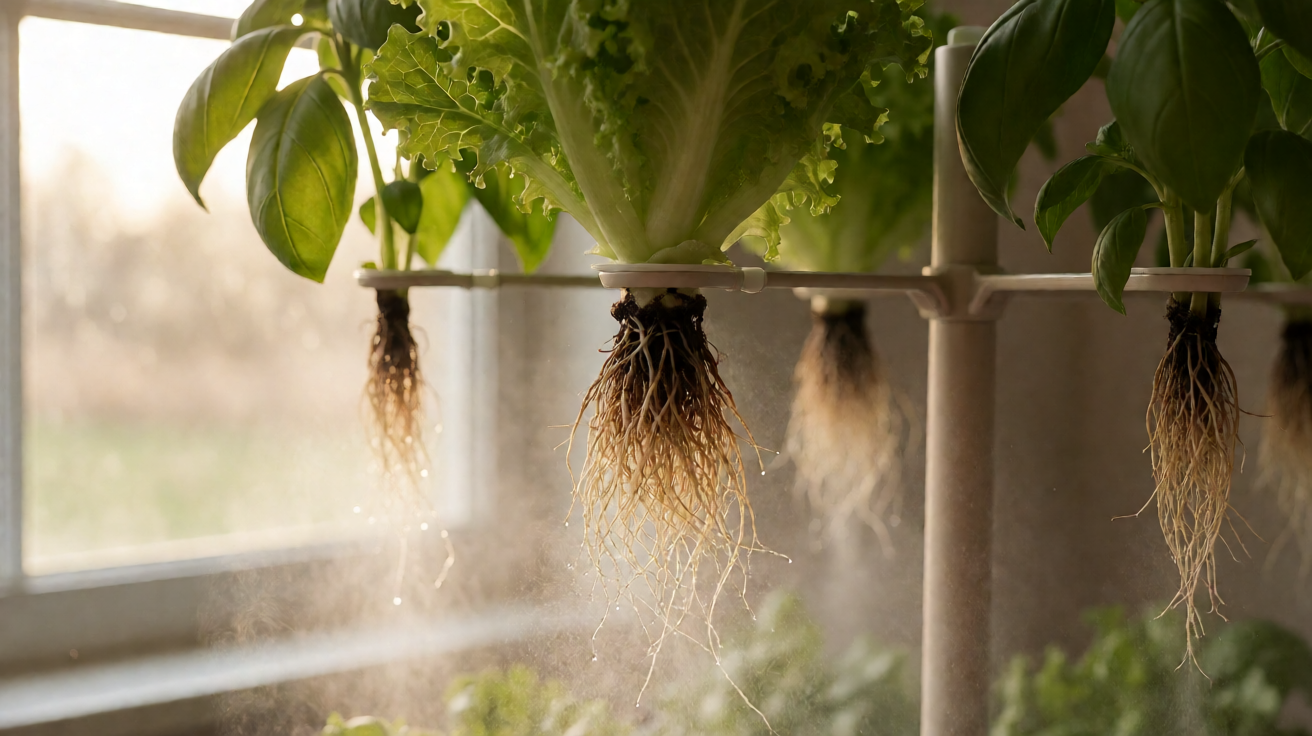
An aeroponic system runs on a simple promise: roots suspended in air, fed by a timed mist of nutrient solution. The catch is that the same thing that makes it fast — a thin film of moisture, no soil buffer, constant oxygen — also makes it unforgiving. A clogged nozzle, a reservoir that drops two degrees, or a biofilm that creeps across the root chamber can turn healthy white roots into brown slime in less than 48 hours.
Most aeroponic system failures are not mysterious. They are routine problems that nobody was scheduled to look for. A weekly maintenance schedule works because the failure modes of an aeroponic system are slow enough to catch and fast enough to punish if you don’t. The goal of this page is to give you a calm, repeatable routine — daily, weekly, and monthly — that keeps misting consistent, roots clean, and the reservoir stable.
If you are still setting up your first unit, the aeroponics for beginners overview covers the core parts of an aeroponic system. This page assumes your system is already running and your plants are in the root chamber.
What “maintaining” an aeroponic system actually means
Maintenance on an aeroponic system is not the same as maintenance on a hydroponic or soil setup. There is no medium to flush, no top-dress to refresh, and no root mass hiding inside a pot. Every root is visible, every droplet is intentional, and the reservoir feeds everything.
Practically, that collapses your maintenance job into four checks: the misting cycle is delivering fine droplets, the root chamber stays dark and clean, the reservoir stays full and at a steady pH and EC, and the pump and nozzles keep working at the same output as the day you calibrated them. When any of those drift, plants respond within hours, not days.
The frame of mind that helps most is preventive, not reactive. You are not waiting for a problem — you are logging small changes so a problem never has room to grow. A two-minute daily look and a 20-minute weekly clean are the difference between a system that runs for years and one that collapses mid-grow.
Daily checks: the 2-minute look
Daily maintenance is observation, not cleaning. You are looking for early signs of drift, not solving problems. Five things, in this order, take about two minutes:
- Mist is fine and even. Walk past the system and watch the nozzles for 30 seconds. Droplets should be a visible fog, not streams or drips. A nozzle that is starting to clog often throws a coarser spray before it stops spraying at all.
- Roots are white to pale cream. Brown tips, dark patches, or a slimy sheen all deserve a closer look. Healthy aeroponic roots look like fresh ginger root — firm, light, and slightly fuzzy with root hairs.
- Reservoir level is where it was yesterday. A drop of more than 10% per day means a leak, an overflowing drain, or plants drinking heavily. Top off with the same nutrient strength you are running — never with plain water, or you will dilute the feed and drift EC.
- Pump is running on schedule. Listen for the cycle. Aeroponic systems usually mist for 15–30 seconds every 3–5 minutes. If the cycle seems louder, slower, or different from yesterday, the pump or timer is starting to fail.
- Temperature is in range. Reservoir solution should sit between 65°F and 72°F (18–22°C). Above 75°F (24°C), dissolved oxygen drops and root rot pathogens multiply. Below 60°F (15°C), growth stalls and the mist can feel cold on the root tips.
That is the entire daily list. If something is off, write it down. The weekly clean is where you act on those notes.
Weekly cleaning: the 20-minute reset
Weekly is where you prevent the failures that kill aeroponic systems. Pick a low-light day so the root chamber stays dark while the lid is off, and set aside a 20-minute window. The order matters — work from the dirtiest task last so you do not redeposit debris into a clean chamber.
1. Calibrate the nutrient solution first
Before you touch the chamber, check the reservoir. Pull a sample, let it come to room temperature, and test pH and EC with a fresh meter. Aeroponic systems run best at pH 5.5–6.0 and EC matched to the crop — leafy greens typically 1.0–1.4 mS/cm, fruiting crops 1.6–2.2 mS/cm. Adjust pH with a pH-down or pH-up solution in small doses, retest after 15 minutes of pump circulation, and only then move on.
Reservoir temperature matters as much as chemistry. If your reservoir climbs above 72°F (22°C) in a warm room, the weekly reset is a good time to add a chiller, an insulated tote, or a frozen water bottle rotation. The advantages of an aeroponic system depend on oxygen-rich root zones, and warm water holds far less oxygen than cool water.
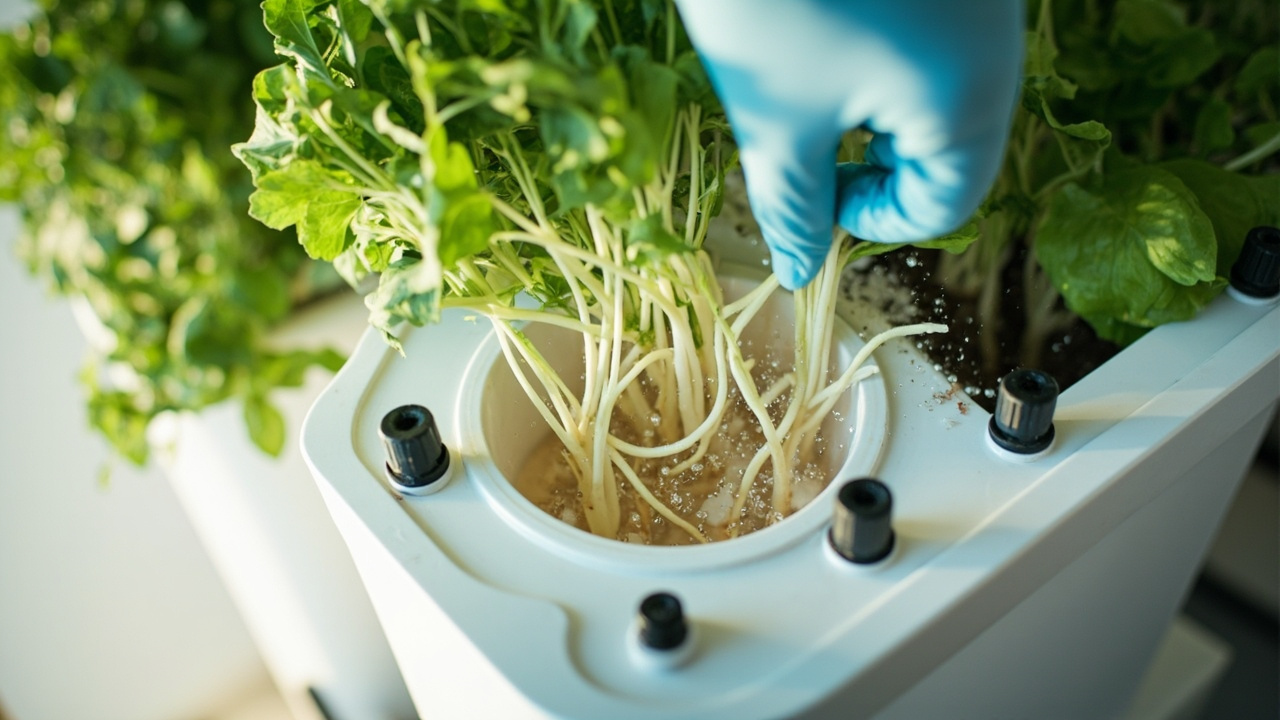
2. Pull the root chamber lid and inspect
With the pump paused, lift the lid and look at the inside walls and the collar area where stems meet the chamber. Wipe down any algae film with a soft cloth dampened in 3% hydrogen peroxide, diluted 1:10 with water. Never use bleach on a system that holds living roots — the residue will burn root tips even at low concentration.
Trim any root tip that has turned brown or mushy with clean, sharp scissors. Sterilize the blades with rubbing alcohol between plants so you do not carry pathogens from one root mass to the next. Healthy roots regrow quickly once the dead material is gone and the misting is back to a fine, even spray.
3. Clean the spray nozzles
Clogged nozzles are the number-one cause of misting failure, and they almost never fail loudly. A nozzle that throws one thick stream will keep a small area wet while the rest of the chamber dries out. Soak each nozzle in a cup of warm water with a drop of hydrogen peroxide for 10 minutes, then ream gently with a soft toothbrush or a dedicated cloning mister cleaning pin. Never use a metal wire — it widens the orifice and permanently ruins the spray pattern.
After cleaning, run the pump with the lid off and watch the spray. Every nozzle should produce the same fine cone of mist. If one still throws a stream after cleaning, replace it. Spare nozzles are cheap; a stressed crop is not.
4. Refresh or top off the reservoir
For smaller reservoirs under 10 gallons (38 L), drain and remix the full volume once a week. For larger reservoirs, top off with a matched-strength solution and do a full change every 14–21 days. Stale nutrient solution loses its chelation, drifts in pH, and grows the biofilm that clogs nozzles in the first place.
When you remix, scrub the inside of the reservoir with a non-scented sponge and a 1:10 peroxide solution. Rinse twice with clean water before refilling. Any soap residue will foam the mist and coat the roots.
Monthly and seasonal tasks most growers forget
Weekly maintenance covers the routine. Monthly and seasonal tasks protect the parts you do not see — pump diaphragms, tubing, sensors, and the structural seals of the chamber. Skipping them is how a quiet system suddenly fails a month after a great run.
Sanitize the full misting loop
Once a month, run the system on plain water with a 1:50 hydrogen peroxide solution for 30 minutes, then flush with clean water for 15 minutes. This breaks down the biofilm forming inside the lines and pump head without leaving the chemical residue that bleach or vinegar would. If you build your own setup, the aeroponic tower garden DIY guide covers line layouts that make this flush easier to run end to end.
Replace the pump diaphragm and check tubing
Most small misting pumps specify a diaphragm replacement every 6–12 months, not a “replace the whole pump” job. Order a spare diaphragm with the unit and swap it in a 5-minute job. While you have the lines open, look for kinks, mineral deposits, or any section of tubing that has gone opaque — those are the next failure points.
Recalibrate meters and sensors
pH probes drift. EC meters drift. Once a month, calibrate both against fresh calibration solution. A meter that reads 6.2 when the buffer is 6.0 is silently feeding you a 0.2 pH error every time you adjust — and a steady 0.2 pH drift is enough to lock out iron and manganese in leafy greens.
Inspect structural seals and collars
The foam collars that hold plants in the lid, the lid-to-chamber seal, and the drain fitting all degrade with UV and humidity. A collar that has gone soft leaks light into the root chamber, which grows algae, which clogs nozzles. Replace collars every 2–3 grows or whenever they stop gripping the stem firmly.
Warning signs and what to do about them
Most aeroponic system problems announce themselves before they become emergencies. The job of maintenance is to read those signs and act in the same week.
Roots turning brown or slimy
Brown, slimy roots usually mean a combination of warm reservoir, low dissolved oxygen, and biofilm buildup. Drop reservoir temperature into the 65–70°F (18–21°C) range, add an air stone if you do not have one, and run the monthly hydrogen-peroxide flush described above. Trim damaged roots during the next weekly clean.
Mist coming out uneven or coarse
This is almost always a clogged nozzle. Soak, brush, retest. If two or more nozzles are failing in the same week, scale has likely built up inside the lines, and you should run a full peroxide flush before the next planting cycle.
Plants wilting despite a full reservoir
If the reservoir is full, the pump is running, and the nozzles are spraying, wilting points to root damage, not water shortage. Check that roots are white, not brown, and that the misting cycle is actually wetting them. A wilting plant in a dry root chamber is a pump, timer, or root problem — not a thirst problem.
Algae on chamber walls or collars
Algae needs light and moisture — both are present in any open aeroponic chamber. A thin film wipes off easily with diluted peroxide during the weekly clean. A heavy coat means light is leaking in, usually through a soft collar or a gap in the lid. Block the light and the algae stops coming back.
A simple maintenance schedule you can print
If you only take one thing from this page, take the schedule. It is the difference between an aeroponic system that hums for years and one that dies mid-grow.
- Daily (2 minutes): Watch the mist, scan the roots, check reservoir level, listen to the pump cycle, note the reservoir temperature.
- Weekly (20 minutes): Calibrate pH and EC, wipe the chamber with diluted peroxide, soak and brush the nozzles, trim damaged roots, top off or fully remix the reservoir.
- Monthly: Run a hydrogen-peroxide flush of the full misting loop, recalibrate meters, inspect tubing and pump diaphragm, replace any soft collars.
- Every 6–12 months: Replace the pump diaphragm, replace nozzles as a set, reseat or replace lid seals.
Stick to that schedule and most of the failures that bring down aeroponic systems never get a chance to start. When something does go wrong, you have the weekly notes to trace it back to — and a clean, calibrated system ready to recover.
Turn PDF Bank Statements Into Workable Spreadsheets
Your bank statement is a mess of numbers, but your books shouldn't be. Use our converter to get Excel, CSV, or QBO files — ready for QuickBooks.
Try It Free Now