Bonnie and Vittatum are the two variegated spider plants you will actually find on a nursery shelf, and they fail in opposite directions. Bonnie curls its leaves when light or water are wrong; Vittatum quietly drops its white center stripe and goes solid green. Pick by the light your room already has, not by the color you like better.
This page answers the cultivar-vs-cultivar decision directly, then walks through the three dimensions that actually separate them in indoor rooms: variegation stability, growth habit, and light tolerance. Per-cultivar care lives in the dedicated Bonnie care guide and the Vittatum vs Variegatum comparison; broader cultivar ranges sit in the spider plant varieties overview.
Bonnie vs Vittatum: Which Spider Plant Keeps Its Variegation
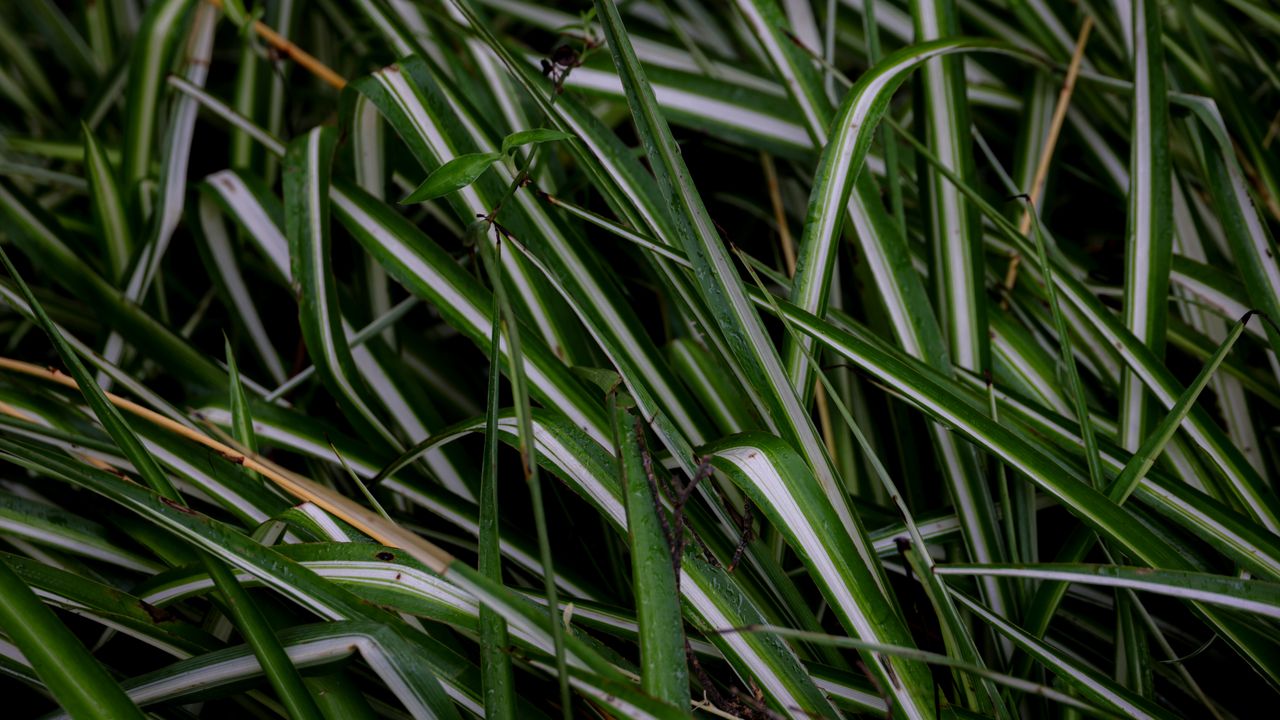
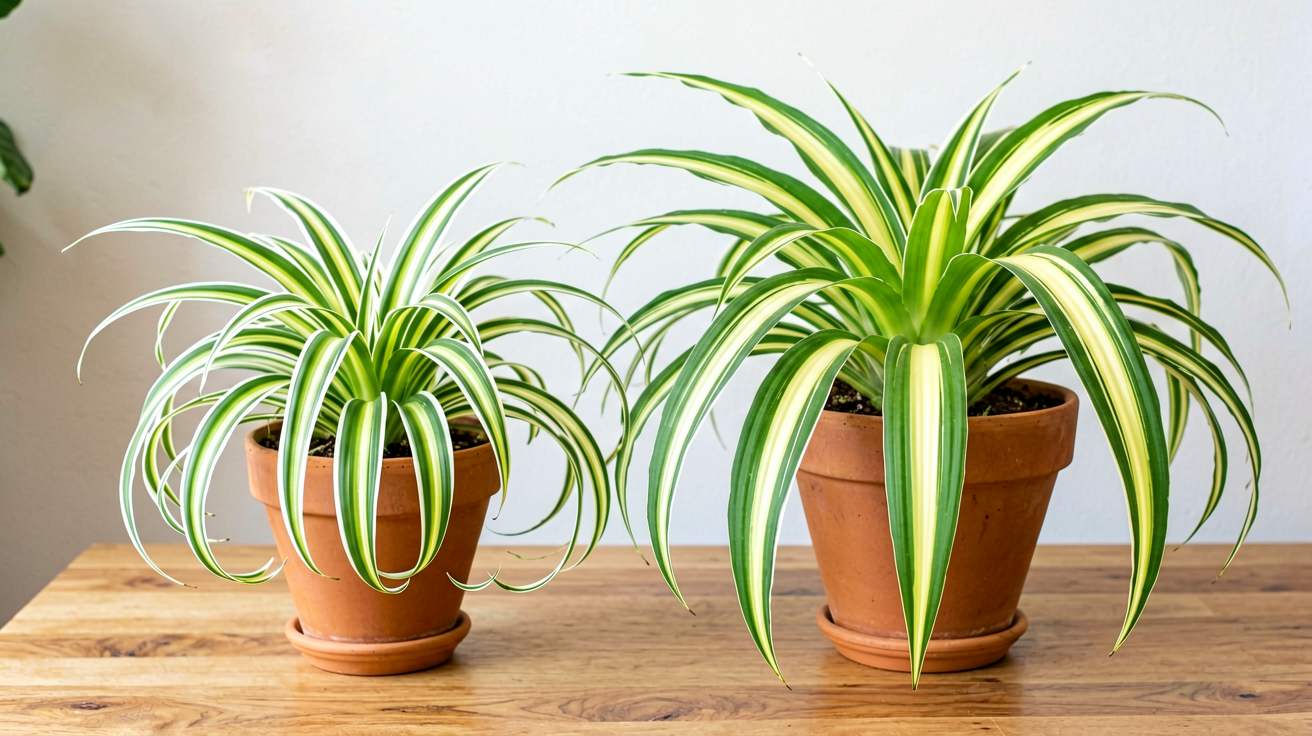
Both are Chlorophytum comosum cultivars; neither is “more variegated” than the other in the absolute sense. The difference is how the variegation behaves when indoor conditions slip. Bonnie (sometimes sold as ‘Bonnie Curly’) has a thin white margin and a tightly curled leaf habit. Vittatum has a broad cream-white center stripe with green edges, and its leaves stay flat and upright. The first is a curly, compact plant that reads as “small and tidy.” The second is a wider, arching plant that reads as “tall and striped.”
If your home has bright indirect light and you want the stripe to keep popping, both will perform. If your home runs dim (north window, room with one small lamp, or a corner more than 3 meters from the nearest window), the cultivar choice decides who keeps variegation and who quietly fades back to green. The short answer, expanded in the table below: Vittatum wins in bright, indirect light; Bonnie wins in moderate to lower light. Vittatum in dim rooms reverts its stripe; Bonnie in dim rooms keeps its pattern but curls its leaves more tightly.
Side-by-Side at a Glance (Three Dimensions)
Three rows cover most of the buying decision for a houseplant shopper comparing these two pots on a shelf:
| Dimension | Bonnie (‘Bonnie Curly’) | Vittatum |
|---|---|---|
| Variegation stability | Holds pattern longer in low-to-moderate light; tighter, thinner white margin | Broad cream-white center stripe; loses stripe first when light is too low |
| Growth habit | Compact, tightly curled ribbon leaves; smaller overall footprint | Upright arching ribbon leaves; broader and taller footprint |
| Light tolerance | Better in medium light and partial low light; accepts east and north windows | Better in bright indirect light; needs an east or filtered south window to keep the stripe |
The table is the cheat sheet. The three H2s that follow explain why each row reads the way it does, and what happens to a plant that lives outside its row’s tolerance window.
Variegation Stability: Why Bonnie Holds Pattern Longer
Variegation in spider plants comes from a genetic mutation in the cells that produce chlorophyll. Cells carrying the mutation produce white or cream sections; cells without the mutation produce green sections. The pattern visible on any given leaf is the leaf that those mutated cells happened to grow. Variegation stability is about how aggressively the plant grows past those cells toward all-green (or all-white) tissue in response to environmental pressure.
Bonnie’s thin white margin sits at the leaf edge, with a wide green center doing most of the photosynthesis. If light dips, the plant keeps growing green-center tissue because that tissue photosynthesizes more efficiently, but the green tissue does not crowd out the white margin as easily on a Bonnie as it does on a Vittatum. Conversely, in very bright light, Bonnie produces more variegated offsets less reliably than Vittatum, but it stays variegated longer in suboptimal indoor light.
Vittatum’s broad cream-white center stripe is structurally more fragile under low light. The stripe carries little chlorophyll, so the leaf has to lean on the green margins to feed itself. In a dim room, the plant favors producing new all-green leaves because those leaves photosynthesize faster, and the cream stripe slowly disappears over one or two growing seasons. Diagnose this early in the spider plant variegation fading guide.
Growth Habit: Why Bonnie Curls and Vittatum Goes Upright
Bonnie’s leaf curl is not a problem to fix; it is the cultivar’s morphology. The leaves are naturally shorter and tighter, and they spiral when they grow. Underwatering and underwatered light do not cause the curl, but they do amplify it; a thirsty Bonnie in a dim room is much curlier than a well-watered Bonnie in bright light. If you see a Bonnie plant on a shelf with flat leaves, it is probably a Vittatum mislabeled as Bonnie.
Vittatum’s upright arching leaf habit is its morphology too. The leaves are longer, broader, and they arch over the pot rather than curling inward. The arch means a Vittatum in a low-light room still photosynthesizes efficiently enough to grow, but it also means the plant puts visible energy into leaf length rather than pattern, which is why the stripe starts to fade before the plant itself looks unhealthy.
In practice, Bonnie’s curl is a sign that you are growing the plant, not a sign of damage. The curl response that does signal a problem is a sudden flattening on a previously curly Bonnie, which usually means overwatering or root suffocation, not variegation loss.
Light Tolerance: Which One Forgives Low Light (and Which Does Not)
Spider plants in general are low-light tolerant houseplants because their broad ribbon leaves grab any indirect light available. The cultivar decision changes how that tolerance shows up. See the spider plant light requirements page for the general framework; the two cultivar patterns below are what change when you pick one over the other.
Bonnie in a medium or low-light room (a north-facing window with no direct sun, or a room with one floor lamp and ambient light) keeps its variegation pattern and stays compact. It may grow more slowly, but it does not lose its stripes. The leaves curl more tightly, which is normal for the cultivar. If you have a north-facing window or a room that never gets direct sun, Bonnie is the safer cultivar.
Vittatum in the same room drops its white center stripe first, then gradually produces all-green new leaves. The plant still lives; it just stops reading as variegated. Vittatum wants bright indirect light for at least 6 hours a day, an east-facing window, a filtered south window, or supplemental light from a grow lamp if you want it to keep the cream stripe indefinitely.
The Reverse Case: When Vittatum Loses Its Stripe (and Bonnie Does Not)
The “reverse” pattern (green-center with cream edges, also called Variegatum) sometimes appears on the same plant that is labeled Vittatum. This is not a separate cultivar chosen by the grower; it is the same plant’s cells reverting toward all-green tissue. In a dim room, Vittatum pushes out new leaves that are mostly green with cream margins, and the original white-center stripe disappears from the crown over a few months.
Bonnie almost never produces a reverse stripe because the variegation pattern is on the leaf edge rather than the center. The opposite failure is a Bonnie that grows flat leaves (which means it is not a Bonnie) or a Bonnie that grows an all-green offset from the mother plant (which can be removed and propagated as a non-variegated spider plant). Diagnose stripe patterns and the difference between Vittatum and Variegatum in the Vittatum vs Variegatum comparison.
Care Routine: What Changes Between the Two (and What Does Not)
Watering, soil, humidity, propagation, and feeding are functionally identical between the two cultivars. A standard well-draining indoor potting mix, watering when the top 2 to 3 cm of soil dries, and balanced diluted fertilizer every 4 to 6 weeks during the growing season work for both. Spider plants in general are sensitive to fluoride and chlorine in tap water, which shows up as brown leaf tips on either cultivar; the cure is the same: switch to filtered, distilled, or rainwater. The full fluoride and chlorine diagnosis lives in the tap water brown tips guide.
Two differences actually move the needle on care. First, fertilize Bonnie slightly less than Vittatum. The curly compact leaves do not push as much new growth, and over-fertilization produces salt buildup that browns the leaf edges faster on Bonnie’s tighter curl than on Vittatum’s broader leaves. Second, repot Vittatum more often because the upright arching habit fills the nursery pot faster than Bonnie does. Otherwise the two cultivars share one care routine.
Pet Safety and Source-Cited Identification
Both Bonnie and Vittatum spider plants are non-toxic to cats and dogs. ASPCA lists Chlorophytum comosum in general as non-toxic. Missouri Botanical Garden’s entry on spider plant cultivars confirms that ‘Bonnie’ and ‘Vittatum’ are cultivar names within the same species, not separate species. The plant also has mild hallucinogenic effects on cats (similar to catnip), but this is a behavioral response, not a toxicity one. For the full safety breakdown, see the spider plant toxicity guide.
Which One to Pick (and Which to Skip) for Your Room
Bright indirect light, east or filtered south window, no supplemental grow lamp: pick Vittatum. The cream stripe will stay bright, and the upright arching habit fills a hanging basket or a tall pot well.
Medium to lower light, north-facing window, room with only ambient light: pick Bonnie. The variegation holds pattern in indoor rooms that would slowly de-stripe a Vittatum, and the compact curl habit fits a small shelf or a desk corner.
You plan to propagate by division and want one cultivar that reads as itself across many pots: pick Bonnie. New divisions read as the parent cultivar faster, and the compacted habit propagates predictably. See the spider plant buying guide for the broader cultivar selection question and which nursery stock tends to be most true to label.
Both are forgiving houseplants for indoor gardeners who want a variegated plant that visibly multiplies. The choice is not about which is “better”; it is about which one matches the light your home already has.
From Bank Statement to QuickBooks-Ready File
That manual cleanup you just read about? This tool skips it. Turn your PDF into QBO for QuickBooks without storing your data anywhere.
Start Converting