Not all spider plants look the same – the genus Chlorophytum comosum has several distinct cultivated varieties that differ in leaf shape, variegation pattern, size, and growth habit. If you have been looking at spider plants varieties and wondering which one to buy, or why your neighbor’s spider plant looks different from yours, this guide covers the most common cultivars and what sets each one apart so you can pick the right variety for your space and light level.
All spider plant varieties share the same core care requirements: bright indirect light, watering when the top inch of soil is dry, and filtered water if your tap water is fluoridated. The differences are mostly aesthetic – choosing one is largely a matter of which look fits your space and your personal preference, though there are real trade-offs in vigor, light tolerance, and growth habit that the comparison below makes explicit.
How to Tell Spider Plant Varieties Apart
All spider plants sold in mainstream shops belong to a single species, Chlorophytum comosum, but the cultivated varieties (cultivars) differ in three observable traits: variegation pattern, leaf shape, and growth habit. Once you can read those three traits at a glance, the cultivar label on the pot becomes secondary – you can identify what you are looking at even without a tag.
Variegation pattern is the easiest tell. Look at where the white or cream sits on the leaf: white margins (edges) with a green center = Variegatum; a central white or pale stripe with green margins = Vittatum; both patterns with curled or wavy leaves = Bonnie or Curly; no white at all = solid green. Leaf shape is the second tell – Bonnie and Curly have visibly curled or wavy leaves while Variegatum and Vittatum grow straight and arch outward. Growth habit is the third tell – Variegatum and Vittatum sprawl, Bonnie stays compact, and solid green forms are typically the most vigorous growers.
The care rules below apply to all five varieties and are detailed in the complete spider plant care guide; the differences between varieties are mostly visual and ornamental rather than cultural.
Chlorophytum comosum ‘Variegatum’
Variegatum is the classic spider plant and the most widely available cultivar in mainstream shops. Its leaves have a white or cream margin running along each edge, with a solid green center. The contrast is sharp and defined, and the white edges give the plant a lighter, airier appearance from across a room. Variegatum is also the most resilient of the variegated forms in lower light, because the green center stripe still contains enough chlorophyll to keep the plant photosynthesizing efficiently when light is limited.
Mature Variegatum plants typically reach 12 to 18 inches of leaf length with arching stems that can extend another 12 to 24 inches when the plant produces spiderettes. It is the strongest spiderette producer of the variegated cultivars, which makes it the best choice if you want a hanging basket full of cascading plantlets. For light matching, Variegatum tolerates a wider range than Vittatum and is the safest pick for rooms with north-facing windows or partial shade, as covered in the spider plant light requirements guide.
Chlorophytum comosum ‘Vittatum’
Vittatum reverses the variegation pattern: a broad white or pale yellow central stripe runs down the middle of each leaf, with green margins on either side. The center stripe is the dominant visual element, which makes Vittatum appear lighter and more white-dominant than Variegatum from a distance – and that is why it shows up so often in interior design photography.
The trade-off is chlorophyll density. The white central stripe contains little to no chlorophyll, so the plant photosynthesizes primarily through the green margins. In low light, Vittatum loses some of its central stripe definition and the leaves may shift toward a more uniform pale green. It still grows well, but the variegation contrast weakens. If you want Vittatum to keep its bright center stripe, give it bright indirect light from an east or west window. Vittatum also tends to grow slightly larger than Variegatum – leaves can reach 18 to 24 inches – so plan for a bit more spread on a shelf or stand.
Variegatum and Vittatum are the most frequently confused pair because the labels sometimes get swapped at the retailer level. If the label matters to you, the dedicated Vittatum vs Variegatum breakdown walks through the side-by-side differences in more detail.
Chlorophytum comosum ‘Bonnie’
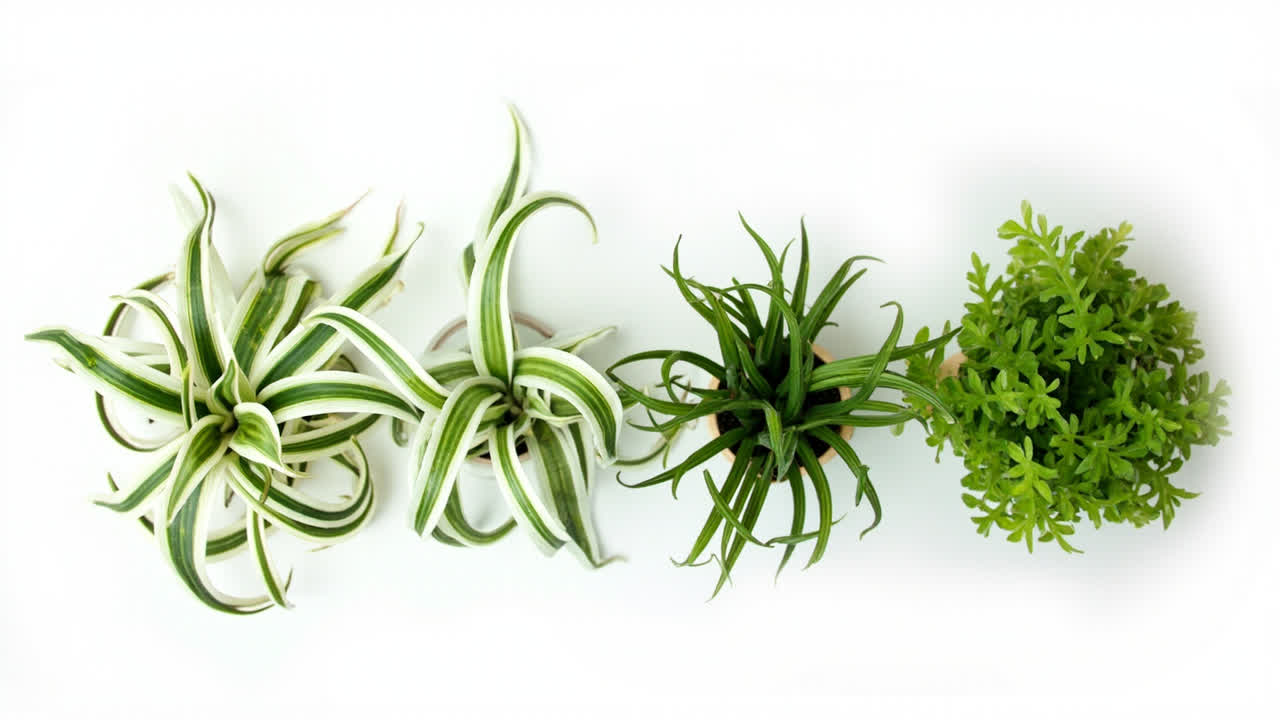
Bonnie is the most visually distinct of the common spider plant cultivars. Where Variegatum and Vittatum leaves grow straight and arch outward, Bonnie leaves curl and wave – they have a natural waviness that makes the entire plant look more compact and textural. The leaves are shorter and more rosette-forming than the standard varieties, which keeps the plant tighter and more symmetrical as it matures.
Bonnie’s variegation is similar to Vittatum (a central white stripe with green margins), but the leaf curl gives the plant a completely different character from across a room. It is an excellent choice for shelves, desks, or plant stands where a sprawling spider plant would be awkward, and the compact growth means it fills a pot more evenly without becoming top-heavy. Bonnie also tends to produce more densely clustered growth rather than long arching stems with spiderettes at the tips, so it stays tidier in a standard pot than in a hanging basket.
For Bonnie’s care, the same rules apply – bright indirect light, filtered water, well-draining soil – and the dedicated Bonnie spider plant care guide covers its specific quirks in more depth. Bonnie is slightly less common in mainstream shops than Variegatum or Vittatum, which makes it a more interesting pick for plant collectors who want something beyond the standard variegated spider plant.
Curly Spider Plant and Solid Green Forms
The curly spider plant (Chlorophytum comosum ‘Curly’) is a naturally occurring mutation that produces leaves which curl and twist along their length rather than growing straight. The effect is almost corkscrew-like – leaves spiral gently as they extend, which makes the plant look like it is in constant motion even when it is still. The variegation is typically the Vittatum pattern (white center, green margins), but the curl means the leaf surface reads differently from every angle. Curly spider plants are just as easy to care for as the standard varieties; the curly mutation does not introduce any new growing challenges, and the curl persists in all light conditions. The dedicated curly spider plant care guide covers its specific display and propagation habits.
Solid green spider plants have no variegation at all – every leaf is uniformly green. These are usually unvariegated seedlings or sports from variegated cultivars that have reverted to all-green foliage. Solid green forms are more vigorous than their variegated counterparts because every leaf cell contains chlorophyll, which means they photosynthesize more efficiently and typically grow faster and larger than the variegated cultivars. They are harder to find in mainstream shops but appear regularly in batches from commercial growers, especially when propagated from root division rather than from spiderettes.
Choosing the Right Variety for Your Space
If you want a dramatic hanging display with long trailing spiderettes, go with Variegatum. It is the most vigorous producer of spider plant babies and its arching growth habit suits hanging baskets and high shelves where the cascade can show.
If you want a lighter, more elegant look with broader white-striped leaves, choose Vittatum. The white center stripe reads strongly from across a room, and it is the most photographed variety for that reason. Pair it with bright indirect light to keep the variegation defined.
If you want a compact, textural plant that stays more contained, go with Bonnie or Curly. Both work well on shelves, desks, and plant stands where a sprawling spider plant would be awkward. Bonnie is the more symmetrical of the two; Curly is the more ornamental.
If you want the toughest, most vigorous spider plant possible, choose the solid green form. It grows faster, tolerates lower light more gracefully, and will outpace any variegated cultivar in the same conditions. For purchase-decision framing beyond just variety choice, the spider plant buying guide walks through size, pot, source, and price considerations.
What About the Other Spider Plant Species?
Chlorophytum comosum is the species you see in virtually every home and garden center, but the genus includes other species worth knowing about if you browse specialty collections. Chlorophytum laxum – sometimes sold as the “earth star” spider plant – forms tight, low-growing rosettes that spread horizontally rather than arching upward. It is rarely sold alongside the standard varieties and is mostly of interest to collectors.
The care requirements for all Chlorophytum species are essentially identical to C. comosum: bright indirect light, well-draining soil, and careful attention to water quality if your tap water is heavily treated with fluoride or chlorine. The five cultivars covered above all belong to C. comosum, which means they share the same cascading spiderette production, the same sensitivity to fluoride in tap water (covered in the spider plant tap water guide), and the same general baseline care as the complete spider plant care guide.
Finding Your Spider Plant Variety
Variegatum and Vittatum are the most commonly stocked and appear in nearly every big-box garden section and grocery store plant aisle. Bonnie and Curly require more looking – specialty plant shops, Etsy sellers, and independent local nurseries are the best sources, and online plant retailers carry them year-round. The solid green form appears occasionally in batches from commercial growers and is most reliably found through specialty channels.
Regardless of which variety you choose, the care rules are the same. Once your plant is established and producing spiderettes, the next step is propagation – any spider plant can be propagated from its spiderettes in water or soil to produce more plants for your own home or to share. If you ever hit a symptom like brown tips, yellowing, or drooping, route by symptom through the spider plant problems index to find the dedicated troubleshooting page.
From Bank Statement to QuickBooks-Ready File
That manual cleanup you just read about? This tool skips it. Turn your PDF into QBO for QuickBooks without storing your data anywhere.
Start Converting