
Air layering a fiddle leaf fig (Ficus lyrata) is the safest way to save a leggy, bare-trunk specimen: keep the mother plant intact, build a root system on the woody stem, and separate a new shorter plant in 10 to 16 weeks. This step-by-step procedure covers species-specific timing, the right stem caliber, moss preparation, root checks, and pot-up aftercare for Ficus lyrata.
Why Air Layer a Fiddle Leaf Fig Instead of Cutting It
Fiddle leaf figs (Ficus lyrata) drop their lower leaves when light is short or humidity drops, leaving a bare woody trunk with a tuft of foliage at the top. The instinct is to chop the top off and root the cutting in water. The problem is that Ficus lyrata stems are thick, woody, and slow to callus; water propagation rots the stem before roots form on most cuttings thicker than a pencil. Air layering keeps the stem attached to the mother plant while the wound calluses and roots, so the upper canopy keeps photosynthesizing and the cutting never has to support itself through the most fragile stage of root development.
If your Ficus lyrata is leggy, top-heavy, or has lost most of its lower foliage, air layering is the safest path to a shorter, bushier plant. You are not removing growth from the mother plant; you are building a root system on the stem before you cut. This is the method fiddle leaf fig care guides recommend when a tree-form plant has outgrown its space and you want a second, shorter specimen instead of a single tall bare trunk.
When to Air Layer a Fiddle Leaf Fig
Air layering a Ficus lyrata works in any season the plant is actively growing, but the callus forms fastest in late spring through early summer when daytime temperatures sit between 22 and 28 degrees Celsius (72 to 82 degrees Fahrenheit) and humidity is naturally higher. The mother plant pushes auxin to the wound during active growth, and the cambium layer to the thin green tissue just under the bark to produces adventitious roots within 8 to 12 weeks under those conditions.
Do not attempt air layering in deep winter. Ficus lyrata enters a slow-growth phase below 18 degrees Celsius (65 degrees Fahrenheit), and a wound made during dormancy may sit for 4 to 5 months without producing roots, then rot. If you must work outside the spring-summer window, use a heat mat set to 24 degrees Celsius (75 degrees Fahrenheit) wrapped around the mother plant’s pot and a clear plastic bag tent over the moss ball to hold humidity above 70 percent.
Tools and Materials for Air Layering Ficus Lyrata
You do not need a propagation lab. The materials are the same as for any air layer, with one species-specific addition: a sharp sterilized grafting knife or single-edge razor blade. Ficus lyrata cambium is thin (1 to 1.5 mm), so a dull blade crushes the stem instead of cutting it cleanly, and crushed cambium does not callus.
- Sterilized grafting knife or single-edge razor blade
- Sphagnum moss (long-fiber, soaked and squeezed until just damp)
- 0.3 percent IBA (indole-3-butyric acid) rooting hormone gel or powder
- Clear plastic wrap or cling film
- Twist ties or soft plant tape
- Aluminum foil (optional, to shade the moss ball from direct sun)
- Small soft brush (to apply rooting hormone)
- Clean 15 to 20 cm pot with drainage holes
- Well-draining mix: 60 percent peat-based potting mix, 20 percent perlite, 20 percent orchid bark
Use sphagnum moss, not perlite or coco coir, for Ficus lyrata. Sphagnum holds moisture evenly without saturating the cambium and is sterile, which lowers the risk of stem rot during the 10 to 16 week rooting window. If you want to compare substrate choices, the sphagnum moss vs perlite comparison covers why sphagnum is the safer pick for thick woody Ficus stems.

How to Air Layer a Fiddle Leaf Fig: Step by Step
Plan on 15 to 20 minutes for the wrap itself; the rest is waiting. The steps below assume a healthy, actively growing mother plant in a 25 cm or larger pot. If your plant is small or struggling, see the air layering troubleshooting page for diagnostic detail.
Step 1 to Choose the stem. Pick a healthy stem between 1.5 and 3 cm (0.6 to 1.2 inches) in diameter, at least 15 cm below the lowest healthy leaf. The stem should be firm, not soft, and free of scars, cracks, or active pest damage. Avoid stems that have been recently pruned; the wound will already be closing and the cambium is committed to sealing that site.
Step 2 to Make two parallel cuts. With the sterilized blade, make two parallel cuts around the stem, 2.5 to 3 cm (1 to 1.2 inches) apart, just deep enough to cut through the bark and into the green cambium. On Ficus lyrata, that is about 2 mm deep. Do not cut deeper than 3 mm or you risk cutting into the xylem and killing the upper stem.
Step 3 to Remove the bark ring. Use the tip of the blade or a clean grafting scraper to lift the bark ring off between the two cuts. The exposed wood should be pale yellow-white, not green. If you see green tissue left behind, scrape again; any remaining cambium will heal the wound back together without producing roots.
Step 4 to Apply rooting hormone. With a small soft brush, dab 0.3 percent IBA gel or powder onto the upper edge of the girdle to the edge closest to the leaves, not the lower edge. Auxin accumulates above the wound; the upper edge is where adventitious roots will form. Do not coat the lower edge or the exposed wood face.
Step 5 to Soak and squeeze the sphagnum moss. Submerge a handful of long-fiber sphagnum moss in room-temperature water for 5 minutes, then squeeze until no water drips out. The moss should feel like a wrung-out sponge to damp, not soaking. Over-wet moss rots Ficus lyrata cambium within 2 to 3 weeks; this is the most common reason air layers on fiddle leaf figs fail.
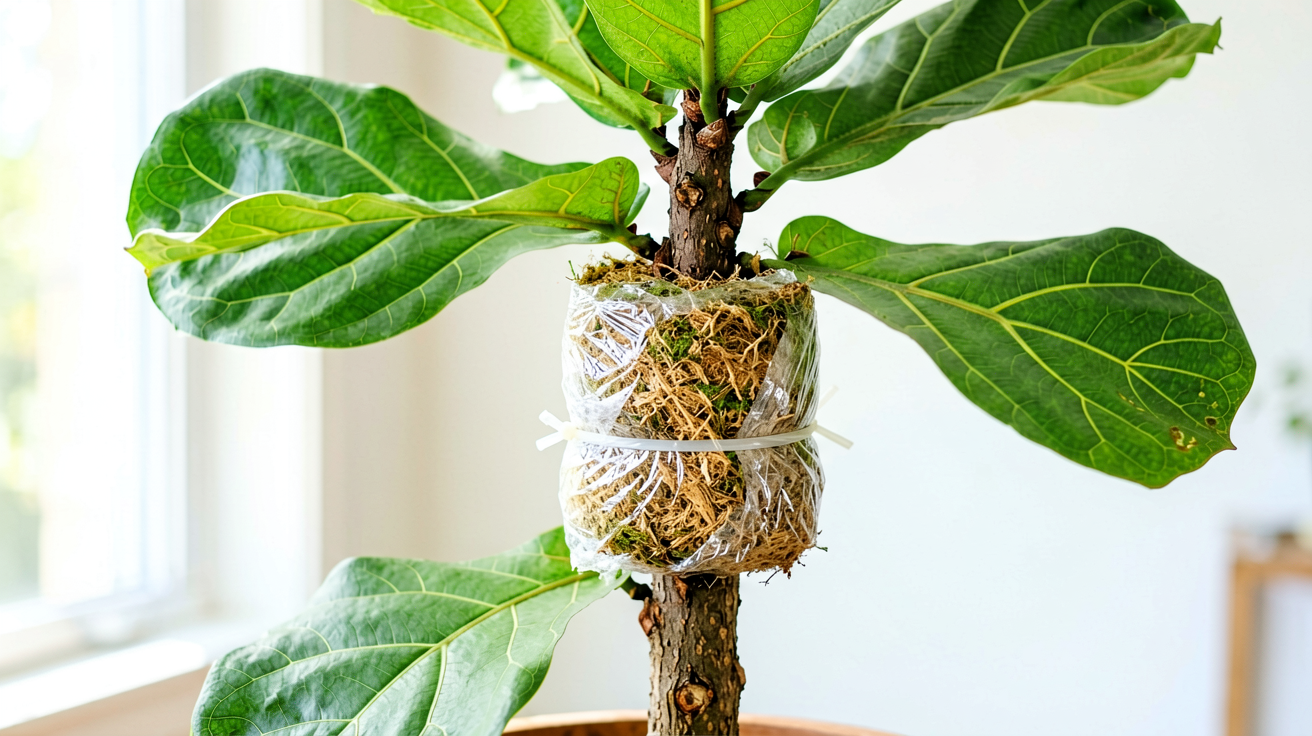
Step 6 to Wrap the moss ball. Press the moist sphagnum moss around the girdled stem so the moss ball is 5 to 7 cm (2 to 2.8 inches) thick on all sides and extends 2 cm above and below the wound. The ball should be substantial enough to hold moisture for 3 to 4 weeks without re-wetting.
Step 7 to Seal with plastic wrap. Wrap the moss ball tightly in clear plastic wrap or cling film, starting 2 cm below the wound and finishing 2 cm above. Twist tie or tape the top and bottom of the wrap to the stem so water cannot enter from above or evaporate from the sides. The plastic should be taut enough that the moss holds its shape but loose enough that the stem is not constricted.
Step 8 to Optional: shade the wrap. If the air layer sits in direct sun, wrap a single layer of aluminum foil over the plastic. Direct sun heats the moss ball above 32 degrees Celsius (90 degrees Fahrenheit), which kills the cambium. The foil reflects light and keeps the rooting zone closer to 24 to 27 degrees Celsius (75 to 80 degrees Fahrenheit).
Step 9 to Wait and check. Roots form in 10 to 16 weeks on Ficus lyrata, slower than on Ficus elastica (rubber plant). Check every 3 weeks by gently loosening the top twist tie and looking through the plastic. White or pale tan roots 2 to 4 cm long are the signal to separate. If you see black roots, soggy moss, or a sour smell, the layer has rotted and you need to start again lower on the stem.
Step 10 to Separate and pot up. Once roots are 3 to 5 cm long and at least 5 to 8 roots are visible, cut the stem 5 cm below the moss ball with sterilized pruners. Remove the plastic wrap and moss, taking care not to damage the new white roots. Pot immediately into a 15 to 20 cm pot with the well-draining mix described above. Water until it drains from the bottom, then place the new plant in bright indirect light under a plastic bag tent for 2 weeks to recover from the cut.
Aftercare for the New Fiddle Leaf Fig
The first 4 weeks after separation are the recovery period. The new plant has just lost its connection to the mother plant’s root system and is supporting a full canopy of leaves with a small root ball it grew inside a moss ball. Two failure modes dominate this window: under-watering and over-fertilizing.
Water when the top 2 cm of the mix feels dry; Ficus lyrata prefers consistently moist but never soggy soil. Do not fertilize for the first 8 weeks to fresh roots are sensitive to salt burn, and a high-NPK feed can scorch them. After 8 weeks, switch to a balanced 10-10-10 fertilizer at half strength every 4 weeks during the growing season. If the new plant drops 2 to 4 leaves in the first 2 weeks, that is normal transplant shock, not failure. New leaves from the apical bud confirm recovery.
The mother plant will branch below the cut site within 4 to 6 weeks. Ficus lyrata releases apical dominance when the top is removed, and dormant lateral buds below the cut push new shoots. To encourage a bushier mother plant, cut back to a node that has an outward-facing bud and feed lightly with a higher-nitrogen fertilizer for one month.
Air Layering vs Stem Cuttings for Fiddle Leaf Fig
Stem cuttings in water or moist perlite are faster to start but fail more often on Ficus lyrata. A 2 cm diameter cutting needs 6 to 10 weeks to root in water, and rot rates exceed 40 percent for stems thicker than 1.5 cm. Air layering takes longer (10 to 16 weeks) but the success rate is 70 to 85 percent because the stem stays attached to the mother plant throughout root formation.
Use stem cuttings for thin, flexible stems under 1 cm in diameter taken in late spring. Use air layering for thick, woody stems, leggy trunks, or any case where you want to keep the mother plant intact while rooting a section. For a broader comparison of air layering against water propagation on houseplants in general, see the air layering vs water propagation page. For rubber plant specifically, the air layering a rubber plant guide uses a similar procedure with a faster root timeline because Ficus elastica cambium is thicker and calluses more quickly.
Fiddle Leaf Fig Air Layering FAQ
Can I air layer a fiddle leaf fig in winter?
Technically yes, but root formation slows from 10 to 16 weeks up to 5 to 6 months, and the risk of stem rot rises in cold homes. If you must work in winter, add bottom heat (a heat mat at 24 degrees Celsius under the pot) and a clear plastic bag tent over the moss ball to keep humidity above 70 percent.
How long does it take for roots to show?
10 to 16 weeks in active growing season. Check by loosening the top twist tie and looking through the plastic; do not unwrap the moss ball until you see white roots 2 to 4 cm long.
What if my air layer has no roots after 16 weeks?
The most likely cause is dormant cambium to the plant is not in active growth. Move the plant to a brighter, warmer spot, add bottom heat, and wait another 4 to 6 weeks. If you see soggy moss or a sour smell, the layer has rotted and you need to start again on a fresh stem section.
Do I need rooting hormone for fiddle leaf fig air layering?
Hormone is not required but increases success rate. 0.3 percent IBA applied to the upper edge of the girdle shortens rooting time by 2 to 3 weeks and produces a denser root mass. Skip the hormone only if you cannot source it; expect slower rooting without it.
What size pot should I pot up the new plant into?
A 15 to 20 cm pot with drainage holes is enough for the first 6 to 12 months. Ficus lyrata prefers a slightly tight pot at this stage; over-potting in a container larger than 25 cm before the root system fills the smaller volume raises the risk of root rot.
From Bank Statement to QuickBooks-Ready File
That manual cleanup you just read about? This tool skips it. Turn your PDF into QBO for QuickBooks without storing your data anywhere.