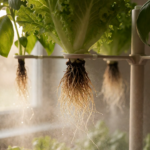
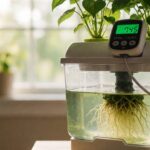
Pick the propagation method by stem type, not by habit. Soft, green, water-storing stems root in a jar in 2 to 4 weeks; thick or woody stems rot before callus tissue can form, and they need air layering. This page walks through how to tell which method fits your cutting, why woody stems fail in water, and what success looks like for each route so you stop guessing and start a propagation plan that actually finishes.
If your last water jar went mushy on a rubber plant, or your moss ball dried out before roots showed, the answer is not more patience. It is matching the stem anatomy to the method. The decision below takes under a minute and saves a cutting.
Air layering vs water propagation at a glance
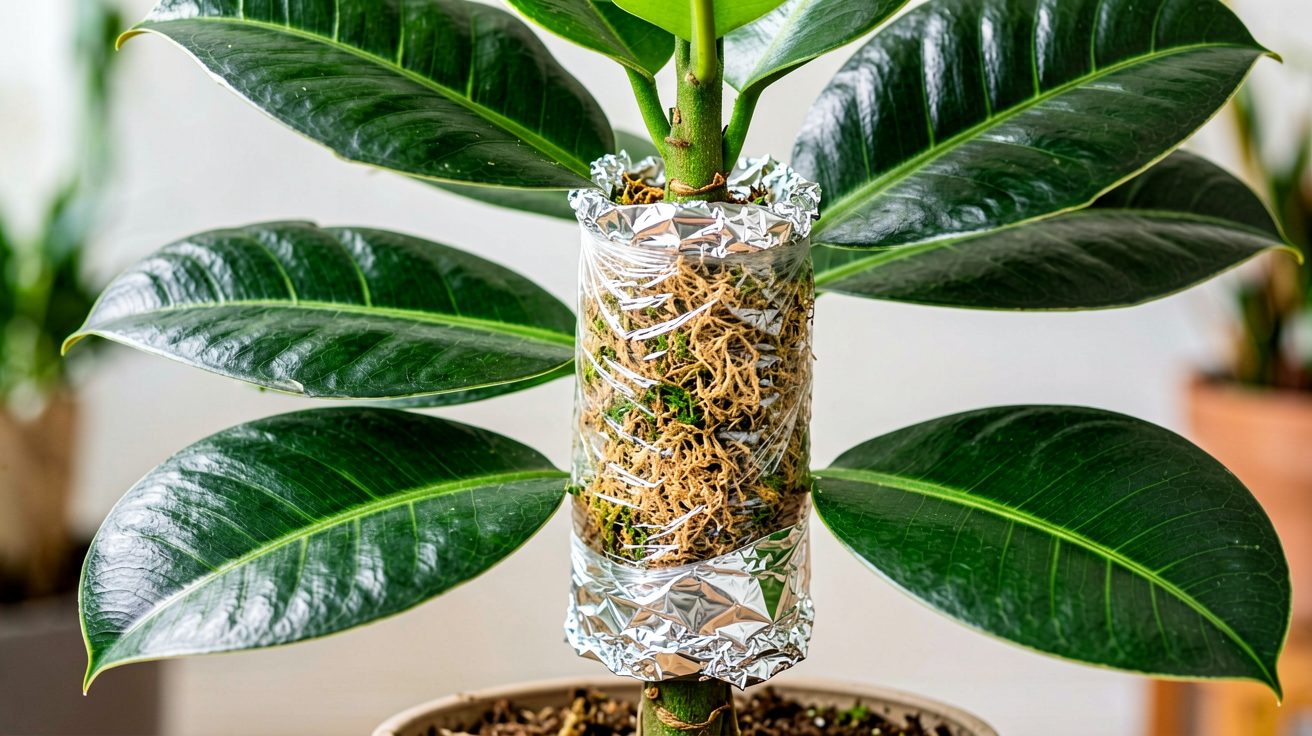
The simplest rule for picking between air layering and water propagation is this: thin and green goes in the jar, thick or woody goes in the moss. Soft-stemmed tropicals like pothos, philodendron, heart-leaf vine, and most hoya push adventitious roots from a clean node in plain tap water, no rooting hormone needed, in 2 to 4 weeks. Thick or woody-stemmed houseplants like rubber plant, fiddle leaf fig, dracaena, schefflera, and money tree refuse to root the same way because their bark cracks, their cut end rots, and the cambium never gets a clean chance to callus. Air layering is the propagation method built for those stems: it keeps the branch alive on the parent plant while the wound calluses inside a moist sphagnum moss ball, so roots form on a stem that is still drawing water and sugar from the mother plant. You cut the new plant free only after the moss ball fills with white roots, which takes 8 to 12 weeks for most species and up to 16 weeks for slow woody ones.
The trade-off between the two methods is time invested against success rate. Water propagation is fast and forgiving on soft stems but unreliable on woody ones; air layering is slow but reliable on woody stems and overkill on soft ones. Picking the wrong method for the stem is the single most common reason a propagation project ends in a black, slimy jar or a moss ball that never roots. A quick stem-thickness check before you start saves both the cutting and the wait. For a full step-by-step on the air-layering side, the air layering propagation guide walks through girdling, sphagnum moss prep, and the 8 to 12 week rooting window in detail.
Why water propagation fails on woody stems (and why air layering fixes it)
The mechanism behind the failure is the cambium. The cambium is a thin ring of actively dividing cells just under the bark that produces both new bark and new vascular tissue, and it is the same layer that pushes out adventitious roots when you wound it. On a soft stem, the cambium is close to the surface, the cut end stays wet and clean, and callus tissue forms within days, then white roots emerge from the callus within weeks. On a woody stem, the cambium is buried under thick bark, the cut end desiccates or rots before the callus can thicken, and the stored water in the thick stem sits in the jar long enough to grow bacteria that finish off the cutting. You see this as a brown, mushy cut end after week 2 and a stem that never pushes a single root.
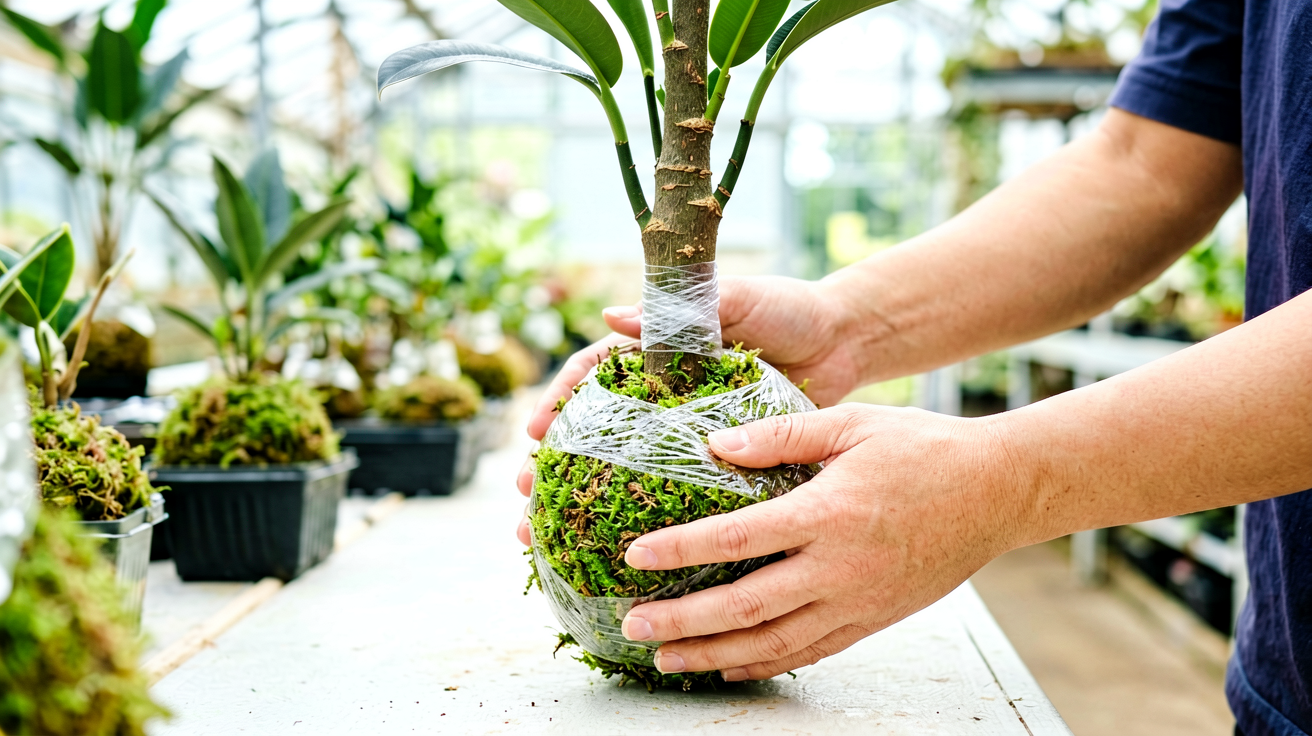
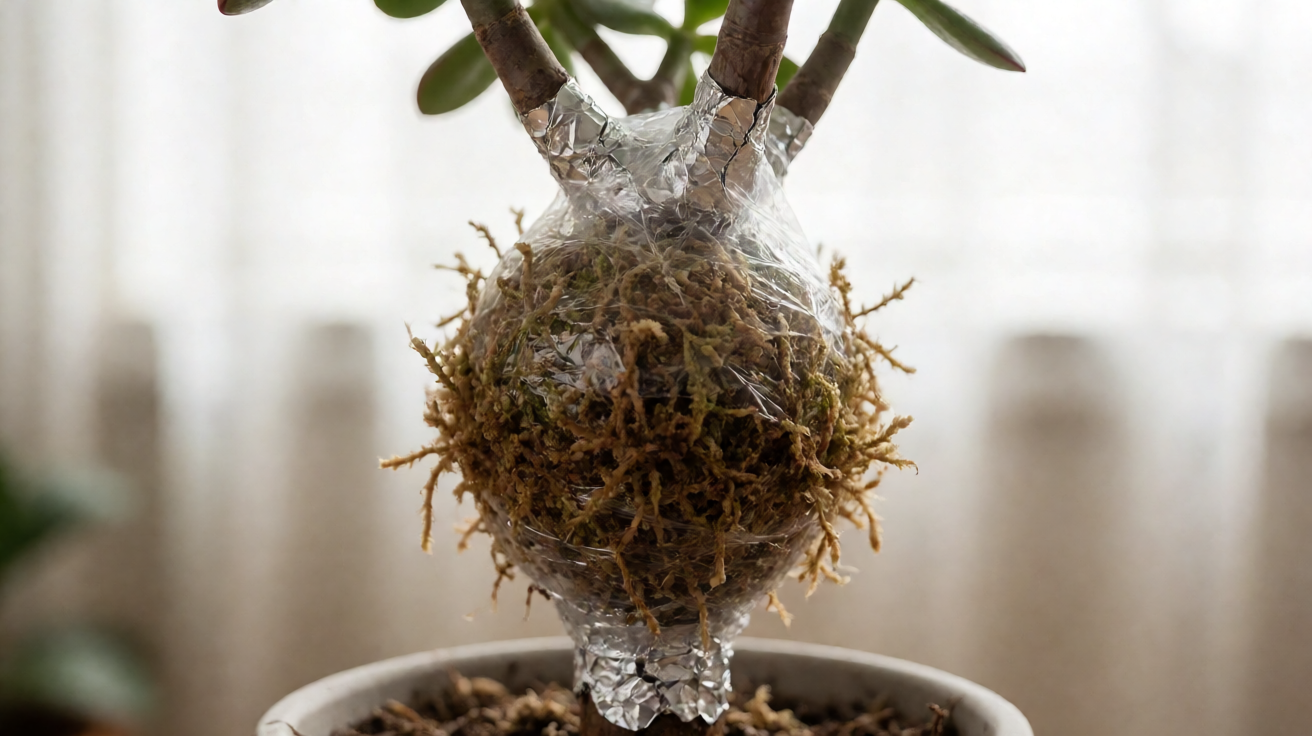
Air layering sidesteps the rot problem by keeping the stem attached to the parent plant. Instead of severing the branch and putting it in a jar, you girdle the stem while it is still drawing water and sugar from the mother plant, wrap the wound in moist sphagnum moss held inside plastic wrap, and let the cambium callus and root in place. The stem never sits in stagnant water, so rot does not get a foothold, and the parent plant keeps feeding the branch while adventitious roots grow into the moss ball. After 8 to 12 weeks you cut below the new root mass and pot the new plant up as a clone. The trade-off is the long wait, which is real but is also the cost of admission for any woody-stemmed species.
The honest limit of air layering is that it is overkill for soft stems. Pothos, philodendron, and most hoya root faster in a jar with a single node submerged, no hormone needed, and forcing them through a moss ball adds 6 to 10 weeks of waiting for no real gain. The same indole-3-butyric acid (IBA) rooting hormone that helps woody stems callus through vegetative propagation in sphagnum moss is wasted on soft-stemmed cuttings that already root in plain water without hormone; a clone identical to the parent plant is the goal of both methods, but the cambium, phloem, and xylem layers only need help when the stem is semi-woody or thick enough that callusing will not finish before rot sets in. The honest limit of water propagation is that it cannot save a thick stem, no matter how clean the cut or how often you change the water. Picking by stem type is the only honest decision rule that respects both limits. The full procedural deep-dive on air layering lives in the air layering propagation guide, which covers girdling depth, sphagnum moss prep, and the moisture window in detail.
Stem type and species decide the method
Look at the stem you want to propagate and ask two questions: how thick is it, and is it green or bark-covered? A stem you can pinch between thumb and forefinger with no resistance is soft, green, and water-friendly; a stem you cannot pinch, or that has visible bark and a woody color, is thick and needs air layering. The thickness cutoff is roughly pencil-thickness or greater, which for most houseplants means anything older than a year of growth on the main branches.
For soft-stemmed species, water propagation is the right default. Pothos (Epipremnum aureum), heart-leaf philodendron (Philodendron hederaceum), monstera (Monstera deliciosa), and most hoya (Hoya carnosa, kerrii, wayetii) root in plain water in 2 to 4 weeks when you take a cutting with at least one node submerged. The hoya propagation guide walks through node selection, jar change frequency, and the white-root signal that tells you when to pot up.
For woody-stemmed species, air layering is the right default. Rubber plant (Ficus elastica), fiddle leaf fig (Ficus lyrata), dracaena (Dracaena marginata, fragrans), schefflera (Schefflera arboricola and actinophylla), dieffenbachia, money tree (Pachira aquatica), magnolia, and camellia all respond to air layering when the cambium is active in spring and summer. Rubber plant is the easiest entry point for a first air layer because its cambium is active for most of the growing season indoors and its bark is thin enough to girdle cleanly with a sharp knife. Fiddle leaf fig is the next step up because its bark is thicker and the rooting window is closer to 12 weeks than 8.
There is one mid-range case worth naming. Jade plant (Crassula ovata) is woody but its thin bark cracks irregularly under the girdle and the cambium often fails to root before the wound dries out, even with sphagnum moss and rooting hormone. For jade, a stem cutting in dry perlite or coarse sand roots faster and more reliably than air layering, and water propagation is even worse. The honest answer is that jade sits in its own category where neither method in this comparison is the best choice. For the rest of the species in this section, the rule holds: soft stem means jar, woody stem means moss ball. Outdoor ornamentals like azalea, holly (Ilex), magnolia, and camellia are also semi-woody candidates for air layering when the cambium is in active growing phase from spring through summer, and the same rule applies in reverse: fall and winter are not viable air-layering windows because the cambium goes dormant and callusing stalls inside the moss ball.

Time, effort, and what success looks like for each method
Water propagation needs almost no equipment. A clean glass jar, tap water, a node submerged, and a windowsill with bright indirect light. Change the water every 5 to 7 days to keep bacteria down, watch for white roots emerging from the node at the 2 to 4 week mark, and pot up into a well-draining mix when the roots are at least 5 cm long with several branches. The visible signal of success is white, firm roots with visible root hairs; a brown, slimy stem or a clear jelly-like substance in the water is the failure signal and means the cutting is going to rot regardless of what you do next. Soft-stemmed cuttings that go slimy by week 3 do not recover, and the right move is to take a fresh cutting from a healthy node and start over.
Air layering needs more equipment and more patience. A sharp sterilized knife, sphagnum moss soaked and squeezed dry, rooting hormone with IBA (indole-3-butyrate) at 0.1 to 0.3 percent concentration, plastic wrap or cling film, twist ties, and a stable branch on a healthy parent plant. The procedure takes about 20 minutes of hands-on work and 8 to 12 weeks of waiting while the cambium calluses and adventitious roots push into the moss ball. The visible signal of success is white roots visible through the plastic wrap, which usually happens between week 8 and week 12 for fast species and can stretch to week 16 for slow woody ones. When the moss ball is roughly half full of white roots, cut below the root mass, pot up into a well-draining mix with peat, perlite, and orchid bark, and tent the new plant with a clear plastic bag for the first 2 weeks to hold humidity while the roots adjust to soil. The snake plant propagation guide covers a different but related waiting pattern for leaf cuttings in soil, useful as a reference for the patience side of any propagation project.
The honest time comparison is that water propagation finishes in a month and air layering takes a season, but the success rate flips with stem type. Soft-stemmed cuttings root in water at roughly 80 to 90 percent success; woody-stemmed cuttings root in water at roughly 10 to 20 percent success, the rest rotting before callus. Woody stems in air layer root at roughly 60 to 80 percent success when the cambium is active and the moss ball stays moist. Picking by stem type is therefore not just a cleanliness rule, it is the dominant variable in whether you spend a month waiting for roots or a season waiting for nothing.
When to switch methods mid-stream (rescue decisions)
Sometimes a project goes wrong even when the rule is followed. The most common mid-stream failure on the water side is a soft-stemmed cutting that goes slimy between week 2 and week 4 despite clean water changes. The rescue move is to take a fresh cutting from a healthy node on the same vine, strip the rotted section, and restart in a clean jar. Do not keep the slimy cutting in the jar hoping it will turn around; bacteria in stagnant water finish off cambium faster than the cambium can callus, and the cutting is gone by week 5 regardless.
The most common mid-stream failure on the air-layering side is a moss ball that dries out between week 3 and week 6 because the plastic wrap tore or the twist tie loosened. A dried-out moss ball stops producing adventitious roots and the callus turns brown and corky. The rescue move is to unwrap, re-wet the sphagnum moss with clean water, dust the wound with fresh rooting hormone, re-wrap tightly, and wait another 4 to 6 weeks. If the parent plant is still in active growth, the cambium will often restart; if the parent plant has gone dormant, the air layer is unlikely to recover and the right move is to cut below the wound, discard the branch, and start a new air layer in spring when the cambium wakes up. Rubber plant is forgiving here because its cambium is active for most of the growing season, and the rubber plant propagation guide covers the timing window for restarting an air layer on a rubber plant.
A second air-layering failure is rot inside the moss ball, which shows up as a soft, dark, foul-smelling wound when you unwrap for inspection. This usually means the moss was too wet at the start or the parent plant was not in active growth. The rescue move is to cut the branch below the rot, discard it, and let the parent plant recover before starting another air layer on a different branch. Air layering is not a salvage technique; it is a propagation technique that needs a healthy, active parent plant and a clean, moist wound to succeed. For aftercare once the new plant is potted up, water thoroughly until the root ball is evenly moist but not soggy, set the pot in bright indirect sunlight with high humidity from a plastic bag tent over the foliage for the first 10 to 14 days, and check drainage holes are open so excess water escapes. Recovery is usually visible within 3 to 4 weeks as new leaves push from the apical dominance point and a lateral shoot breaks below the wound site; if the wound site still looks dark or wet at the 4 week mark, unpot and inspect for partial roots versus no roots versus rotting moss, which is the honest troubleshooting sequence that catches a failed air layer before it spreads rot back into the parent plant.
The one-glance decision rule
Here is the rule, in one paragraph: pinch the stem. If it gives, water propagation in a clean jar, change water weekly, pot up when white roots reach 5 cm. If it does not give, air layer on the parent plant with sphagnum moss and rooting hormone, wait 8 to 12 weeks, cut below the moss ball, pot up. Jade plant is the exception and prefers a dry perlite or coarse sand stem cutting instead. Species-level defaults: pothos, philodendron, monstera, and most hoya go in the jar; rubber plant, fiddle leaf fig, dracaena, schefflera, dieffenbachia, money tree, magnolia, and camellia go in the moss ball. The wait is longer on the moss side, but the success rate is the trade-off that makes the wait worth it on any stem that will not pinch between thumb and forefinger.
Read Also on Aqualogi
Related on the site, broken out by topic:
Start here: Best Plants for Air Layering guide and Air Layering Propagation guide.
For the vocabulary that names the steps: Air Layering Glossary covers the vocabulary: the wound, the wrap and its substrate, the hormone, and the cycle terms.
For choosing the method and the setting: Indoor vs. Outdoor Air Layering guide covers the one-minute decision frame, the three variables, and the timing in each context.
Turn PDF Bank Statements Into Workable Spreadsheets
Your bank statement is a mess of numbers, but your books shouldn't be. Use our converter to get Excel, CSV, or QBO files — ready for QuickBooks.
Try It Free Now