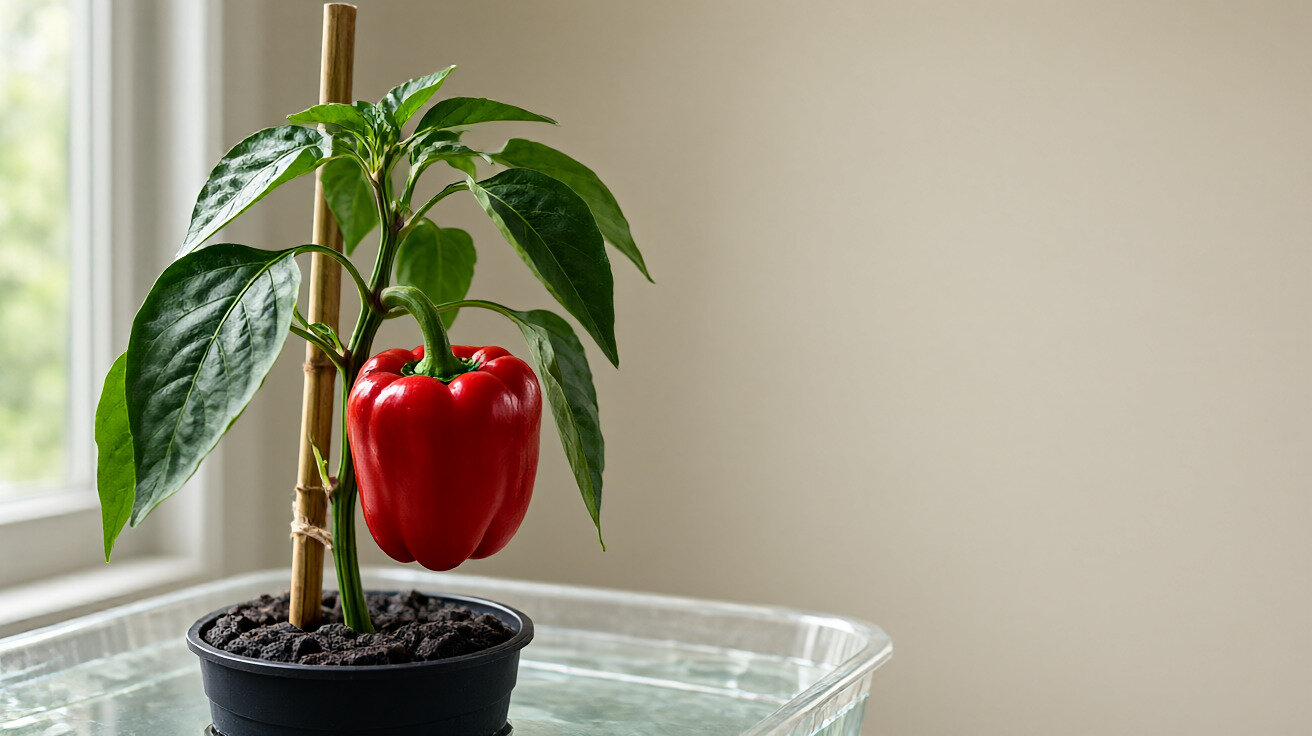

Hydroponic peppers need three numbers right before they need anything else: nutrient solution between 1.8 and 2.4 mS/cm, pH between 5.8 and 6.3, and 20 to 30 mol of light per square metre per day. Get those three right and the rest is a schedule you can keep. Leave any one of them alone and the plant still looks healthy while the fruit never arrives, which is the specific failure that ends most home pepper crops.
A pepper is a demanding crop for a home system, and not because it is fussy about nutrients. It is that a pepper plant spends months on one question: will this flower turn into fruit? Everything else here, the seed temperature, the day and night air temperatures, the reservoir temperature, the calcium in the water, the shaking of the flower, serves that question. What follows is the numbers in the order they matter, then the two failure modes worth planning for.
What Hydroponic Peppers Ask of a System
Peppers, Capsicum annuum, are not lettuce with bigger leaves. They are a long-cycle fruiting crop that needs more root volume than a leafy plant, more light than a shelf, and more patience than most people expect. The system has to hold a bigger plant without letting the water go stagnant, and deliver light at an intensity a 40 watt bulb cannot reach.
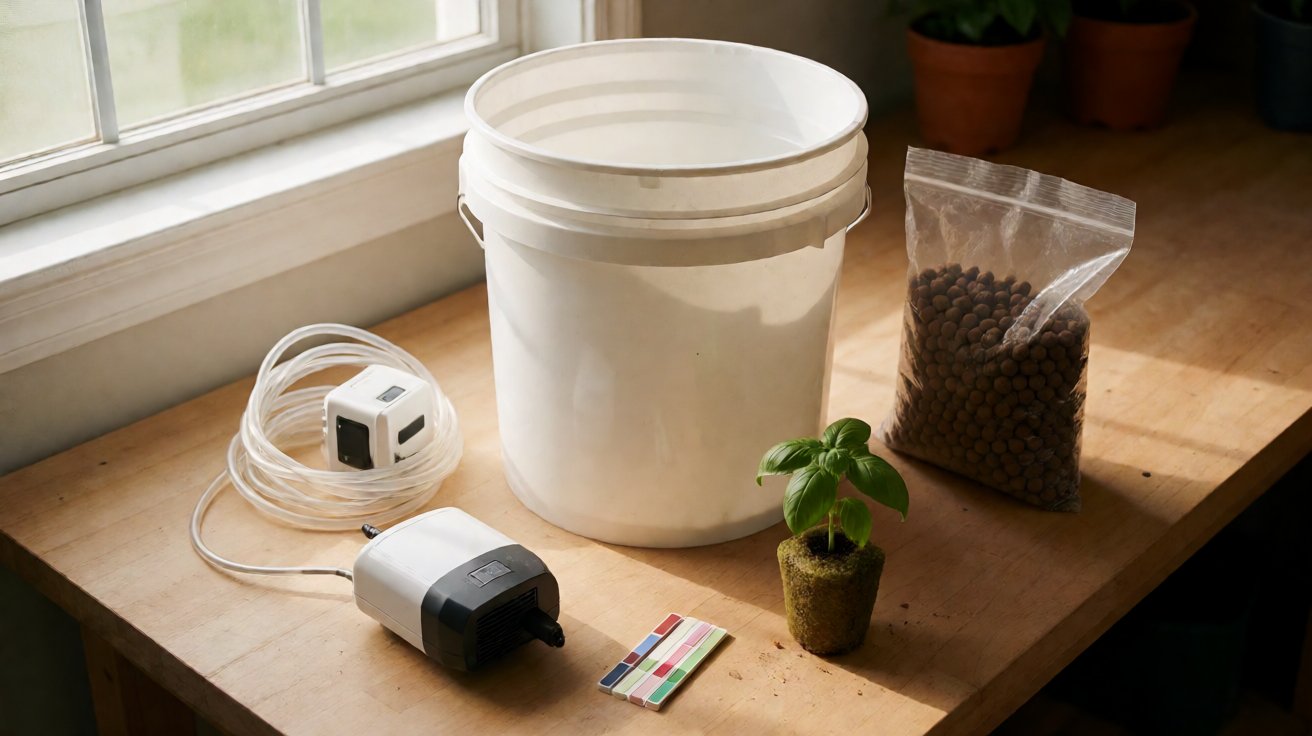
A pepper will run in Dutch bucket, drip, or ebb and flow, and struggle in a small deep water culture bucket with a single plant. If you are still choosing hardware, the hydroponic systems explained hub compares all seven types against what you are growing, and how to choose a hydroponic system works through the decision by space and budget. The short version: more root space than you think you need, and a reservoir you can hold steady.
- Root space: peppers run in Dutch bucket or ebb and flow, rarely NFT
- Light: 20 to 30 mol per square metre per day, 14 to 16 hours on
- Solution strength: 1.8 to 2.4 mS/cm during fruiting
- Air: 70 to 85 F by day, 60 to 70 F at night
- Seed to first fruit: about 100 to 120 days
One thing to settle before you buy seed is how much fruit you actually want. A single pepper plant in a Dutch bucket produces a handful of peppers over a two month harvest window, not a crop. Growers who want volume run four to six plants in a 20 gallon reservoir, and the hydroponic plant spacing guide has the arithmetic.
Starting Pepper Seeds
Pepper seed is slow and stubborn, and the temperature decides almost everything. The extension range is 80 to 85 F for germination, well above what tomato seed wants, and emergence takes 8 to 14 days at that temperature. Below 60 F the seed does not simply slow down, it rots.
This is the most common reason a home pepper crop never starts. A tomato seed that sits cold for three weeks comes up late. A pepper seed that sits cold for three weeks is dead, and you find out at transplant when nothing lifts out of the plug tray. Use a heat mat at 82 F, or a warm closet with a thermostat, and keep it there until you see the first green hook.

The seed-starting numbers that matter
- Germination temperature: 80 to 85 F
- Time to emergence: 8 to 14 days
- Below 60 F: seed viability collapses
- Sowing to transplant: 8 to 10 weeks, at 6 to 8 true leaves
- Seedling light: 16 to 18 hours per day
Once emerged, drop the heat back to 70 to 75 F and give the seedlings 16 to 18 hours of light. Sixteen hours is the standard because seedlings are stretching for light, not fruiting. Peppers are notoriously leggy as seedlings, and a stretched transplant stays leggy for life, so it never carries enough leaf area to fill fruit.
One nuance if you buy treated seed. Many commercial pepper seeds are sold heat-treated to kill seedborne viruses, and that treatment also drives the germination threshold up. If your seed takes three weeks and nothing, it is temperature, not a dead lot.
Transplanting Into the System
Do not rush the transplant. A pepper plant that enters the reservoir with four leaves has too little root to feed the top, and it will sit for two or three weeks looking pale while the root system catches up.
Spacing follows greenhouse practice scaled down. Bell pepper trials place plants 30 by 60 cm, with 50 cm between plants as the optimum, at densities near 16,000 plants per hectare. Home Dutch buckets hold one plant each, so the translation is one plant per 8 to 10 litres of reservoir, and a 20 gallon reservoir supports four to six mature plants. Closer than that and the canopy goes humid, which costs you fruit through the calcium mechanism below.
Give the plant a full root zone from the start. The rockwool versus coco coir versus clay pebbles comparison covers the three media that work in a Dutch bucket, and a pepper tolerates all of them as long as the medium stays evenly wet and never air-dries at the top. If you are still building the system, types of hydroponic systems shows the physical differences that matter for a root this large.
Setting EC and pH for Each Growth Stage
Here is the part that gets skipped, and skipping it is why home peppers stall. A pepper wants a weaker solution while it builds root and leaf, then a stronger one when it sets fruit, because strength drives flower retention and fruit fill. The band that works is 1.8 to 2.4 mS/cm during fruiting. Below 1.6 mS/cm the plant stays vegetative and drops blossoms. Above 2.6 mS/cm the leaf tips burn and calcium uptake locks out, which shows as blossom end rot on the first fruit truss. The full weekly rhythm is in the hydroponic nutrient schedule.
| Growth stage | EC (mS/cm) | pH | What changes |
|---|---|---|---|
| Post-transplant, weeks 1 to 3 | 1.2 to 1.6 | 5.8 to 6.0 | Weak solution while the root establishes |
| Vegetative, weeks 4 to 8 | 1.6 to 1.8 | 5.8 to 6.2 | Building leaf area for flowering |
| Flowering and fruit set | 1.8 to 2.2 | 5.8 to 6.3 | Higher strength holds blossoms on the plant |
| Fruit fill and ripening | 2.2 to 2.4 | 6.0 to 6.3 | Peak demand as fruit expands |
Commercial greenhouse numbers run higher than home numbers, and that is not a contradiction. A published sweet pepper trial in a hydroponic greenhouse found best growth at 2.9 dS/m, and another bell pepper trial put the optimum at 2.4 dS/m. Those systems run top-grade fertilizer, commercial lighting and a controlled climate. A home system with a shelf lamp is a different machine, and the home band sits lower because the light and the buffer capacity are lower.
Here is the counterintuitive part. Raising EC does not make a pepper plant grow more. It makes the plant work harder for the same water, and the water harder to pull. Strength sets the osmotic cost of a drink of water, not the plant’s carbon budget. A pepper at 2.4 mS/cm under a weak lamp will not out-perform one at 1.8 mS/cm under a strong one, because the carbon that turns into fruit comes from light, not the feed. If plants look stalled, raise the light before the EC.
On pH, hold 5.8 to 6.3 for peppers and check it every day. Pepper roots take up iron most readily around 6.0, and a solution drifting above 6.5 locks out iron first, showing up as yellowing between the veins on new leaves while old leaves stay green. The hydroponic reservoir maintenance page covers the daily correction routine, and the crop bands are in the reservoir water temperature by crop matrix.
Light Is the Ceiling Nobody Plans For
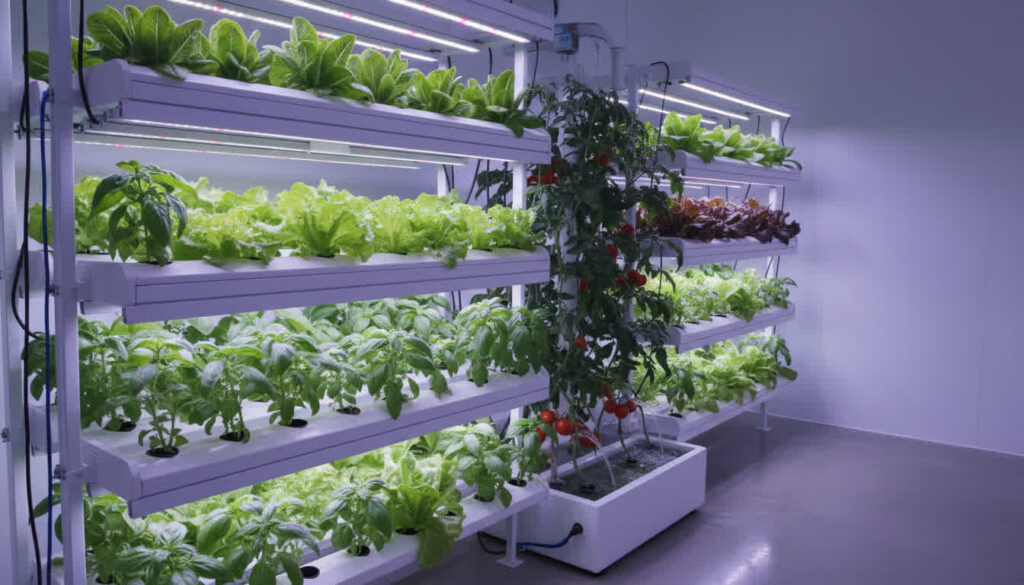
For a fruiting crop, light is not one setting among several, it is the ceiling on everything else. Fruiting vegetables under protection are held at 15 to 30 mol per square metre per day, and greenhouse tomato and bell pepper programs target 20 to 30 mol. Seedling bell pepper in an indoor vertical farm performed best at 39.6 mol, which shows how far commercial growers push it when the light is uniform.
DLI is daily light integral, and it is arithmetic rather than a setting you buy: photosynthetic photon flux density multiplied by photoperiod, converted to moles. So 400 micromol per square metre per second over 16 hours gives roughly 23 mol, and 300 over 16 hours gives about 17. That second number is where most home growers land, roughly a third short of what the crop wants.
- PPFD 400 micromol per square metre per second, 16 hours: about 23 mol per day
- PPFD 300, 16 hours: about 17 mol per day
- PPFD 250, 14 hours: about 12 mol per day
- Greenhouse bell pepper target: 20 to 30 mol per day
The consequence of undershooting light is not a leggy plant. It is a plant that flowers normally, holds blossoms normally, then fails to pull fruit, because the carbon a fruit needs has to come from somewhere and there was not enough of it. This is the EC point above seen from the other side, and it is why lighting and feeding must be set together.
A second lever is photoperiod, and for peppers it is not a free choice. Moving from 16 hours to 24 hours does not buy more fruit, because the plant still runs on carbon it captured by day. Peppers also want a real night: steady 24 hour light pushes the plant toward vegetative growth, and the flower development that leads to fruit set needs the night drop. The hydroponic farming guide covers where a 16 hour day sits.
Two Temperature Levers, Not One
Most guides talk about temperature as one number. A pepper needs two, and they fail independently: air temperature sets the pace of the plant, reservoir temperature sets the pace of the roots, where nutrient uptake happens.
Air temperature
70 to 85 F by day, 60 to 70 F at night. Peppers will hold at 55 F for a while without dying and resume when it warms, but they will not set fruit while cold, because the flower development that becomes fruit set happens in the warm part of the cycle. A room that is warm by day and cold at night because the heat goes off at bedtime grows good leaves and no fruit.
Reservoir temperature
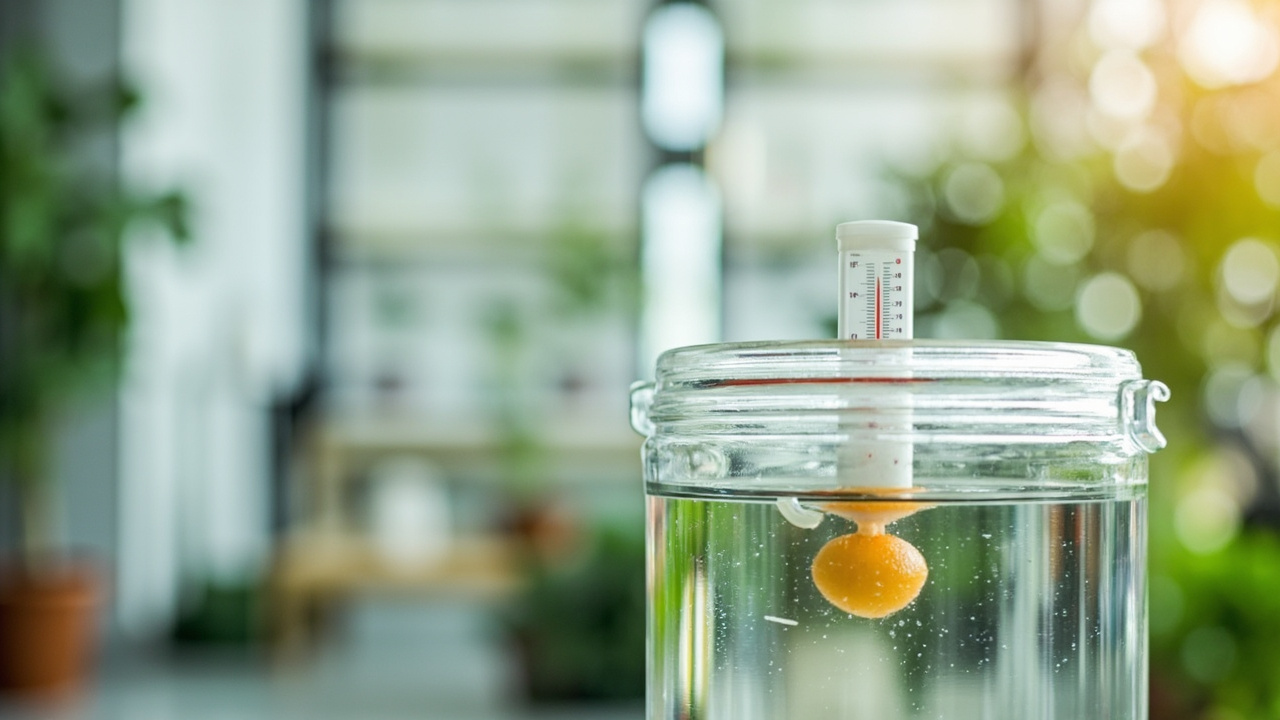
65 to 75 F, optimum at 70 to 74 F. Below 60 F root metabolism slows, and phosphorus uptake drops first, followed by nitrogen, potassium and calcium, so the plant stops putting on new growth without dying. Above 78 F you enter the range where blossom end rot starts showing on the first fruit. Peppers tolerate the warm edge slightly better than tomatoes but punish cold snaps harder.
These two levers fight each other in a closed loop, which is the detail most home systems get wrong. A recirculating system in a 72 F room typically holds solution 3 to 8 F above room temperature, because the pump and reservoir absorb heat all day. Add a chiller and you have solved the summer problem, but only if you also check the night, when the room drops and the reservoir drops with it. A reservoir swinging 10 F overnight gives you the cold stall in the morning and the warm problem in the afternoon, and the plant responds to the average of the two rather than to either one.
Why Pepper Flowers Drop
Two things cause a pepper flower to fall. One is pollination, which you can fix by hand in five minutes. The other is calcium reaching the fruit, which you cannot fix by adding calcium.
When the flower was never fertilised
Pepper flowers are self-fertile, so the pollen is already there, but it still has to be moved. In a greenhouse, bumblebees do that work, and a published study of greenhouse pepper found bumblebee pollination raised the share of fertilised ovules from 27.5% to 49.8%. At home you have no bees, so you supply the vibration yourself, using the same technique as tomatoes: a gentle tap, an electric toothbrush on the flower stalk, or a small paintbrush. The full method is in the hydroponic tomato pollination guide.
Here is what happens if you skip it, with the timeline. An unpollinated pepper flower drops within 7 to 10 days. You do not notice on day seven, because the plant still looks perfect. The cost surfaces later, between 70 and 85 days after transplanting, when you reach for fruit that is never going to exist. A grower who skipped hand pollination in weeks 9 to 12 of a pepper plant loses the entire first crop, and usually never diagnoses it, because the plant looks healthy the whole time.
When the fruit started and the calcium never arrived
This is blossom end rot, and the mechanism runs against intuition. The cause is not a shortage of calcium in the solution, it is a failure to deliver the calcium that is already there. Calcium moves in the water stream, and the water stream is driven by transpiration. Leaves transpire far more than a developing fruit does, so the plant pulls calcium into the canopy first and the fruit gets what is left over.
So the things that cause a sunken, dark, leathery patch on the bottom of a fruit are the things that suppress transpiration: still air, high humidity, an inconsistent root zone. Extension guidance agrees, that air movement and steady root moisture matter more than the calcium concentration in the feed. Grow peppers in a closed, humid closet with no fan and you get blossom end rot even at a measured 2.0 mS/cm and a generous calcium level, because the calcium is in the solution and never leaves the leaf.
The fix is unglamorous. Run a fan across the canopy, keep the reservoir temperature steady, and do not let the root zone swing wet and dry. A pepper in a room with moving air and a stable reservoir will set and fill fruit at the same calcium concentration as one in a humid box that never does.
The Numbers That Decide a Pepper Harvest
If you keep one page in the room with the plant, make it this one. Every number below is a decision point, and each has a failure mode that shows up weeks later.
- Seed germination at 80 to 85 F, emerging in 8 to 14 days
- Transplant at 6 to 8 true leaves, 8 to 10 weeks after sowing
- EC 1.8 to 2.4 mS/cm once flowering, pH 5.8 to 6.3
- Light at 20 to 30 mol per square metre per day, 14 to 16 hours
- Air at 70 to 85 F by day, 60 to 70 F at night
- Reservoir at 65 to 75 F, optimum 70 to 74 F
- Hand pollination every 2 to 3 days through flowering
- Fan running across the canopy, always
- First fruit 70 to 85 days after transplanting, 100 to 120 days from seed
- Four to six plants per 20 gallon reservoir
The honest summary is that a hydroponic pepper is a two to four month commitment, not a weekend project, and the crop rewards hitting the same six numbers consistently rather than any one clever fix. Peppers are also the most satisfying plant in this group to grow indoors for one reason: when a flower sets, you can watch a real fruit form and ripen on a plant that never touched soil.
Last reviewed on November 15, 2026.
Sources and further reading
Every number on this page traces back to one of these sources, which are listed here in plain text rather than as links:
- Clemson Cooperative Extension, home pepper growing factsheet and starting seeds indoors guide (Extension)
- University of Maryland Extension, peppers production guide for the home garden (Extension)
- Utah State University Extension, vegetable crop germination and transplant guidance (Extension)
- Mississippi State University Extension, greenhouse production of tomato and pepper (Extension)
- University of Tennessee Extension, hydroponic crop nutrient and environmental guidance (Extension)
- University of Wisconsin-Madison Extension, blossom end rot physiology in fruiting vegetables (Extension)
- Virginia Cooperative Extension, greenhouse vegetable calcium transport and air movement guidance (Extension)
- Peer-reviewed hydroponic bell pepper EC, spacing and DLI trials published in Acta Scientiarum and Horticulturae (peer-reviewed paper)
- Peer-reviewed greenhouse pepper pollination study on fertilised ovule rates with and without bumblebees (peer-reviewed paper)