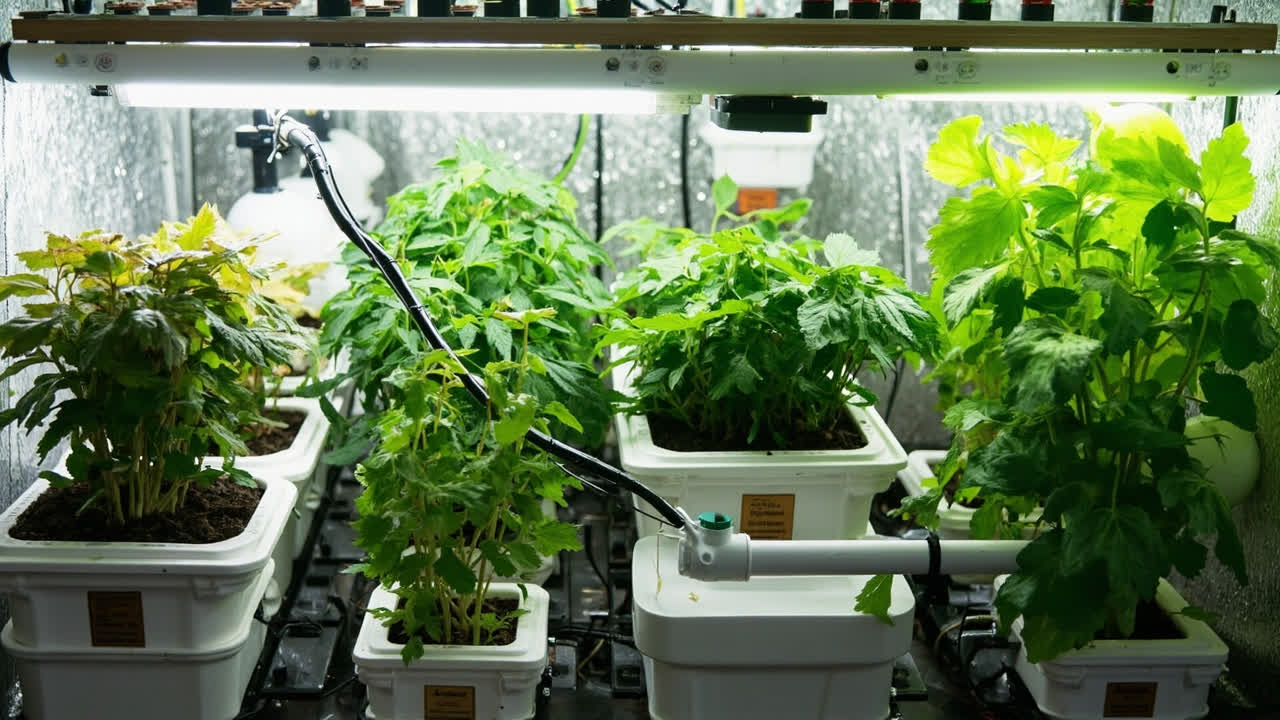

Choosing the right hydroponic system is less about finding the “best” technology and more about matching your space, budget, and how much hands-on time you can give it weekly. Five main system types dominate the market: deep water culture (DWC), nutrient film technique (NFT), ebb and flow, drip systems, and aeroponics. Each converts water and nutrients into plant growth in fundamentally different ways — and each comes with specific failure modes that the marketing rarely mentions.
Most buyers choose wrong because they optimize for price or impressiveness rather than fit. A system that looks advanced on paper but demands more attention than your schedule allows will fail — not because it’s bad technology, but because it’s the wrong system for that particular person. The decision logic is simpler than the product descriptions suggest.
Why Most Hydroponic Buyers Choose the Wrong System
The most common mistake is treating all hydroponic systems as roughly equivalent variations on the same idea. They are not. DWC works by suspending roots directly in oxygenated nutrient solution — the reservoir is the growing space. NFT works by running a thin film of nutrient solution over roots in angled channels — roots spend most of their time in air, with only a shallow flow passing underneath. These are fundamentally different mechanical relationships, and they create fundamentally different maintenance demands.
A DWC system fails when the reservoir runs warm and oxygen levels drop — roots suffocate even if the pump is running. An NFT system fails when the pump misses a cycle — roots dry out in hours, not days. The failure modes are specific and different, which means the prevention strategies are also different. Choosing based on features or price ignores this completely.
The three questions that actually determine which system is right for you:
- Space: How much floor area and ceiling height do you have? NFT systems need horizontal run space for channels. DWC needs depth for the reservoir. Aeroponics needs height for the spray chamber.
- Budget: Not just the upfront cost — what does nutrient solution cost per month at your intended scale? What is the replacement cost for the pump, timer, and other components?
- Time and attention: Some systems need daily checks. Others can run for a week with minimal intervention. Honest self-assessment here prevents most failures.
The Four Decisions That Determine Which System Is Right for You
Before looking at specific systems, lock these four dimensions. They filter out options faster than any feature comparison.
Space. A system that fits in a 2×2-foot corner is not the same as one that needs 4 feet of horizontal run. Measure your actual space, then check system dimensions — not the marketing photo that shows the system in an empty warehouse.
Budget. DWC and NFT cost less to start ($100–$300 for a small hobby setup). Aeroponics starts at $400–$800 and goes up quickly. Beyond the initial cost, factor in monthly nutrient solution (drip systems use more than DWC) and electricity (HID lights and large pumps add up).
Time. DWC and NFT can run reliably with one check every 2–3 days if the reservoir is sized correctly. Drip systems need more frequent monitoring because emitters clog. Aeroponics needs daily attention — nozzles clog and roots dry fast.
Crop goal. Leafy greens (lettuce, basil, spinach) grow well in DWC and NFT. Fruiting crops (tomatoes, peppers, cucumbers) need more root space and typically perform better in ebb and flow or larger DWC setups. Root vegetables do not work in NFT — the channels do not provide enough depth or medium.
Deep Water Culture (DWC) : Best for Beginners Who Want Low-Maintenance
DWC suspends plants in a net pot with roots hanging directly into a reservoir of oxygenated nutrient solution. An air stone keeps the water moving and oxygenated. The simplicity is the point: no timers, no drip lines, no moving parts beyond the air pump.
Best for: 1–6 plants, small spaces, beginners who want to learn hydroponics without managing multiple system components. Lettuce, basil, and herbs perform reliably in DWC at hobby scale.
The trade-off nobody mentions: Reservoir temperature management is critical in warm weather. Water above 72°F holds less dissolved oxygen, and roots in warm, low-oxygen water develop root hypoxia — the plant looks fine for a few days, then collapses rapidly. In summer or in warm rooms, a DWC reservoir may need a chiller to stay in the safe range. This is a cost most beginners don’t budget for.
Who should skip DWC: if you want to grow more than 8 plants continuously, if your grow space runs warm in summer, or if you want a true continuous-harvest system — DWC works well but requires batch harvesting.
One practical tip that most guides skip: start with a reservoir that’s slightly larger than you think you need. A 5-gallon reservoir for a single tomato plant works. A 5-gallon reservoir for four tomato plants runs dry and goes nutrient-imbalanced in two days. Size the reservoir to your plant count, not the other way around.

Nutrient Film Technique (NFT) : Best for Leafy Greens in Compact Spaces
NFT runs a thin film of nutrient solution down angled channels — roots sit in the channel but are mostly exposed to air, with the film flowing underneath. The angle keeps the solution moving and the roots partly aerated. The result is a system that grows lettuce and basil densely in a relatively small footprint.
Best for: Lettuce, spinach, basil, and other leafy crops in a tight floor plan. NFT channels can be stacked or arranged in long rows. If floor space is your constraint, NFT is the most space-efficient design at hobby scale.
The critical trade-off: Pump failure equals total crop loss. If the pump stops for more than 2–4 hours in warm conditions, roots in NFT channels dry and die faster than in any other system type. This is not a rare edge case — pump timers fail, power outages happen, and an NFT garden without a backup battery on the pump timer will not survive a night without power. If you run NFT, a battery-backup timer is nearly mandatory, not optional.
Who should skip NFT: anyone growing root vegetables (carrots, radishes, beets need more medium depth), anyone in hot climates without climate-controlled grow spaces, or anyone who cannot reliably check or backup the pump timer.
Ebb and Flow : Best for Growers Who Want Flexibility
Ebb and flow floods the growing tray with nutrient solution on a timer, then drains it back into the reservoir. The plant roots sit in the tray medium during the flood, then air-fill during the drain cycle. The design allows for more flexibility in growing media and plant size than DWC or NFT.
Best for: Gardeners who want to experiment with different crops and growing media — clay pebbles, rockwool, and coco coir all work in ebb and flow. It’s also the best hobby-scale system for fruiting crops like peppers and small cucumbers because the tray provides more root space than NFT channels.
The trade-off: Two failure points — the timer and the pump. If the timer fails in the “flood” position, the tray overflows. If the pump fails during a flood cycle, the roots dry out during the next dry period. A battery-backup timer handles the timer failure case. But if the pump fails outright, you need to catch it before the next scheduled flood — or the plants miss that feeding cycle.
Most ebb and flow setups also need occasional recalibration of the flood schedule as plants grow larger and drink more. What worked in week 3 may be too much or too little by week 7.
Drip Systems : Best for Scaling Up
A drip system delivers nutrient solution slowly onto the growing medium from above, with excess draining back to the reservoir. The slow delivery allows for precise control of feeding, and the drippers can be individually placed at each plant’s base — making it the most scalable option for larger grows with multiple plants.
Best for: Larger grows, multiple plants, greenhouse setups, anyone planning to scale beyond 10 plants. Drip systems can be expanded by adding more lines; they don’t require the system-wide redesign that DWC or NFT might need when adding capacity.
The trade-off: More parts means more potential failure points. Drip emitters especially are prone to clogging — nutrient solution concentrates as water evaporates in the lines, and crystallized salts block the small openings. Regular flushing of the lines and checking of emitters is required maintenance that DWC and NFT don’t demand. A clogged emitter looks fine from outside; by the time you notice the plant wilting, the damage is done.
For this reason, drip systems at hobby scale are actually more complex to maintain than they appear in the marketing. They work well when managed consistently, but they add a monitoring burden that most first-time buyers underestimate.
Aeroponics : Best for Maximum Oxygen and Fast Growth
Aeroponics keeps roots suspended in air inside a closed chamber, misted with nutrient solution at short intervals — typically every few minutes. The high-oxygen environment accelerates root development and nutrient uptake compared to any other system. The growth rates are genuinely impressive when the system runs correctly.
Best for: Advanced growers, indoor labs, high-value crop production. If you are growing at a commercial scale or have specific research-level needs, aeroponics delivers results no other system matches in controlled environments.
The honest trade-off: Highest cost, highest complexity, and the most unforgiving failure mode. The misting nozzles have very small openings. Even a brief clog — a few minutes of no misting in a warm room — can kill roots. Root tissue in aeroponic chambers is exposed and has no buffer moisture the way DWC or NFT roots do. If nozzles clog and the system runs dry for 30 minutes on a warm day, the crop can be lost before you notice the problem.
Aeroponics also requires consistent backup power and regular nozzle maintenance that other systems do not. For a first hydroponic setup, the learning curve is steep and the cost of mistakes is high.
Who should skip it: beginners, anyone without a backup power solution, anyone not willing to do daily nozzle checks.
Your Quick Decision Guide : Which System Should You Actually Buy
The decision tree is shorter than the product descriptions suggest. Answer these four questions and the right system usually becomes clear:
- Space <4 sq ft, simple setup preferred? → DWC, single reservoir, air stone. Lowest barrier to entry.
- Floor space limited but ceiling height available, growing leafy greens? → NFT. Most space-efficient for lettuce and basil.
- Want to grow multiple crop types, experiment with media? → Ebb and flow. Most flexible hobby system.
- Planning to scale beyond 10 plants, greenhouse setup? → Drip system. Most scalable.
- Advanced, want maximum growth rate, have backup power and daily attention? → Aeroponics.
No system is objectively superior. The right system is the one that fits your actual space, your actual schedule, and your actual crop goals. A DWC system maintained consistently will outperform an aeroponic system that gets checked twice a week. Start small, learn the system, prove it works for you — then scale up once the first run is done.
From Bank Statement to QuickBooks-Ready File
That manual cleanup you just read about? This tool skips it. Turn your PDF into QBO for QuickBooks without storing your data anywhere.
Start Converting