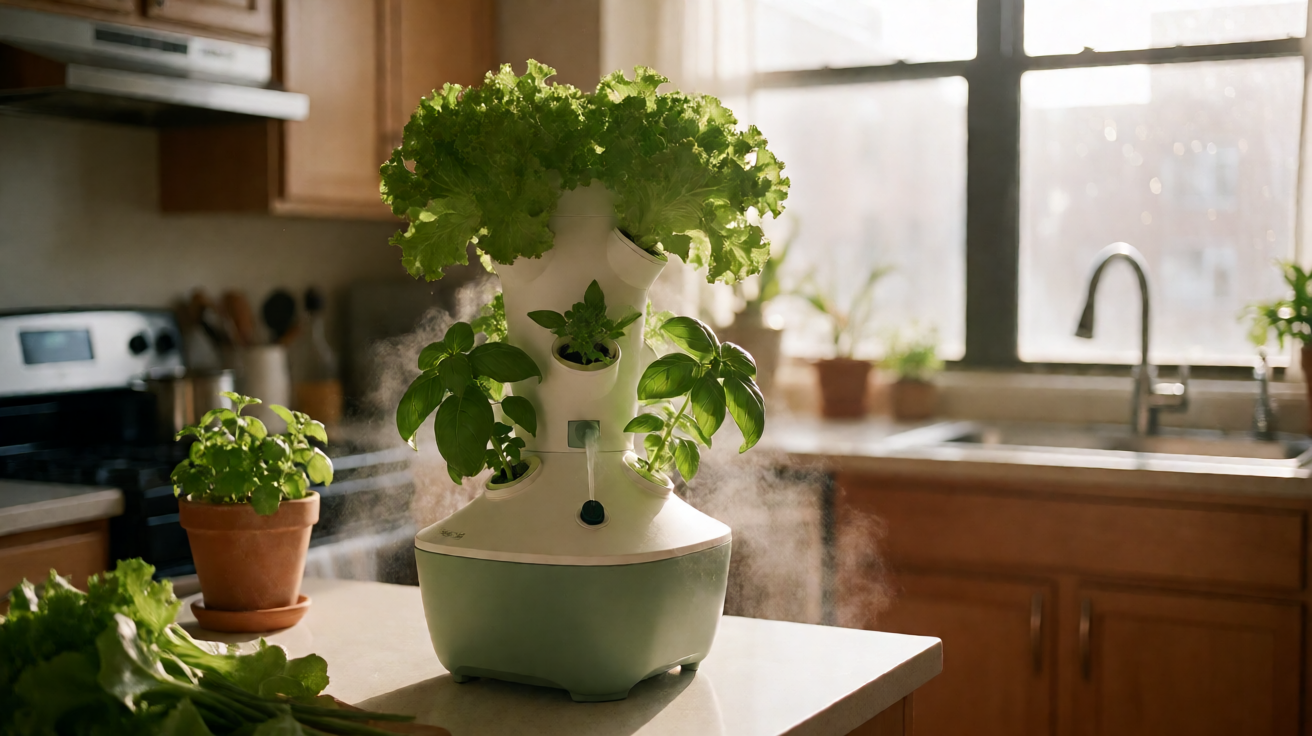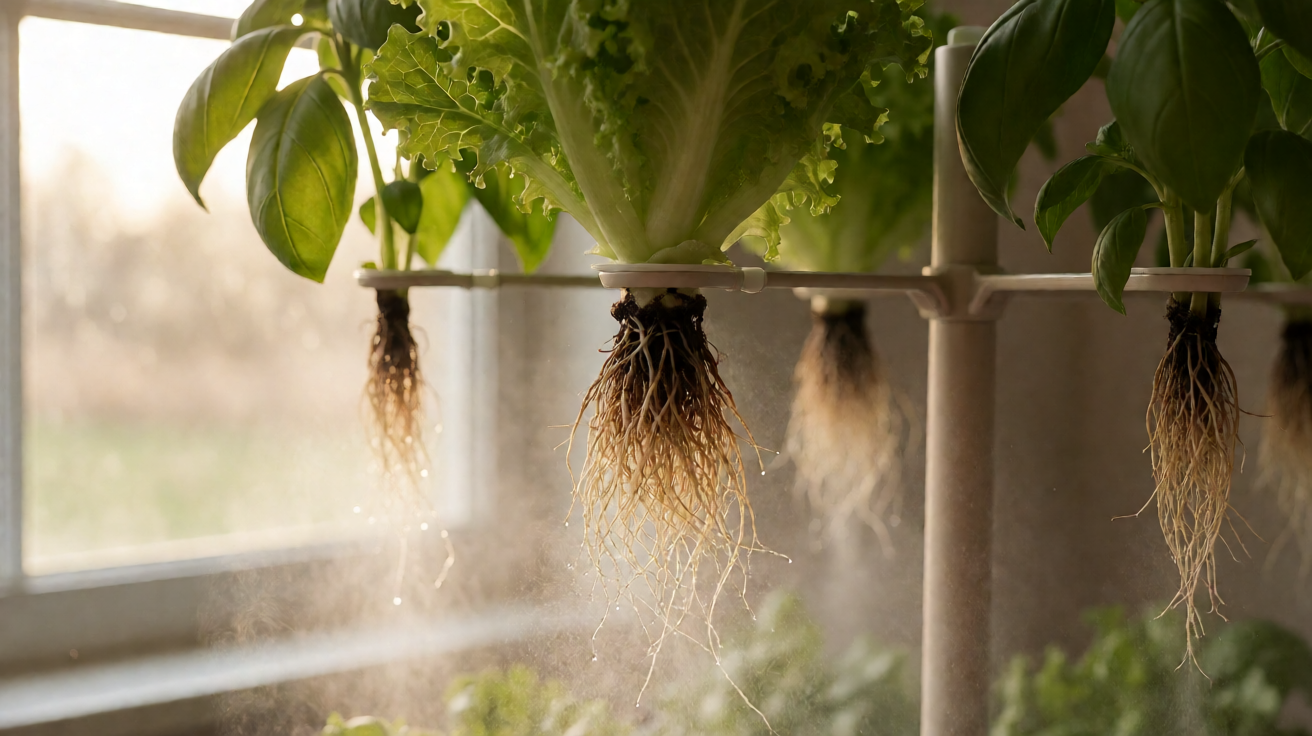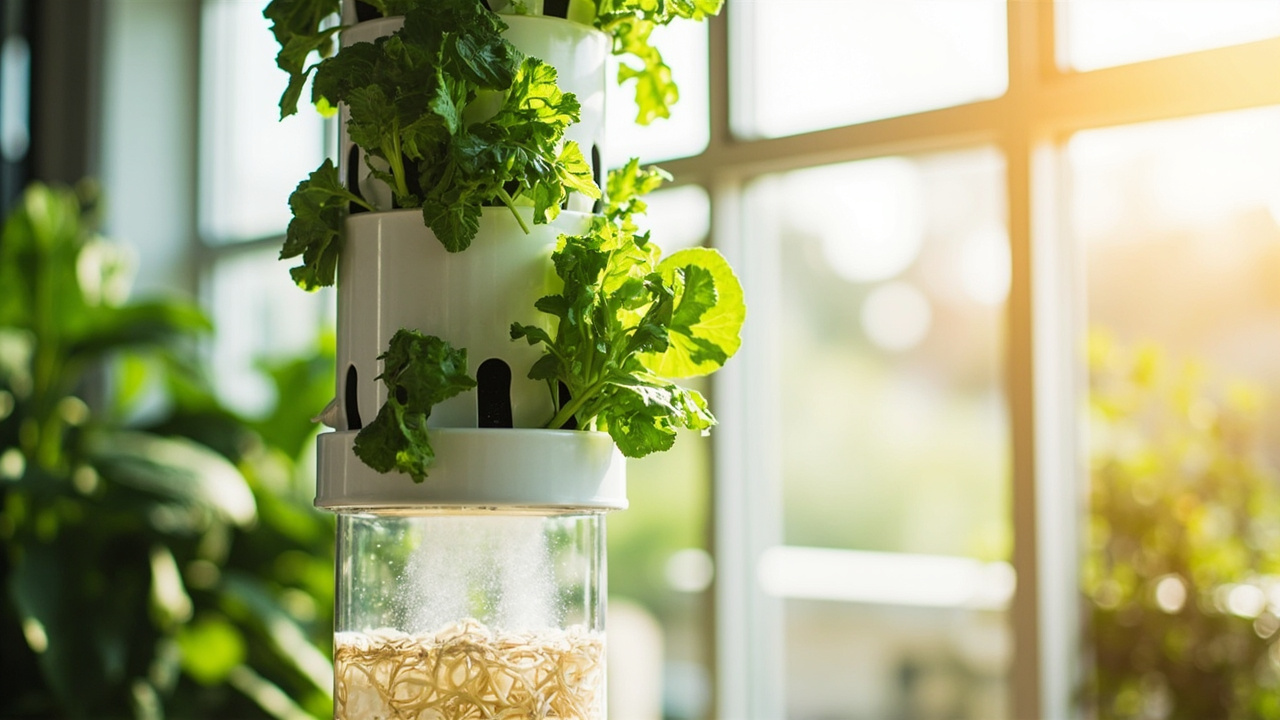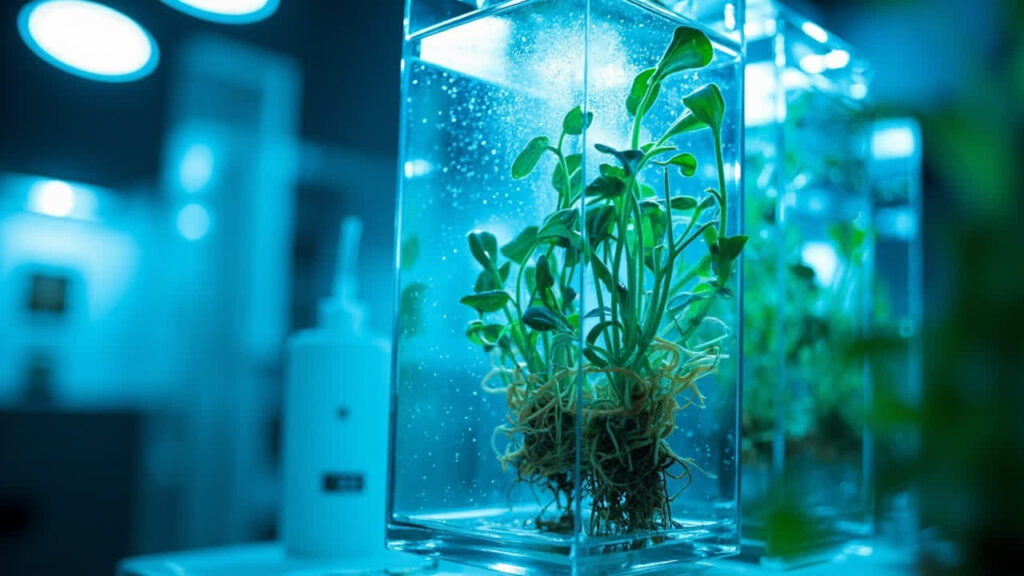

An aeroponics system produces roughly three times the yield of soil-based growing in the same space. That is the headline number behind every claim you have probably seen about this method. An aeroponics system delivers water and nutrients directly to roots as a fine mist, keeping them suspended in air. This means roots get more oxygen than they ever could in soil or standing water, and that extra oxygen is what drives the growth gap.
If you have been comparing growing methods, you have probably run into claims that sound exaggerated — water savings up to 90%, growth rates doubled. Some of them are overstated. But the core mechanisms are real, and understanding them means you can evaluate aeroponics honestly instead of trusting marketing language.
This article walks through exactly how an aeroponics system works, why it outperforms soil and other hydroponic methods on specific attributes, and where it falls short. By the end you will know whether it is the right choice for your setup.
Why Soil and Standard Hydroponics Hit a Ceiling
Soil has served growers for millennia, but it comes with built-in constraints that modern hydroponic methods can eliminate. In soil, roots spend energy pushing through particles to access water and nutrients. That process requires energy the plant could otherwise spend growing. Overwatering compounds the problem — saturated soil displaces the air pockets roots need for respiration, a condition called root hypoxia. Once hypoxia sets in, root function declines and the plant shows it in slower growth and yellowing leaves.
Standard hydroponic methods improve on soil in some ways. deep water culture hydroponics suspends roots directly in oxygenated nutrient solution, eliminating soil-based pathogens and giving roots constant access to water and nutrients. But DWC still submerges roots continuously. The roots get oxygen from the bubbled air stone, but the submerged surface area cannot match the exposure available in air. If the air pump fails for more than a few hours, roots begin suffocating in the stagnant solution.
Aeroponics sidesteps both problems entirely. Roots hang in air and receive nutrient solution as a periodic fine mist. The mist interval — typically every few seconds to every few minutes depending on the system — keeps roots moist but never saturated. The result is root-zone oxygen levels that soil and DWC simply cannot match.
How Aeroponics Delivers More Oxygen to Roots
The mechanism is straightforward and it is what makes aeroponics fundamentally different from every other growing method. In an aeroponics system, roots hang in air and receive nutrients through misting frequency — short bursts of fine nutrient mist that coat the exposed root surface. In a deep water culture hydroponics system, roots sit in water continuously, and the submerged surface area cannot match the oxygen exposure that air-based misting provides.
Root cells need oxygen just like leaf cells do. They absorb dissolved oxygen from the moisture film that clings to root hairs after a misting cycle. Because the root surface is exposed to air between mister pulses, oxygen diffuses continuously from the atmosphere into that moisture film. In DWC, oxygen must travel from the air stone through the water column before reaching the root surface. In aeroponics, the limiting step is eliminated — oxygen is available at the root surface immediately from the air.
This difference in root exposure duration between aeroponics and submersion methods is the core mechanical advantage. Plants in aeroponics systems show measurably higher oxygen availability at the root zone, which translates directly into faster metabolic activity.
Water Efficiency: Aeroponics Uses Up to 90% Less Water
Research on aeroponics consistently shows water usage roughly 90% lower than conventional soil-based growing for the same crop output. The mechanism is simple: aeroponics recirculates nutrient solution in a closed loop, misting roots with precise volumes rather than flooding a medium. Unused mist falls back into the reservoir and is recirculated.
Soil growing loses water through evaporation from the surface and drainage through the bottom. Drip systems to soil reduce this waste but still deliver water to a medium where the plant uses only a fraction. Aeroponics delivers nutrient solution directly to the root surface in the exact amount the root can absorb during each misting cycle. Excess drains back and the system recycles it.
For home gardeners growing in apartments or areas with water restrictions, this efficiency matters. A single aeroponics tower can produce the same lettuce yield as a soil bed using roughly one-tenth the water. On a balcony or indoor shelf where water access is limited, that difference is practical, not just theoretical.
The best hydroponic systems for home gardeners guide covers how water efficiency compares across all major hydroponic methods in more detail.
Faster Growth Rates: The Oxygen-Carbon Relationship
The faster growth in aeroponics is directly tied to the oxygen advantage, and the causal chain is worth understanding. Roots absorb nutrients actively — the process requires energy in the form of ATP. ATP production in root cells depends on aerobic respiration, which requires a constant supply of oxygen. When roots have more oxygen available, they produce more ATP, which fuels more active nutrient uptake.
More oxygen at the root zone also affects the oxygen-carbon relationship in the plant as a whole. Improved root respiration supports stronger leaf function, which increases photosynthesis capacity. The plant is not just growing faster because it has more water — it is growing faster because its entire metabolic engine is running more efficiently.
Studies comparing aeroponics to DWC and soil consistently show shorter vegetative cycles and higher biomass accumulation per day in aeroponics. In practical terms, a lettuce head that takes 60 days in soil might reach harvest size in 30 to 35 days in an aeroponics system running at proper misting intervals.
Growth rate comparisons between aeroponics and deep water culture hydroponics are covered in more detail in the DWC article, including the specific parameters that affect the difference.
Eliminating Soil-Borne Diseases Without Chemicals
One of the most practical advantages of aeroponics for home growers is the elimination of soil-borne diseases. Soil harbors fungi — Pythium, Fusarium — and bacteria that attack roots. These pathogens survive in the soil medium for months or years and reinfect plants season after season. Once root rot from Pythium takes hold in soil, there is no easy fix without chemical treatments.
Aeroponics eliminates soil entirely. Without soil, there is no medium for soil-borne pathogens to survive. Roots that are healthy and exposed to air mist are far less vulnerable to the water mold infections that devastate DWC and soil systems. The fine mist itself is typically generated by high-pressure pumps that produce droplets too small to sustain fungal growth in the reservoir.
The practical result for home gardeners is disease management without pesticides or fungicides. This matters especially for edible crops grown indoors or on balconies where food safety and family exposure to chemicals are concerns. The aeroponics environment is sterile by definition — no soil means no soil-borne diseases. Growers who have lost entire soil gardens to Pythium root rot understand this advantage immediately.
Higher Nutrient Absorption and Maximum Yield
Nutrient absorption efficiency in aeroponics exceeds what soil and most other hydroponic methods can achieve. The fine mist creates maximum surface area contact with root hairs. A root suspended in air coated with nutrient mist has a surface area utilization approaching 100%. In DWC, roots are partially submerged — the portion facing away from the oxygenated water column absorbs fewer nutrients.
The nutrient delivery efficiency in aeroponics also allows more precise control over what nutrients the plant receives and when. Because the solution is recirculated and misted in short cycles, growers can adjust nutrient concentration and composition between misting intervals without overhauling an entire reservoir. This fine-tuning supports higher crop yields per liter of nutrient solution than any submersion method.
Yield data across multiple crop types consistently shows aeroponics producing more grams of harvest per square foot per year compared to DWC, NFT, and soil. For home gardeners with limited space — a single shelf or a small balcony corner — that yield-per-area advantage is significant. Growing lettuce, herbs, or leafy greens in an aeroponics tower rather than a soil bed of equal footprint can triple the harvest.
The Honest Trade-offs: What Aeroponics Cannot Do
Aeroponics has real limitations and this article would be incomplete without naming them directly. The method requires active management in ways that DWC and soil do not.
Electricity dependency is the most critical. If the mister pump fails and you do not notice within a few hours in a warm environment, roots begin drying. Unlike DWC where the reservoir holds enough water for a day or two, an aeroponics system can lose its entire root moisture film within hours if misting stops. A backup battery or manual misting backup plan is essential for anyone growing with aeroponics.
Nozzle maintenance is required regularly. The fine misting nozzles — typically 0.5mm to 0.7mm orifice — are susceptible to mineral buildup from hard water or concentrated nutrient solutions. Without periodic cleaning, nozzles clog and produce uneven misting or complete blockage. In a DWC system, a clogged air stone affects oxygenation but the plant survives. In aeroponics, a clogged nozzle can starve an entire plant of nutrients within days.
Higher upfront cost is the third major trade-off. A basic DWC bucket setup can cost under 50 dollars. A comparably sized aeroponics tower with a reliable mister pump, reservoir, and timers typically runs 150 to 300 dollars or more. The cost is justified by higher yields and faster cycles for some growers, but not all.
The best hydroponic systems for home gardeners article covers these trade-offs in the context of choosing the right system for your budget and skill level.
Aeroponics vs Deep Water Culture: Side by Side
The table below summarizes the key differences between aeroponics and deep water culture hydroponics across the attributes that matter most for home growers.
| Attribute | Aeroponics | Deep Water Culture |
|---|---|---|
| Root environment | Air, misted periodically | Water, oxygenated by air stone |
| Water efficiency | Up to 90% less than soil | Moderate — recirculated but larger volumes |
| Growth rate | Fastest of all hydroponic methods | Fast, but slower than aeroponics |
| Disease risk | Minimal soil-borne disease | Pythium root rot if oxygen drops |
| Maintenance | Regular nozzle cleaning | Weekly reservoir change, air stone check |
| Upfront cost | Higher (150–300 USD+) | Lower (under 50 USD for bucket setup) |
| Electricity dependency | Critical — pump failure = root drying | Moderate — reservoir holds water if pump stops |
Both methods outperform soil for yield and speed. The choice comes down to how much management you want to do, how much space you have, and whether the higher yield potential of aeroponics justifies its higher cost and maintenance requirements for your situation.
Is Aeroponics Right for Your Setup?
The honest answer depends on your specific constraints. Aeroponics works best in three scenarios for home gardeners.
If you are a tinkerer who enjoys system management and fine-tuning, aeroponics gives you more parameters to adjust — misting frequency, nutrient concentration, cycle timing — than any other hydroponic method. You will spend more time with your system but you will also understand it more deeply.
If you are space-limited and need maximum yield per square foot, aeroponics towers are the most productive footprint per liter of output. A 1-square-meter tower can produce the equivalent of 3 square meters of soil beds. For apartment growers and balcony gardeners, that density is decisive.
If you are growing high-value crops — herbs, leafy greens, microgreens — where disease-free production and fast cycles matter economically, aeroponics justifies its cost through higher turnover. The 30-day lettuce cycle versus a 60-day soil cycle means you can harvest twice as many crops per year in the same space.
If you are a beginner looking for a low-maintenance entry point into hydroponics, DWC or a wick system is a better starting point. Those methods forgive pump failures and irregular maintenance schedules in ways that aeroponics does not.
The DIY aeroponic tower garden article covers specific build options and the practical realities of setting up an aeroponics system at home.
Getting Started with Aeroponics: What Comes Next
If the advantages align with your goals, starting with aeroponics is straightforward. The most accessible entry point for home growers is a DIY aeroponic tower garden — a vertical system that uses a central misting column and low-pressure pumps, designed to fit on a balcony or sunny corner indoors.
Before you build or buy, you need one thing in place: a reliable nutrient solution recipe formulated for aeroponics. The concentration and mineral balance matter more in aeroponics than in DWC because the plant receives nutrients directly with minimal buffering from a growing medium. A recipe designed specifically for aeroponics — typically with higher calcium and lower phosphorus than soil formulas — will give you better results from day one.
From there, the learning curve is manageable. Start with one system, one crop — lettuce is forgiving — and learn how the misting schedule affects root health before scaling up. Within two to three cycles you will know whether the maintenance requirements fit your routine.
The aeroponics system you choose does not have to be commercial-grade to deliver real results. A well-built DIY tower with consistent nutrient solution and reliable misting can produce harvests that rival any soil garden in half the time.
Turn any PDF statement into a clean sheet
Skip the typos and the hours of copying. Our converter handles any bank statement format and outputs Excel, CSV, or QBO for QuickBooks. No file retention, free to try.
Convert your statement