
Reading a prayer plant care guide without knowing the basic vocabulary is like following a recipe in a language you do not speak. Terms like nyctinasty, rhizome division, and node requirement appear repeatedly in care instructions, propagation tips, and problem diagnosis articles, but they are rarely defined where you need them. This glossary collects the most important terms into one reference so you can read any prayer plant article with full comprehension and apply the advice confidently. Whether you are troubleshooting brown leaf tips or planning to propagate a new plant, these definitions will help you understand exactly what each care instruction means and why it matters.
The prayer plant, Maranta leuconeura, belongs to the Marantaceae family, which also includes calathea, stromanthe, and goeppertia. Plants in this family share several distinctive characteristics, including the nyctinastic leaf movement that gives them their common name, rhizomatous growth habits, and a preference for warm, humid, shaded environments. Understanding the terminology used to describe these shared traits will help you care for any member of the family, not just your prayer plant specifically.
Growth and Structure Terms
Understanding how a prayer plant grows is the foundation for all care decisions. These terms describe the physical structure of the plant and the methods used to reproduce it, as detailed in our propagating prayer plant guide. The vocabulary here applies to all Maranta species and many related genera, so these definitions will serve you beyond just prayer plant care.
Rhizome division is a propagation method that involves separating the underground stems (rhizomes) of a mature prayer plant into clumps, each with its own roots and growing points. Rhizome division is the most reliable way to propagate Maranta leuconeura, and it works best when done during repotting in spring. Each divided section must have at least one healthy node and a portion of the root system to establish successfully. This method produces mature plants faster than stem cuttings because each division already has an established root system.
Stem cutting involves taking a piece of prayer plant stem that includes at least one node and a few leaves, removing it from the parent plant and placing it in water or moist soil to develop roots. Stem cuttings root more slowly than rhizome divisions but are useful when you want to propagate from a single stem without disturbing the mother plant. Keep the cutting in warm, indirect light and change the water weekly until roots appear, which typically takes 3 to 6 weeks. Stem cuttings are ideal for sharing plants with friends, because a single healthy stem can produce a complete new plant.
Node requirement is the principle that any prayer plant cutting or division must include at least one node, the point on the stem where leaves and roots emerge. A stem segment without a node will not produce new growth, no matter how favorable the conditions. When propagating, always select cuttings that include a visible node, ideally with a small aerial root already forming at that point. The node is the growth engine of the plant, and without it, no new leaves or roots can develop regardless of how perfect the soil or water conditions are.
Leaf and Foliage Terms
The leaves are what make prayer plants recognizable, and the vocabulary used to describe them spans movement, color, and pattern. Understanding these terms helps you diagnose problems, communicate with other growers, and select the right variety for your home. The leaf is the primary organ through which prayer plants express their health, and learning to read leaf signals is one of the most valuable skills a prayer plant owner can develop.
Nyctinasty is the scientific term for the sleep movement of prayer plant leaves, caused by a structure called the pulvinus at the base of each leaf stalk. At dusk, the pulvinus changes turgor pressure and folds the leaves upward. At dawn, the leaves unfold again. This daily rhythm is the defining behavior of the Maranta genus and the reason the plant carries its common name. Nyctinasty is a reliable health indicator, because stressed or severely underwatered plants may fold less dramatically or not at all. A prayer plant that fails to fold at night is sending a clear signal that something in its environment needs attention.
Leaf folding is the visible action of nyctinasty, where prayer plant leaves curl upward and inward during the evening hours. Leaf folding should be smooth and complete in a healthy plant, with the upper surfaces pressed together and the purple undersides hidden from view. Incomplete folding or leaves that remain partially open at night often signals low humidity, inconsistent watering, or inadequate light. Watching your prayer plant fold each evening is one of the most satisfying aspects of owning one, and the completeness of that fold tells you more about the plant’s well-being than any test strip or meter ever could.
Purple underside refers to the rich maroon to deep purple coloration on the reverse side of prayer plant leaves, caused by anthocyanin pigments that protect the photosynthetic tissue from excess light. The intensity of the purple underside varies by cultivar and light conditions, with stronger color appearing under brighter indirect light. A pale or green-tinted underside suggests the plant is not receiving adequate light for optimal pigment development. The purple underside is not merely decorative; it serves a functional role in photoprotection, filtering harmful wavelengths before they reach the delicate chloroplasts beneath.
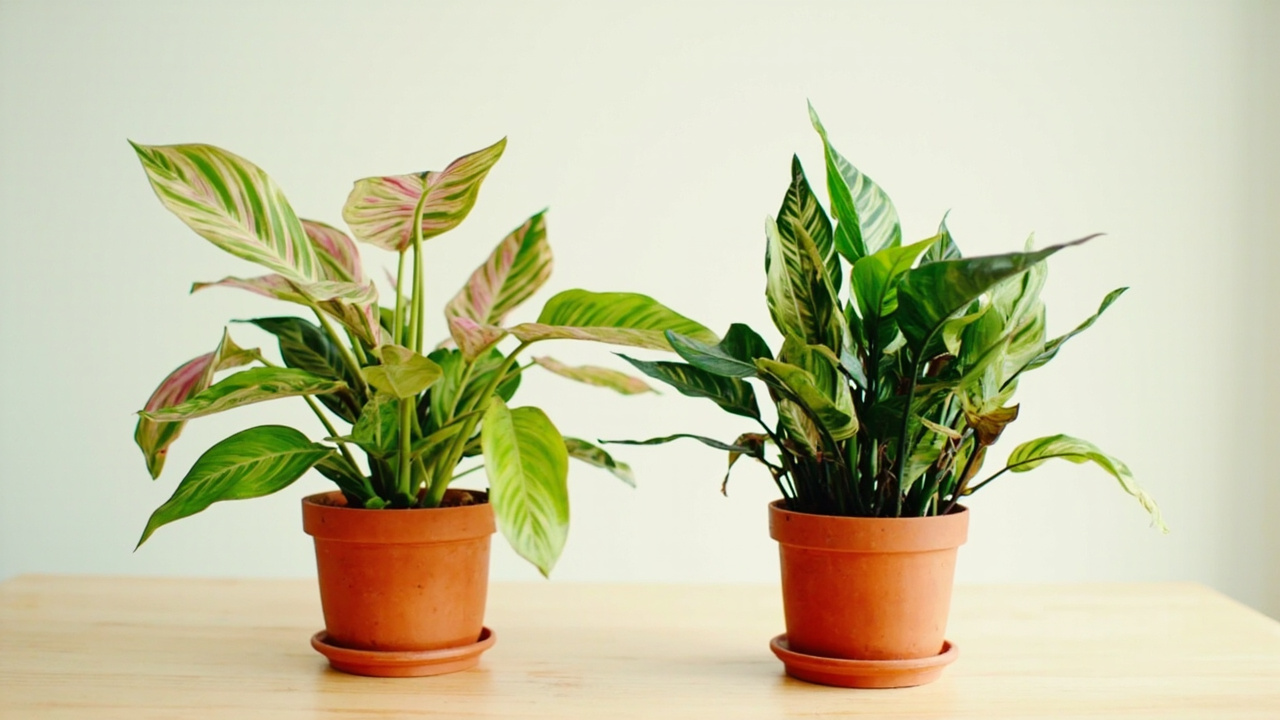
Leaf pattern describes the arrangement of color, stripes, spots, and markings on prayer plant leaves, which differs between cultivars. The green cultivar has simple dark markings, the rabbit stripe has bold red veins, the tricolor has silver and pink edges, and the red cultivar has deep crimson veining. Leaf pattern is the primary visual identifier used when choosing among prayer plant varieties, and it remains relatively stable once the leaf fully expands. Each leaf’s pattern is unique, much like a fingerprint, which is why no two prayer plant leaves look exactly alike even on the same plant.

A healthy prayer plant displays vibrant leaf patterns and deep purple undersides, key indicators of proper care conditions.
Water and Humidity Terms
Water quality and ambient moisture levels are the most common sources of prayer plant problems, and these terms describe what to aim for. Learn more in the prayer plant watering guide. The relationship between water chemistry and leaf health is one of the most important connections a prayer plant owner needs to understand, because the symptoms of poor water quality accumulate silently over months before becoming obvious.
Fluoridated water is tap water that contains added fluoride, a chemical commonly used in municipal water treatment. Fluoride accumulates in prayer plant leaf tips over time and causes the brown, crispy tips that confuse many new owners. The plant does not need fluoride, and removing it from your watering routine is one of the simplest improvements you can make. Switching to distilled water, rainwater, or filtered water often eliminates brown tips within a single growing season, because the damage is cumulative and reversible once the source is removed.
Distilled water is water that has been boiled and condensed, removing minerals, fluoride, chlorine, and other dissolved substances. Distilled water is ideal for prayer plants because it eliminates the chemical stress that tap water introduces. Rainwater, reverse osmosis water, and filtered water are also acceptable alternatives. Use room temperature water, never cold water straight from the tap or distiller. Cold water shocks the roots and can cause temporary wilting that lasts several hours, which is harmless but alarming if you do not know what to expect.
Humidity crack refers to small tears or splits that appear along the edges or between veins of prayer plant leaves, usually triggered by rapid humidity fluctuations or air that is too dry. Humidity cracks are most common in winter when heating systems drop indoor relative humidity below 30 percent. The cracks do not harm the plant but reduce its aesthetic appeal, and preventing them requires maintaining steady humidity above 40 percent. Once a humidity crack forms, it will not heal, but the plant will continue producing new leaves without cracks if conditions improve.
Light and Placement Terms
These terms describe where prayer plants belong in a home and what kind of light they receive in those locations. For more on optimizing your plant’s light, see the prayer plant low light guide. Light placement is perhaps the single most important decision you make for a prayer plant, because it influences everything from leaf color intensity to the strength of the nyctinastic rhythm.
Bedroom plant describes a prayer plant suited for bedroom placement because of its moderate light needs, non-toxic foliage, and ability to thrive in typical sleeping room conditions. The prayer plant is one of the recommended bedroom plants for people who want greenery without bright windows or specialized equipment. It performs its nyctinasty rhythm in response to your own sleep cycle, folding at night and unfolding during the day. This behavior between plant and human sleep schedules is one of the reasons prayer plants feel so naturally suited to bedroom environments.
East-facing window is a window that receives morning sun and afternoon shade, providing the bright indirect light that prayer plants prefer. East-facing windows deliver 2 to 4 hours of gentle morning sunlight, which is enough to support healthy growth without the risk of leaf scorch that comes from direct afternoon sun. An east-facing window is often considered the ideal location for most prayer plant cultivars. If your home only has south or west facing windows, you can still grow prayer plants successfully by placing them several feet back from the glass or using a sheer curtain to diffuse the stronger light.
Full spectrum LED is a grow light that emits light across the entire visible wavelength range plus some near-infrared and ultraviolet bands, mimicking natural sunlight. Full spectrum LED fixtures are effective for prayer plants placed in locations that receive insufficient natural light, such as north-facing rooms or interior spaces without windows. Position the fixture 6 to 12 inches above the foliage and run it for 10 to 14 hours per day to replace or supplement available light. A full spectrum LED is preferable to a warm white or daylight bulb because it supports photosynthesis more efficiently and helps maintain leaf color intensity, especially for variegated cultivars like the tricolor and rabbit stripe.
Safety and Household Terms
Before placing a prayer plant in your home, these safety terms confirm that the plant is compatible with your household environment. The prayer plant is considered pet-safe according to the ASPCA, making it a worry-free choice for homes with cats and dogs. This safety profile is one of the key reasons prayer plants remain popular despite their reputation for being finicky about humidity and light.
Pet-safe means a prayer plant is non-toxic to cats, dogs, and other common household animals if ingested. The ASPCA lists Maranta leuconeura as non-toxic, so you do not need to worry about accidental chewing by curious pets. This pet-safe status is one reason the prayer plant is recommended for homes with animals, though any plant material can cause mild stomach upset if consumed in large quantities. If your pet is a persistent chewer, consider hanging the prayer plant above floor level or placing it in a room that is off limits to animals, because while the plant is not poisonous, no amount of foliage consumption is ideal for any pet.
Species and Cultivar Terms
These terms identify the plant scientifically and horticulturally, helping you navigate care guides and nursery labels with confidence. For comprehensive care information, refer to the prayer plant care guide. Understanding the scientific name and cultivar designation is essential for finding accurate care information, because generic searches for “prayer plant” yield results that may not apply to your specific variety.
Maranta leuconeura is the scientific species name for the common prayer plant, belonging to the Marantaceae family alongside calathea, stromanthe, and goeppertia. Maranta leuconeura is native to the Atlantic coastal forests of Brazil, where it grows on the forest floor under the shade of taller trees. This understory origin explains its preference for bright indirect light, high humidity, and protection from direct sun. The species name “leuconeura” means “white-veined” in Latin, though confusingly, the most popular cultivars have red or pink veins rather than white ones. The name persists from early botanical descriptions that focused on the lighter central vein visible on some forms.
Cultivar is short for “cultivated variety,” and it refers to a plant that has been selectively bred for specific desirable traits. When you see a name in single quotes after the species name, such as Maranta leuconeura ‘Erythroneura’, that single-quoted name is the cultivar designation. Cultivars are propagated separately from the species because they do not come true from seed; each cultivar must be maintained through cuttings, division, or tissue culture. Understanding this distinction helps you recognize why two plants labeled “prayer plant” from different nurseries may look noticeably different, even though they share the same species name.
The care guidance for Maranta leuconeura applies across all cultivated varieties, with minor adjustments for light and humidity preferences specific to each cultivar. Understanding these terms helps you communicate with nurseries, follow care instructions accurately, and troubleshoot problems more effectively. When you know the exact cultivar name, you can find variety-specific care guidance that addresses the unique requirements of your particular plant rather than relying on generic advice that may not apply.
From Bank Statement to QuickBooks-Ready File
That manual cleanup you just read about? This tool skips it. Turn your PDF into QBO for QuickBooks without storing your data anywhere.
Start Converting