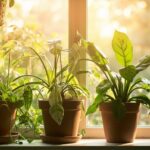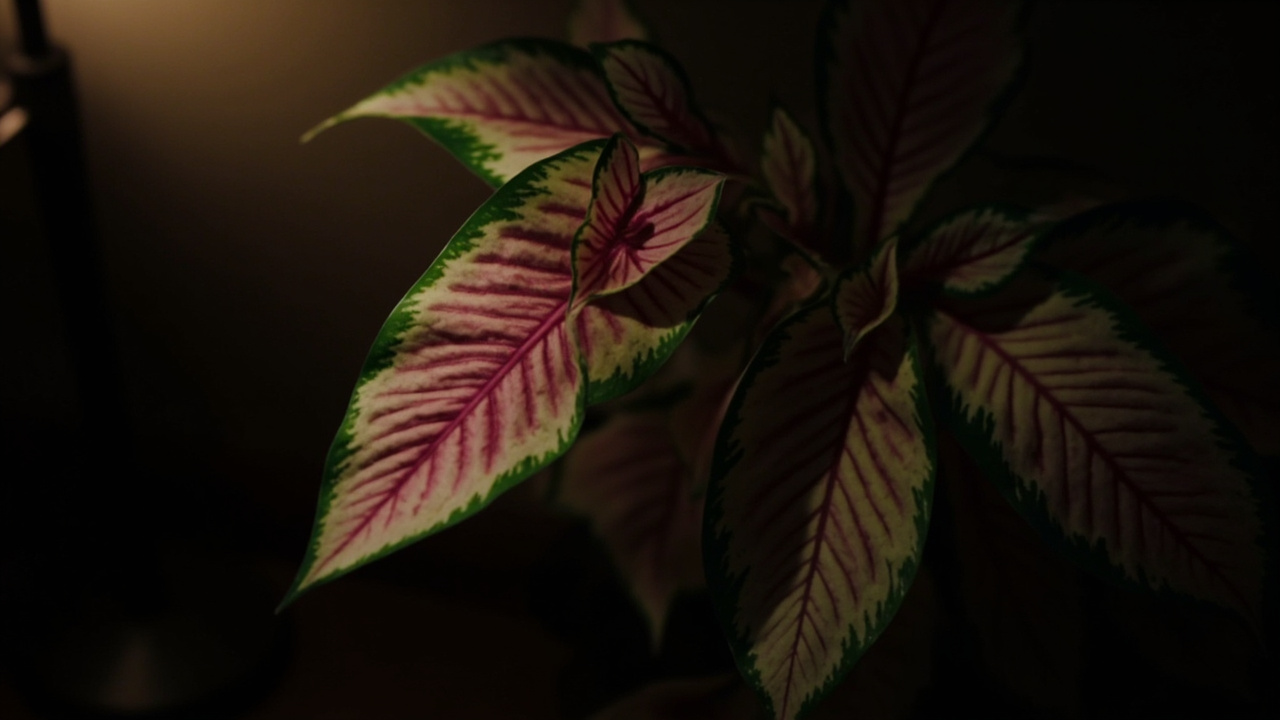

A prayer plant, scientifically known as Maranta leuconeura, can survive in low light, but survival is not the same as thriving. The plant that folds its leaves at dusk and raises them at dawn needs a minimum of 100 to 200 lux on its leaves every day to maintain its pattern color, leaf firmness, and natural nyctinastic rhythm. Below that threshold, the plant will not die quickly, but it will slowly lose everything that makes it worth growing: the vivid purple undersides fade to dull green, the intricate leaf pattern blurs, and the daily leaf folding motion slows until it stops altogether. This pet-safe houseplant is popular in bedroom settings precisely because of its striking foliage, but that same foliage demands adequate light to remain visually striking. The daily nyctinasty, the rhythmic leaf movement that gives the plant its common name, depends on consistent light exposure to function properly, and a bedroom placed too far from any window will show the first signs of light stress within six to eight weeks.
This guide is not about pushing a prayer plant to grow faster in low light. It is about understanding the exact light range your space provides, knowing when that range is sufficient versus when it will cause slow decline, and choosing between relocation or artificial light based on what your room actually offers. The difference between a prayer plant that survives for years in low light and one that fades within months comes down to understanding three things: how much light your window provides, how the plant responds when that light drops too low, and what you can do when you cannot move the plant to a brighter spot.
Understanding Low Light: What Your Window Actually Provides
Most people underestimate how little light their indoor spaces provide. A north-facing window in a typical apartment delivers between 50 and 200 lux during the day, while an east-facing window gets 200 to 500 lux before the sun moves away. South and west windows can reach 1,000 to 5,000 lux, but even those numbers drop sharply within six feet of the glass. A prayer plant sitting three feet back from a north window may be receiving less light than you expect, even if the room feels bright to your eyes. The complete prayer plant care guide covers the general light requirements in a single section, but this article goes deeper into measuring and acting on what your specific space actually provides.
Your eyes adapt to indoor light conditions in a way that makes low light feel normal. Human vision adjusts continuously to ambient brightness, so a dimly lit room can feel perfectly adequate after a few minutes of exposure. A prayer plant has no such adaptation. It responds to the actual photon flux density hitting its leaves, not how the room appears to you. This mismatch between human perception and plant perception is why prayer plants placed in what their owners consider low light often decline, while the same plant would struggle in a room that feels dark to a human.
The practical solution is to measure your light rather than guess. Free smartphone lux meter apps cost nothing and give you a reading within seconds. Hold the phone flat on the soil surface of your prayer plant’s current location, or better yet, place it where the top leaves sit when the plant is healthy and upright. Record the reading at midday on a cloudy day and again at midday on a clear day. These two numbers tell you more about your actual light environment than any general rule about window direction.
If your reading is below 100 lux, the prayer plant is in what botanists call deep shade. It will survive for months or even a year or more, but the leaf color will fade, the nyctinasty response will weaken, and the plant will become susceptible to overwatering because the soil dries extremely slowly. Use distilled water rather than fluoridated tap water when possible, because prayer plants are particularly sensitive to the fluoride and chlorine compounds added to municipal water supplies. These chemicals accumulate in the leaf tips over time and produce brown edge burn that mimics low humidity damage, making diagnosis confusing for growers who are already managing light constraints. If your reading is between 100 and 300 lux, the plant can persist with careful watering, but expect gradual fading over six to twelve months unless you add artificial light. Readings above 300 lux on the soil surface generally support reasonable health for a prayer plant, though the brightest pattern color still requires higher light levels. The prayer plant watering guide covers the dry-down rhythm that becomes even more critical in low light, where soil moisture lingers far longer than in brighter conditions.
Reading Your Prayer Plant’s Light Signals
A prayer plant communicates its light stress through three observable signals: leaf color change, nyctinastic rhythm alteration, and growth pattern shift. Learning to read these signals early gives you the chance to intervene before the damage becomes difficult to reverse. By the time a prayer plant shows severe etiolation or complete color loss, the structural recovery is slow and often incomplete.
Leaf fading is the earliest and most reliable sign of insufficient light. The purple undersides and vivid green patterns on the upper leaf surface depend on pigment production that requires adequate photosynthetic photon flux. When light drops below the plant’s compensation point, it reduces pigment investment to conserve energy. The purple deepens into brownish murky tones, the green patterns soften to pale olive, and the overall leaf appearance becomes washed out. This fading is reversible if you increase light before the plant enters prolonged stress, but once the chlorophyll and anthocyanin production has suppressed for several months, new leaves will continue to grow pale until conditions improve.
The nyctinastic rhythm, which gives the prayer plant its common name, is highly sensitive to light quantity and quality. In adequate light, leaves raise fully during the day and fold completely at night in a smooth, coordinated motion. In low light, this rhythm slows and becomes irregular. Leaves may not fold as deeply at night, remain partially open during the day, or show delayed response to light changes. A prayer plant that used to fold predictably each evening but now stays partially open is sending a clear signal that its light environment has dropped below its preferred range.
Growth pattern shift is the third and most delayed signal. In low light, a prayer plant prioritizes vertical growth over leaf production. New leaves may emerge smaller, thinner, and spaced further apart along the stem. The plant becomes leggy as it stretches toward any available light source. This etiolation response is the plant’s attempt to reach better light, but in a indoor container setting, it only makes the problem worse by creating weak, elongated stems that cannot support full-sized leaves. If you notice new leaves growing significantly smaller than mature leaves, the plant has been light-starved for weeks or months.

When to Move the Plant Versus Adding Artificial Light
The decision to relocate a prayer plant or add grow lights depends on your measured lux levels, your willingness to change the plant’s position seasonally, and the quality of light available from your windows. Moving the plant is always the first option to consider because natural light, even from a less-than-ideal window, provides a full spectrum that artificial lights struggle to replicate cost-effectively. But relocation is not always possible, and some homes simply cannot provide adequate natural light for a prayer plant year-round.
If your midday lux reading is between 100 and 300 on the soil surface and you can move the plant within three feet of a window, do so. Even an east-facing window that receives only morning sun can provide enough light for a prayer plant if it is close enough to the glass. The key measurement is the light at the leaf position, not the light at the window sill. A plant sitting on a stand two feet from an east window receives different light than the same plant on the floor six feet away. Measure at the actual plant location before deciding whether relocation is sufficient.
Relocation works best for seasonal light changes. A prayer plant that thrives near a south window in summer may starve in the same spot during winter when the sun sits lower in the sky and daylight hours shrink. If you live in a climate with dramatic seasonal light variation, plan to move the plant between summer and winter positions, or commit to a grow light system that compensates for the winter deficit. The simplest seasonal strategy is to track the plant’s leaf-folding rhythm through the year. If folding becomes inconsistent during winter months, the natural light has dropped below the plant’s requirement.
Artificial grow lights become necessary when relocation is impossible or insufficient. The most effective grow lights for prayer plants are full-spectrum LED panels that deliver between 2,000 and 5,000 lux at the leaf surface, matching the grow light spectrum that mimics natural daylight. You do not need expensive horticultural fixtures. A simple LED shop light positioned six to twelve inches above the plant and running for 10 to 12 hours per day can transform a light-starved prayer plant back to health. The critical factor is duration and proximity, not fixture price. A budget LED panel close to the plant provides more usable photons than an expensive fixture mounted too far away, and this approach works especially well for an east-facing window setup where morning sun alone cannot sustain the plant through winter.
Choosing and Positioning a Grow Light for Prayer Plants
Not all grow lights are equally effective for prayer plants. The plant responds best to full-spectrum output that mimics natural sunlight, with emphasis on the blue and red wavelengths that drive photosynthesis and pigment production. Avoid single-color red or blue LEDs, which provide the right wavelengths for photosynthesis but fail to support the visual qualities that make prayer plants attractive. A plant grown under pure red light will survive but develop pale, unhealthy foliage lacking the vibrant patterning that defines the species.
Position the grow light so that the bottom of the fixture is six to twelve inches above the tallest leaves. At this distance, a 10-watt to 20-watt full-spectrum LED panel delivers sufficient photon flux without generating excess heat that could damage the leaves. If the light feels warm to your hand when held at leaf level, it is too close. Move it up until there is no detectable warmth. Prayer plant leaves are thin and sensitive to heat stress, which can cause edge burn that compounds the low-light damage you are trying to fix.
Set the light timer for 10 to 12 hours per day, matching the natural daylight cycle of your local latitude during the growing season. Do not leave the light on 24 hours a day. Prayer plants require darkness to complete their nyctinastic rhythm, and continuous light disrupts this cycle just as severely as insufficient light. A full spectrum LED panel set to this schedule mimics the natural dawn-to-dusk cycle that the plant evolved under in its native Brazilian forest understory. A timer ensures consistent photoperiod without manual intervention, and the cost of a basic plug-in timer is negligible compared to the value of a healthy, patterned prayer plant.
Maintaining Your Prayer Plant in Low Light Long-Term
If you commit to keeping a prayer plant in low light without grow lights, adjust your care routine to compensate for the slower growth and reduced transpiration. Water less frequently, because low light means slower soil drying. Check the top inch of soil before watering, and only water when that layer feels dry to the touch. Overwatering is the most common secondary killer of prayer plants in low light, compounding the primary stress of insufficient photons with root rot from saturated soil.
Fertilize at half strength during the active growing season, but skip fertilization entirely during winter if your light levels drop further. A prayer plant in low light cannot process nutrients efficiently, and excess fertilizer in slow-growing soil creates salt buildup that damages the roots. The plant’s reduced metabolic rate means it needs far less food than a prayer plant sitting in bright indirect light, and providing the standard dose causes more harm than good.
Expect that a prayer plant maintained in true low light without artificial supplementation will never reach its full visual potential. The deep purple underside coloration, the sharp contrast of leaf pattern markings, and the vigorous daily leaf folding cycle all require adequate light to express fully. This is especially noticeable in a bedroom plant situation where the plant sits far from any window and receives only ambient reflected light. If these visual qualities matter to you, the investment in a simple grow light system pays for itself in the plant’s longevity and aesthetic return. If you value the plant primarily as a living object that brings greenery to a dark corner, acceptance of gradual fading may be your only realistic path.
The honest limit is that no prayer plant thrives indefinitely in light below 100 lux without artificial supplementation. A plant placed in a windowless bathroom or a deeply shaded interior room will survive for a time, but survival without the visual expression that defines the species is not sustainable care. Understanding your light environment honestly, measuring it rather than guessing, and acting on what the measurement reveals is the difference between a prayer plant that fades quietly and one that remains a vibrant part of your indoor space.
From Bank Statement to QuickBooks-Ready File
That manual cleanup you just read about? This tool skips it. Turn your PDF into QBO for QuickBooks without storing your data anywhere.