Rockwool is one of the most reliable hydroponic substrates, but it does not arrive ready to plant into. Straight from the factory, the fiber matrix is dry, hydrophobic, and sitting at pH 8.0–8.5. If you place a fresh cube into your system as-is, two things go wrong: the core stays dry while the surface looks wet, and your nutrient solution drifts upward in pH over the first week. The preparation step — soaking, buffering, and pH adjustment — is what turns factory rockwool into a safe, plant-ready medium.
This article walks through the exact preparation sequence: what to soak the cubes in, how long to soak them, how to bring pH down to the 5.5 target, and how to confirm the cube is actually ready for transplant. It assumes you’ve already chosen a system and a cube size, and it stays focused on getting the substrate right.
You will need a clean bucket, a digital pH meter, pH-down solution, water, and a way to measure temperature. A kitchen thermometer and a calibrated meter handle the work in under ten minutes of setup; the rest is waiting time.
Why Rockwool Must Be Prepared Before It Enters a System
Rockwool is made by melting basalt rock and spinning the molten material into fine fibers, then compressing those fibers into cubes and slabs. The fibers are naturally water-repellent on a microscopic level, and the manufacturing process leaves a thin alkaline residue distributed throughout the matrix. Neither problem is visible from the outside, but both become problems within the first 24–48 hours in a system.
When a dry cube is placed into a net pot and exposed to nutrient solution, the solution wicks along the outer fibers but fails to penetrate the dense core. The surface appears moist, and within minutes the cube may even feel heavy — but a cross-section reveals a dry center where the taproot will eventually grow. Hydrophobic fiber bundles resist rewetting, so the dry core persists through the first week of growth and stress the seedling exactly when it can least handle it.
The alkalinity is the second problem. Rockwool at pH 8.0–8.5 will slowly release hydroxide ions into your nutrient solution, pushing the system pH above the 5.5–6.5 range that most hydroponic crops prefer. The drift is slow enough to look like a calibration issue or a nutrient imbalance, and the source — the rockwool itself — is easy to miss. The fix is preparation: saturate the fibers fully and bring the substrate pH down before the cube ever touches a system.
This preparation step is the part most growers skip the first time, and the part that determines whether the rest of the system performs as expected.
What You Need on the Bench Before You Start
Preparation is a small physical job that becomes inconsistent when anything is missing. A digital pH meter, a bottle of pH-down (usually phosphoric acid), a clean bucket, and a thermometer handle the entire process. A small squeeze bottle works for dosing, and a kitchen scale or measuring cup is useful if you’re preparing a known volume of solution.
Water source matters more than people expect. Tap water with high alkalinity — common in municipal supplies with pH 7.5+ and high bicarbonate content — fights the pH adjustment the entire soak. If your tap water is hard or alkaline, use filtered or RO water for the soak, then resume using your normal nutrient solution for the system. Softened water is also a poor choice: the sodium in ion-exchange softening is hard on young roots and adds up over multiple soaks.
Distilled or RO water gives the cleanest result because you are starting from a known baseline. Most municipal tap water in the 6.5–7.5 range works fine with a slightly longer adjustment time.
Step 1: Prepare the Soak Solution
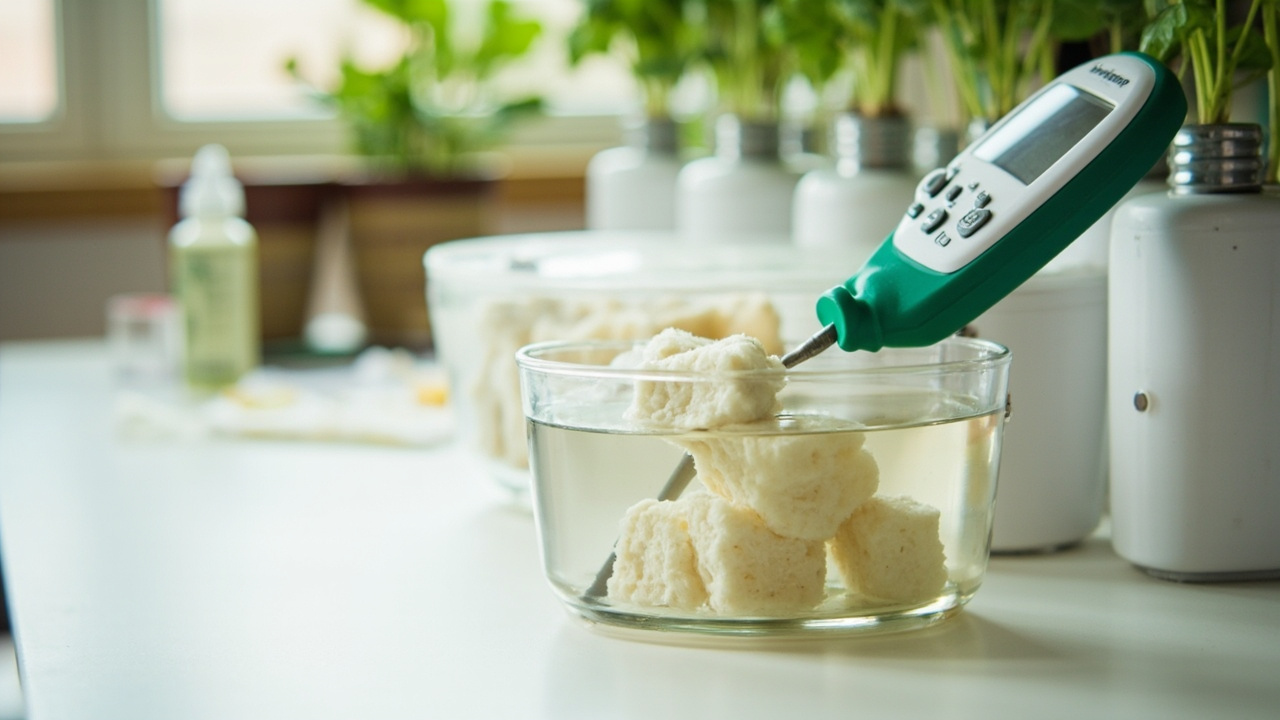
Fill your bucket with water at 40–45°C (104–113°F). Warmer water penetrates the fiber matrix faster and helps flush loose manufacturing dust out of the cubes. Cooler tap water at 15–20°C (59–68°F) works but requires a longer soak and rarely fully flushes the dust from the cube center. Do not exceed 50°C (122°F) — at that point, the binding agents in some brands begin to soften, which slightly deforms the cube geometry.
Calibrate or verify your pH meter before dosing. A meter that reads 6.5 in clean water when the actual pH is 7.0 will have you overshooting pH-down and ending up with a soak solution in the 4.0–4.5 range — too acidic for safe rockwool conditioning. Two-point calibration with fresh reference solution takes two minutes and removes the most common preparation mistake.
Add pH-down to the water in small doses, stirring between each addition. The target is pH 5.5, and the dose depends on the alkalinity of your source water. A 10 L bucket of RO water usually reaches pH 5.5 with 1–2 ml of standard pH-down; a 10 L bucket of hard tap water may need 5–10 ml and a longer stir. Confirm with the meter, not by smell or feel.
Step 1 check: the soak solution reads pH 5.5 ± 0.1 and the temperature is 40–45°C (104–113°F). If either is off, adjust before adding the cubes.
Step 2: Soak the Rockwool for 24 Hours
Submerge the cubes fully in the prepared solution. Dry rockwool floats — place a clean weight (a plate, a small pot, or a sealed container of water) on top to keep them under the surface. Any cube that floats with the upper face exposed will develop a dry patch on that face, and roots will avoid that patch later.
Leave the cubes in the solution for a full 24 hours. This is the single most consistent variable in the whole preparation. Soaks shorter than 12 hours leave hydrophobic fiber bundles in the cube core, particularly in 2-inch and 3-inch cubes where the cross-section is thick. Soaks longer than 24 hours do not improve the result, but they do not damage the cubes either — 48 hours produces the same pH-conditioned, fully saturated cube as 24 hours.
During the soak, the pH of the solution will drift upward as alkalinity leaves the rockwool and enters the water. In a closed bucket with no air exchange, the drift is small — usually less than 0.3 pH units over 24 hours. This drift is fine: it means the rockwool is buffering into the solution, exactly as intended. Do not “correct” the drift by adding more pH-down during the soak; the goal is to let the alkalinity leave the rockwool, and the drift is the visual evidence that the process is working.
Step 3: Drain and Verify the Runoff
After 24 hours, lift the cubes out and let them drain freely for 15–20 minutes. Do not squeeze them. Squeezing compresses the fiber structure, reduces the air-to-water ratio in the pore spaces, and sets the cube up for poor aeration in the system. A properly conditioned cube holds its shape and drips steadily when lifted; an over-squeezed cube feels dense and stops dripping within a few seconds.
Collect a small amount of the runoff — the water that drips out of the cubes after soaking — and measure its pH. The runoff should read between 5.5 and 6.0. If it reads above 6.0, the rockwool still holds alkalinity and a second 12–24 hour soak in fresh pH 5.5 solution will finish the job. If it reads below 5.0, the soak solution itself was too acidic, and the cubes should be re-soaked briefly in plain pH 6.0 water to bring the substrate back to a safe range.
The runoff check is the only reliable way to confirm preparation worked. Visual inspection tells you nothing about the substrate pH inside a saturated cube, and a dry test strip pressed against the surface will read the surface water, not the conditioned fiber underneath.
Step 4: Store or Use the Prepared Cubes
Once the runoff reads in the 5.5–6.0 range, the cubes are ready to use. Plant seeds or cuttings directly, or place the cubes back into a clean container with a small amount of pH 5.5 water in the bottom and a loose cover to keep them from drying out. Prepared rockwool holds its condition for several days in a covered tray; after a week, re-check the runoff pH before using a cube that’s been sitting.
For a deep water culture setup, prepared cubes drop into net pots and stay there for the crop’s life — the cube’s pH is set at this stage and should not drift more than 0.3 units inside the system if the nutrient solution is in range. For an ebb-and-flow or drip configuration, prepared cubes perform similarly as long as the irrigation frequency matches the cube size.
If you have leftover prepared cubes, store them submerged in a closed container of pH 5.5 water for up to two weeks. Beyond that, biological growth in the standing water can colonize the cube surface and create odor or film; discard the storage water, give the cubes a fresh 1-hour rinse in pH 5.5 water, and use them.
Common Preparation Mistakes and How to Catch Them Early
The most common mistake is a soak that’s too short. A 1–2 hour soak looks convincing — the surface is wet, the cube feels heavy — but the core is still dry. The first sign appears at transplant: the seedling wilts within a day even though the cube surface is moist. A cross-section of a similar cube reveals the dry center, and a runoff pH test confirms the substrate was never fully conditioned.
The second common mistake is using water that’s too hot. Above 50°C (122°F), the binding agents in some rockwool brands start to soften and the cube loses its shape slightly. This shows up as cubes that have rounded corners or sit slightly compressed in the net pot. Stick to 40–45°C (104–113°F) for the reliable window.
The third mistake is skipping the runoff check. Cubes that look fine and feel heavy can still be in the pH 6.5–7.0 range if the soak was too short or the solution pH was wrong. The runoff test is the only honest answer to “is this cube ready.”
One more pitfall: pH-up and pH-down are not interchangeable. If your tap water sits at 5.5, you do not need pH-down at all — start with the water as-is. Adding acid to already-acidic water sends the soak solution below 4.5, which damages the fiber structure and leaves the cube in a stressed state for the first week of growth.
What Preparation Sets Up for the Rest of the Cycle
Prepared rockwool behaves predictably in the system. The substrate starts at pH 5.5–6.0, holds 60–65% moisture and 35–40% air in its pore spaces, and resists the dry-out that kills seedlings in unconditioned cubes. For a full overview of rockwool as a growing medium, including how it compares to other substrates, the preparation step is the foundation that makes everything else work.
The four-part sequence — solution at 40–45°C (104–113°F) and pH 5.5, full 24-hour submerge, free drainage for 15–20 minutes, and a runoff check — is the whole job. After that, the cube is ready for the home system of your choice. Run the steps once, confirm the runoff is in range, and the substrate is no longer a variable in the rest of the cycle.
Turn any PDF statement into a clean sheet
Skip the typos and the hours of copying. Our converter handles any bank statement format and outputs Excel, CSV, or QBO for QuickBooks. No file retention, free to try.
Convert your statement