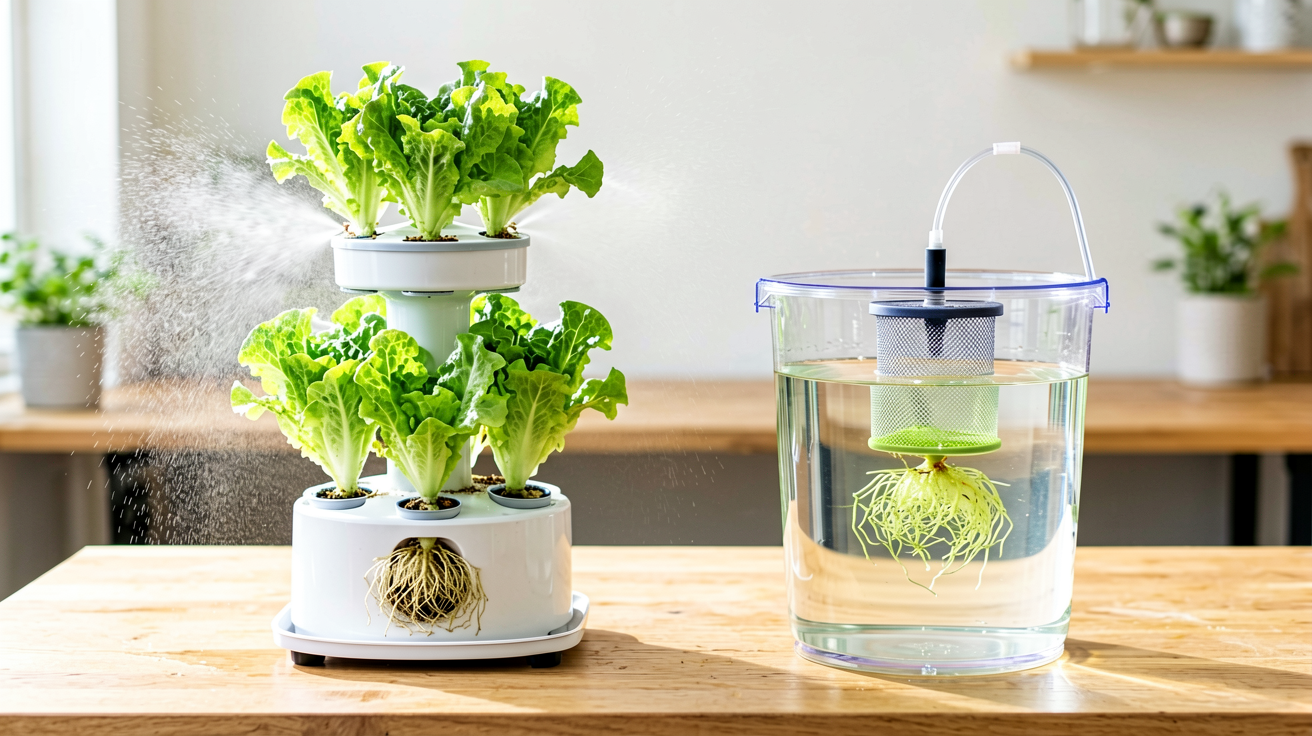

Aeroponics and hydroponics both grow plants without soil, but they feed the roots in two completely different ways. In a hydroponic system, roots sit in or run through a nutrient solution that carries water, nutrients, and dissolved oxygen together. In an aeroponic system, roots hang in open air inside a sealed chamber and get misted with nutrient solution on a timer, usually a few seconds every few minutes. That single difference in mechanism drives everything else that follows: how much the setup costs, how often it fails, which crops thrive, and whether a beginner can keep the system alive past month three.
If you are choosing between aeroponics and hydroponics, the honest answer is that most home growers should pick hydroponics for their first system and only graduate to aeroponics once they understand what a stable nutrient solution, a working pH range, and a complete reservoir cycle actually feel like in practice. Aeroponics rewards attention with faster growth. Hydroponics rewards consistency with fewer crop losses. This guide walks through seven real differences between aeroponics vs hydroponics so you can pick the system that matches your grow, your schedule, and your crop list, not the marketing photo that convinced you to click.
The 2-Minute Verdict
Pick hydroponics if you want the lowest failure rate, the cheapest setup, and the widest crop fit for a home grower. Pick aeroponics if you are willing to spend more, accept the constant pump-failure risk, and want the fastest growth rates on leafy greens and herbs. Hydroponics wins on cost, simplicity, and resilience. Aeroponics wins on oxygen exposure to roots, water efficiency, and growth speed when every misting cycle stays clean and the timer never skips.
The decision comes down to three honest questions. How much can you spend upfront. How often are you willing to check on the system. And which crops do you actually want to grow. Lettuce, basil, mint, and most microgreens lean toward aeroponics for speed. Tomatoes, peppers, and large fruiting crops lean toward hydroponics for stability and root mass support. Strawberries go either way depending on whether you value yield per plant or flavor concentration. The rest of this guide explains why those splits exist, what each system demands from you, and where the hidden costs hide in the spec sheet.
Mechanism: Mist vs Water Contact
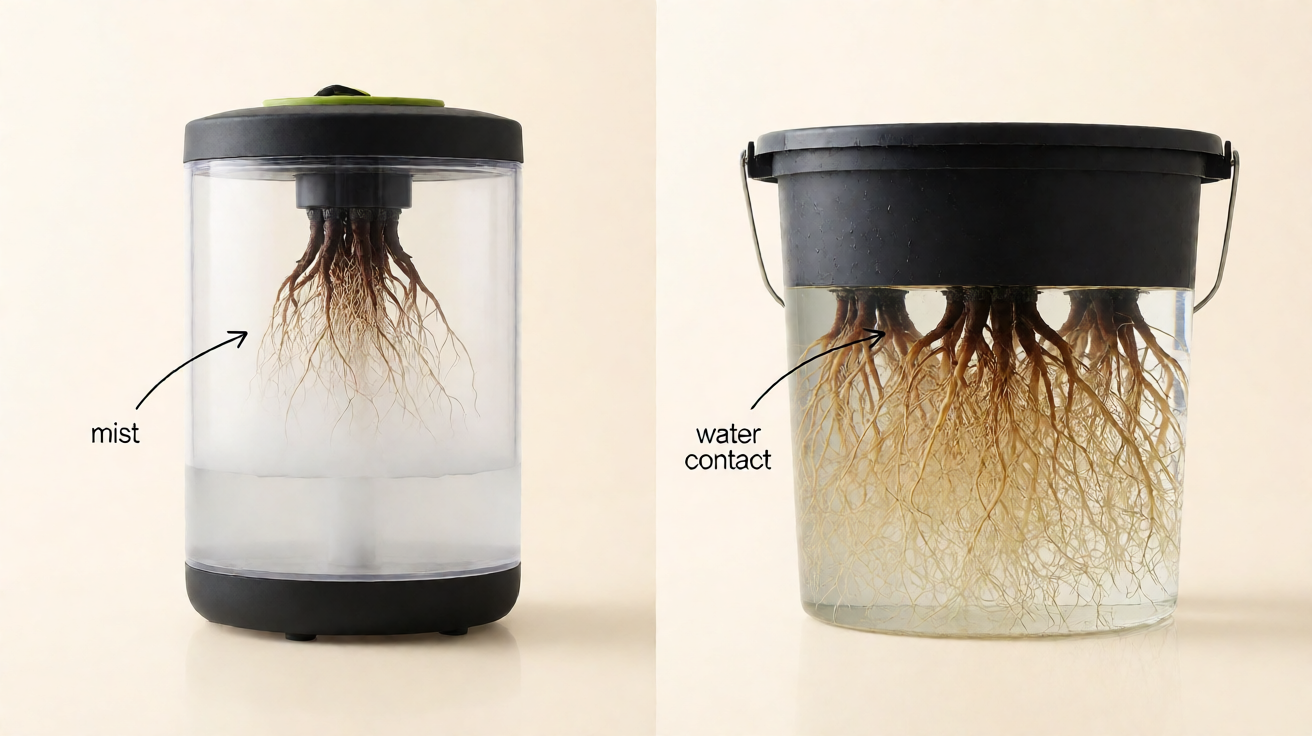
The mechanism is the cleanest place to start because it explains every other difference between aeroponic and hydroponic systems. If you understand how the roots receive water and oxygen, the cost numbers, the maintenance schedule, and the failure modes all start to make sense.
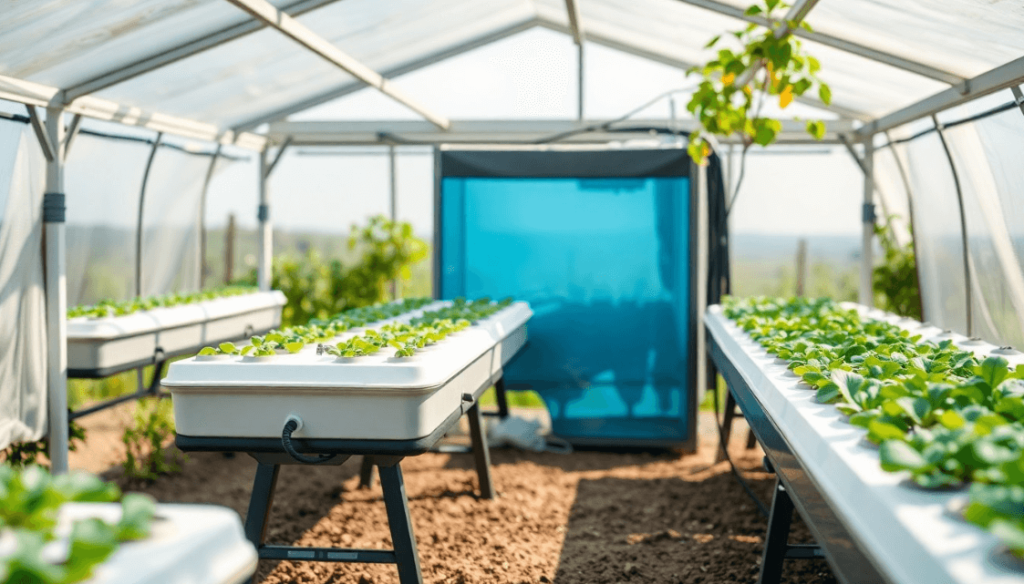
In a hydroponic system, plant roots sit in a reservoir of nutrient solution, flow through a thin film of solution along a sloped channel, or dip into a tray that floods and drains on a timer cycle. The roots get water, dissolved nutrients, and dissolved oxygen from the same liquid. Deep water culture, nutrient film technique, the Kratky method, and Ebb and Flow systems (also called flood and drain) are all hydroponic variants that differ in how the solution moves or stays still. The roots never leave the water or the wet growing medium like rockwool, clay pebbles, coco coir, perlite, or LECA. Most beginner kits use an air pump with an air stone to keep dissolved oxygen high in the reservoir, and a separate water pump drives the flow on timed cycles.
In an aeroponic system, roots hang in a sealed chamber with no standing water at all. A high-pressure or low-pressure pump pushes nutrient solution through misting nozzles on a short timer cycle. The roots get their water and nutrients as airborne droplets in the mist and pull oxygen directly from the air inside the chamber. That constant oxygen access is the core mechanism that drives faster growth in aeroponics. Roots in mist have full access to atmospheric oxygen rather than competing for dissolved oxygen in a reservoir, and that single difference shortens vegetative time on leafy crops by a measurable margin. There is no growing medium buffer either, which means no rockwool, no clay pebbles, no coco coir, no perlite to buy, sterilize, or replace between crops.
The trade-off is mechanical and unforgiving. Aeroponic misters clog with mineral buildup, biofilm, or particles in the nutrient solution. Hydroponic pumps move bulk liquid and tolerate small particles and minor scale. If a hydroponic pump loses prime for an hour, the reservoir buffer keeps the roots wet. If an aeroponic mister clogs for an hour, the exposed roots start to dry and the plants stress within the same hour. The mechanism difference is small on paper and enormous in practice. If you want a deeper walkthrough of how each system type actually delivers nutrients to roots, the hydroponic systems explained guide covers DWC, NFT, Kratky, Ebb and Flow, and aeroponic side by side with their mechanism differences called out.
Crop Fit: What Each System Actually Grows Best
Both systems can grow almost any plant, but they do not do it equally well. The crop fit difference comes down to root mass, fruiting load, and how much margin for error the crop gives you when something drifts out of range.
Aeroponics shines on leafy greens, herbs, and propagation. Lettuce, basil, mint, kale, spinach, parsley, and most microgreens respond with explosive growth in misted chambers because the roots get maximum oxygen and the plants do not need heavy fruiting support. The root mass stays compact, which fits the limited space of a mist chamber perfectly. Strawberries do well in aeroponics too, especially in vertical towers where the air-pruned roots branch aggressively and the crowns stay dry. Propagation of cuttings is faster in aeroponics than in any other soilless method because the callus forms in clean, oxygen-rich air with no pathogen load from a wet growing medium.
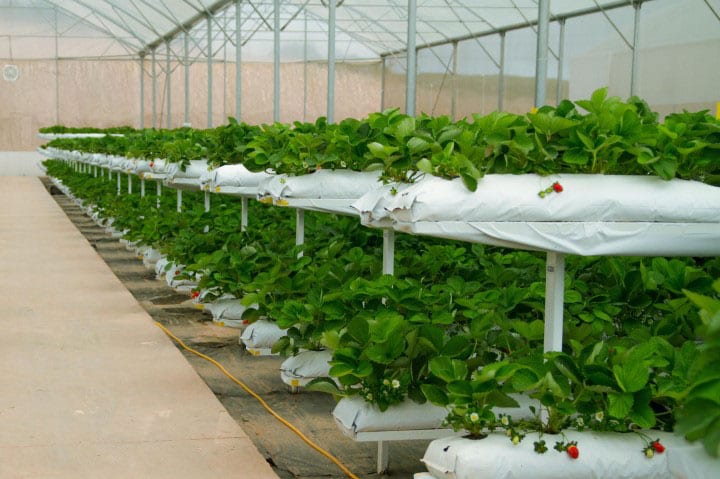
Hydroponics carries the heavier crops with more confidence. Tomatoes, peppers, cucumbers, and large fruiting plants want a stable, anchored root zone that aeroponics struggles to provide once the plant tops out and the fruit load climbs. Deep water culture and Dutch bucket systems handle the weight and the daily nutrient swings that come with fruiting plants entering the flowering stage. Hydroponic strawberry systems also do well when you want larger fruit over longer production cycles, especially in greenhouses where temperature and humidity stay steady. For a beginner, the crop fit usually decides the system before anything else. If you want to grow tomatoes on your first attempt, pick hydroponics and you will not spend the season fighting a mist chamber that was never built for that crop.
If you are still deciding which crops to start with, the best hydroponic system for home guide ranks systems by crop fit and yield, and the best plants for aeroponics page narrows the aeroponic side down to what actually thrives in mist without constant intervention.
Cost and Energy: The Real Numbers
The cost gap between aeroponics and hydroponics is wider than most beginner guides admit. The real numbers depend on what you build versus what you buy, and what counts as the same system on paper versus the same system in your grow room.
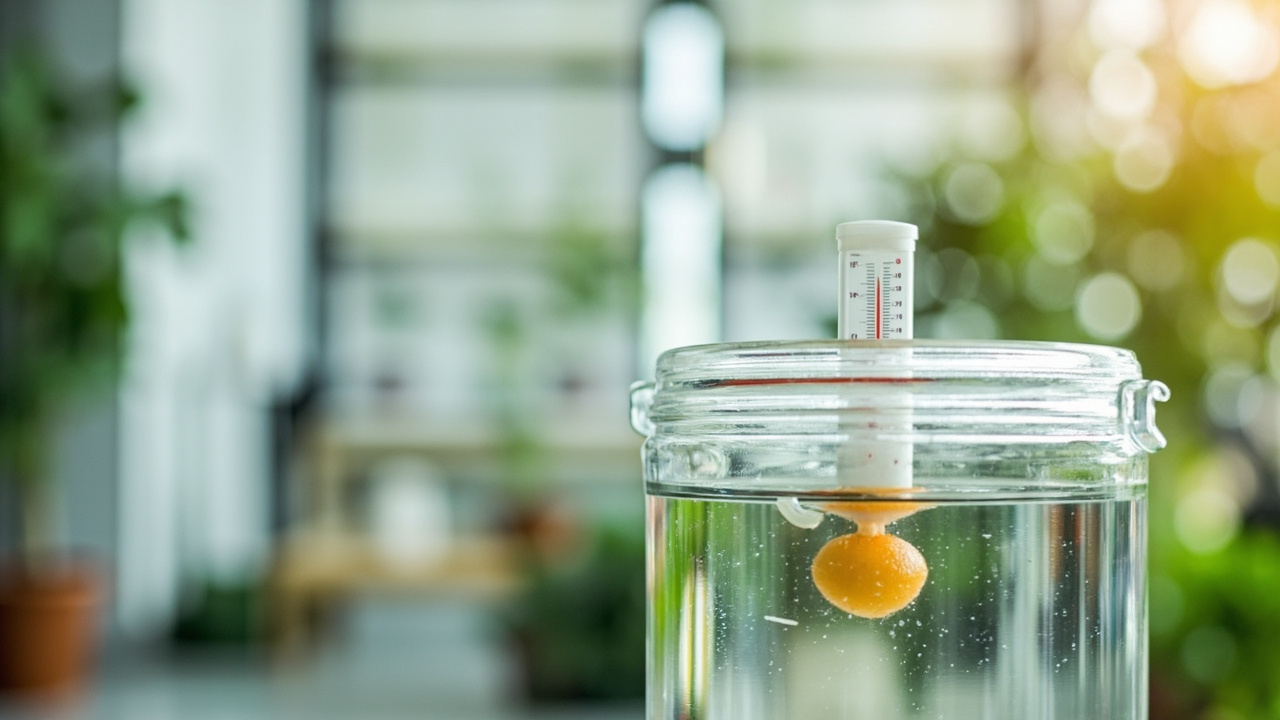
A DIY hydroponic system using a five-gallon bucket, a small air pump, and a net pot runs about thirty to seventy dollars total. A pre-built deep water culture kit lands in the one-hundred to two-hundred-dollar range with reservoir, pump, and net pots included. A Kratky method setup can be under twenty dollars if you have a mason jar, a net cup, and a bag of dry nutrients. Nutrient film technique and Ebb and Flow kits sit between one-fifty and four hundred dollars depending on reservoir size, channel count, and pump quality.
Aeroponics costs more because of the misters, the pressure pump, and the sealed root chamber that has to hold mist without leaking. A low-pressure aeroponic build with a pond fogger starts around one hundred dollars but mist droplet size is uneven and coverage at the root tips suffers. A true high-pressure aeroponic system with diaphragm pumps, stainless steel misters, and a pressurized tank starts around five hundred dollars and climbs past a thousand dollars for anything larger than a small hobby cabinet. The pump also draws more continuous wattage than a hydroponic air pump and runs on a tighter duty cycle to keep the chamber misted.
Energy is the second cost and the one most guides skip. A small hydroponic air pump pulls five to fifteen watts and runs constantly, twenty-four hours a day, every day. A high-pressure aeroponic system pulls fifty to two-hundred watts to run the pump and timer cycle, and even a low-pressure mist system pulls more than a comparable air pump. Over a year of continuous use, that energy gap adds up to real dollars on the utility bill, especially if you run multiple grow chambers or run the system in a heated indoor space where waste heat becomes a climate load. If you want a deeper breakdown of what each system actually costs to run month over month, the hydroponic fertilizer and system cost page compares nutrient spend and electricity draw across system types so you can budget before you build.
Maintenance and Failure Modes
Every soilless system fails in characteristic ways. The maintenance burden is where aeroponics and hydroponics diverge hardest, and where most beginner runs end.
Hydroponics fails when pumps stop, when pH drifts outside the five-point-five to six-point-five range, when the reservoir runs low, or when roots sit in anaerobic water long enough to invite root rot. Every failure mode gives you visible warning. Leaves yellow or curl, roots turn brown and slimy, algae blooms in the reservoir, the pH reading stops holding. You usually have hours to days to fix the problem before plants die because the reservoir holds a large buffer of nutrient solution that keeps the roots wet while you diagnose. Deep water culture and DWC systems are especially forgiving because the reservoir volume is large relative to root mass and you can top off with pH up or pH down, add a Cal-Mag supplement, and rebalance the nutrient solution without losing the crop. EC and PPM readings tell you when to add nutrients or dilute with fresh tap water, and most chloramine-heavy municipal water works fine once you let it sit or treat it.
Aeroponics fails when misters clog, when the pump dies, when the timer skips a cycle, or when the root chamber leaks and loses pressure. None of these failures announce themselves gently. If the mister clogs at two in the afternoon and you do not check the chamber until eight in the evening, the exposed roots dry out and the plants wilt within hours. Aeroponic systems have almost no buffer. The constant mist is the entire point of the system, and the absence of mist is the entire failure mode. If you want to read the full troubleshooting map for clogged misters, skipped timer cycles, and root chamber leaks, the aeroponics maintenance guide walks through the weekly schedule that keeps a mist system alive past the first ninety days.
For a beginner, this is the single deciding factor. A Kratky method system can survive a forgotten water change for a week because the reservoir still covers the roots. An aeroponic system cannot survive a missed timer cycle for more than a day because the exposed roots desiccate fast. The forgiving system teaches you the rhythm of nutrient management, pH checks, and reservoir cycling. The unforgiving system punishes every gap in attention with visible crop loss, and the lesson costs you a harvest. Nutrient lockout is the silent failure both systems share: pH drift or salt buildup locks out calcium, magnesium, or iron even when those nutrients are present in the solution, and the leaves show deficiency symptoms that look like underfeeding. Checking pH and EC weekly catches lockout before it costs you a crop.
Beginner Fit and Learning Curve
The learning curve for hydroponics is gentler because the system runs on simple physics that a beginner can observe and correct. Pump pushes water. Roots drink. Reservoir refills. You learn pH, EC, and reservoir cycling in your first month, and each variable has a visible symptom when it drifts. Mistakes cost you a leaf, a stalled harvest, or a single crop, not the whole system. The skills transfer across every hydroponic variant you try next.
The learning curve for aeroponics is steeper because the system depends on misting nozzles staying clean, timers staying accurate, and chambers staying sealed at the right pressure. You learn plumbing, pressure calibration, nozzle maintenance, and root chamber design before you learn plant care. A clogged mister looks identical to a dying plant from the leaf side, and beginners often diagnose the wrong problem first. If the hydroponics guide for beginners is where most people should start, aeroponics is the second system you build once you already know what a healthy root mass looks like, what a stable pH reading feels like, and how a reservoir cycle behaves over a week.
For a complete walkthrough of how to set up your first soilless grow without buying a kit that will frustrate you in the first month, the hydroponic systems for beginners guide ranks setups by learning curve, resilience, and total cost of ownership through the first year.
The Decision
Five questions settle the aeroponic versus hydroponic choice for most home growers, and most of them come down to attention and budget rather than yield.
One. What is your upfront budget. Under one hundred dollars means hydroponics, full stop. Over five hundred dollars opens aeroponics to a serious high-pressure build that will actually deliver the growth speed the marketing promises. Two. How often will you check the system. Daily check-ins favor aeroponics because misters need monitoring. Every-few-days check-ins favor hydroponics because the reservoir buffer covers gaps in attention. Three. What crops do you want most. Leafy greens and herbs favor aeroponics. Fruiting crops favor hydroponics. Strawberries split the difference depending on whether you want yield or flavor. Four. How much do you value growth speed. Aeroponics wins by twenty to thirty percent on leafy crops when everything runs clean and the timer never skips. Five. Are you okay with pump failure as a real and constant risk. Aeroponics depends on the pump more than hydroponics does, and pump failure in aeroponics is the fastest way to lose a crop.
If you answered mostly hydroponics, start with deep water culture or Kratky and learn the rhythm of nutrient management, pH, and reservoir cycling. You can always graduate to aeroponics once you understand how nutrient solution, pH drift, and reservoir cycling actually behave in your space. If you answered mostly aeroponics, build a low-pressure mist system first to learn the failure modes and the maintenance schedule before investing in high-pressure hardware. The low-pressure system teaches the same lessons for less money, and the failures cost less when they happen.
The one sentence that decides it is this. Pick the system you will still be running six months from now, not the one that looks best in a marketing photo. Hydroponics wins that question for most home growers because it survives neglect and teaches you the fundamentals without punishing every mistake. Aeroponics wins it for growers who want maximum oxygen exposure to roots and are willing to stay close to the system every day. Both work. Both produce healthy plants. Pick the one that matches your attention, your budget, and the crop you actually want to harvest.
Once you have picked a system, the next read is the aeroponic system guide if you went aeroponic and want the build details, or the full hydroponics comparison hub if you went hydroponic and want DWC, NFT, Kratky, and Ebb and Flow side by side. Both pages assume you already understand the fundamentals, so start with whichever system you can keep alive through the first three months, then optimize from there once the rhythm feels automatic. Either way, start with the system you can keep alive through the first three months, then optimize from there once the fundamentals feel automatic.
From Bank Statement to QuickBooks-Ready File
That manual cleanup you just read about? This tool skips it. Turn your PDF into QBO for QuickBooks without storing your data anywhere.