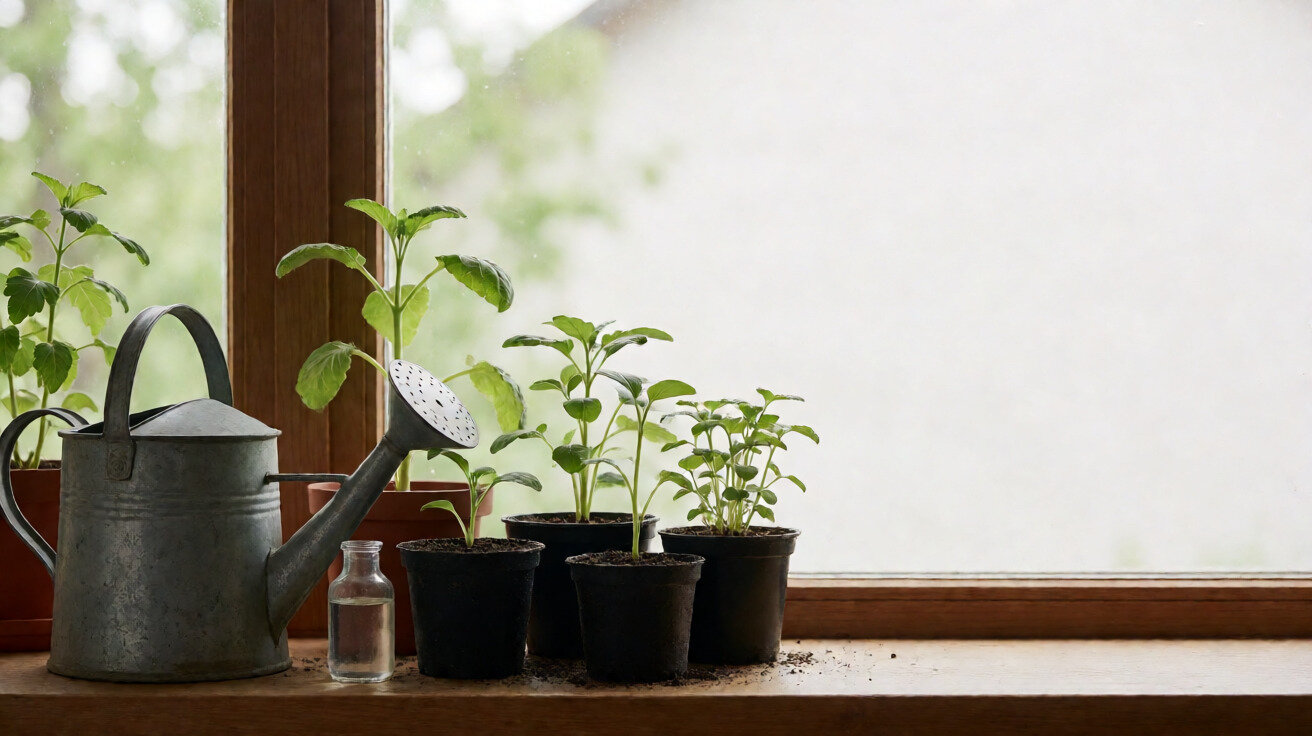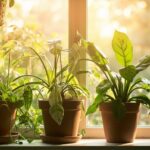

Containers are the one place where the same fertilizer needs different math. A garden bed has soil volume to buffer mistakes. A six-inch pot does not. Nutrients wash out with every watering, and the small soil mass depletes fast. Feeding potted plants well is less about choosing a better product and more about changing how you apply the one you already have.
Why containers need different feeding
Three factors separate container feeding from in-ground feeding. First, limited soil volume. A standard six-inch pot holds roughly one quart of potting mix. A garden bed of the same surface area holds many times that. The pot simply cannot store many nutrients at once.
Second, faster depletion. With less soil, roots exhaust available nutrients sooner. A bed might feed a plant for weeks. A pot can run short in days during active growth.
Third, more frequent watering. Containers drain faster and are watered more often. Each watering carries dissolved nutrients out the drainage hole. This leaching is the single biggest reason container plants need more frequent feeding than in-ground plants.
The soil-volume math is simple. If a plant needs a fixed amount of nitrogen per week, and the pot holds one-tenth the soil of a bed, the pot must be replenished one-tenth as much at a time but ten times as often. That is the origin of the dilution rule.
Container mix also matters. Most potting mixes are soilless: peat, coir, bark, and perlite. They hold few nutrients on their own, especially after the first few weeks. Once the starter charge in a commercial mix is used up, the plant depends entirely on what you add.
The dilution rule: half-strength, twice as often
The standard practice for containers is to use half the recommended rate at twice the recommended frequency. If a label calls for one tablespoon per gallon every two weeks, apply half a tablespoon per gallon every week instead.
This does two things. It keeps the concentration of salts in the root zone low, reducing burn risk. And it matches supply to the steady, rapid uptake that container plants experience. Roots in a pot cannot store a large dose for later; they use what is available and the rest leaches away.
The dilution rule applies to liquid and water-soluble fertilizers. For granular products, the equivalent is to use the lower end of the label range and split applications. Never apply a full garden rate to a pot in one dose.
Watering before feeding also helps. A dry root zone absorbs a concentrated solution unevenly, which causes burn patches. Water the plant first, then apply the diluted fertilizer. This distributes nutrients evenly through the mix.
Track what you do. A simple log of date, product, and dilution keeps you consistent and prevents accidental double-feeding, which is the most common cause of salt buildup in containers.
Best ratios for containers
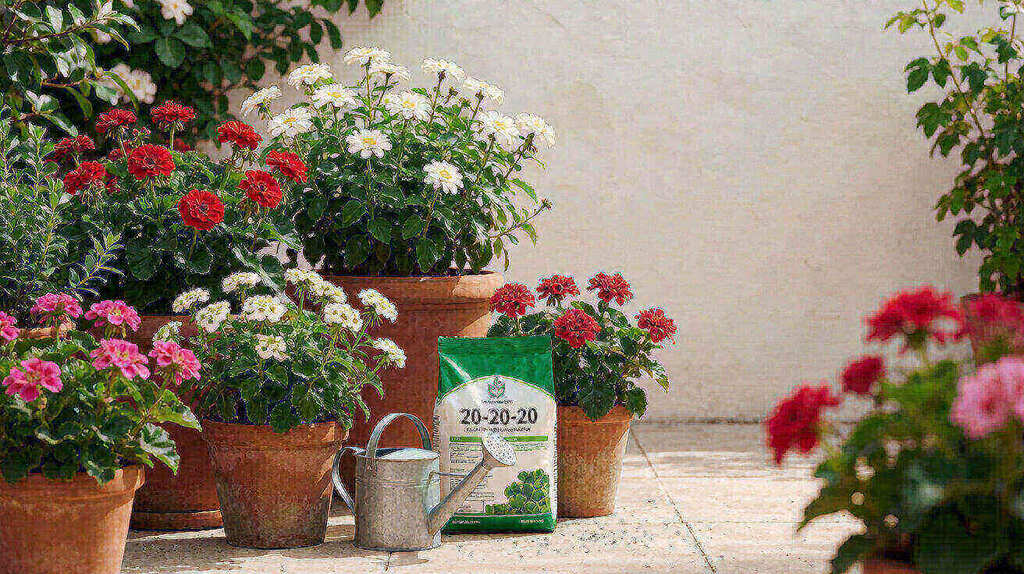
Three ratios dominate container feeding. 20-20-20 is a high-analysis balanced formula useful for general feeding of mixed containers and foliage plants. It delivers a lot of nutrient per unit volume, which suits the small doses containers need.
15-30-15 tilts toward phosphorus and suits flowering and fruiting container plants, such as tomatoes in pots or hanging baskets. The higher middle number supports bloom and fruit set.
10-10-10 is a gentler, lower-analysis balanced option. It is forgiving for beginners and for plants sensitive to salt, such as ferns and some herbs. Because it is weaker, it may need slightly more frequent application.
These ratios are starting points, not prescriptions. The right choice depends on the plant and the stage of growth. For more on what the numbers mean, see NPK ratio explained. For choosing among products, the fertilizer buying guide covers the decision.
Balanced fertilizers suit containers because the mix itself is inert. In a garden, soil supplies some nutrients and you top up the rest. In a pot, you are the entire nutrient supply, so a complete formula is usually safer than a single-nutrient product.
Liquid vs granular vs slow-release for pots
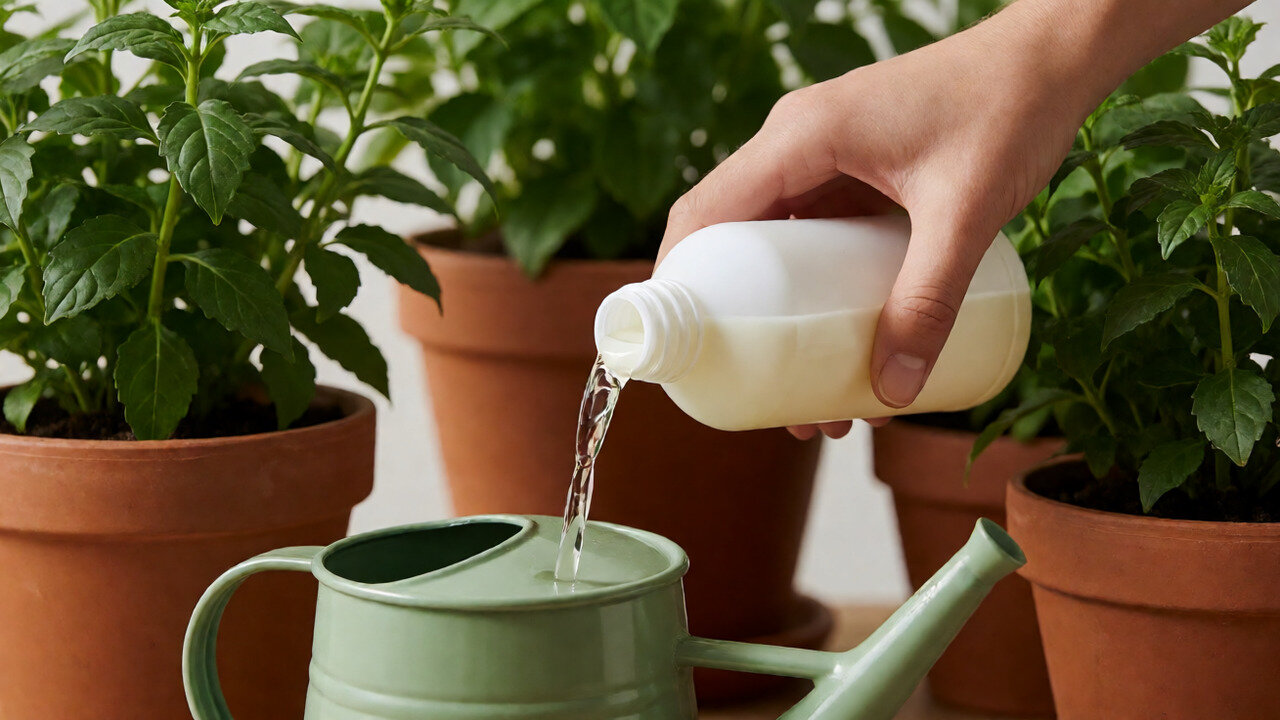
Liquid and water-soluble fertilizers are the most common choice for containers. They are easy to dilute, act within hours, and let you adjust feeding week to week. The cost is labor: you must mix and apply them regularly.
Granular fertilizers can be used in containers but require care. They are harder to distribute evenly in a small volume, and a single pellet cluster can burn roots. If you use granular, scratch it lightly into the surface and water well.
Slow-release and controlled-release products are often the best fit for containers. Mixed into the potting mix at planting, they feed steadily for weeks or months with little effort. They also reduce the risk of a single over-dose. The trade-off is less control: you cannot easily stop feeding if a plant is stressed. Slow vs quick release explains the mechanisms.
Many container gardeners combine approaches: a controlled-release base in the mix plus occasional liquid feeding during peak growth. This gives steady baseline nutrition with the flexibility to boost when plants are fruiting or flowering.
When choosing, consider your watering habits. If you water lightly and infrequently, granular and slow-release products persist better. If you water heavily and often, liquid feeding matches the leaching pattern and prevents salt spikes from undissolved granules sitting in wet mix.
Salt buildup: the container-specific problem
Salt buildup is the main fertilizer-related problem unique to containers. Because water evaporates from the pot surface and drains through the mix, dissolved salts accumulate over time. The potting mix becomes increasingly salty even when you are feeding at reasonable rates.
Signs of over-fertilizing containers include white crust on the soil surface or pot rim, brown or burned leaf tips and margins, stunted growth despite adequate water, and wilting that does not respond to watering. These symptoms are often mistaken for drought or disease.
Salt buildup raises osmotic pressure around roots, making it harder for plants to take up water. A plant sitting in salty mix can wilt even in moist soil because the roots cannot draw water against the gradient. This is the same mechanism behind fertilizer burn.
Prevention is simpler than cure. Use the dilution rule, water thoroughly so some water drains out the bottom each time, and avoid letting pots sit in saucers of drained water, which reabsorbs salts.
Repotting is the ultimate reset. Replacing the mix every one to two years removes accumulated salts and refreshes the root zone, especially for long-lived container plants like citrus and woody herbs.
How to flush (leach) excess fertilizer
Flushing removes accumulated salts by passing a large volume of water through the mix. Water the pot until water runs freely from the drainage hole, then continue for several minutes. The goal is to push the salty solution out and replace it with clean water.
Use roughly twice the pot volume in water for a thorough flush. For a one-gallon pot, that means about two gallons of water. Let it drain completely. Do not let the pot sit in the runoff.
Flush when you see salt crust, when leaves show burn, or as routine maintenance every four to six weeks during heavy feeding. After flushing, wait a few days before feeding again to let the plant recover.
Flushing is not a substitute for correct rates. If you flush monthly but still over-feed weekly, salts will rebuild. Treat flushing as a reset, then return to the dilution rule.
For plants that are especially salt-sensitive, such as ferns, citrus, and some herbs, flush more often, every two to three weeks during active feeding. Watch leaf tips: browning at the margins is the earliest sign of trouble, appearing before any visible crust.
Seasonal adjustments
Spring is buildup time. Plants are growing fast and nutrient demand is high. Start feeding as growth resumes, using the dilution rule from the first application. If you are repotting, mix slow-release into fresh potting mix at planting.
Summer is maintenance. Growth is steady and watering is frequent, so leaching is at its peak. This is when the dilution rule matters most. Flush every four to six weeks during hot weather. Watch for salt buildup more closely in summer.
Fall is reduction. As growth slows and light drops, plants use less. Cut feeding frequency in half or stop entirely for plants going dormant. Continuing summer rates into fall causes salt accumulation that shows up as spring damage.
Winter is rest for most container plants. Feed only plants actively growing under lights. For dormant plants, no fertilizer is needed. Resume in spring when new growth appears.
These seasonal shifts are not arbitrary. They follow the plant’s growth rate, which drives nutrient demand. Feeding a dormant plant does not make it grow faster; it only adds salts to a mix that is not being actively cycled by roots.
Container size and soil volume
Larger pots buffer better. A ten-gallon container holds more mix, depletes slower, and is less prone to salt buildup than a small pot. It also needs less frequent feeding. If you struggle with container feeding, upsize the pot.
Small pots, under one gallon, are the hardest case. They dry fast, deplete fast, and salt up fast. Use the most dilute feeding schedule, flush often, and consider slow-release mixed into the mix to reduce the number of applications.
Pot material affects watering and thus feeding. Terra cotta breathes and dries faster than plastic or glazed ceramic, so it needs more frequent watering and feeding. Self-watering containers hold a reservoir and feed more steadily, which suits slow-release products.
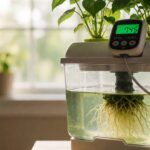
When in doubt, test the mix. A simple soil test or even a basic EC meter can reveal salt levels before symptoms appear. Adjust feeding based on what the mix shows, not just on the calendar.
Drainage is non-negotiable. A pot without drainage traps water and salts, leading to root rot and toxicity. Always use containers with drainage holes, and empty saucers after watering.
Application rate math for any container size is covered in fertilizer application rate. For vegetables in containers specifically, see NPK ratio chart for vegetable crops.
Container feeding rewards consistency over intensity. Small doses, applied on schedule, with regular flushing, keep potted plants healthy without the salt problems that come from occasional heavy feeding.
Last updated: October 28, 2026.
Sources
- Penn State Extension, “Fertilizing Container Plants.”
- University of Minnesota Extension, “Fertilizing Houseplants and Container Plants.”
- UF/IFAS Extension, “Container Gardening.”
- NC State Extension, “Container Gardening.”
- Purdue Extension, “Container Plants.”
- Cornell Cooperative Extension, “Container Gardening.”
The actual number is the decision.
Turn any PDF statement into a clean sheet
Skip the typos and the hours of copying. Our converter handles any bank statement format and outputs Excel, CSV, or QBO for QuickBooks. No file retention, free to try.
Convert your statement