
Mixing fertilizers is like mixing paint: done right, you get the exact shade you want; done wrong, you get mud. The question “can you mix NPK fertilizers” has a short answer and a long one. The short answer is yes, usually. The long answer is the rules that decide when yes becomes no, and they matter because a bad mix can lock nutrients out of reach or send nitrogen into the air before plants ever see it.
The short answer
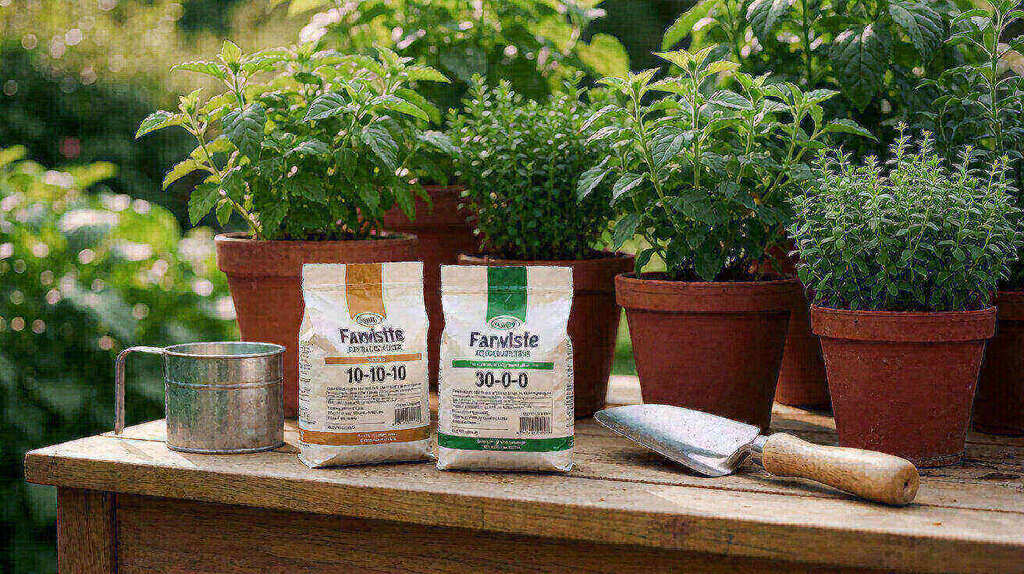
Most dry granular NPK fertilizers can be mixed with each other. A 10-10-10 and a 30-0-0 can share a spreader load without a chemical fight.
The problems start when you mix forms that react: ammonium with urea, high phosphorus with high calcium, liquid concentrate with dry granules, or anything with a pesticide that is not labeled for tank mixing. So the real question is not “can you mix” but “what are you mixing, and in what form.”
If a single product already matches your soil test, do not mix. Mixing adds steps, adds error, and adds the chance of a bad combination. Mix only when one product leaves a gap that another product fills cheaply and cleanly. That is the decision frame: not capability, but fit.
When mixing works (compatible combinations)
These combinations are routine and safe for home gardeners, assuming you follow label rates for each product.
- Two granular NPK products with no reactive partners. A balanced 10-10-10 plus a nitrogen-only 30-0-0 is the classic example. Both dissolve in soil moisture; neither precipitates the other.
- A granular NPK plus a micronutrient supplement. Iron, zinc, or boron products are usually formulated to be compatible with standard NPK granules. Check the supplement label for a “compatible with” list.
- A slow-release granular plus a quick-release granular of the same nutrient, when you want both a fast bump and a long tail. See slow-release vs quick-release fertilizer for how release rates interact.
- Dry fertilizer blended into compost before application, as long as rates are calculated on the final blend, not on each component separately.
- Two products with overlapping nutrients, when you reduce each rate so the total stays within label limits. This is common when a soil test shows two moderate gaps rather than one severe one.
The common thread: dry plus dry, no reactive ions, and rates recalculated for the blend. If those three hold, mixing is fine. If any one fails, stop and rethink.
Even compatible mixes benefit from a small test. Blend a handful in a cup of water, let it sit for ten minutes, and look for cloudiness, clumping, or heat. Clear water means the mix dissolves cleanly. Cloudiness or sediment means something is precipitating, and you should not spray or dissolve that combination. This ten-minute test has saved many gardeners from a clogged sprayer.
When mixing fails (incompatible combinations)
These are the combinations that cause real, measurable damage.
Ammonium nitrate with urea
Both are nitrogen sources, but mixing them raises volatilization risk. Urea converts to ammonia gas, especially on warm, wet, high-pH surfaces. Ammonium nitrate in the same pile can speed that loss. The nitrogen you paid for leaves as gas. If you need both, apply them at different times or in different spots, not blended.
Volatilization is worse on hot days, on alkaline soils, and on residue-covered surfaces where the fertilizer sits above the soil. If you must use urea, incorporate it or water it in immediately. Never leave a urea-containing blend sitting on the surface in summer.
High phosphorus with high calcium
Phosphorus and calcium form insoluble calcium phosphate. In a dry blend this is less of a problem because reaction is slow; in a liquid tank mix or a wet blend it precipitates immediately, producing a sludge that clogs sprayers and locks phosphorus away from roots. This is the precipitation problem, and it is the reason you do not tank-mix high-P and high-Ca liquid concentrates.
The same chemistry explains why hard water can ruin a liquid fertilizer mix. Calcium and magnesium in tap water can precipitate with phosphate or sulfate products. If your mix turns cloudy, the water may be the culprit, not the fertilizer.
Liquid concentrate with undissolved granules
Granular fertilizer does not dissolve fast enough to be sprayed. If you pour liquid concentrate over dry granules and spray, you get uneven distribution, clogged nozzles, and burn spots. Dissolve the granules fully in water first, or keep the forms separate.
If you need a foliar spray, buy a water-soluble formulation designed for spraying. Do not improvise by dissolving lawn granules. The particle size and coatings are wrong for sprayers, and the result is uneven coverage and equipment damage.
Anything with a pesticide unless labeled
Herbicides, insecticides, and fungicides have their own chemistry. Some are stable with fertilizer solutions; many are not. Only mix when the pesticide label explicitly permits tank mixing with fertilizer. Otherwise you risk deactivating the pesticide or creating a phytotoxic mix.
Even when a label allows tank mixing, order of addition matters. Add products one at a time with agitation, and never mix two concentrates together before adding water. Concentrated contact between reactive partners is where most tank-mix failures start.
The math: weighted average N-P-K
When you mix two fertilizers, the resulting N-P-K is a weighted average by weight. The formula is simple: multiply each product’s percentage by its share of the total weight, then add.
Result N = (weight A x N% A + weight B x N% B) / total weight. Same for P and K. Work in pounds or kilograms; the units cancel.
A few rules that keep the math honest:
- Always use the label percentages, not the product name. A “tomato fertilizer” might be 5-10-10; the name tells you nothing the label does not.
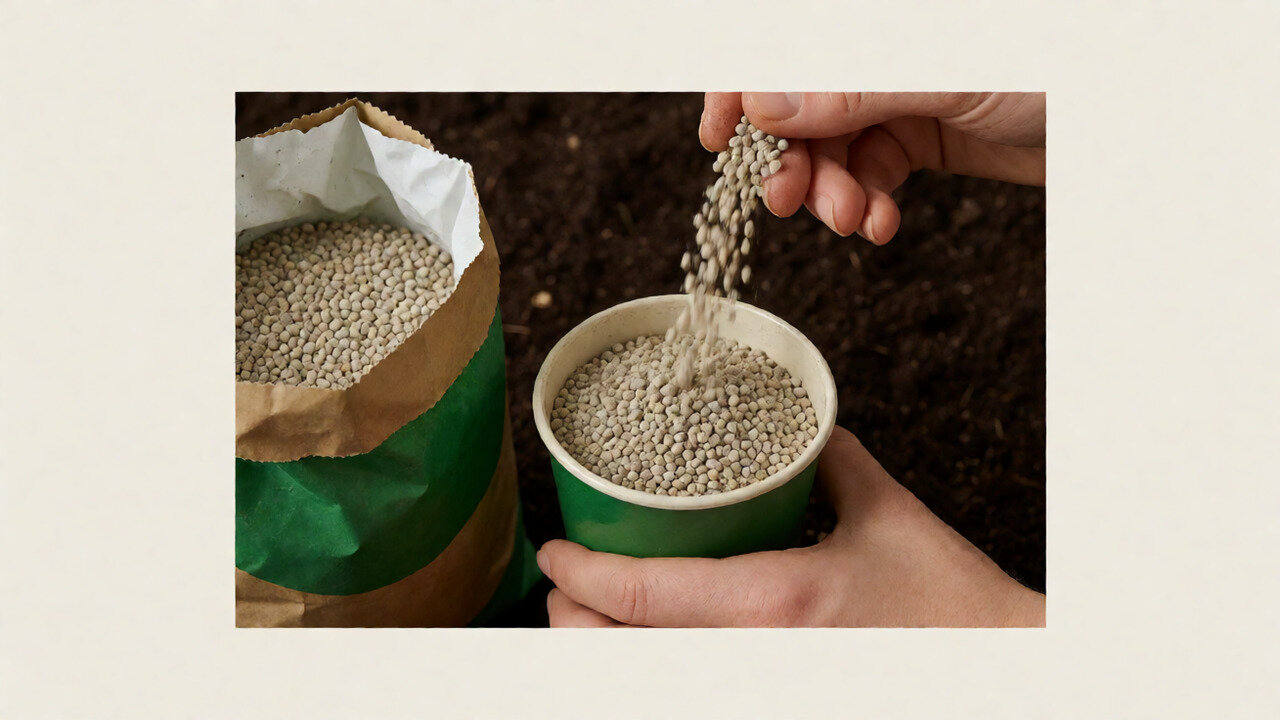
- Weight by actual dry weight, not by volume. A cup of dense 30-0-0 weighs more than a cup of fluffy 10-10-10. Weigh it.
- Recalculate for the blend, not for each component. If you mix 5 lb of A and 5 lb of B, the blend is 10 lb total, and the rates apply to 10 lb.
- Remember the label is N, P2O5, K2O, not elemental. If you need elemental phosphorus, multiply P2O5 by 0.44. See NPK ratio explained for the conversion.
- For three or more products, the same formula extends: sum of (weight x percentage) divided by total weight. A spreadsheet handles this faster than hand arithmetic.
The weighted average is also why mixing rarely produces a clean target ratio. You are averaging two points on a line, and the result lies between them. If neither component is close to your target, no blend of them will be either.
Worked example: mixing 10-10-10 and 30-0-0
Say you want more nitrogen without adding phosphorus or potassium, and you have 10-10-10 and 30-0-0 on hand. Mix equal weights: 5 lb of 10-10-10 plus 5 lb of 30-0-0, 10 lb total.
| Component | Weight (lb) | N % | P2O5 % | K2O % |
|---|---|---|---|---|
| 10-10-10 | 5 | 10 | 10 | 10 |
| 30-0-0 | 5 | 30 | 0 | 0 |
| Blend | 10 | 20 | 5 | 5 |
Result: 20-5-5. Nitrogen doubled, phosphorus and potassium halved relative to the 10-10-10. That is a reasonable blend for a lawn or a nitrogen-hungry crop, and it shows why mixing is not always better: you just made a product that exists on the shelf, and probably for less money if you had bought it directly.
Check the application rate against the blend, not against either component. See fertilizer application rate for the rate math. A 20-5-5 blend applied at the 10-10-10 rate would over-apply nitrogen; applied at the 30-0-0 rate would under-apply phosphorus and potassium. The blend has its own rate, derived from its own analysis.
When NOT to mix
- When a single product already fits. If your soil test calls for 20-5-5, buy 20-5-5. Do not blend two products to approximate it.
- When the soil test shows one gap. If only nitrogen is low, use a nitrogen-only product. Adding phosphorus and potassium you do not need wastes money and can build up in soil. See how to read a soil test report.
- When forms differ. Do not blend liquid and dry unless you dissolve the dry fully first.
- When rates would overlap. If both products contain nitrogen, their rates add. Over-application burns plants and leaches into water.
- When you are guessing. If you do not know what the soil needs, test first. Essential nutrients for plants in gardens covers where nutrients come from and when to test.
- When the blend would be used across different crops with different needs. A custom blend tuned to tomatoes is wrong for lettuce.
Safety rules
- Never mix concentrated liquids without checking labels for compatibility and order of addition.
- Never mix fertilizer with a pesticide unless the pesticide label explicitly allows it.
- Wear gloves and eye protection when blending dry fertilizers; dust is a real inhalation hazard.
- Blend in a dry, well-ventilated place. Moisture starts reactions early.
- Label the blend container with the recipe and date. An unlabeled bucket of mixed granules is a guessing game next season.
- Store blends dry and sealed. Mixed fertilizers cake and lose flowability.
- Keep children and pets away during blending and until the product is watered in or incorporated.
One more trap: the custom blend. Gardeners often mix to feel in control, then end up with a product that is close but not right, applied at a rate that is also close but not right. Buying the correct single product is almost always cheaper and more accurate. Mix when you have a specific, calculated reason, not when you have leftovers to use up.
The honest test before mixing: can you state the target ratio, the blend ratio, and the application rate of the blend in one sentence each? If any of the three is vague, you are not ready to mix. Go back to the soil test and the label until all three are numbers.
Home gardeners mix for three reasons: to save money by using up leftovers, to hit a ratio no single bag offers, or to add a missing nutrient. The first reason is the weakest. Leftover-driven blends usually approximate a ratio you could buy directly, and the approximation costs accuracy. The second and third reasons are legitimate when the math is done honestly. In practice, most successful home blends are simple two-component mixes with clearly different roles, such as a balanced base plus a nitrogen boost.
Last updated: October 28, 2026.
Sources
- Penn State Extension, “Mixing Fertilizers” (extension.psu.edu)
- University of Minnesota Extension, “Fertilizer Compatibility” (extension.umn.edu)
- Purdue Extension, “Fertilizer Mixing” (extension.purdue.edu)
- NC State Extension, “Fertilizer Management” (content.ces.ncsu.edu)
- Colorado State Extension, “Fertilizers” (extension.colostate.edu)
- UF/IFAS, “Fertilizer Compatibility” (edis.ifas.ufl.edu)
The actual number is the decision.
From PDF to Excel in one click
Forget retyping line by line. Upload any bank statement, get a spreadsheet you can actually use. Your files are never stored, and you can test the converter with 3 free conversions.
Try it free