
Mexican bird of paradise is not a bird of paradise. It is Erythrostemon mexicanus, a drought-hardy legume in the pea family that happens to share a common name with the Strelitzia houseplant almost everyone picture when they hear the words.
University of Arizona Cooperative Extension makes the point plainly: three species in the genus Caesalpinia carry the bird of paradise name, with yellow, Mexican, and red modifiers, and none of them belongs in the same botanical group as the tropical Strelitzia that needs a cool, moist climate.
That confusion is the whole reason this article exists. A gardener who buys a Mexican bird of paradise for its yellow flowers and treats it like the houseplant will drown it, and a gardener who sees “bird of paradise” in a nursery catalogue has no way to tell which of four plants is about to arrive.
Here is what the Mexican species actually is, how it differs from the two Caesalpinia relatives that share its name, and how to grow it in a pot or a hot, dry garden.
Which Bird of Paradise Are You Actually Buying
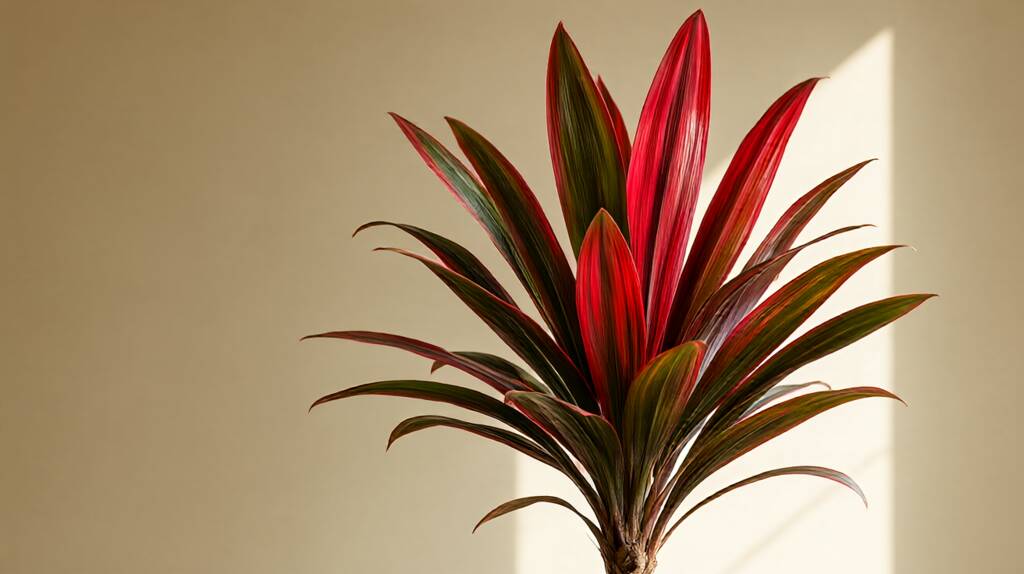
Four plants answer to the name, and they split across two families. The one most houseplant owners mean is Strelitzia reginae, the orange and blue flowering clumping perennial in the banana family, Strelitziaceae.
The other three sit in Fabaceae, the legume family, and all three are called Caesalpinia in older literature and Erythrostemon in current taxonomy. Extension guidance is clear that none of the three should be confused with the Strelitzia, because the Strelitzia is not easily grown in a desert garden at all.
The Mexican bird of paradise is Caesalpinia mexicana, now Erythrostemon mexicanus, the yellow-flowered one.
Its close namesakes are the yellow bird of paradise, Caesalpinia gilliesii, with yellow flowers and long red stamens, and the red bird of paradise, Caesalpinia pulcherrima, also known as Pride of Barbados, with red and orange flowers. The Arizona comparison table below is the fastest way to tell them apart before you buy.
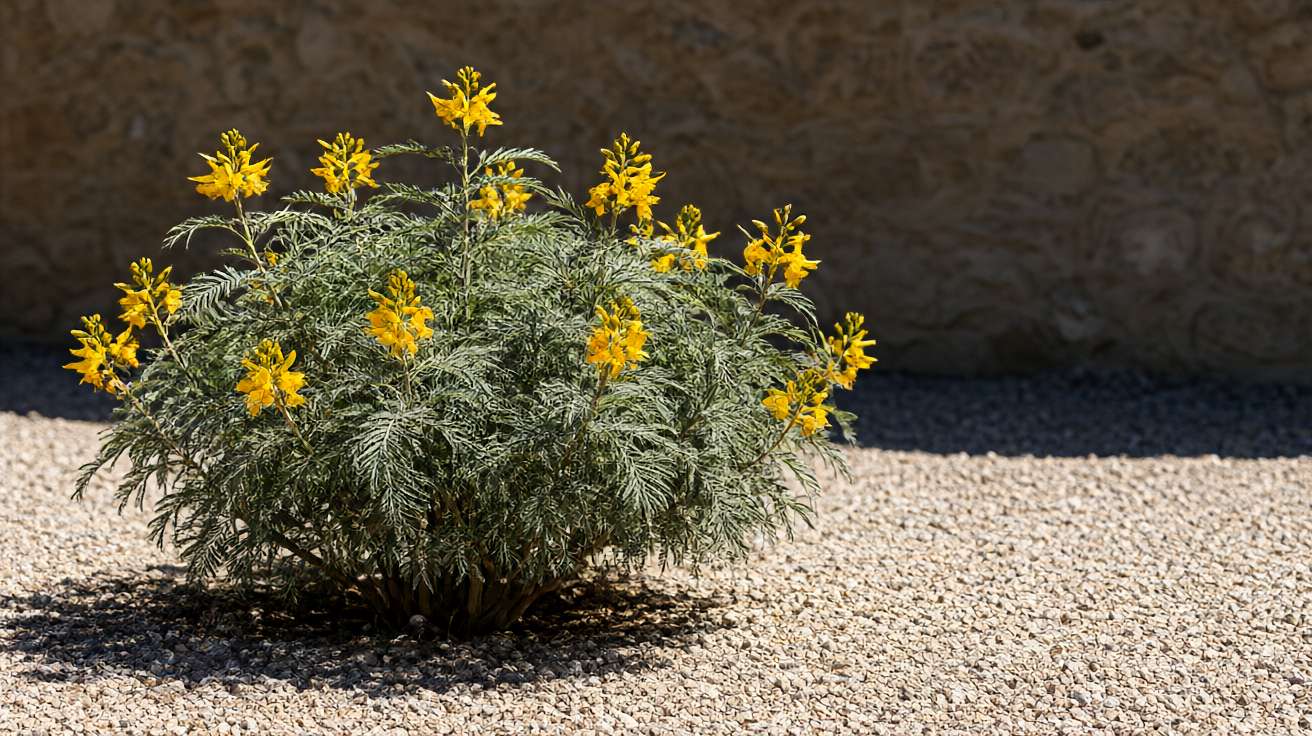
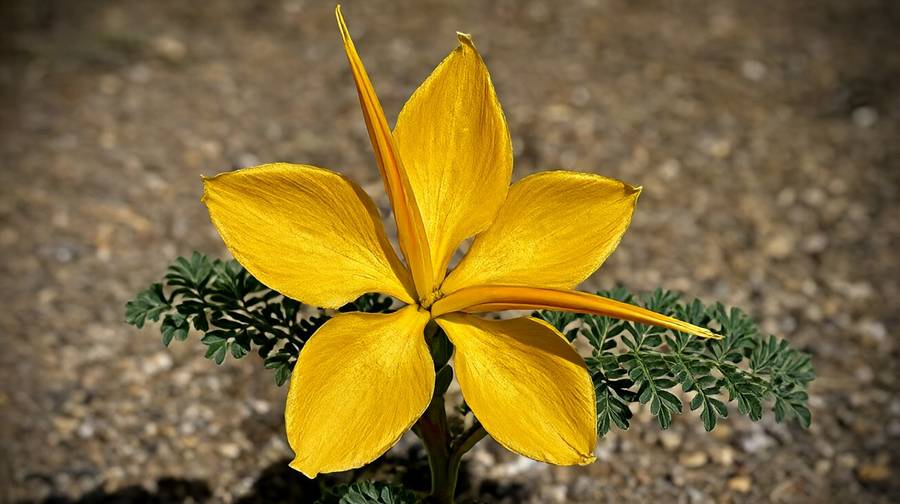
Mexican bird of paradise is the one with solid yellow flowers, no red stamens, and grey-green feathery foliage on a rounded shrub that grows to 10 to 15 feet. If the flowers in the catalogue picture have visible red filaments or are orange-red, you are looking at a different species entirely.
| Feature | Mexican (Erythrostemon mexicanus) | Yellow (C. gilliesii) | Red (C. pulcherrima) |
|---|---|---|---|
| Mature size | 10 to 15 ft tall, 10 ft spread | 5 to 10 ft tall, 4 to 6 ft spread | 4 to 10 ft tall, 4 to 6 ft spread |
| Hardiness | Hardy to 18 F | Hardy to 10 to 15 F | Damaged at 32 F |
| Flower colour | Solid yellow | Yellow with long red stamens | Red and orange |
| Leaf length | 5 to 9 cm | 10 to 15 cm | 20 to 40 cm |
| Watering once established | Every month; weekly in spring and summer for continuous bloom | Every month | Every month; weekly in spring and summer for continuous bloom |
| Exposure | Full sun or light shade | Full or reflected sun | Full sun or light shade; avoid northern exposure |
What the Mexican Species Is Built For
The plant is a scrubland shrub. University of Florida IFAS Extension describes it as native to southernmost Texas and central Mexico, where it grows naturally in scrub and dry tropical forests, and gives its hardiness as USDA zones 9A through 11B. It is an evergreen large shrub or small tree with a rounded habit, fine-textured foliage, and bright yellow flowers borne on the new growth in terminal clusters that cover the canopy from spring through fall.
Two numbers explain why it survives where the Strelitzia cannot. IFAS records a drought tolerance of high and a soil salt tolerance of moderate, and lists its soil tolerances as acidic, slightly alkaline, well-drained, and sand.
University of Arizona notes that all three Caesalpinia species tolerate any soil type as long as there is good drainage. The combination of high drought tolerance, sandy or freely draining soil, and heat tolerance is the entire adaptation. A Strelitzia wants the opposite: moist, humus-rich soil and a cool, humid room.
This is a desert plant dressed in a houseplant’s name, and the fastest way to kill it is to water it like a Strelitzia. Give it full sun, fast drainage, and a dry-down between waterings, and it will thrive where the orange bird of paradise would sulk.
Why it is worth growing at all
Beyond the flowers, IFAS lists real ecological reasons. The yellow flowers attract hummingbirds and other pollinators, and the plant hosts the curve-winged metalmark butterfly, Emesis emesia, in its native range. The Australian index of the site puts the value plainly: it is a specimen plant, a container plant, and a parking-lot-island plant, and its evergreen foliage gives winter interest in a landscape where everything else has gone dormant.
Light, Water and the Difference from a Houseplant
Light is the one requirement the Mexican species shares with the tropical Strelitzia: full sun, or light shade. IFAS notes that it produces the most blooms in full sun but may also be located in partial shade.
NC State Extension gives the same range for the related red species, listing full sun at 6 or more hours of direct sunlight a day as the ideal, with partial shade of 2 to 6 hours acceptable.
Watering is where the two plants diverge completely. Arizona guidance for the Mexican bird of paradise is to water every month once established, and to water every week through spring and summer for continuous blooms.
That weekly summer schedule is a drought-landscape schedule, not a houseplant schedule: it assumes the plant is in the ground with a deep root run and heat around it. In a container, the equivalent is to water thoroughly, then let the mix dry out almost completely before the next watering.
Monthly in the ground, weekly in spring and summer for bloom, and never soggy in a pot. A Strelitzia in the same pot would be drying out within 5 days and would want a drink every 7 to 10 days instead, which is precisely the reversal that kills the Mexican plant.
| Situation | Mexican bird of paradise | Strelitzia reginae houseplant |
|---|---|---|
| Soil | Any type with good drainage; sand tolerated | High organic matter, moisture retentive |
| Winter minimum | Down to 18 F | Bring in below 60 F; damaged near freezing |
| Drought tolerance | High | Low; sulks if the root ball dries hard |
| Watering interval, summer | Weekly in the ground; dry-down between waterings in a pot | Every 7 to 10 days indoors |
| Feeding | Light; a drought-adapted shrub | Heavy feeder, every 2 weeks in summer |
Soil, Potting and the Roots in a Container
If you are growing the Mexican species in a pot, the container changes the rules in one specific way: the root volume shrinks and the drying rate rises. NC State lists its soil textures as clay, loam, and sand with a good drainage rating, and its drainage as good drainage and occasionally dry, which tells you the mix must never hold water at the bottom. Arizona’s advice is blunter: all three species tolerate any soil type as long as there is good drainage.
For a container, that means a gritty, free-draining mix, a pot with generous drainage holes, and a saucer that is emptied after watering rather than left full. A pot that sits in a tray of water is the fastest route to the mushroom root rot that NC State flags for the red species in poorly drained soil, and the Mexican species is no more resistant.
Fill the pot so that the mix drains freely within a minute of watering, and empty the saucer. For the ground-planting case, plant on 10- to 15-foot centres, which is the spacing IFAS recommends for this species.
Pruning: Less Than You Think, and Where It Matters
For all three Caesalpinia species, University of Arizona is precise about pruning: when grown as a shrub, pruning is necessary only to remove frost-damaged limbs, or dead, crossing, or damaged branches. More pruning is needed only if the Mexican bird of paradise is being developed and maintained as a small tree, which is done by removing lower foliage and branches.
IFAS frames the same idea as training the plant into a small tree by removing lower foliage and branches, or letting the rounded multi-trunked form develop with branches drooping to the ground if there is room to spread.
The second pruning job is more important than the first, and it is about seeds rather than shape. Once flowering finishes, the flower stalks on all three species may be removed to prevent seed pods forming and to reduce the likelihood of volunteer seedlings. If the pods are left on the plant to dry and split, Arizona warns that the seeds can be thrown a surprising distance, and that cleanup of split pods and volunteer seedlings is needed for a tidy landscape.
Cut the spent flower stalks, and leave the healthy wood alone. This is one of the few situations in gardening where the tidy option is also the safer one, because the seeds of all three species are poisonous.
The seed problem
Arizona states it without softening: the ripe seeds of all three species are poisonous. NC State rates Caesalpinia pulcherrima as low severity poison, with leaves containing hydrogen cyanide and the seeds and seed pods containing tannins, and lists the plant as a problem for cats, dogs, and children.
IFAS records the same warning for the Mexican species: seed pods and seeds are toxic if ingested, and the pods cause gastrointestinal distress. The seeds are about 1/4 inch in diameter, dark brown to black, with 8 to 10 per pod.
Propagation From Seed, and the Scarification That Makes It Work
Seed is the recommended propagation strategy for the red species, and the method transfers directly to the Mexican one. The hard part is not the sowing, it is the seed coat.
Arizona describes the technique precisely: the seeds have a hard coating that needs to be penetrated to ensure germination, and the horticultural term for breaking through that coat is scarification, done by scraping and nicking the seed with sandpaper or a wood file until a colour change is seen.
One warning from that guidance is worth repeating because it is the difference between a sprout and a dead embryo. The scarification should be done on the seed’s surface and not on the edge, to prevent damage to the embryo.
Arizona also gives the collection method: if you want to save seed, remove the flower stalks when the seed pods first turn brown and put them into paper bags to dry fully. Once dry, the pods split open and the seeds disperse, and NC State notes that the pods are 3 to 6 inches long, waxy and lima-bean shaped, turning from green to red to shiny brown.
Scarify the flat face, not the edge, and sow the seed into warm, fast-draining mix. The whole method rests on one small act with sandpaper, and skipping it is why most seeds never sprout.

Growing It Indoors: What Changes
Growing the Mexican species indoors is possible, and IFAS lists container use as an appropriate application. The limits are light and volume. A 15 foot shrub in a pot will not stay 15 feet; it will be a bushy 3 to 4 foot plant that needs rotating for even light, and it will drop or shrink leaves in winter if it does not get full sun through a window.
Two things make indoor life easier for this plant than for a Strelitzia. First, its drought tolerance means an occasional missed watering does no lasting damage.
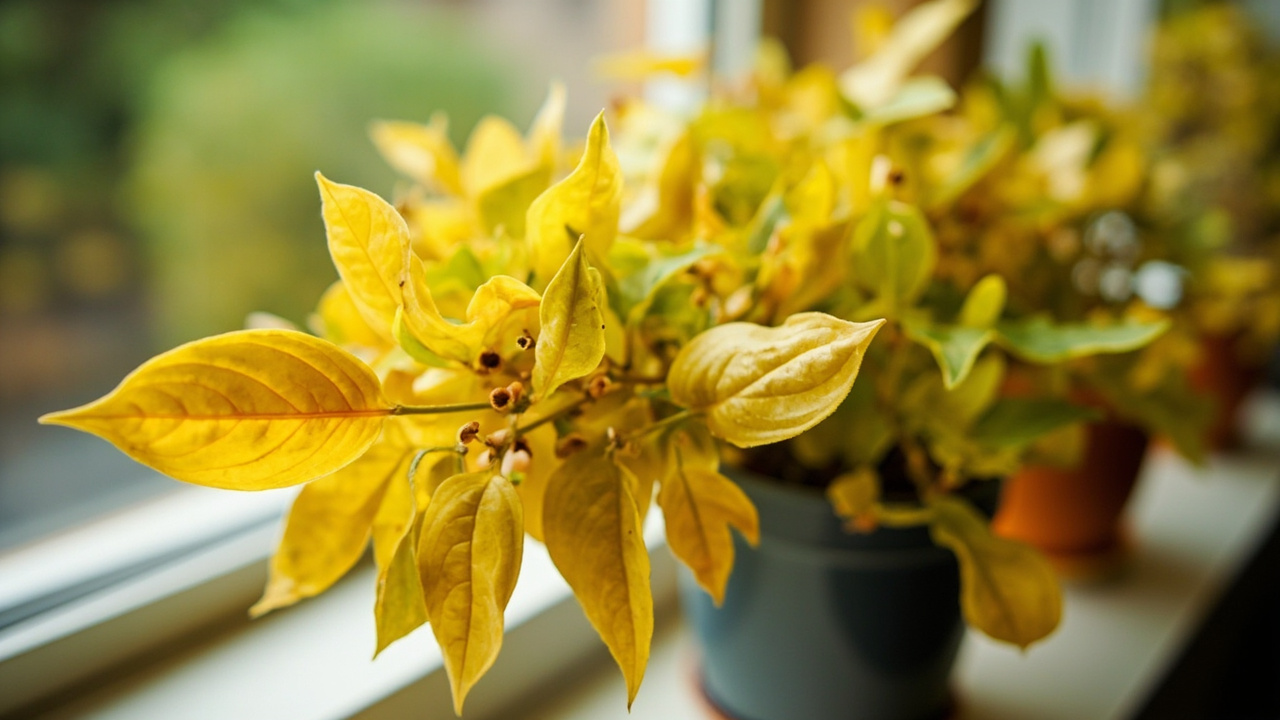
Second, its problems are visible: yellowing from waterlogging appears as dull foliage and leaf drop, while a plant in too little light stretches thin and stops flowering. There is no leaf splitting and no VPD threshold to manage, because there is no large, thin, tropical leaf surface drying out in conditioned air.
Over winter, keep it above 18 F and as bright as you can manage. Below that, Arizona’s red-species guidance applies and shows the pattern: the plant dies back to the ground and regrows in spring. That same recovery, and the ability to be pruned to a few inches above the ground in late winter, is a reasonable container strategy.
Sources and further reading
The species facts and comparisons in this guide come from university extension publications rather than from nursery listings. Here is where the specifics come from:
Bird of Paradise Shrubbery for the Low Desert, publication AZ1634, extension.arizona.edu, University of Arizona Cooperative Extension.
Erythrostemon mexicanus: Mexican Bird of Paradise, Mexican Caesalpinia, publication FP082, ask.ifas.ufl.edu, University of Florida IFAS Extension.
Caesalpinia pulcherrima plant profile, plants.ces.ncsu.edu, NC State Extension Gardener Plant Toolbox.
Last reviewed on 24 November 2026. Updated as new evidence and extension guidance are checked.