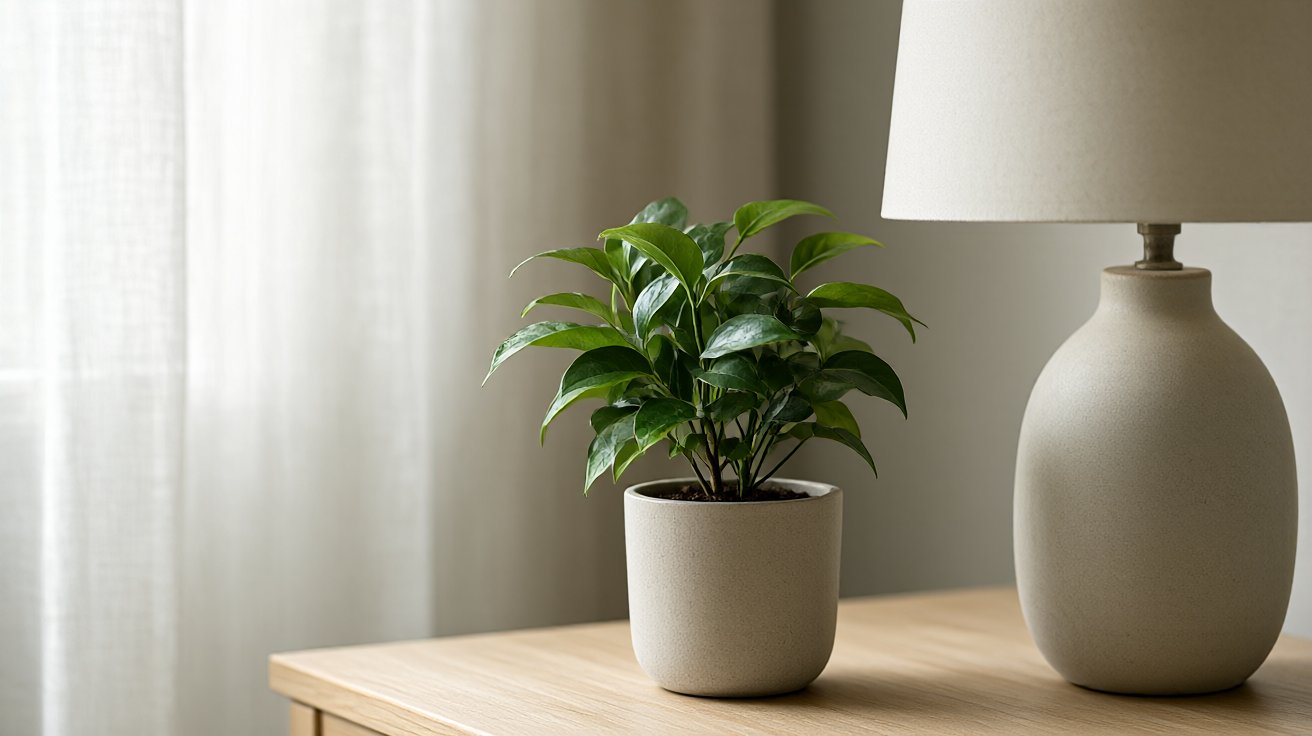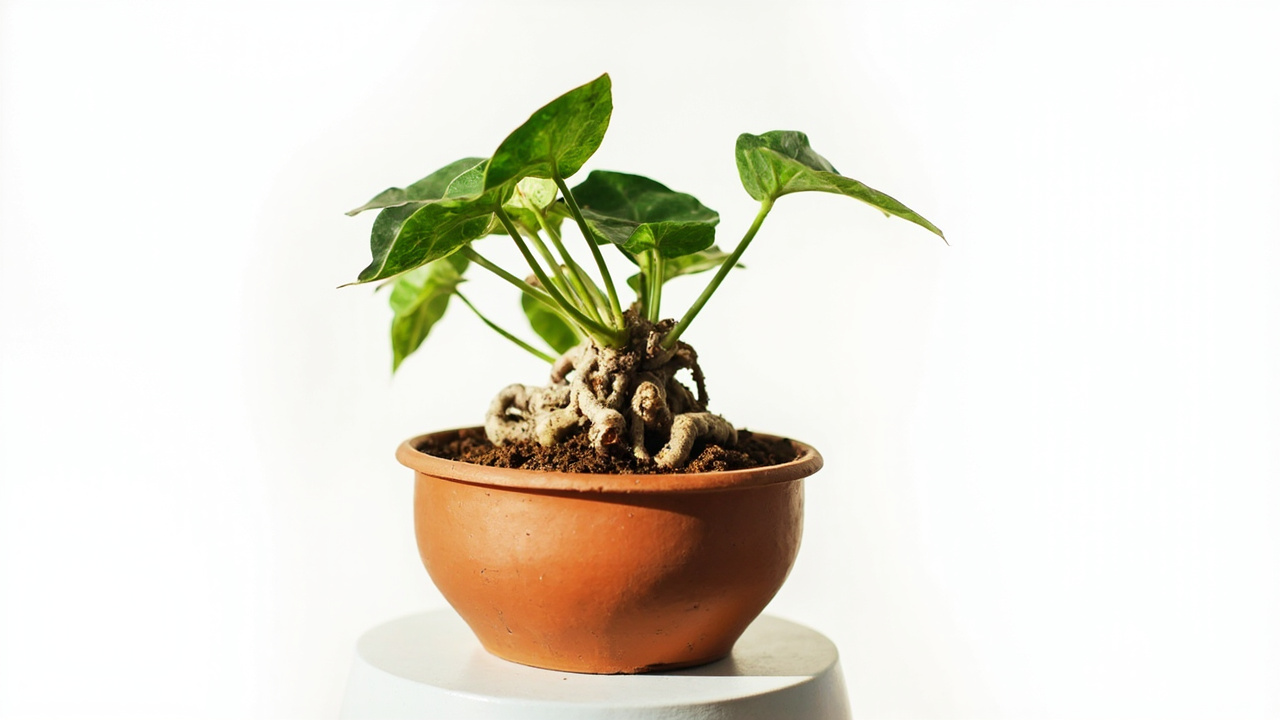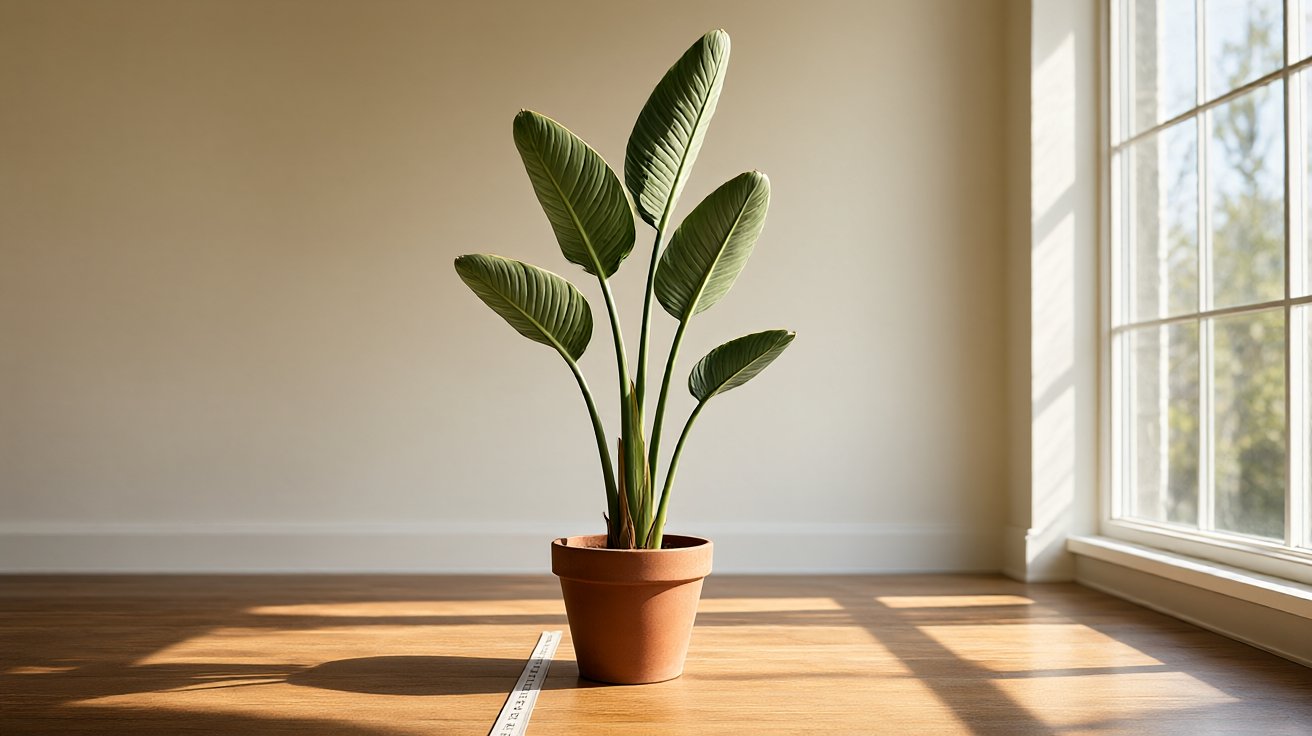

Nobody sells a bird of paradise with a growth rate on the label, and that is exactly why the question gets asked. Extension services are unusually consistent on the answer: Strelitzia reginae is a slow-growing, clumping perennial with fleshy roots that leaves emerge from a crown at the base, and NC State Extension rates its growth rate as medium rather than fast.
A plant bought at 2 feet tall in a 10 inch pot may take a year to add one leaf, and a plant in a bright window may add 6 leaves in a season. Both are normal. The variable is not the plant, it is the light, the water, and the pot.
There is a second reason the question matters. A bird of paradise that grows 5 to 6 feet tall and 3 to 5 feet wide is not going to fit the shelf you had in mind, and a plant that has outgrown its pot can be held back rather than accelerated. This article covers how fast the plant actually grows, what sets the rate, and how big it gets in a pot.
How Fast a Bird of Paradise Actually Grows
The published numbers describe the shape of the plant rather than a per-year figure, because extension services describe mature dimensions and growth class instead. Here is what the authorities actually state.
NC State Extension lists the mature height of Strelitzia reginae at 3 to 4 feet and the mature width at 2 to 4 feet, with a growth rate of medium and a space to plant of 3 to 6 feet. Clemson Cooperative Extension gives a height and width of about 5 feet, with leaves 6 inches wide and 18 inches long on stalks that sometimes reach 5 feet in length.
University of Florida IFAS Extension lists a height of 3 to 5 feet and a spread of 2 to 4 feet, and describes the plant as slow-growing and clumping. The RHS puts the maximum height at 1 to 1.5 metres and the spread at 0.5 to 1 metre, with a time to maturity of 10 to 20 years.
Plan on a mature height of 3 to 5 feet and a spread of 2 to 4 feet, and on reaching that size somewhere between 5 and 10 years after it starts. The leaves, not the stems, are what you measure. The stems are petioles, and a 5 foot stalk carrying an 18 inch blade is one leaf, not a 5 foot plant.
| Source | Mature height | Mature spread | Growth class |
|---|---|---|---|
| NC State Extension | 3 to 4 ft | 2 to 4 ft | Medium |
| Clemson HGIC | about 5 ft | about 5 ft | Not stated |
| UF/IFAS Extension | 3 to 5 ft | 2 to 4 ft | Slow-growing |
| RHS | 1 to 1.5 m | 0.5 to 1 m | Time to maturity 10 to 20 years |
What Actually Sets the Rate
Four variables move the number, and they are the same four that move every other measurement on this plant.
The first is light, and it dominates. A bird of paradise in bright indirect light grows steadily and produces full-size leaves but will not push a flower. The same plant with 6 or more hours of direct sun grows faster and stores the reserves a flower needs.
NC State rates the species as full sun, 6 or more hours of direct sunlight a day, with partial shade of 2 to 6 hours as the alternative. A plant in a dim corner is effectively a foliage plant on a slow clock, and it will tell you through small new leaves and a lean rather than through a slower trunk.
The second is water, and the mechanism is evaporation. A plant in strong light and warm air drives higher transpiration through its stomata, uses more water, and dries faster. Water availability therefore caps the growth rate.
A pot that dries out in 6 days cannot support the growth a pot that stays moist for 12 days can, and this is why a plant moved from a dim spot to a sunny window needs watering more often, not less.
The third is the pot, and the direction of the effect is counter-intuitive. Extension guidance is consistent that plants bloom more profusely when pot-bound. UF/IFAS states that plants seem to flower more freely under crowded conditions and are best left undisturbed.
Wisconsin advises that once the plant is about 3 feet tall you should not be too anxious to repot it, and that replacing the top soil every year or so is enough. Root restriction slows vegetative growth and concentrates the plant’s reserves into flowering. A tight pot produces a slower, shorter plant that blooms sooner.
The fourth is feeding, and it matters more indoors than outdoors. Wisconsin describes these plants as heavy feeders and recommends fertilising every 2 weeks through the summer and monthly in the winter, while NC State advises feeding every 2 weeks in spring and weekly in summer. This is a plant that will use whatever you give it, and the growth response is fastest where the light and water are also generous.
Light sets the ceiling, water sets the supply, and the pot decides which of those you actually get. A plant cannot be pushed to grow fast by feeding it more in a dim corner, because the leaves it makes will be small and the plant will lean to compensate.
How Big It Gets Indoors, and How Tall the Leaves Reach
Mature height is a poor way to judge a bird of paradise, because the structure is unusual. The plant is clumping and multi-stemmed, with leaves arising from a crown at the base rather than from a trunk. University of Wisconsin Extension describes it as a slow-growing, clump-forming plant with fleshy roots, whose leaves grow from a crown at the base and arise alternately, so each clump is somewhat flattened.
Leaf blades are stiff, leathery, concave, and greyish or bluish green with a pale midrib, borne on a long stalk that sometimes reaches up to 2 feet in length. Clemson gives a taller figure for the same structure, with the stalk sometimes reaching 5 feet.
That is the practical point. A 5 foot plant in a pot is usually 2 feet of pot and 3 feet of leaf stalk, and the leaf mass spreads sideways rather than rising. This is also why the plant leans rather than grows tall. The plant reaches for light because the leaves are heavy and the crown is at floor level, so the whole clump tips toward the window, and the space it needs is floor space, not headroom.
The number that matters indoors is the spread, not the height. A mature plant occupies a 2 to 4 foot footprint with leaf blades arching well past the pot rim, and the leaves are what block the light of everything growing beside it.
What the plant looks like at each stage
Seed-grown plants and divisions follow recognisable timelines, and knowing the stage saves a lot of worry. A division with a fan of leaves and roots attached is potted and kept in bright indirect light for 8 weeks while it establishes roots, then moved to bright sunlight.
A seed takes 6 to 12 weeks to emerge and 4 to 7 years to bloom, so a seed-grown plant is a decade-long project rather than a two-year one. A 2 year old plant bought at 2 feet is behaving normally if it has added only 2 or 3 leaves, because it is building root mass and crown first.
How to Measure Your Own Plant’s Growth
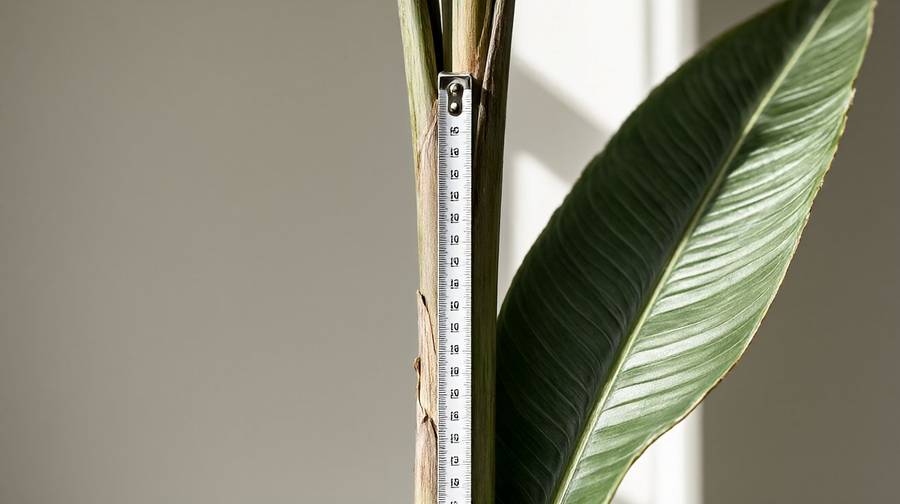
Extension services describe growth class, not inches per year, which leaves you to benchmark your own plant. The method is simple: pick a fixed reference on the plant, measure from it, and record the date. Measure the height of the tallest leaf stalk from the soil line to its tip in inches, count the number of leaves on the clump, and note the pot diameter and the light the plant receives. Write it down and check again 30 days later.
Those three numbers, stalk height in inches, leaf count, and pot size, tell you which of the four levers is actually limiting the plant. A plant whose leaf count rises but whose stalk length does not is putting its energy into leaf area, which is what you want in good light. A plant whose stalk length rises while the leaf count holds steady is stretching for light, and the fix is the window, not the pot.
A plant where both numbers are flat for 30 days is either pot-bound in a small container, which is exactly what it should be doing, or it is in too little light to photosynthesise at a useful rate.
The table below gives the reference values to compare against. The numbers are the published figures for a healthy plant in good light, not targets to chase.
| Measurement | Healthy reference | What a stall means |
|---|---|---|
| Leaf count | 6 to 10 leaves on a mature clump | Under 4 leaves: pot-bound or underlit |
| Tallest stalk length | 12 to 24 inches in a 14 inch pot | Longer than 24 inches with small blades: stretching |
| Leaf blade length | 12 to 18 inches | Under 10 inches: not enough light |
| Daily light | 6 hours of direct sun | Under 4 hours: foliage only, no flowers |
| Watering interval | Every 7 to 10 days in summer | Every 3 to 4 days: light or pot size too high |
| Feeding interval | Every 14 days in summer | Monthly: growth will be slower |
Measure the same three things every 30 days and the plant tells you which lever is wrong. A guess about a bird of paradise’s growth rate is worth far less than a number on a tape measure and a date on a calendar, and the reference values above tell you which of the four variables to change first.
How Growth Rate and Size Relate to What You Can Change
One last piece of context matters for anyone planning around this plant: the ways to hold a bird of paradise at a smaller size, and the reason a big plant tips over, are physical interventions rather than questions of rate.
Root restriction in a smaller pot holds the height down and concentrates the plant’s reserves into flowering, but it does not make the plant grow more slowly in any other sense. Removing old leaves tidies the crown without changing the plant’s dimensions at all. And a leaning plant is almost always leaning toward light, or standing in a pot too narrow for its own weight.
Those three levers, containment, tidying, and rotation, are the subject of a separate guide, which covers exactly how to keep a bird of paradise smaller and upright without stunting it.
Sources and further reading
The growth dimensions and care figures in this guide come from university extension publications and horticultural institutions rather than from plant forums. Here is where the specifics come from:
Strelitzia reginae (Bird of Paradise) plant profile, plants.ces.ncsu.edu, NC State Extension Gardener Plant Toolbox.
Bird of Paradise, Strelitzia reginae, hort.extension.wisc.edu, University of Wisconsin Madison Extension.
Strelitzia reginae Bird of Paradise, publication FPS-563, ask.ifas.ufl.edu, University of Florida IFAS Extension.
Bird of Paradise, factsheet HGIC 1562, hgic.clemson.edu, Clemson Cooperative Extension Home and Garden Information Center.
How to grow strelitzia, rhs.org.uk, Royal Horticultural Society, and Strelitzia reginae plant profile, rhs.org.uk.
Last reviewed on 24 November 2026. Updated as new evidence and extension guidance are checked.