Most gardeners who switch to hydroponics make the same mistake: they grab whatever fertilizer they used for soil and expect it to work the same way. It doesn’t. In soil, there’s a whole ecosystem breaking things down and slowly releasing nutrients. In a hydroponic reservoir, nutrients go straight from the bottle to the root zone with no intermediary. That changes the entire game for what you buy, how you mix it, and how you maintain it over time.
What Makes Hydroponic Fertilizer Actually Different
Soil fertilizers rely on microbial activity and gradual decomposition to make nutrients plant-available. Organic matter breaks down through bacterial and fungal action, converting organic compounds into mineral ions that roots can absorb. This process buffers nutrient delivery — plants get a slow, steady supply regardless of immediate concentration.
In hydroponics, you eliminate that buffer entirely. Every nutrient must already be in the correct ionic form the plant can absorb immediately upon contact with the root zone. If the nutrient isn’t dissolved and available when it enters the reservoir, it isn’t available to the plant at all. This means precision matters more than in soil — both in what products you choose and how you mix them.
The three main nutrient delivery forms you’ll encounter:
- Pre-blended liquid concentrates — two-part or three-part formulations that separate calcium from phosphate (they precipitate when mixed directly). Easier to use, less room for error in mixing. Higher cost per unit of nutrient but more forgiving for beginners.
- Powdered nutrient salts — higher concentration, longer shelf life, more control over exact ratios. Requires accurate weighing and mixing. What professionals use for fine-tuning. The cost savings are significant if you’re running multiple systems.
Either form works. The product type matters less than understanding what you’re actually delivering to the root zone — and the critical difference between the two is the ionic form nitrogen takes.
Nitrogen Forms in Hydroponics: Nitrate vs Ammonium
This is where hydroponic fertilizer chemistry gets practical. Most soil fertilizers deliver nitrogen as ammonium or urea, which convert to nitrate through soil microbial activity. In hydroponics, where there’s no soil biology, you need nitrate-based nitrogen from the start — the plant can’t wait for conversion.
Nitrate (NO₃⁻) is immediately available to roots and promotes fast, compact vegetative growth. Ammonium (NH₄⁺) can cause toxicity at high concentrations in hydroponic systems because roots absorb it directly without the buffer soil provides, leading to accumulation in plant tissue. Most quality hydroponic nutrients are predominantly nitrate-based, with small amounts of ammonium for systems where microbial conversion is possible (rare in pure hydroponics).
What this means for your buying decision: check the label for the nitrogen form. If it doesn’t specify or uses urea as a primary nitrogen source, look for a better-formulated product. Urea-based hydroponic nutrients depend on conversion that doesn’t reliably happen in water culture.
Understanding NPK Numbers in a Soilless Context
Hydroponic nutrients show NPK ratios just like soil fertilizers. But in a soilless system, what those numbers represent — and how they affect plant behaviour — differs from soil growing.
If you’re not familiar with what the NPK numbers mean in general, read what NPK numbers actually mean first. The following builds on that foundation.
- Nitrogen (N) drives leaf growth and green colour. In vegetative growth stages, you’ll run higher nitrogen ratios — something like 3-1-2 or 4-2-3. Too little nitrogen and plants go pale and stunted; too much and you get soft, leggy growth under artificial light that’s especially prone to disease pressure.
- Phosphorus (P) supports root development and early establishment. In seedling and clone stages, a modest phosphorus boost helps establish a strong root system before foliage takes off. During flowering, phosphorus demand increases again for bud development.
- Potassium (K) regulates water management, enzyme activation, and disease resistance. As plants transition from vegetative growth toward flowering or fruiting, potassium demand climbs significantly — a 1-2-3 or 1-3-2 ratio becomes appropriate at this stage.
Most complete hydroponic fertilizers use a ratio like 3-2-1 for vegetative growth and shift toward lower nitrogen with elevated potassium during flowering. Some brands sell separate “grow” and “bloom” formulations; others use a single stable formula designed for all stages and rely on you to adjust application concentration.
For most home hydroponic setups — DWC, NFT, ebb-and-flow — a single balanced or slightly nitrogen-high formula works fine across the entire grow if your light isn’t intense. If you’re running strong LED or HID lighting that drives fast growth, a bloom-oriented formula mid-cycle often produces better results because the plant’s nutrient demand shifts faster than the single-formula products anticipate.
EC and TDS: The Measurements That Actually Matter
NPK ratios tell you the proportions of nutrients in solution. EC (electrical conductivity) and TDS (total dissolved solids) tell you the actual concentration — how much total dissolved salt is present per unit of water. This is the number you adjust as plants grow, not the NPK ratio.
EC Explained
EC measures how effectively the nutrient solution conducts electricity, which correlates to overall dissolved salt concentration. Higher EC means more nutrients in the water. Different crops and growth stages prefer different EC ranges:
- Seedlings and clones: 0.8–1.2 mS/cm — the low end avoids burning delicate new roots
- Vegetative growth: 1.5–2.5 mS/cm — the range for most leafy greens and herbs
- Fruiting and flowering: 2.0–3.5 mS/cm — the higher end for tomatoes, peppers, strawberries
These are guidelines, not absolute rules. The exact EC your plants prefer depends on temperature, light intensity, and the specific crop. Start in the middle of the range and adjust based on plant response — if growth looks vigorous and leaves are deep green, the concentration is right. Pale leaves and slow growth suggest EC is too low; brown leaf tips and hard, crispy growth suggest it’s too high.
TDS and Meter Scales
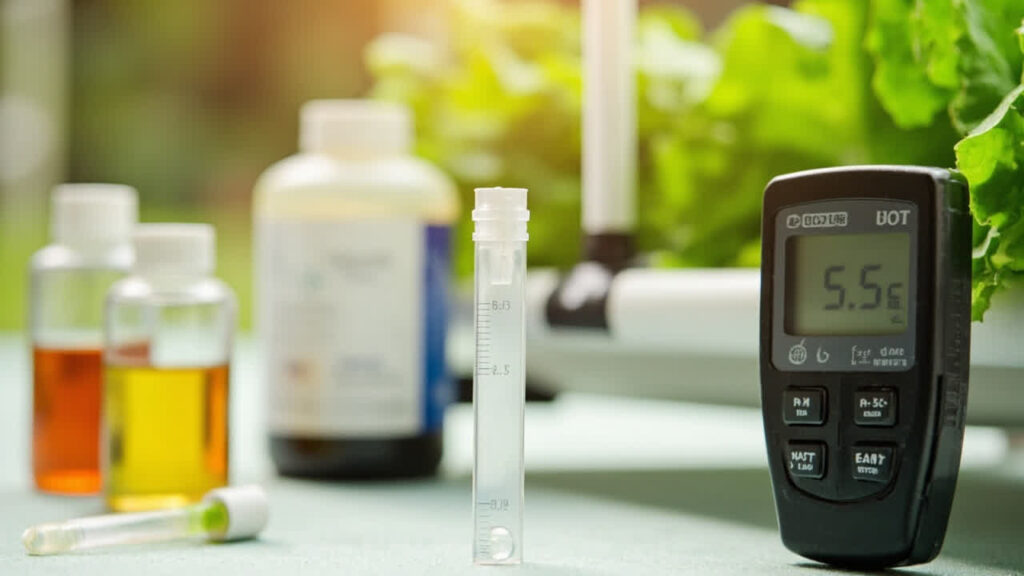
TDS measures the same thing as EC but expresses it in parts per million (ppm). This is where confusion enters: there are two common conversion scales — the 500 scale and the 700 scale — and they don’t agree. A reading of 1000 ppm on a 500 scale meter is approximately equivalent to 1420 ppm on a 700 scale meter. Using the wrong scale makes every reading misleading.
Know which scale your meter uses. It’s in the documentation. If you can’t find it, test with calibration solution (1.41 mS/cm = 700 ppm on the 700 scale, 500 ppm on the 500 scale) to determine which scale you’re reading.
Why You Start Low
The most common beginner mistake in hydroponics is mixing nutrients too concentrated. It seems logical — more food, better growth. But roots in hydroponic systems have no soil buffer to moderate uptake. When concentration is too high, osmotic pressure in the root zone makes water uptake more difficult than it should be, and the plant experiences salt burn that shows up as browning leaf tips, yellowing between veins, and stunted growth. The fix is to always start at half the recommended strength and work up. You can always add more; you can’t easily remove excess salts from a system.
pH: The Other Half of the Equation
Nutrients only become available to plant roots within a specific pH range. In hydroponics, keep your reservoir between 5.5 and 6.5 — slightly on the acidic side. This is the range where the majority of essential nutrients stay soluble and available. Above 6.5, iron, manganese, and phosphorus start to precipitate out even if they’re present in the solution. Below 5.5, calcium, magnesium, and phosphorus become locked out.
The 5.5–6.5 window isn’t arbitrary — it’s where the chemical equilibrium works for the widest range of nutrients simultaneously. Most complete hydroponic nutrient products are formulated to stay within this range when mixed correctly with pH-neutral water.
Check pH daily. It drifts as plants absorb nutrients (they selectively take up certain ions, changing the solution chemistry) and as water evaporates (concentrating everything). Small adjustments with pH up or down solution are normal and expected — the goal isn’t a static number but a stable range. If you’re adjusting more than 0.3 pH points per day, something else is wrong (usually reservoir temperature, nutrient concentration, or plant load being mismatched for the system size).
pH in hydroponics explained goes deeper on the chemistry, including how to handle hard water situations where your source water pushes pH upward continuously.
What to Buy and What to Skip
For a home hydroponic setup, a quality two-part liquid nutrient system covers most needs without overcomplicating things. Look for products that list specific micronutrients — iron (Fe), manganese (Mn), zinc (Zn), copper (Cu), boron (B), molybdenum (Mo) — not just NPK. Plants need these in small quantities but can’t grow properly without them. The micronutrient package is where cheap fertilizers cut corners.
Skip expensive hydroponics-specific products marketed at double or triple the price of a well-formulated general hydroponic nutrient. For home-scale DWC and NFT systems, any major brand’s two-part system works adequately. The brand matters less than mixing accurately and maintaining pH and EC consistently. A gardener who mixes precisely at lower concentration will always outperform a gardener using premium products carelessly.
If you’re running deep water culture, avoid products with high phosphorus in early stages — it can encourage algae pressure in the reservoir, which competes with roots for oxygen and nutrients. For DWC specifically, the fertilizer approach described in deep water culture hydroponics covers the system-specific adjustments that matter.
When Organic Fertilizers Make Sense in Hydroponics
Organic hydroponic fertilizers exist, but they’re fundamentally different from synthetic options. They rely on microbial breakdown to make nutrients available — which means the mechanism that works in soil is partially lost in a hydroponic context where biological activity is minimal. If you’re considering organic options for hydroponics, understand the trade-offs before committing.
See organic hydroponic fertilizers for a full breakdown of what organic approaches can and can’t do in water culture.
Maintenance: The Routine That Actually Keeps Systems Running
Mix fresh nutrients every 1–2 weeks. Old nutrient solution accumulates waste salts and loses proper ratio balance as plants absorb selectively. The selective absorption is the key problem — plants don’t take up all nutrients equally. They might consume nitrogen rapidly while leaving phosphorus relatively untouched, gradually skewing the solution’s ratio away from what you mixed. “Topping off” a reservoir with plain water dilutes everything and worsens the ratio problem. Either change the reservoir completely with fresh mix, or mix a new batch to replace exactly what was absorbed.
Clean your reservoir between grows, not just between nutrient changes. Algae biofilm, salt deposits, and decomposed root matter accumulate on surfaces and become breeding grounds for root pathogens like Pythium. A 15-minute clean with food-grade hydrogen peroxide between cycles prevents more problems than any fertilizer brand can solve.
If you see signs of deficiency — interveinal yellowing, purplish stems, or browning edges — check your pH first. Most deficiency symptoms in hydroponics are pH problems in disguise. If the pH is within range and deficiency persists, check your EC against the target range for your crop and growth stage. pH corrected, EC in range, deficiency continuing: then consider whether your nutrient product’s micronutrient package is adequate.

Bottom Line
Hydroponic fertilizer isn’t complicated — it just requires understanding that you’re delivering nutrients directly with no soil buffer. The practical implications: mix at half-strength and work up, check pH daily, check EC every 2–3 days, change the reservoir every 1–2 weeks, and clean between every cycle. A quality two-part liquid system with complete micronutrients covers 95% of home hydroponic needs. The fertilizer brand matters far less than the consistency of your maintenance routine.
Turn any PDF statement into a clean sheet
Skip the typos and the hours of copying. Our converter handles any bank statement format and outputs Excel, CSV, or QBO for QuickBooks. No file retention, free to try.
Convert your statement