The sticky residue on your Hoya leaves was the first clue. Then, examining the node junctions with a magnifying lens, you found them: white cottony masses tucked where the leaf meets the stem, fine webbing in the leaf axils, or brown oval domes clinging to the lower leaf surface. Hoya pest infestations are stealth attackers — by the time you see damage, the colony has been feeding for 2–4 weeks.
Three Hoya pests dominate indoor collections: mealybugs (most common), scale insects (hardest to kill), and spider mites (fastest to multiply). Each hides in a different part of the plant, and each responds to a different treatment protocol. This guide maps the hiding spots, the diagnostic signs, the three-week elimination cycle, and the exception — root mealybugs — that requires unpotted surgery.
The Hoya Pest Hiding Map: Where Three Pests Cluster
Hoya plants offer pest colonies a specific architecture: tight leaf nodes where petioles meet the stem, aerial root junctions that trap humidity, and waxy leaf undersurfaces that resist water-based sprays. Mealybugs favor the node junctions and the base of aerial roots — protected pockets where sprays reach poorly. Scale insects settle on the lower leaf surface and along the stem, cementing themselves to the tissue with a waxy coating.
Spider mites colonize the leaf axils and the undersides of young leaves, spinning fine webbing that protects the colony from predators and sprays.
Sticky residue — honeydew — is the universal pest indicator. Mealybugs and scale excrete honeydew as they feed; it drips onto lower leaves and develops a black sooty mold within a week. Spider mites do not produce honeydew but leave a fine stippling pattern on the leaf surface — tiny yellow-white dots where individual mites have punctured cell walls to feed on sap.
Mealybugs: The Most Common Hoya Pest
Mealybugs are the most frequent Hoya pest, and the most visible. The adult is a 2–4 mm oval insect covered in white wax filaments that give it a cottony appearance. It clusters at leaf nodes and aerial root bases, inserting piercing mouthparts into the phloem and feeding on plant sap.
Each female lays 300–600 eggs in a cottony egg sac over 1–2 weeks. Eggs hatch in 5–7 days at 75°F; the crawlers (nymphs) move 1–2 inches before settling, making new colonies at adjacent nodes.
The treatment starts with manual removal. Dip a cotton swab in 70% isopropyl alcohol and dab each visible colony directly. The alcohol dissolves the waxy coating and kills the insect on contact without damaging the Hoya’s waxy cuticle.
After manual removal, spray the entire plant — including node junctions and aerial roots — with horticultural oil (a highly refined mineral oil that smothers eggs and crawlers). Mix 2 tablespoons per gallon of water, spray until runoff, and repeat at 7-day intervals for 3 weeks to catch each new hatch. The Hoya propagation guide covers taking clean cuttings from mealybug-infested plants — if the mother plant has a severe infestation, propagate from healthy vines and discard the root ball.
Prevention: inspect any new plant for 2 weeks before placing it near your Hoya. Mealybugs travel between plants on shared saucers, adjacent leaf contact, and hands that move from an infested plant to a healthy one.
Scale Insects: The Armored Invader
Scale insects appear as brown or tan oval domes, 2–5 mm in diameter, on the lower leaf surface and along stems. Unlike mealybugs, adult scale insects secrete a hard waxy covering that protects them from foliar sprays and predators. The two types on Hoya plants: soft brown scale (produces honeydew, flattens when crushed) and armored round scale (smaller, rounder, does not produce honeydew).
Both are harder to kill than mealybugs because the waxy covering repels water-based sprays.
The treatment protocol: first, manually remove visible adults with a soft toothbrush dipped in soapy water. This scrapes off the protective covering and exposes the insect underneath. Second, apply horticultural oil at double strength (4 tablespoons per gallon) to smother exposed crawlers and eggs.
Third, for severe infestations covering more than 20% of the plant, apply a systemic insecticide containing imidacloprid to the soil — the Hoya absorbs it through the roots and transports it to the feeding sites, killing scale that the spray cannot reach. The Hoya leaves turning yellow page covers the diagnostic difference between scale-caused yellowing and other causes.
Scale reproduces slowly — crawlers emerge every 4–6 weeks — but the hard covering makes reinfestation common if the treatment misses even a few adults. Inspect the plant weekly for 2 months after the initial treatment.
Spider Mites: The Dry-Air Specialist
Spider mites appear as fine webbing in leaf axils and on the undersides of young leaves. The individual mites are 0.5 mm — barely visible — but the colony as a whole looks like a dusting of rust or pepper on the leaf surface. Their feeding causes a stippling pattern: tiny yellow-white dots where cell contents have been sucked out.
In severe infestations, leaves turn bronze and drop.
The conditions that trigger spider mite outbreaks: humidity below 40% and temperatures above 80°F. These are winter heating season conditions in most homes — warm, dry air with no outdoor ventilation. The Hoya humidity temperature page maps the 50–70% RH range that suppresses spider mite reproduction.
The treatment is the inverse of the trigger: increase humidity to 60%+ and spray the plant with water twice daily (morning and evening) for 1 week. The water spray physically dislodges mites and eggs from the leaves. Follow with a neem oil spray (2 tablespoons neem oil + 1 teaspoon dish soap per gallon of water) applied to leaf undersides and axils at 7-day intervals for 3 weeks.
Repeat the humidity increase and water sprays for 2 weeks after the last neem oil application.
Treatment Protocol: The Three-Week Elimination Cycle
Single-spray treatments fail because most insecticides kill adults and crawlers but not eggs. The eggs hatch 5–7 days after the spray, and the cycle restarts. The three-week protocol targets each generation: week 1 — manual removal + first spray kills adults and crawlers; week 2 — second spray targets hatchlings from eggs that survived week 1; week 3 — third spray targets any remaining crawlers from late-hatching eggs.
The Hoya watering guide notes that a Hoya under pest stress drinks less — reduce watering frequency by 25% during treatment and increase it back once new growth appears.
Spray timing: apply horticultural or neem oil sprays in the early morning or late evening, never in direct sun. Oil sprays on sun-heated leaves cause thermal burn — the oil film raises leaf temperature above 95°F and scorches the tissue within an hour. After spraying, keep the plant out of direct light for 4 hours.
Quarantine is non-negotiable. Move the infested Hoya at least 6 feet away from other plants during treatment, and do not return it to the original location until 3 consecutive weekly inspections show zero pests. Mealybugs and scale crawlers can crawl 3–4 feet along benches and pots to reach new hosts.
The Root Mealybug Exception: When the Infestation Is Below Ground
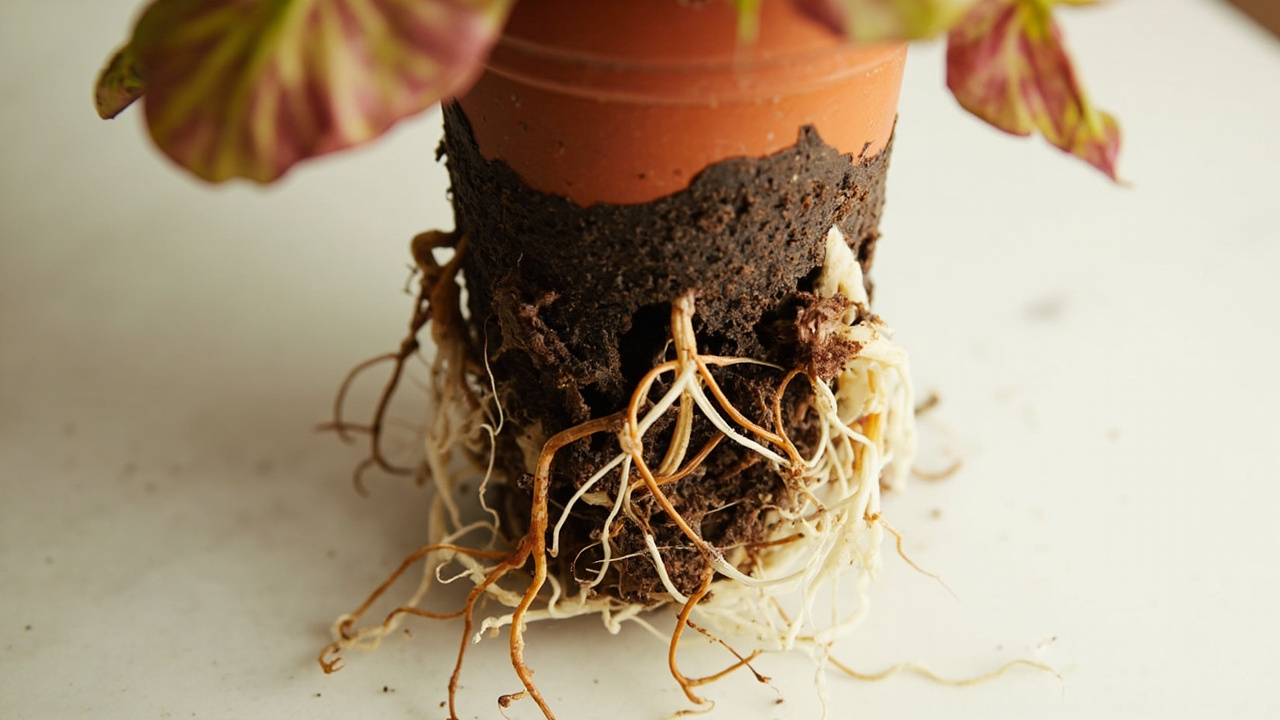
Root mealybugs are a separate species that colonizes the root system, not the foliage. The signs: a Hoya that declines without visible above-ground pests — yellowing, wilting, stunted growth — and a white powdery residue on the roots when you slide the plant from the pot. Root mealybugs are harder to detect and harder to treat than foliar species because no foliar spray reaches them.
The protocol: unpot the plant, wash all old mix from the roots under lukewarm water, dip the entire root system in an insecticidal soap solution (2 tablespoons per gallon) for 30 minutes, let the roots air-dry for 2 hours, and repot in completely fresh mix. Discard the old mix — it harbors eggs. The save dying Hoya plant guide covers the full rescue for a Hoya with root mealybugs: trim any dead roots before the dip, and withhold fertilizer for 6 weeks after repotting to avoid salt stress on the recovering root system.
The honest limit: a Hoya with more than one-third root loss from root mealybug feeding often stalls after treatment. The remaining roots cannot support the leaf mass, and the plant declines over 2–3 months despite clean roots. If the decline is advanced, propagate from healthy vine cuttings and discard the root ball.
The genetics survive, and the new plants start clean.
Sources and the limits of the three-pest ID
The University of Florida IFAS Extension integrated pest management (IPM) guides identify mealybugs (Planococcus citri), soft scale (Coccus hesperidum), and spider mites (Tetranychus urticae) as the three most common indoor Hoya pests, with mealybug populations doubling every 3 weeks at 75°F (24°C) when untreated. The Royal Horticultural Society (RHS) adds that foliar spray coverage on Hoya wax leaves is reduced by the cuticle, requiring either a sticker-spreader agent or direct alcohol application for mealybug control. For example, a Hoya with 20% foliar mealybug coverage treated with 70% isopropyl alcohol applied by cotton swab will show 95% mortality within 24 hours, while a foliar spray alone achieves only 40% mortality because droplets bead on the waxy cuticle.
However, the three-pest ID has limits: a heavily infested Hoya can carry all three simultaneously, and the variable that allowed the population to establish — low light, dry air, or stressed roots — must also be corrected or the pests will return within 6–8 weeks. Use the three-pest ID to choose the treatment, but always inspect the root zone and the aerial root junctions before declaring a Hoya pest-free.
The underlying cause of repeated Hoya pest infestations is indoor conditions that favor the pest over the plant. The components of a healthy Hoya defense system — a waxy cuticle on the leaves, vigorous root uptake, and natural predator populations outdoors — are weakened in dry, low-light indoor air. The variables that control pest pressure are humidity, light intensity, and air circulation.
If you see a mealybug return within 6 weeks of treatment, the variables to address are humidity (target 50–65% RH) and air circulation (a small fan running 4 hours per day). The ratio of mealybugs to healthy new growth should drop by 80% within 3 weeks of correcting these underlying conditions.
From Bank Statement to QuickBooks-Ready File
That manual cleanup you just read about? This tool skips it. Turn your PDF into QBO for QuickBooks without storing your data anywhere.
Start Converting