The most common reason a blueberry bush looks sick — yellow leaves, stunted growth, no fruit — has nothing to do with the amount of fertilizer applied. It is the soil pH. When pH drifts above 5.5, blueberry roots cannot access the iron and manganese they need regardless of how much fertilizer is in the soil.
This is not intuitive. Most gardeners assume that if a plant is yellowing, it needs more of whatever nutrient is missing. The save a dying blueberry plant guide covers the visual symptoms that distinguish pH-induced chlorosis from actual nutrient deficiency.. So they add iron — and the plant doesn’t improve. The iron is there, but at pH 6.0 or higher, the roots simply cannot absorb it.
Understanding pH, how to test it, and how to adjust it — this is the technical foundation that makes everything else in blueberry care work.
What pH Actually Is and Why It Matters for Blueberries
pH measures the concentration of hydrogen ions in the soil solution — specifically, whether the soil is acidic, neutral, or alkaline. The scale runs from 0 to 14, with 7.0 as neutral. Values below 7.0 are acidic; values above are alkaline.
Blueberries evolved in the forest floor of eastern North America, where decades of decomposing pine needles and oak leaves create a naturally acidic soil environment. The pH range of 4.5 to 5.5 is where blueberry roots function best — the soil chemistry at this pH keeps iron, manganese, and phosphorus in forms that blueberry roots can absorb.
Above pH 5.5, the chemistry changes. Iron and manganese become less soluble — they stay in the soil but in forms the roots cannot access. The plant shows deficiency symptoms despite adequate nutrient levels in the soil. This is called “induced deficiency” and it is the most common cause of chlorosis in blueberry bushes.
Below pH 4.5, the soil becomes too acidic for healthy root function. Aluminum and manganese can reach toxic levels, and beneficial soil microorganisms are inhibited. The goal is 4.5 to 5.5 — not as acidic as possible, but the specific range where blueberries thrive.
—
How to Test Soil pH for Blueberries
Testing tools:
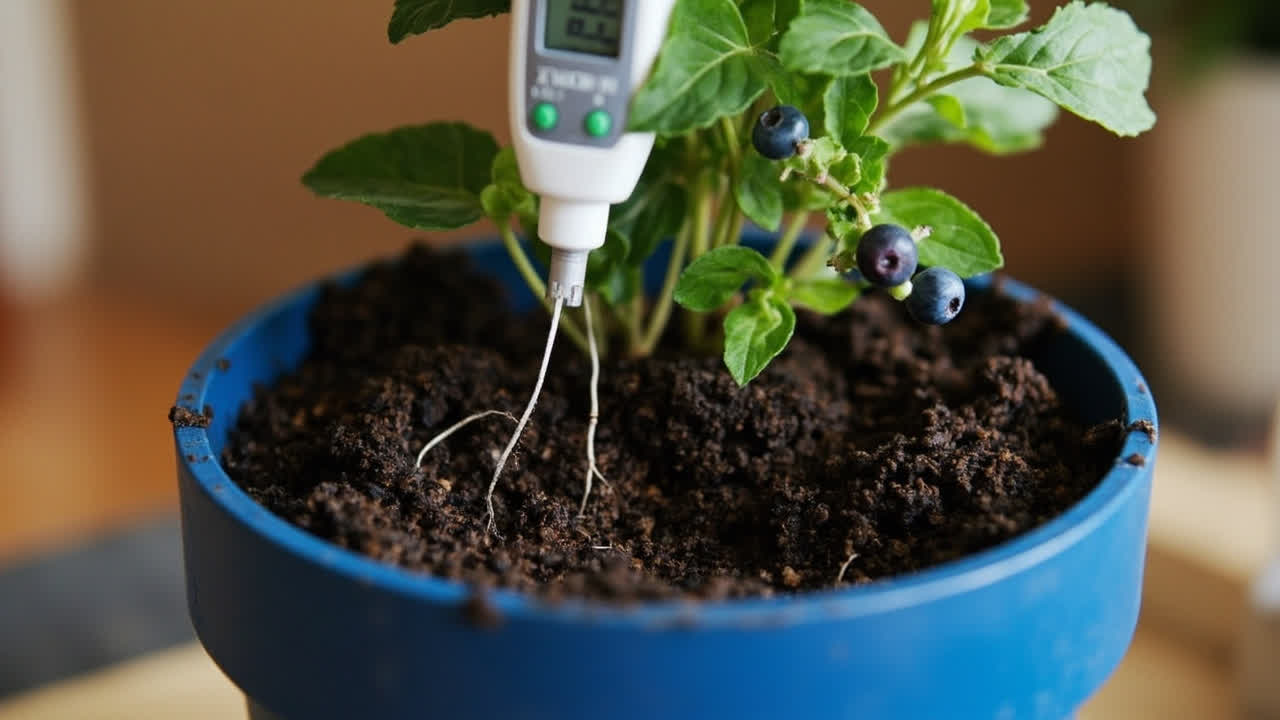
Digital pH meters are the most accurate option for home use. Insert the probe into moist soil at the base of the bush, at six inches depth. Take readings in three to four spots around the root zone and average them.
Soil test kits (dye-based) work well enough for a general reading and cost less. Follow the kit instructions precisely — the color reading is approximate and depends on following the procedure exactly.
Laboratory soil tests (through your local extension service) give the most accurate results and also provide complete nutrient level analysis. Most extension services offer soil testing for a small fee or free. Submit samples from the root zone area specifically for the blueberry, not just a general garden sample.
How often to test:
Before planting any blueberries — test and correct soil at least one full season before planting, ideally the fall before a spring planting.
Every spring for the first three years as the plant establishes.
Annually for container blueberries, where pH can drift in either direction faster than in-ground plantings.
Every two to three years for established in-ground bushes once you have established the pH baseline and confirmed it is stable.
—
Turn That PDF Into a Spreadsheet in Minutes
You've seen how to do it manually — now let the tool handle the heavy lifting. Upload your bank statement and get Excel, CSV, or QBO in a few clicks.
Try It FreeAdjusting Soil pH : Lowering Acidity
Elemental sulfur: The most reliable way to lower soil pH for blueberries. Sulfur converts to sulfuric acid through soil microbial activity, which acidifies the root zone. The conversion is slow — it takes three to four months for sulfur to fully affect pH — so plan ahead.
Application rate depends on soil type:
Sandy soil — One pound of elemental sulfur per 100 square feet lowers pH by approximately 0.5 units.
Loam (average garden soil) — One and a half to two pounds per 100 square feet for the same 0.5 unit change.
Clay soil — Two to three pounds per 100 square feet for the same change.
Apply sulfur in fall for spring planting — align the application timing with the late-winter pruning schedule so that soil correction and cane removal happen together, or at least three months before you need the pH adjusted. Retest before planting or before applying additional sulfur.
Ammonium sulfate: A nitrogen fertilizer that also acidifies the soil. Each time ammonium converts to nitrate in the soil, it releases hydrogen ions that lower pH. For established bushes, ammonium sulfate is both a fertilizer and a pH maintenance tool — apply in early spring as the first fertilizer application of the season.
For container soil that has drifted above 5.5: use aluminum sulfate or sulfuric acid amendments labeled for container use. For the full container growing context and winter care that affects soil stability, our growing blueberries at home guide covers container soil maintenance across all seasons. or sulfuric acid amendments labeled for container use. Elemental sulfur is too slow for container correction.
—
Fertilizing Blueberries : The Nitrogen Priority
Blueberries are heavy nitrogen feeders. The primary nutrient they need is nitrogen, and the form matters.
Ammonium sulfate (21-0-0): The preferred nitrogen source for blueberries. The ammonium form of nitrogen is taken up by blueberry roots more efficiently than nitrate, and it acidifies the soil as it converts. Apply one to two ounces per mature bush in early spring as growth begins, and again after harvest in early summer.
Urea (46-0-0): A slow-release nitrogen source that also acidifies the soil as it converts. Use at roughly the same rate as ammonium sulfate (the actual nitrogen content is higher, so use proportionally less).
Avoid on blueberries:
Calcium nitrate and potassium nitrate — The nitrate form of nitrogen raises soil pH and is not efficiently used by blueberry roots.
Standard all-purpose fertilizers (like 10-10-10) — These are typically nitrate-based and may raise pH. They also have phosphorus and potassium levels that may be excessive for blueberries.
—
Secondary Nutrients and Deficiency Symptoms
Iron (Fe): Blueberries need more iron than most plants, and it is the nutrient most likely to be present but unavailable due to high pH. Deficiency symptoms: yellowing between green leaf veins (interveinal chlorosis), most visible on new growth. Cause: almost always pH above 5.5, not actual iron deficiency. Fix: correct pH, then iron becomes available.
Manganese (Mn): Also unavailable when pH is above 5.5. Deficiency: interveinal chlorosis similar to iron, but with necrotic spots forming on older leaves. Again, this is almost always a pH problem.
Phosphorus (P): Blueberries don’t need high phosphorus levels. Excessive phosphorus interferes with iron and zinc uptake. Only apply phosphorus if a soil test shows deficiency.
Potassium (K): Deficiency shows as browning leaf edges and poor fruit quality. Apply potassium sulfate if soil test indicates deficiency.
Soil pH is the master variable in blueberry health. Everything else — watering, pruning, variety selection — works only when the pH is in the right range. A blueberry bush in correctly acidic soil absorbs nutrients efficiently, resists disease, and produces the fruit you planted it for. A blueberry bush in neutral or alkaline soil struggles to survive no matter how much you feed it.