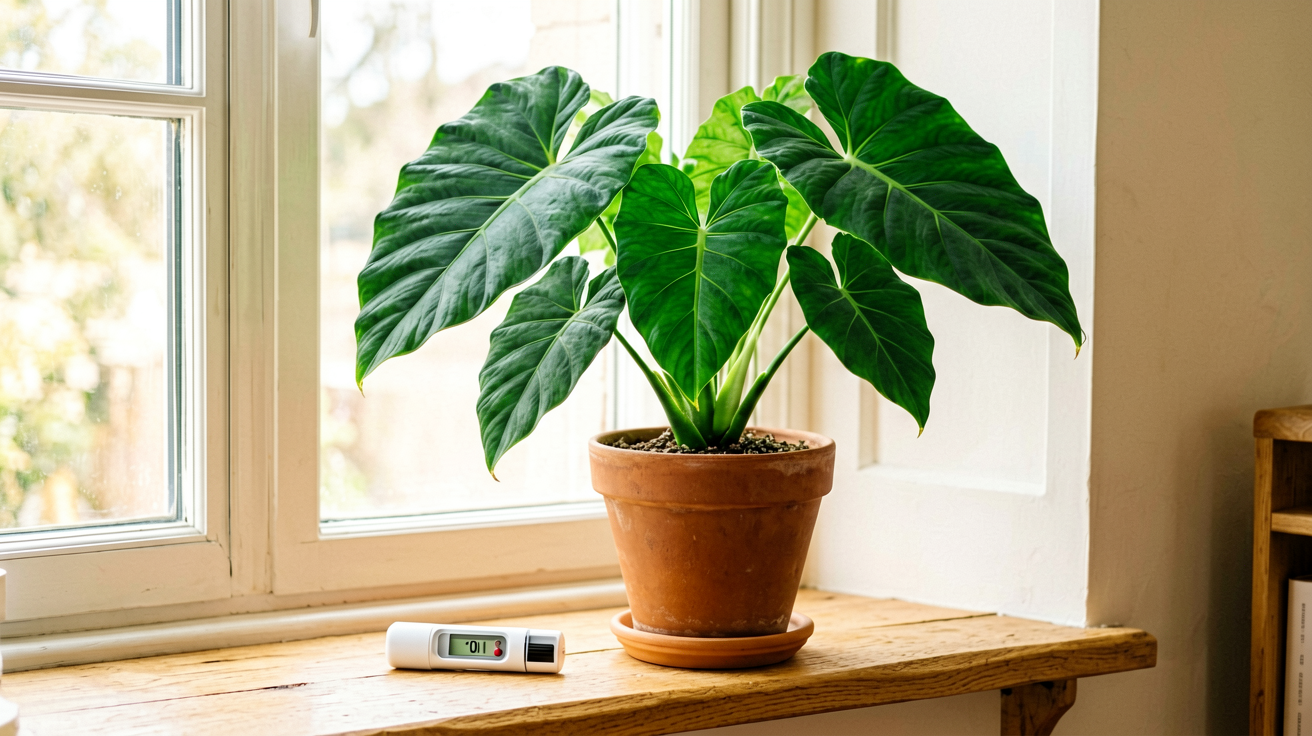
Alocasias want genuinely high humidity — 60 to 80% relative humidity is the working range, with most species doing best at the higher end. Standard household humidity in the 30 to 45% range is too dry for an alocasia and almost always shows up as crispy leaf edges, yellowing, and a slow decline that looks mysterious until you check the hygrometer. A digital hygrometer at the plant’s level is the only reliable way to know what the local air is actually doing.
Why Alocasias Need More Humidity Than Most Houseplants
Alocasias evolved on the forest floor of tropical Southeast Asia, where humidity stays between 75 and 95% year-round. The large, broad leaves are designed to release water vapor slowly through their stomata, in conditions where the surrounding air is already nearly saturated. Bring that plant into a typical living room at 35 to 45% humidity and the leaf loses water faster than the roots can replace it, which is why the leaf tips and margins crisp up first.
Alocasia leaves are also thinner and more delicate than philodendron or monstera leaves, so they show humidity stress earlier. A brown, papery edge that is only a few millimetres wide on a small alocasia leaf is the equivalent of a much larger patch of damage on a heartleaf philodendron, because the plant has less leaf area to spare. The same humidity that keeps a philodendron happy is usually not enough for an alocasia.
The Working Humidity Range by Alocasia Type
Not every alocasia wants the same humidity, and a few species are more tolerant of average household air than the rest.
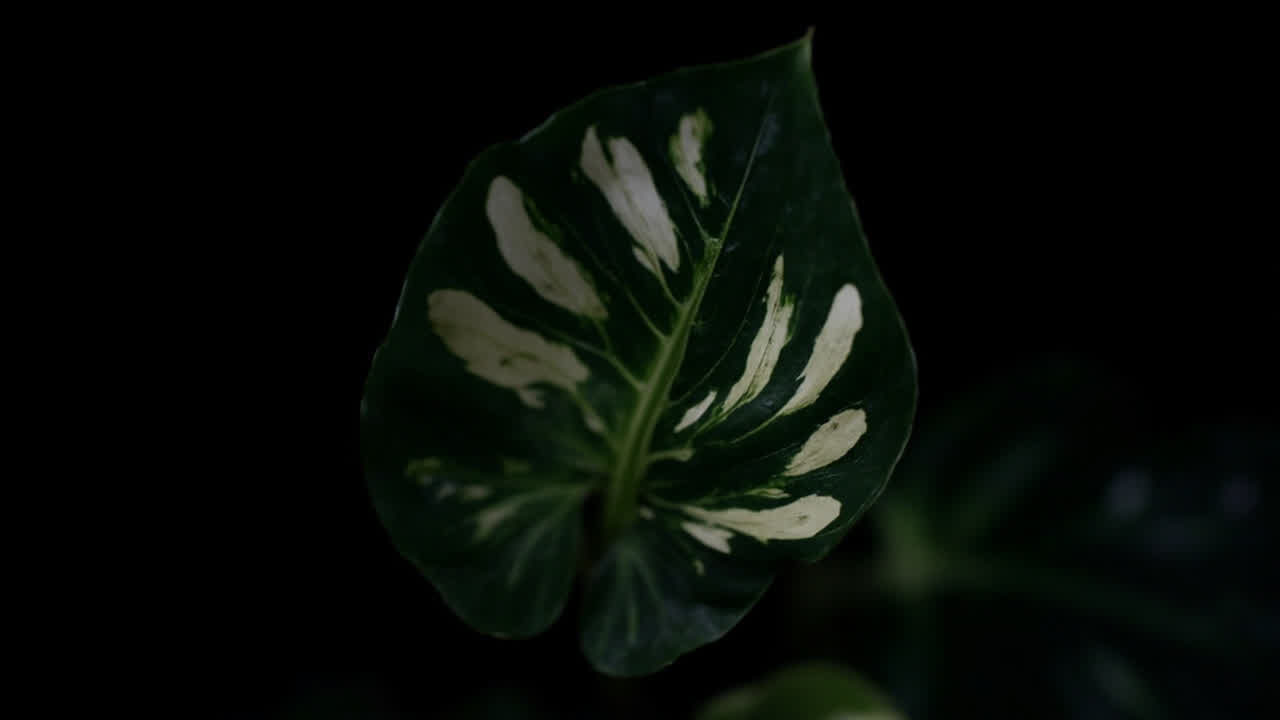
- Jewel alocasias (Polly, Amazonica, Black Velvet, Dragon Scale, Silver Dragon, Cuprea): 65 to 80%. The thick, textured leaves can hold moisture a little better than the smooth-leaved types, but they are still humidity-sensitive and prefer the higher end of the range.
- Large smooth-leaved alocasias (Calidora, Zebrina, Macrorrhizos, Stingray): 60 to 75%. The bigger leaves lose more water per hour, so a steady reading in the middle of the range works well, with a small humidity boost in winter when indoor air dries out.
- Tolerable alocasias (Zebrina is borderline; Polly and Amazonica are the most common household types): 55% as a floor, but the plant will look noticeably better at 65% and above.
The most useful single number is 65% as a floor for almost every alocasia, with 70 to 75% being the safer target for jewel types. Going above 85% for prolonged periods is usually a mistake indoors, because the leaf surface stays wet enough to invite fungal spotting.
How to Measure Humidity the Right Way
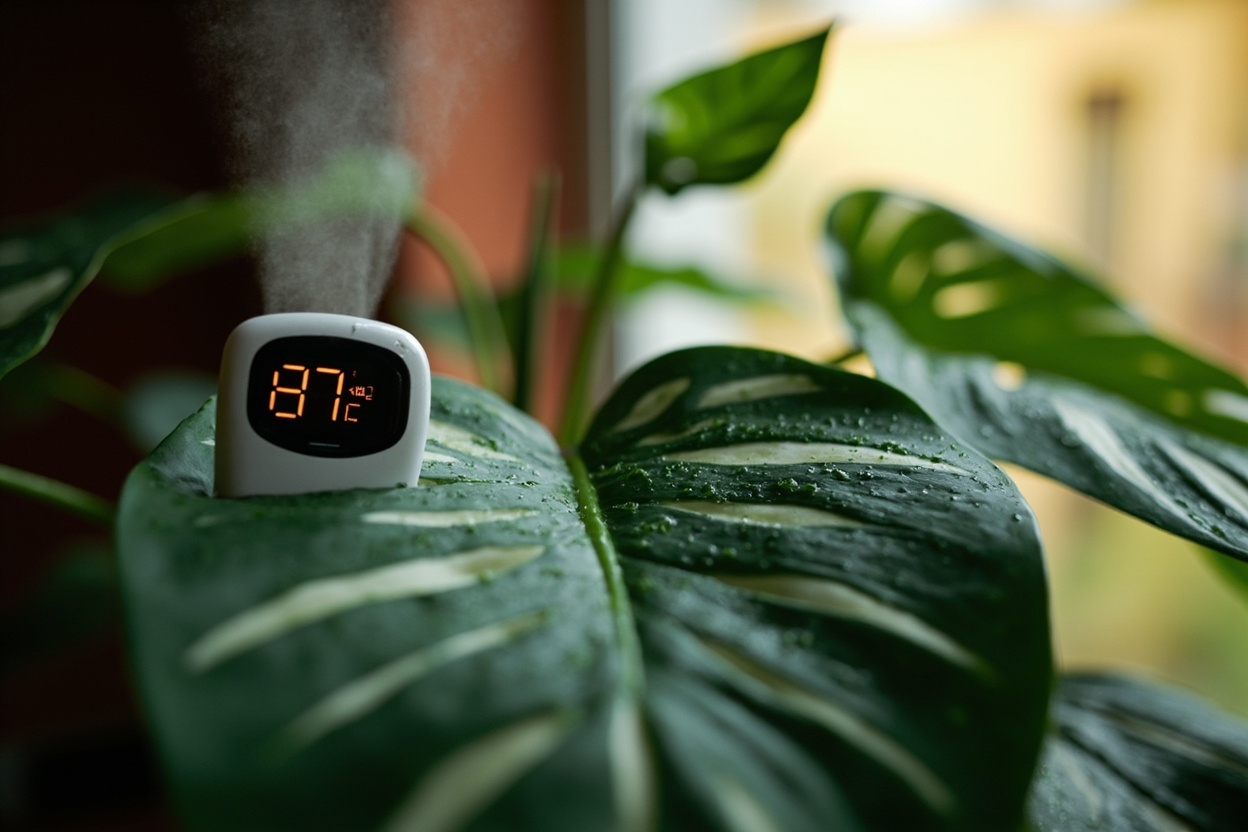
A small digital hygrometer placed at the plant’s level, not at eye level, is the single most useful tool. A unit that costs a few dollars and sits on the shelf next to the alocasia gives a real, repeatable number. The midday reading matters most, because humidity is usually lowest when the room is warmest and most active. Check the morning, midday, and evening readings for a week to see the full range and the average.
Watch the daily swing as well as the average. A room that holds 65% during the day and 40% overnight is harder on the plant than a room that holds steady at 55% all day, because the leaves cannot adapt quickly to that range. The goal is a stable reading inside the working band, not a single peak number that only happens in the morning.
Reliable Ways to Raise Humidity Around the Plant
A small humidifier set to 65 to 70% on a hygrostat is the most controllable option. Cool-mist ultrasonic humidifiers are quiet and energy-efficient, and they let the grower dial in a target humidity that holds steady day and night. Two rules: keep the humidifier a few feet from the plant (so the leaves do not stay constantly wet) and run it with good air circulation in the room to prevent stagnant, overly humid pockets that encourage fungal growth.
Grouping plants together is the cheapest and most reliable first step. Each plant releases water vapor through transpiration, and a cluster of three to five humidity-loving plants in the same area can lift the local humidity by 5 to 10 percentage points compared to the rest of the room. A pebble tray with water in the base of the pot works for a small lift of 3 to 5%, but it must be cleaned and refilled regularly to prevent mosquito breeding and mineral buildup.
Why Misting Is Not the Answer for Alocasias
Misting is the most common humidity myth, and it is especially unhelpful for alocasias. The water on the leaves evaporates within minutes, so it does almost nothing to raise the ambient humidity around the plant. Worse, frequent misting leaves a thin film of minerals on the leaf surface, especially in hard-water areas, and the constant wet-then-dry cycle is exactly the pattern that triggers fungal leaf spot — and alocasia leaves are particularly prone to that.
The one situation where misting has value is on propagation divisions with no roots yet, where the leaf is the only source of moisture. For an established alocasia, skip the spray bottle and put the effort into a humidifier or a larger plant cluster instead.
Signs That Humidity Is Too Low
Three visible signs tell you the humidity is consistently below the working range. First, brown, crispy leaf tips and edges, often starting on the older leaves and the leaf with the most exposure to the room air. Second, leaves that curl slightly inward at the edges, or that develop a slight cup shape, as a way of reducing the surface area exposed to dry air. Third, slower growth in the active season, with new leaves emerging smaller than the previous ones or stalling partway through unfurling.
It is worth distinguishing low humidity from underwatering. A plant that is consistently underwatered usually has limp leaves and dry soil. An alocasia in low humidity has firm leaves with crisp edges and soil that is moist but not waterlogged. The two are easy to confuse, which is why a hygrometer reading is the only honest confirmation.
Signs That Humidity Is Too High
High humidity is less common indoors but does happen, especially in summer in naturally humid climates, or around a humidifier set too high. The early sign is small, dark, water-soaked spots on the leaves, often ringed with a yellow halo, which is the start of a fungal or bacterial leaf spot. Left unchecked, the spots merge, the affected leaves drop, and the infection can spread to nearby plants.
Alocasias are especially vulnerable to leaf spot because their large leaves hold moisture on the surface for a long time. The fix is to drop the humidifier setting to 65%, increase air circulation with a small oscillating fan set on low for a few hours a day, and remove the most heavily spotted leaves so the spores do not spread. The plant will usually push out a new clean leaf once the conditions settle.
Matching Humidity to Light and Watering
Humidity does not work in isolation. An alocasia in bright indirect light, with a chunky alocasia soil mix and a steady watering routine, will use the humidity more efficiently than a plant sitting in dry soil in low light. The three factors pull on each other: high humidity with poor light produces leggy, weak growth; high humidity with wet soil produces root rot. The right combination is bright indirect light, an airy mix, water when the top 2 to 3 cm of soil are dry, and humidity in the 65 to 75% range.
For a closer look at how humidity interacts with the other care factors, the alocasia watering guide covers the soil-moisture side of the system, and the alocasia problems guide walks through the most common combinations of yellowing, drooping, and crispy edges so the cause can be matched to the right fix. If a humidity event has already caused visible damage, the alocasia care guide covers the long-term recovery routine.
From Bank Statement to QuickBooks-Ready File
That manual cleanup you just read about? This tool skips it. Turn your PDF into QBO for QuickBooks without storing your data anywhere.
Start Converting