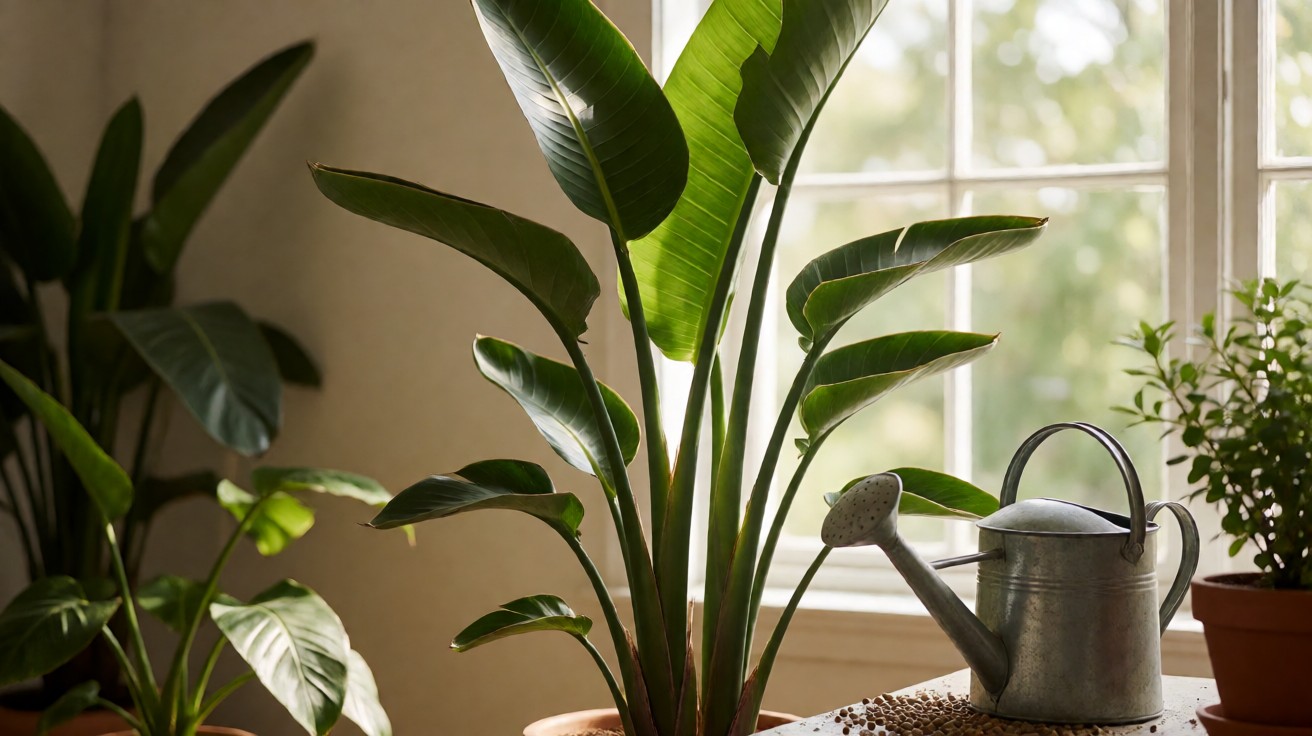

A bird of paradise in a container is a closed nutrient system, and that single fact is the entire reason feeding schedules matter indoors. In the ground, Strelitzia reginae and Strelitzia nicolai send roots outward into a continuously refreshed soil ecosystem, where nitrogen, phosphorus, and potassium are recycled by microbial activity and replenished by mineral weathering. In a container, the root system is bounded by the pot wall, the soil volume is finite, and every watering leaches a measurable amount of nutrient ions out through the drainage holes. The plant draws from a shrinking reservoir. If you do not replace what is lost, growth slows, foliage yellows, and the flowering that mature bird of paradise is famous for simply does not happen.
Two failure modes follow from missing that. The first is the unfertilized plant: slow or stalled growth, pale new leaves, no blooms even on a mature specimen, and a general air of a plant that is surviving but not thriving. The second is the overcorrected plant: a grower who heard that bird of paradise is a heavy feeder and starts applying full-strength fertilizer every week, which creates salt accumulation in the soil, root burn, and a plant that wilts despite wet soil because the osmotic balance around the roots has reversed. Both patterns are common. Neither is what the plant wants. Both belong to the Strelitziaceae family of monocot perennials native to southern Africa.
What most indoor growers get wrong is treating fertilizer as a growth booster they can pour on when they want a new leaf, rather than as a steady replacement of ions that are being constantly lost. The plant is not asking to be fed. It is asking to have its depleted soil replenished. The distinction changes the entire feeding rhythm.
Why Feeding Matters More Indoors Than Outdoors
Outdoors, a bird of paradise in the ground has access to a root zone measured in cubic meters, not liters, and that root zone is biologically active. Mycorrhizal fungi extend the effective reach of the root system, soil bacteria mineralize organic matter into plant-available ions, and earthworms and other fauna keep the substrate aerated. A mature outdoor plant can pull enough nitrogen from a healthy soil ecosystem that supplemental feeding is rarely needed except on depleted sites. The plant is essentially running on a renewable nutrient cycle.
Indoors, in a container, almost none of that is true. The soil volume is small, often 3 to 10 liters for a mature indoor specimen, and the microbial activity in a peat-based potting mix is a fraction of what lives in a living soil outdoors. Every watering event moves water through the soil and out the drainage holes, and dissolved nutrient ions go with it. Nitrate, the primary form of nitrogen plants take up, is particularly mobile and leaches quickly. Potassium leaches moderately. Phosphorus binds to soil particles and is lost more slowly, but is also the nutrient most easily locked into unavailable forms in a container environment.
The practical consequence: an indoor bird of paradise will deplete the available nitrogen in a typical potting mix within 6 to 8 weeks of active growth, and will start showing deficiency symptoms within 3 to 4 months if not fed. The plant is not sick. It is starving in slow motion. A consistent feeding schedule during the growing season replaces the ions being lost to leaching and keeps the plant in active growth without the boom-bust cycle of feeding too much, then too little, then too much again.
For a complete picture of how feeding fits into the broader indoor care rhythm, the indoor bird of paradise care guide covers light, humidity, and watering in the same level of detail. The feeding schedule is one of three or four variables that have to move together for the plant to thrive indoors, and treating it in isolation tends to overcorrect.
The Mechanism: N-P-K, Salt Buildup, and Slow-Release vs Liquid
Every fertilizer label shows three numbers, called the N-P-K ratio, representing the percentage by weight of nitrogen, phosphorus, and potassium. For bird of paradise, the ratios that work in practice are balanced formulations in the 3-1-2 to 2-1-2 range, meaning a fertilizer labeled 6-3-6 or 10-15-10 or 9-3-6 is appropriate. The reasoning is biological..
Salt buildup is the second mechanism to understand. Fertilizers are salts. When you apply them to soil, the dissolved ions increase the electrical conductivity of the soil solution..
Slow-release vs liquid is a real choice, and the two have different mechanisms. Slow-release fertilizers are coated granules that release nutrients gradually over 2 to 6 months as the coating breaks down. The advantage is steady feeding without weekly effort, and the lower risk of salt shock because the release rate is buffered. The disadvantage is that you cannot respond to the plant’s current needs. If the plant is in active growth, you are feeding at the rate the granules release, not at the rate the plant actually wants.
The most reliable approach for indoor bird of paradise is a hybrid: a single application of slow-release granules in early spring as new growth begins, supplemented with half-strength liquid feed at every other watering during the active growing season. That combination gives a steady baseline plus a responsive top-up, and the salt risk stays low because the liquid is always half-strength.
What Actually Works: A Seasonal Feeding Rhythm
The feeding schedule that works for indoor bird of paradise follows the seasonal growth pattern, not the calendar. Here is the rhythm, with the reasoning attached.
- Late February to early March: Apply a slow-release granular fertilizer, balanced ratio in the 3-1-2 to 2-1-2 range, at the label rate for the pot size. Work it lightly into the top inch of soil and water thoroughly to activate the coating. This is the season to give the plant the long-release baseline it will draw on for the next 3 to 4 months.
- March through September (active growth): Supplement with half-strength liquid fertilizer, same balanced ratio, applied at every other watering. If you water once a week, that means feeding every two weeks. If you water twice a week, feed once a week. The half-strength is not negotiable: full-strength liquid fertilizer applied at the frequency that indoor watering requires will build salt faster than the plant can use it, and you will see tip burn within 4 to 6 weeks.
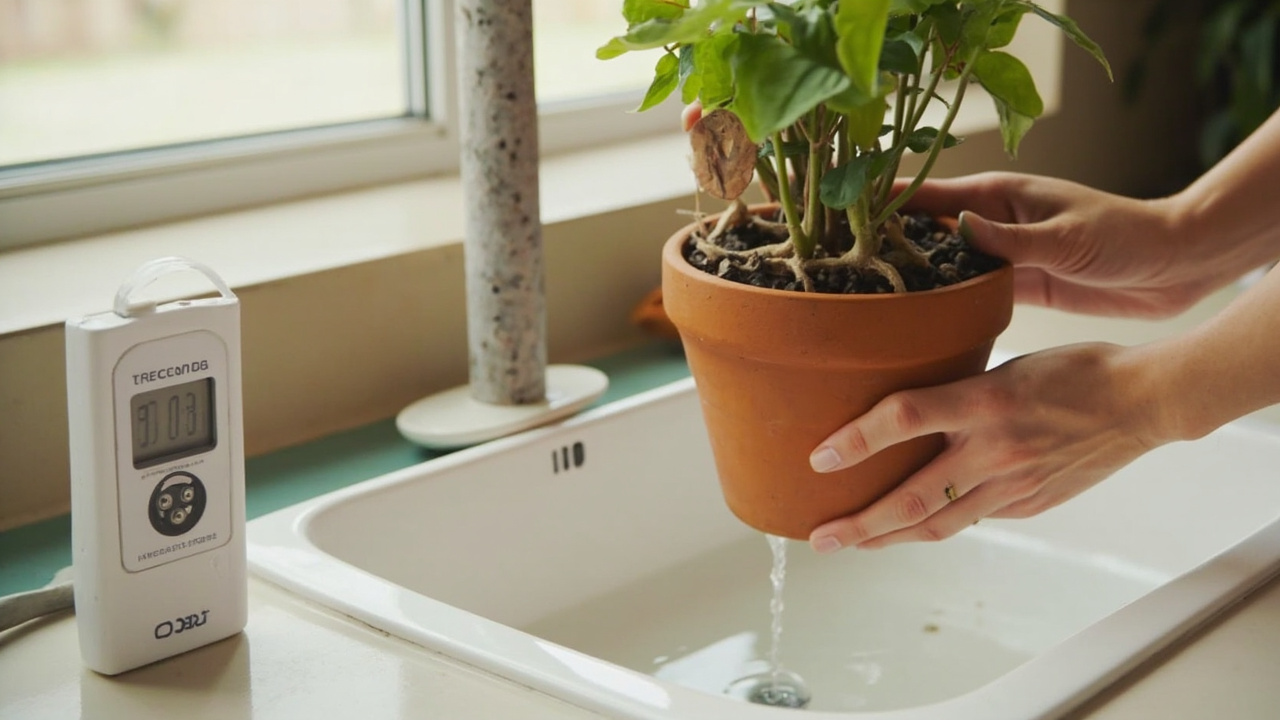
- October: Stop the liquid feeding. Apply a final quarter-strength watering to flush any built-up salts from the soil profile. Run plain water through the pot until it drains freely from the bottom, then do it again. This is the single most overlooked practice in indoor fertilization, and the one that prevents the salt accumulation that causes winter leaf burn.
- November through February (low light, slow growth): Do not feed. The plant is not in active growth, the ion uptake is minimal, and any fertilizer you apply sits in the soil and accumulates as salt. This is the season most over-fertilization damage happens, because well-meaning growers keep their summer feeding schedule through the winter months.
The frequency number to remember: in active growth, half-strength every other watering. The strength matters more than the frequency. A quarter-strength weekly feed is roughly equivalent to half-strength every two weeks, and either is fine. Full-strength weekly will eventually burn the roots regardless of which balanced ratio you use, because the salt input exceeds what the plant can absorb before the next watering leaches it out.
For brand-neutral guidance, the most reliable form factors are water-soluble powders, concentrated liquids, and coated slow-release granules. Avoid “bloom booster” fertilizers with very high middle numbers (10-30-10, for example) unless your specific goal is flower initiation on a mature plant, because the high phosphorus locks out micronutrients in container soil. Avoid organic fertilizers that rely on microbial mineralization for indoor use, because the microbial activity in a peat-based potting mix is too low to release the nutrients on a useful timeline.
If your bird of paradise is the indoor flowering goal, the feeding schedule above is the foundation, and the rest of the flowering picture is light. The bird of paradise not flowering guide covers the light side of the same equation. Fertilizer without adequate photons produces a leafy plant that never blooms. Light plus proper feeding produces a mature plant that flowers on its natural schedule.
For the cluster context, see the full bird of paradise indoor care guide and related articles: general Bird of Paradise care best soil for Bird of Paradise common Bird of Paradise problems.
Common Fertilizer Mistakes Indoor Growers Make
The single most common mistake is feeding through the winter. The instinct is that a plant needs food year-round, which is true for plants in active growth under consistent indoor conditions. It is not true for bird of paradise, which slows its growth in response to the shorter photoperiod and lower light intensity of winter even in a well-lit room. Feeding a slow-growing plant produces salt accumulation, not growth. If you see new leaves emerging tight, glossy, and smaller than the previous ones in December, the answer is almost always to stop feeding, flush the pot, and wait for spring.
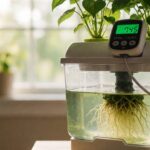
The second mistake is assuming that yellowing leaves mean the plant needs more fertilizer. Yellowing can mean nitrogen deficiency, but it can also mean overwatering, root rot, cold stress, or natural senescence of the oldest leaves. Diagnosing yellowing requires checking the soil moisture, the root health, and the recent temperature exposure before reaching for the fertilizer. A $15 soil EC meter takes the guesswork out: if the soil EC is above 3.0 mS/cm, the problem is too much salt, not too little nutrient. Flush the pot and stop feeding for a month before assuming the plant needs more.
The third mistake is using the wrong ratio. A common assumption is that flowering plants need a high-phosphorus “bloom” fertilizer. For bird of paradise, the balanced 3-1-2 to 2-1-2 ratios produce better results than bloom boosters in container culture, because the phosphorus lockout effect in potted soil is severe, and the micronutrient deficiencies that follow high-phosphorus feeding show up as interveinal chlorosis and distorted new growth. The bloom signal in bird of paradise is overwhelmingly a light signal, not a phosphorus signal, and pouring on bloom booster in low light produces a salt-stressed plant with no flowers.
The fourth mistake is fertilizing a dry plant. Liquid fertilizer should always be applied to moist soil, not to bone-dry soil. Applying fertilizer to dry soil concentrates the salts in the root zone and burns the fine feeder roots, which are the very roots that absorb the nutrients you are trying to deliver. Water the plant first, let it drain, then apply the fertilizer solution. The same principle applies to slow-release granules, which should be watered in thoroughly after application.
What to Expect in the First Two Months of a Real Schedule
Once you shift to a proper feeding schedule, the visible response comes in stages. In the first 2 to 3 weeks, the plant uses the new nutrient availability to push out a new leaf that is slightly larger and deeper green than the previous one, assuming light and humidity are already in a reasonable range. In the first 6 to 8 weeks, the second new leaf confirms the trend, and the overall foliage colour deepens. By the end of the second month, the plant is operating from a stable nutrient baseline rather than from a depleting reservoir, and the growth rate settles into the consistent 4 to 6 weeks per new leaf that a healthy indoor bird of paradise maintains in active growth.
The longer-term picture, over 6 to 12 months of consistent feeding, is a plant that holds its mature leaf size, develops the strong petioles and glossy blade surface that mark a well-fed Strelitzia, and on a mature specimen of flowering age (4 to 5 years or older), begins to set the bud sheaths that lead to a bloom the following season. The feeding schedule is not the whole story for flowering, but it is the prerequisite, and a starving mature bird of paradise will not bloom no matter how much light you give it.
The simplest version of the rule: feed the plant when it is growing, do not feed it when it is not, keep the dose at half-strength in liquid form, flush the pot once before winter, and trust the rhythm. The next new leaf is the answer, and it usually shows up within a month of getting the schedule right.
From Bank Statement to QuickBooks-Ready File
That manual cleanup you just read about? This tool skips it. Turn your PDF into QBO for QuickBooks without storing your data anywhere.
Start Converting