
Money tree and money plant are not the same species: Pachira aquatica is a tropical tree in the Malvaceae family with a braided trunk and palmate leaves, while Epipremnum aureum is a trailing vine in the Araceae family with heart-shaped leaves and aerial roots, and confusing the two is the single most common reason first-time gift recipients lose their plant within a season.
The naming overlap is regional. In the U.S. and U.K. florist trade, money tree almost always means Pachira aquatica and money plant almost always means Epipremnum aureum (sometimes sold as pothos). In much of South Asia and East Asia, money plant is the dominant name for Epipremnum aureum and money tree is reserved for Pachira aquatica. The species are distinct in every retail market; the confusion is a search-engine problem, not a botanical one.
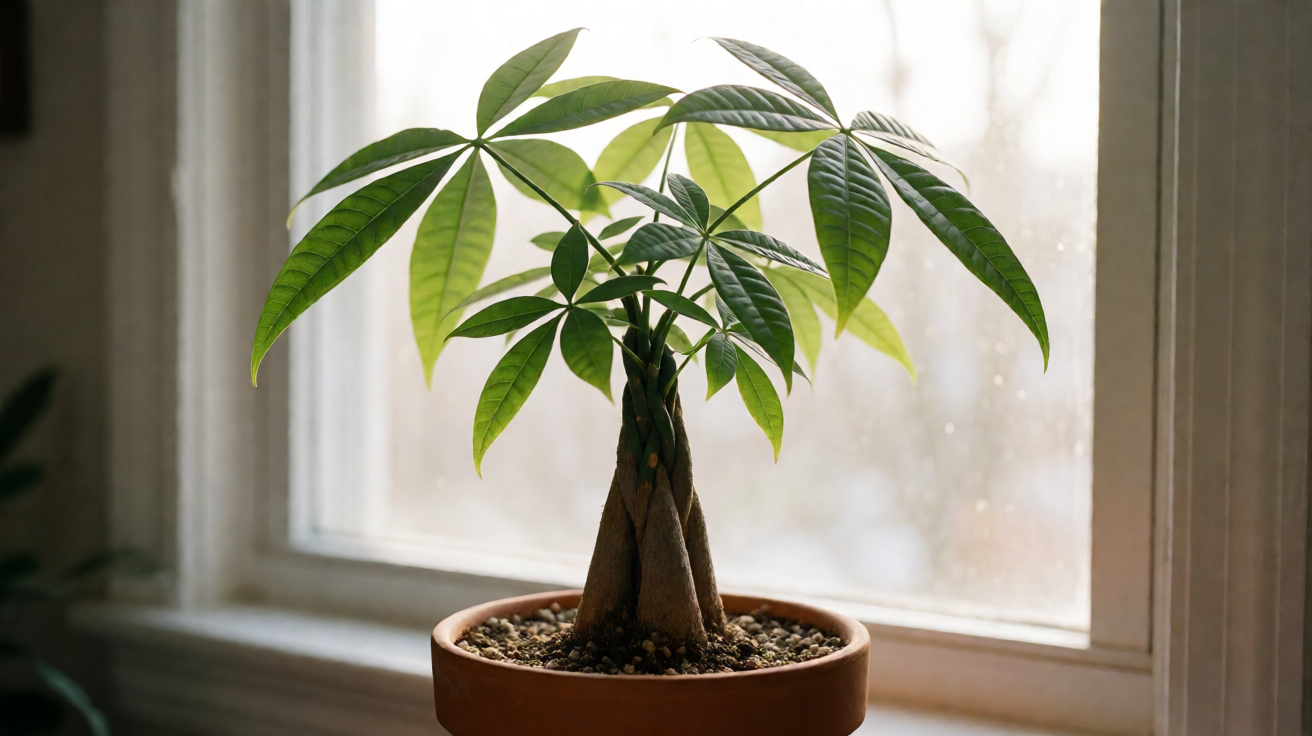
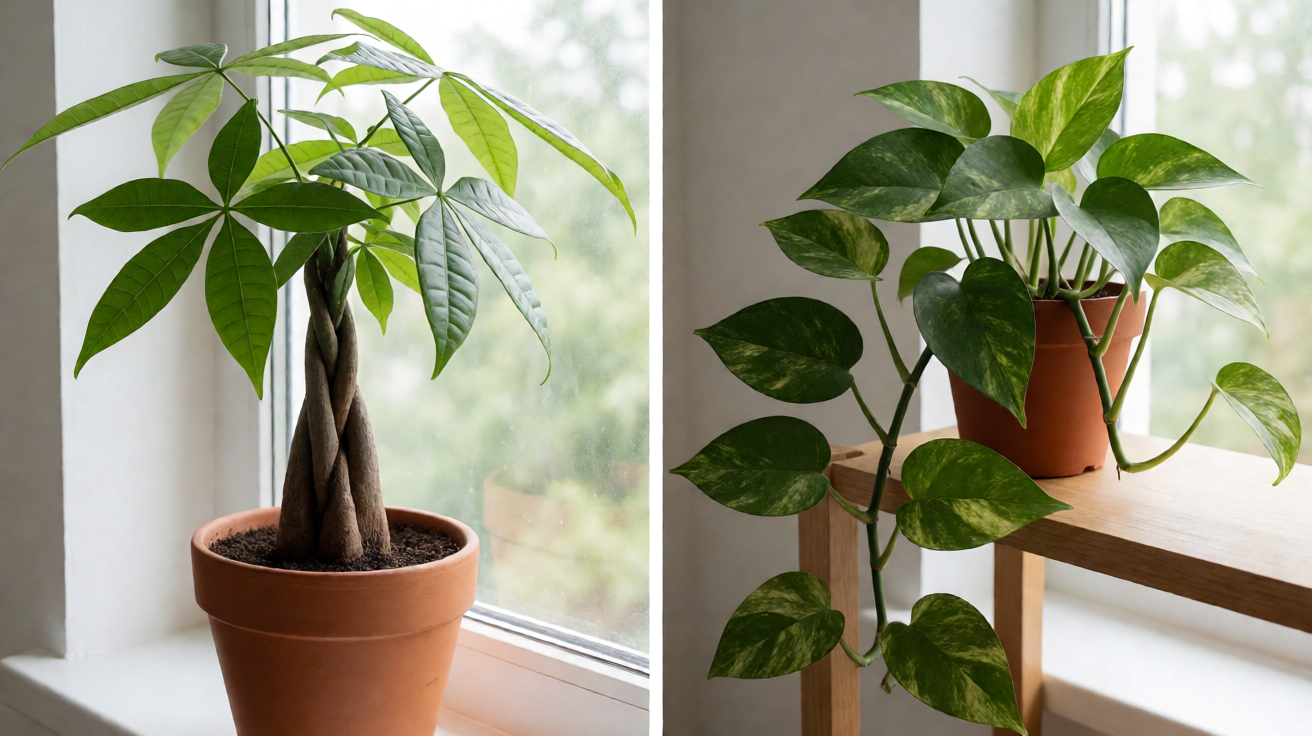
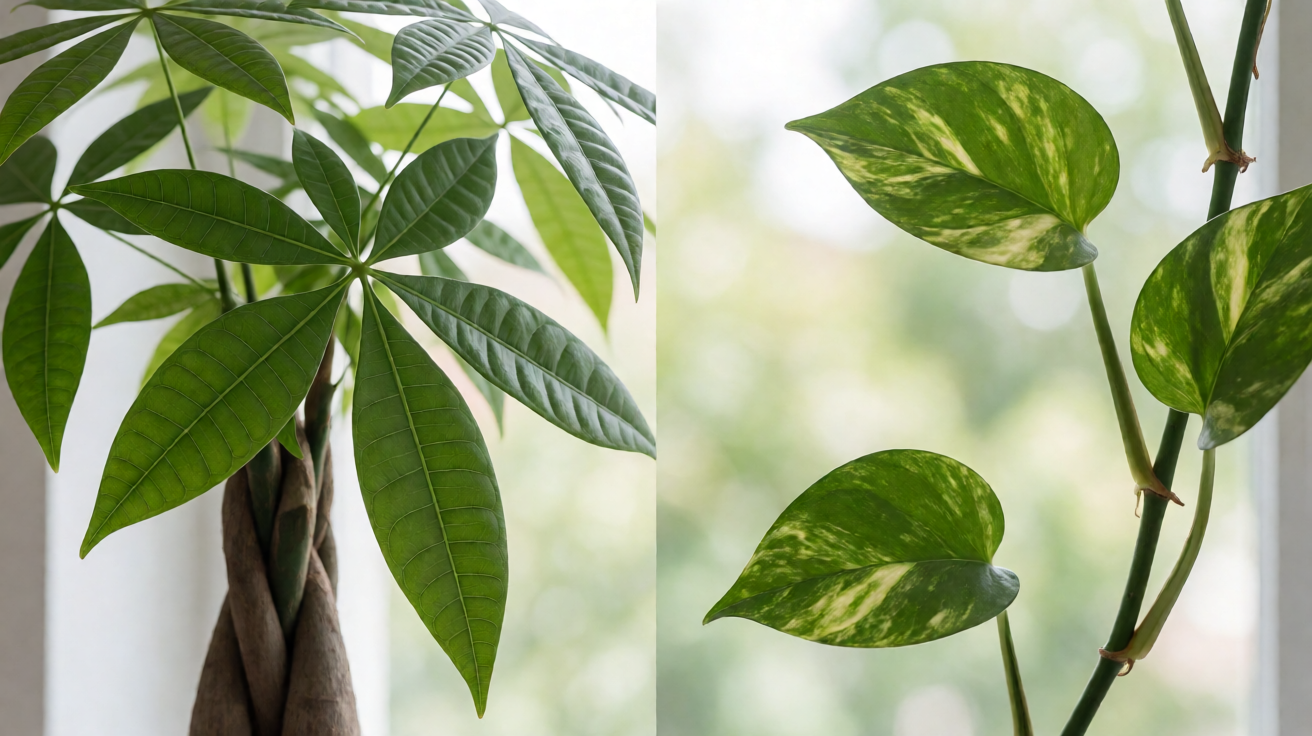
The 30-second test uses two visible traits: trunk shape and leaf shape. A Pachira aquatica has a single thick, often braided, woody trunk topped with a palm-fan canopy of five-leaflet leaves. An Epipremnum aureum has no visible trunk at all, just a green trailing vine with heart-shaped leaves spaced along a single stem.
Once the test is done, route to the correct care hub: money tree care guide for Pachira, money plant care guide for Epipremnum. The two care pages are different in light placement, watering rhythm, and propagation method.
The 30-Second Identity Test
Pachira aquatica is sold as a small tree, typically 1 to 3 feet tall when purchased, with a single woody trunk. The trunk is usually braided from three to five young stems that have grown together at the nursery; the braid is a styling choice, not a natural growth pattern.
Above the braid sits a palm-like canopy of leaves, each leaf divided into five to seven oval leaflets that radiate from a central point like fingers on a hand. Mature Pachira can reach 6 feet indoors and produce small yellowish flowers with a brush of red stamens under ideal conditions, though indoor flowering is rare.
The leaves stay glossy and bright green when light, watering, and humidity are correct, and they fold slightly inward at night, a movement called nyctinasty that signals a healthy circadian rhythm.
Epipremnum aureum is sold as a potted trailing or climbing vine. There is no woody trunk; the plant is a soft green stem with heart-shaped leaves arranged alternately along its length.
Each leaf is a single heart, not a fan of leaflets, and the leaves alternate up the stem rather than radiating from a central crown. Mature Epipremnum can trail 6 to 10 feet from a hanging basket or climb a moss pole to 20 feet in tropical conditions.
Wild Epipremnum produces fenestrated leaves with slits and holes in mature growth, but indoor plants usually keep the juvenile heart shape because they never reach the canopy size that triggers fenestration.
The simplest visual test: if you can see a woody trunk or a braid, you have a Pachira. If you see only a green stem with heart-shaped leaves trailing over the pot edge or climbing a support, you have an Epipremnum. The two species do not share leaf shape, growth habit, or trunk structure; the only thing they share is a common name.
Botanical Background: Two Families, Two Continents
Pachira aquatica belongs to the Malvaceae family, the same family as cotton, cacao, hibiscus, and durian. The genus Pachira includes about 50 species native to the wetlands of Central and South America, from southern Mexico through Brazil.
The plant forms a swollen caudex at the base that stores water for the dry season, and the trunk grows straight upward to 30 to 60 feet in its native range. Indoor specimens are pruned to 4 to 8 feet for structural reasons. The flowers and seeds are edible in some cultures; the seeds are roasted or ground into a flour used in traditional Mexican and Central American cooking.
Epipremnum aureum belongs to the Araceae family, the same family as philodendrons, anthuriums, and ZZ plants. The genus Epipremnum has about 15 species native to the tropical forests of Southeast Asia and the western Pacific.
The plant climbs tree trunks in the wild using aerial roots that grip bark and rock. In indoor cultivation, those same aerial roots attach to moss poles and trellises, or trail freely from hanging baskets. The aerial roots also sprout along the stem, producing the small brown nubs that show up between leaves on healthy vines.
The two species evolved on two different continents in two different families. Pachira is a wetland tree from the Americas; Epipremnum is a tropical vine from Asia. They share only the cultural label “money plant” that retailers attach to species associated with prosperity, and that label is the source of every care mistake covered below.
Care Differences at a Glance
The care requirements diverge in light, water, soil, temperature, and propagation. Treating one species like the other produces the death symptoms that the cluster’s Problem pages address: Pachira dropped in dim light, Epipremnum yellowed in dry soil.
| Need | Pachira aquatica (money tree) | Epipremnum aureum (money plant) |
|---|---|---|
| Light | Bright indirect, 6+ hours/day | Low to bright indirect, tolerates dim corners |
| Watering rhythm | Every 7 to 14 days; top 1 inch dry | Every 7 to 14 days; top 2 inches dry |
| Soil | Well-draining mix with perlite and orchid bark | Standard potting mix; tolerates dense blends |
| Temperature | 65 to 75 degrees F; below 50 damages | 60 to 80 degrees F; tolerates cooler nights |
| Humidity | 40 to 60 percent preferred | 30 to 60 percent tolerated |
| Growth habit | Upright tree, single trunk | Trailing or climbing vine |
| Propagation | Stem cutting in water or soil; slow | Stem cutting in water; roots in 7 to 14 days |
| Pet toxicity | Mildly toxic (calcium oxalate) | Mildly toxic (calcium oxalate) |
Both species share a single toxicity class (calcium oxalate crystals in the leaves and stems), but the visible symptoms differ in intensity. A pet that nibbles a Pachira leaf typically drools for an hour and recovers; a pet that chews an Epipremnum vine drools for an hour and recovers. Both species are mild irritants, not lethal; keep both out of reach of cats and dogs that graze on houseplants.
The watering rhythm is the single highest-leverage difference for new owners. Pachira aquatica needs the top inch of soil dry before each watering because the swollen caudex holds reserve moisture and overwatering triggers crown rot within days. Epipremnum aureum tolerates wetter soil and rebounds from missed waterings within a single watering cycle. A Pachira watered on an Epipremnum schedule rots in 30 days.
Why the Common Name Overlap Exists
The shared label “money plant” is a commercial and cultural tradition, not a botanical fact. In feng shui, both species are placed in homes and offices for prosperity, but the placement tradition differs: Pachira is placed near the entry or in the wealth corner of a room, while Epipremnum is trained up a pole or hung in the same corner as a softer alternative.
In Vastu, the Indian tradition of architectural harmony, both species are associated with financial growth and good fortune. Pachira is preferred for permanent placement because the braided trunk is considered more rooted; Epipremnum is preferred for rental spaces because it can be moved without disturbing a structural arrangement.
The label is functional in both traditions: a plant with five-lobed leaves (Pachira) or five green leaves per vine node (Epipremnum in its juvenile form) is associated with the five elements of prosperity in feng shui. The number five is the symbolic anchor, not the species. Two different plants became prosperity plants in two different cultures for two different reasons.
The U.S. and U.K. retail convention is the cleanest one: money tree = Pachira aquatica, money plant = Epipremnum aureum. The convention is not universal; many online retailers list a Pachira as “money plant” and a separate Epipremnum as “pothos.” When in doubt, the trunk and leaf test in the section above is the fastest way to confirm.
Which Plant Is Right for Which Reader
Choose a money tree (Pachira aquatica) if the reader wants a structural statement plant that lives in a single spot year-round, has a bright window available, and is willing to follow a 7-to-14-day watering rhythm. Pachira rewards consistent care with a fattened trunk and a dense palm canopy.
It tolerates low light for 60 to 90 days using caudex reserves but will decline after that without brighter placement. It is also the right pick for a gift recipient who wants a plant that looks like a tree, not a vine.
Choose a money plant (Epipremnum aureum) if the reader wants a trailing or climbing plant that fills a corner or drapes from a shelf, tolerates dim corners for months at a time, and recovers quickly from missed waterings. Epipremnum is the right pick for a beginner who does not want to track a strict watering schedule and prefers forgiving care.
It also propagates easily in water, so a single starter plant can fill a home within a year. Office spaces, dorm rooms, and rental apartments are the natural fit because the vine can move with the tenant.
Both species can coexist in the same home. Place the Pachira near the brightest window and the Epipremnum in a corner 6 to 10 feet from the same window or in a different room entirely. The two plants share no pests or diseases of note, and they do not interfere with each other’s growth.
Cross-Cluster Routing
After the identity test, route to the correct care hub. The two care pages cover the same care attributes (light, water, soil, temperature, fertilizer, propagation) but with different species-specific numbers and rhythms.
Pachira aquatica owners should read money tree care guide first, then the Attribute ladder: watering requirements, light requirements, and the planned soil, temperature, and fertilizer pages. Each Attribute links to the next.
Epipremnum aureum owners should read money plant care guide first, then the Attribute ladder under that cluster: watering, light, soil, temperature, fertilizer, propagation, and the Problem pages for yellow leaves, root rot, and pet safety.
The disambiguation page itself does not need a refresh every season; the species are stable and the care hubs stay accurate for years. Bookmark the page once and use the 30-second trunk-and-leaf test whenever a new “money plant” arrives in the home or office.
The shared label is the cause of every confusing care search, every mixed advice thread, and every dead plant that the cluster’s Problem pages diagnose. The species are different. The care is different. The plant you actually own is the one that sits on your shelf right now; identifying it correctly is the first step to keeping it alive past the first season.
Quick Reference: Pachira Vocabulary and Care Anchors
The Pachira aquatica vocabulary below is the cluster’s own terms, used here in the comparison context only. Each term anchors a deeper Attribute or Problem page that this comparison page points to.
Pachira aquatica is a tropical houseplant sold as a gift plant or prosperity plant; its braided money tree trunk is a styling choice, the swollen trunk or caudex is a water reserve, and the leaf nodes are where new stems and air roots emerge. A happy plant keeps its palmate leaves glossy and tight; a stressed plant drops its lower leaves within 2 to 4 weeks.
Pachira care centers on bright indirect light from an east-facing window or a south-facing window with a sheer in summer; north-facing windows and west-facing windows require a grow light or grow lamp to hit the bright indirect band. Low light tolerance is real but limited to 60 to 90 days of caudex reserve; rotation every two weeks prevents the trunk from leaning toward the brightest source.
Watering rhythm: the top 1 inch of well-draining soil dries between waterings. Overwatering triggers root rot at the trunk base; underwatering shows as leaf drop and a soft trunk. A scratch test on the trunk base confirms the live wood layer (green under bark = recoverable) versus the dormant layer (brown all the way through = severe damage).
Soil recipe: a blend of perlite, orchid bark, and coco coir in equal parts, in a pot with drainage holes. Pachira indoors tolerates a balanced fertilizer at half-strength every 30 days during the growing season; nitrogen deficiency shows as uniform yellow leaves rather than the patchy yellowing of overwatering.
Temperature: 65 to 75 degrees Fahrenheit is the happy band; below 60 stops new leaf nodes from pushing, below 50 causes cold damage and draft-driven leaf drop. Household humidity between 40 and 60 percent keeps the leaf edges and leaf browning in check; household humidity below 30 percent shows as leaf scorch and leaf curl on the upper canopy.
Repot every 2 to 3 years in fresh well-draining soil; root pruning at repot removes circling roots without stressing the caudex. Recovery from a transplant shows in 4 to 6 weeks. Propagation is via stem cutting with at least two leaf nodes, rooted in water or soil under bright indirect light; cuttings root in 4 to 6 weeks.
The Pachira care hub (money tree care guide) walks through each Attribute in detail. The money tree plant is a slow but forgiving species once the placement, watering, and soil recipe are right; indoors, a braided money tree can live 10+ years in the same 8-inch pot with quarterly half-strength feedings and a stable bright indirect window.
Turn PDF Bank Statements Into Workable Spreadsheets
Your bank statement is a mess of numbers, but your books shouldn't be. Use our converter to get Excel, CSV, or QBO files — ready for QuickBooks.
Try It Free Now