
Every hydroponic system, whether it is a simple deep water culture setup on your kitchen counter or a commercial NFT installation, lives or dies by one number: pH in hydroponics.
That single digit tells you whether your nutrient solution is in the range where plants can actually absorb what you are feeding them.
Get it right, and your plants race ahead. Get it even slightly off, and you can pour in every nutrient in the book and your plants will still starve — right in front of you, with no obvious wilting or drama.
The scale runs from 0 to 14. Zero is pure acid, 14 is pure alkaline, and 7 is neutral. For most hydroponic crops, you are looking at a narrow target window between 5.5 and 6.5.
Inside that band, nutrients dissolve and plants can take them up efficiently. Outside it — even by half a point — the chemistry changes enough that entire nutrient groups become unavailable, no matter how rich your solution is.
That is the core of why pH management matters: it is the gatekeeper between your nutrients and your plant.
What Actually Causes pH to Drift in Recirculating Systems
If you have been managing a recirculating system for any length of time, you have noticed that pH does not stay still. It rises one day, drops the next, and rarely sits where you set it. Understanding what is moving the number is the first step to controlling it.
Plant nutrient uptake is the biggest daily driver. As plants absorb ions from the solution, they release hydrogen ions (H⁺) or hydroxyl ions (OH⁻) in exchange. When a plant takes up more cations than anions — which happens with ammonium-heavy nutrition — the solution becomes more acidic. When it favors nitrate uptake, pH tends to rise. This happens every single day, often multiple times, and it is normal.
Bacterial activity in the root zone also shifts pH. Nitrifying bacteria, which convert ammonia to nitrate, produce hydrogen ions as a byproduct and gradually lower solution pH. This is more pronounced in systems with active biofilters or where root material is decomposing.
Your water source is the foundation everything else builds on. Municipal water varies enormously. Some sources are soft (low calcium and magnesium, low alkalinity) and lack buffering capacity — pH can swing wildly after you add nutrients. Others are hard (high in calcium carbonates) and resist change naturally. If your water is soft, you may be fighting pH drift every 24 hours. If it is hard, your baseline stability is higher but correcting pH becomes harder when you do need to move it.
Nutrient concentration changes as water evaporates and plants draw from the reservoir. As solution concentrates, the ratio of available ions shifts and pH follows. Topping up with concentrated nutrient solution rather than plain water can reduce this effect.
The Daily pH Testing Routine: When and How to Measure
Checking pH once at setup and forgetting it is not an option in any recirculating system. Here is the routine that actually works.
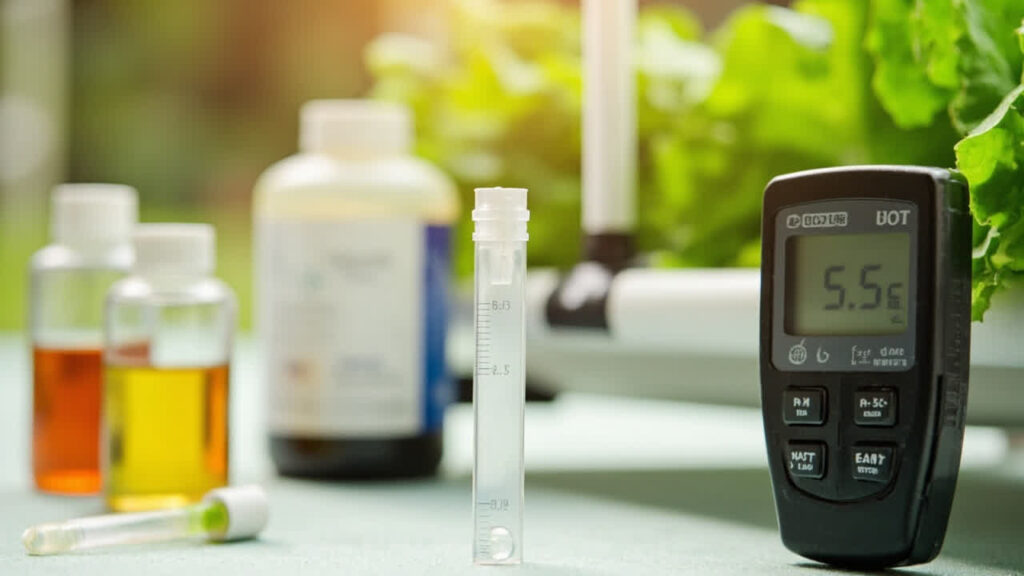
Test before you add anything. Every time you check your reservoir, check pH first — before nutrients, before additives, before topping up. If you measure after adding products, you will not know what your baseline was, and any readings become guesswork. A sample drawn before nutrient dosing gives you a clean snapshot of where the system actually is.
Draw from the reservoir, not the runoff. The solution returning from your grow tray or channels has passed through the root zone, where it has interacted with plant uptake and bacterial activity. It is not representative of what your plants are currently experiencing at the roots. The reservoir sample tells you the bulk solution condition — the starting point you control.
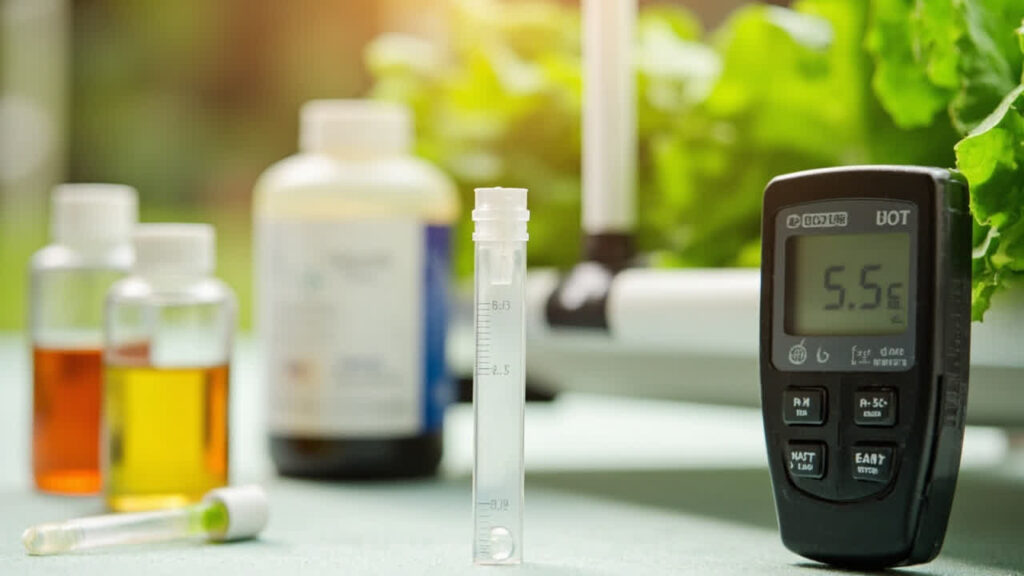
Temperature matters more than most growers realize. pH meters are calibrated at a specific temperature (usually 25°C / 77°F). If your nutrient solution is significantly colder or warmer than calibration temperature, your reading will be off. In a cold basement grow room, a reading that looks fine could actually be a full point different. Let your sample come to room temperature before measuring, or use a pH meter with automatic temperature compensation (ATC).
Testing at the same time each day — ideally morning, before lights ramp up and transpiration accelerates — gives you consistent data you can actually trend. Random sampling at wildly different times will show you noise, not signal.
Why Water Buffer Capacity Is the Hidden Variable
Buffer capacity is your water’s ability to resist pH change when acids or alkalis are added. It is determined primarily by the alkalinity of your water — a measure of dissolved carbonates, bicarbonates, and to a lesser extent, hydroxide compounds.
Soft water (rainwater, RO water, some groundwater in granite-heavy regions) has almost no buffer capacity. Adding nutrients — which are acidic salts — can drop pH dramatically. A single dosing of a phosphorus-heavy bloom nutrient can push a soft-water system from 6.0 to 4.5 within an hour. In these setups, pH can require correction every single day, sometimes twice.
Hard water (common in limestone or chalk regions) has high alkalinity and resists pH change effectively. pH tends to be stable day to day. The trade-off is that when you do need to shift pH — say after a nutrient change — it takes more acid or alkali to move it. You also need to account for the calcium and magnesium already present; you may need to reduce supplemental calcium in your nutrient mix to avoid lockout.
The practical implication is simple: know your water before you choose your nutrients. A reverse osmosis filter is worthwhile for any grower starting with soft water who wants predictable pH management. For those with hard water, a pH Down product may be needed more often than pH Up, which is the reverse of what most soil gardeners expect.
Potassium Silicate: Buffering and Beyond
Among the additives that get discussed more than they are used, potassium silicate stands out for both its pH management role and its broader benefits. If you have been searching for a way to add natural stability to your reservoir pH while giving your plants a structural edge, this is worth understanding.
Silicate ions (SiO₄⁴⁻) act as a weak base in solution, meaning they resist pH changes in both directions. In a soft-water system prone to sudden drops, silicate provides a cushion against dramatic swings. In harder water, it does not over-correct but smooths out smaller fluctuations.
Beyond pH buffering, potassium silicate builds cell wall strength. Plants with stronger cell walls stand better against pests, transport nutrients more efficiently, and tolerate heat stress better. Silicon is the only mineral element that does not require reduction before incorporation into plant tissue — it deposits as silica gel in cell walls, where it remains.
The standard use is to add it to your reservoir at roughly 1–2 mL per gallon of concentrate, or as directed by the product label. Note that potassium silicate is not compatible with all nutrient formulations — particularly those containing calcium or magnesium in high concentrations, as precipitates can form. Add it to a clean reservoir with its own nutrient line if your setup allows, or use a separate application method.
The Nutrient Lockout Chart: What Becomes Unavailable at Each pH
This is the chart that converts pH management from vague theory into specific action. Each nutrient has a pH range where it is fully available to plant roots. Below or above that range, the element becomes locked out — present in the solution but chemically bound and inaccessible.
Nitrogen (as nitrate, NO₃⁻) — Available from 6.0 to 8.0. Below 6.0, availability drops sharply. Below 5.5, nitrification slows and plants may show deficiency even with adequate nitrate in the tank.
Nitrogen (as ammonium, NH₄⁺) — Available from 5.5 to 7.0. Above 7.0, ammonium begins converting to ammonia, which is toxic to roots. Hydroponic nutrients typically use mostly nitrate to avoid this issue.
Phosphorus (PO₄³⁻) — Available from 6.0 to 7.5. Below 6.0, phosphorus begins to precipitate with iron and aluminum, becoming unavailable. Above 7.5, it bonds with calcium to form hydroxyapatite.
Potassium (K⁺) — Available from 5.5 to 8.0. Potassium lockout is less dramatic in hydroponics than soil, but below 5.5, root membrane function degrades and potassium uptake suffers.
Calcium (Ca²⁺) — Available from 5.5 to 7.0. Below 5.5, calcium uptake is severely limited and blossom end rot or tip burn can develop even with adequate calcium in the solution. Above 7.0, calcium can precipitate with phosphorus.
Iron (Fe²⁺/Fe³⁺) — Available from 5.5 to 6.5. Below 5.5, iron is generally available but calcium lockout may occur simultaneously. Above 6.5, iron precipitates as ferric hydroxide (rust-colored compounds) and cannot be absorbed. This is the most pH-sensitive major nutrient.
Manganese (Mn²⁺) — Available from 5.5 to 7.0. Above 7.0, manganese oxidizes and becomes unavailable. Below 5.5, availability drops while iron may simultaneously lock out, creating a double deficiency situation.
Magnesium (Mg²⁺) — Available from 5.5 to 7.0. Below 5.5, magnesium uptake decreases and interveinal chlorosis (yellowing between leaf veins) can appear, similar to iron deficiency symptoms.
The practical takeaway: staying within 5.5 to 6.5 covers all nutrients at acceptable availability for the majority of crops. Most experienced hydroponic growers target 5.8 to 6.2 as a daily range because it sits in the center of most of these windows simultaneously.
DWC and the Fast Swing Problem
If you are running a deep water culture system, you will notice something that does not happen the same way in NFT, drip systems, or media-based grows: pH swings can be sudden and large, sometimes correcting itself, sometimes not.
The reason is volume. A typical DWC reservoir holds relatively little solution per plant compared to the root mass consuming it. A single large plant in a 5-gallon DWC bucket can draw a significant volume of nutrient solution overnight. As the water level drops, the concentration of nutrients rises (or the pH shifts with the remaining ions), and what looked fine at 6.0 in the morning can be 4.5 by afternoon.
The fix is not mystery. Keep your reservoir topped up — ideally with an automatic top-off (ATO) device that maintains water level continuously. This alone can cut pH volatility by half. Second, monitor pH twice daily in DWC rather than once. Morning and late afternoon readings give you a trend line instead of a single point.
Third, choose a reservoir size appropriate to your plants and root mass. The more plants per gallon of solution, the more aggressive the uptake per volume and the more your pH will move. In tight DWC setups with heavy vegetative growth, moving to a larger reservoir is often the single most effective change you can make.
Soil Gardeners Making the Transition: What Changes and What Stays the Same
If you come to hydroponics from soil gardening — and many growers do — the pH framework you know will need some adjustment, but not as much as you might expect.
In soil, the target range is 6.0 to 7.0. That is where most nutrients are available in soil biology. In hydroponics, the range shifts downward to 5.5 to 6.5. The reason is direct availability. Soil has cation exchange capacity — particles that hold and release nutrients — which extends the effective pH range where nutrients stay accessible. In hydroponics, without that buffering matrix, you need the narrower, more acidic window where nutrients dissolve directly in solution.
You will notice that pH drifts faster in hydro than in soil. In a soil pot, the organic matter, clay particles, and microbial community all resist sudden change. In a hydroponic reservoir, there is nothing between you and the chemistry except the solution itself. That is not a flaw — it is a feature. You can see and correct problems in hours rather than weeks. But it does require you to check pH daily instead of monthly.
The tools are similar: pH meters work the same way (though electrode care is even more important in hydro because the solution is clean and has no particulates to protect the glass). pH Up and pH Down products are the same compounds (potassium hydroxide for up, phosphoric or citric acid for down). The calibration discipline is the same. What changes is the urgency and the frequency of checking.
Putting It Together: Your Day-to-Day pH Management Protocol
After all the theory, here is the actionable summary that ties it together for every grow.
- Know your water before you build your nutrient program. Test alkalinity, or use RO water if your tap is soft.
- Check pH daily, ideally at the same time, before any nutrient or additive additions.
- Sample from the reservoir, not from the return line or grow tray.
- Allow sample temperature to match calibration temperature before measuring, or use ATC-equipped equipment.
- Target 5.8–6.2 as your daily working range for most crops.
- Top up reservoirs automatically in DWC to reduce swing amplitude between check intervals.
- Use potassium silicate for additional buffer capacity and cell wall strength, adding it to a clean reservoir.
- Know your lockout thresholds — particularly that iron goes unavailable above 6.5 and calcium below 5.5.
- Keep a log. pH management becomes exponentially easier once you can see your system’s pattern over weeks rather than reacting to individual daily readings.
pH in hydroponics is not a one-time setup task. It is a daily conversation with your system. The growers who get consistently strong results are the ones who show up every morning with a meter, know what they are looking at, and correct before the problem becomes visible in the leaves. That routine, repeated reliably, is what separates a hydroponic setup that survives from one that actually thrives.
From PDF to Excel in one click
Forget retyping line by line. Upload any bank statement, get a spreadsheet you can actually use. Your files are never stored, and you can test the converter with 3 free conversions.
Try it free