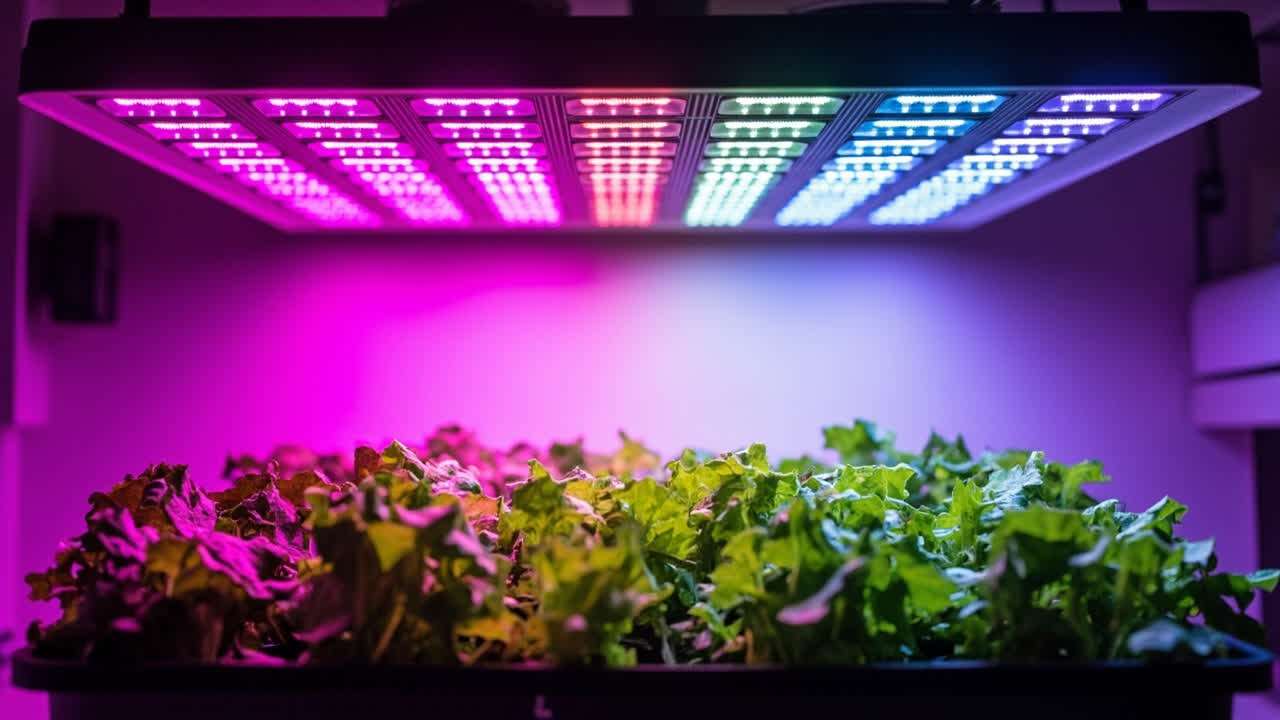

Hydroponic grow lights work by providing PAR — photosynthetically active radiation, the specific wavelengths of light (400–700 nanometers) that plants convert into energy through photosynthesis. The metric that actually determines whether your plants have enough light is not the wattage or the Kelvin color temperature on the box — it is PPFD, which measures how many PAR photons land on a surface per square meter per second. Reading and understanding PPFD lets you replace guesswork with a spec sheet, regardless of which brand of light you buy.
Most grow light marketing focuses on the numbers that matter to human perception — but for any hydroponic farming setup, the only numbers that matter are the ones that drive plant growth — how bright the light looks in a showroom, what color temperature feels right to the eye — rather than the numbers that matter to plants. PAR is not a marketing term; it is a photobiology definition. A light can look dim to your eyes but deliver high PAR to a plant’s leaves. Conversely, a very bright-looking LED can deliver almost no useful PAR if most of its output falls outside the 400–700nm range. This is why the spec sheet matters more than the product photography.
For readers who have been researching grow lights and encountering terms like “full spectrum,” “600W equivalent,” and “color temperature 6500K” without clear guidance on what any of it means for their actual plants — this article cuts through to the numbers that control growth outcomes.
Why Grow Light Marketing Talks About the Wrong Numbers
The two numbers most prominently featured on grow light packaging — watts and Kelvin color temperature — describe what the light looks like and how much electricity it consumes, not what the light does for plants.
Watts is a measure of power consumption. A 100-watt LED uses 100 watts of electricity. This tells you electricity cost, not plant growth output. A 100-watt LED that is poorly designed for plant use will deliver less useful PAR than a 50-watt LED that is designed for horticultural spectrum output. The wattage tells you what you pay to run the light; it does not tell you how many photons reach your plants.
Kelvin color temperature describes the color of light as it appears to human vision — warm yellow-white around 2700K, neutral white around 4000K, cool blue-white around 6500K. This is useful for choosing ambient room lighting. It is nearly useless for evaluating grow lights for plants because the Kelvin rating describes visible light composition, not PAR output. A 6500K light looks bright blue-white and has a Kelvin rating that matches daylight — but whether it delivers usable PAR in the quantities plants need depends on the actual spectrum inside that blue-white light, not the color temperature itself.
PAR (photosynthetically active radiation) is the actual measurement for plant growth light. PAR measures the photons in the 400–700nm range — the wavelengths that drive photosynthesis. PAR is measured in micromoles per square meter per second (μmol/m²/s). A higher PPFD number means more photons are reaching the plant’s leaves per second, which drives faster and more productive growth.
The marketing numbers make for impressive packaging. The PAR and PPFD numbers on the spec sheet tell you whether the light will actually grow your plants.
PAR and PPFD : The Two Numbers That Actually Matter
PAR is the spectrum range (400–700nm). PPFD is how many photons in that range land on a surface per second. These are the two numbers to look for on any grow light spec sheet.
PAR is not a single number — it is a range. The wavelengths plants use for photosynthesis cluster in blue (400–500nm) and red (630–700nm), with green light (500–565nm) also contributing though less efficiently. A light that emits only blue wavelengths is technically full PAR but is not ideal for full plant growth. A light that emits across the full 400–700nm range with good balance is the practical goal for most growers.
PPFD (photosynthetic photon flux density) measures the quantity of PAR reaching a surface — the μmol/m²/s number. Common PPFD targets for hydroponic crops:
- Seedlings and very low light crops: 100–200 μmol/m²/s
- Leafy greens (lettuce, basil, spinach): 300–500 μmol/m²/s
- Fruiting crops (tomatoes, peppers, cucumbers): 500–800+ μmol/m²/s
- High-light fruiting in deep indoor setups: 800–1200 μmol/m²/s
A single PPFD reading from the center of a light’s coverage area does not tell you enough. Light output varies across the coverage area — the center is typically 20–40% brighter than the edges. A light with good average PPFD may leave corners severely underlit. Measuring PPFD at multiple points across the grow area (1-foot grid intervals) and creating a PPFD map reveals the actual distribution. If the corners are at 200 μmol/m²/s while the center is at 600, your lettuce in the corners is starving for light while your center plants are adequately lit.
DLI (daily light integral) is an advanced metric worth knowing. DLI measures the total PAR received by a surface over 24 hours — μmol/m²/day. It converts the instantaneous PPFD reading into a cumulative daily total. Different crops have different DLI requirements:
- Lettuce and herbs: 12–17 mol/m²/day
- Tomatoes and fruiting crops: 25–35+ mol/m²/day
A light running 18 hours at 300 PPFD delivers more total DLI than the same light running 12 hours at 500 PPFD. Duration matters as much as intensity.
Which Light Spectrum Drives Which Type of Growth
The wavelength of light determines which physiological process it drives. Understanding spectrum-to-growth relationships lets you choose or adjust light for the stage your plants are in.
Blue light (400–500nm): drives vegetative growth — leaves, stems, and root development. Plants exposed primarily to blue light tend to be more compact, with thicker leaves and more密集 leaf surfaces. Blue light is critical in seedling stages and during the vegetative growth phase. Most grow lights designed for vegetative growth lean blue-heavy in their spectrum output.
Red light (630–660nm): drives flowering and fruiting. Red wavelengths trigger the photoreceptors that control bloom response. When plants receive high red light ratios, they shift from vegetative growth to reproductive growth — flowering, fruiting, and seed production. Red light alone produces leggy, stretched growth; it needs blue to balance. But a deliberate shift toward red during the transition from vegetative to flowering is what triggers the plant to begin fruiting.
Green light (500–565nm): penetrates deeper into the plant canopy than red or blue. Both red and blue are absorbed quickly at the leaf surface. Green light reaches lower leaves in dense canopies, allowing more even photosynthesis across the plant’s total leaf area. Removing green from a grow spectrum (which many cheap LEDs do) means lower-canopy leaves receive significantly less useful light.
Far-red (700–800nm): affects flowering response and stem elongation. Far-red is present in natural sunlight and is detected by plant photoreceptors that influence when plants switch from vegetative to reproductive growth. In typical indoor growing with strict light schedules (12 hours on/off for flower), far-red has minimal effect. But in mixed-spectrum or continuous-vegetative setups, far-red influences how compact or stretched plants grow under the available light.
The practical spectrum rule: blue-heavy (5000–7000K equivalent) for seedlings and vegetative growth; shift toward red-dominant (3000–4000K) when transitioning to flowering and fruiting; full-spectrum with green and far-red for transition periods and overall plant health. Specific manufacturers have their own spectrum recipes, but this directional principle holds across brands.
The Three Most Common Grow Light Mistakes in Hydroponic Setups
These mistakes appear consistently in failure cases — the plant that looks like it has a nutrient problem but does not, the slow growth despite good nutrient levels, the sudden collapse that seems inexplicable.
Mistake 1: Lights positioned too close. The signs are bleaching and yellowing of leaves from the top down, crispy brown edges that feel dry to the touch, and bleaching that appears first on the highest leaves. This is photobleaching — the leaf pigments have been overloaded with photons and are breaking down. It is distinct from heat burn (which causes wilting and dark wet-looking damage) even though the symptoms look similar. The fix is to raise the light 3–6 inches at a time until the bleaching stops. The general guideline: LED at 18–24 inches for vegetative growth, 12–18 inches for heavy flowering — but start higher and work down while watching for the first signs of stress.
Mistake 2: Running lights 24 hours. Plants need a dark period. Continuous light causes oxidative stress — the photosynthetic system has no recovery window and accumulates damage over time. Plants under 24-hour light may look fine for 2–3 weeks, then suddenly show symptoms of system failure: yellowing, necrosis, stunted growth. The standard photoperiods: 18 hours on / 6 hours off for vegetative growth, 12 hours on / 12 hours off for flowering and fruiting. Seedlings can use 20–24 hours initially to maximize early growth, but transition to the standard 18-hour schedule once true leaves are established. Use a timer and stick to it — inconsistent light schedules are more stressful than a consistent 18/6 schedule.
Mistake 3: Ignoring PPFD distribution. A single PPFD reading taken at the center of a light’s coverage area tells you almost nothing about whether all your plants are getting enough light. Measuring PPFD at multiple points — a grid pattern across the entire grow area — reveals the actual light availability map. If the corners of a 4×4 grow tent measure 180 μmol/m²/s while the center reads 500, the plants in the corners are effectively in the dark for lettuce and basil growing purposes, regardless of what the center reading suggests. The fix: either move plants to where light is adequate, or add a second light to cover the underlit zones.

LED vs HID vs Fluorescent : Which Light Type Is Right for Your Setup
Each major light technology has a specific strength profile and specific limitations. Matching the technology to the grow situation matters more than buying the most expensive option.
LED (light emitting diode): the most common current choice for hobby hydroponic grows. LEDs are energy-efficient (more PAR per watt than any other technology), run cooler than HID (allowing closer positioning to plant canopy), and have long lifespans (25,000–50,000 hours before significant output degradation). The honest limitations: quality varies enormously by price tier. Cheap LEDs often lack meaningful UV and far-red output, have poor spectrum balance, and experience faster lumen depreciation than stated. A well-designed full-spectrum LED costs more than a cheap one but delivers measurably better PPFD and spectrum coverage. For most hobby grows, a mid-range LED ($150–$300 for a 300–400 watt equivalent fixture) is the practical sweet spot.
HID (high intensity discharge — metal halide and high pressure sodium): the traditional commercial grow light technology. HID delivers very high PPFD and has a proven track record in large-scale horticulture. The honest limitations: HID runs hot, requires reflective hoods and significant ventilation, and the bulbs have relatively short lifespans (10,000–15,000 hours) with noticeable output degradation before they fail outright. The heat output means HID lights need to be positioned farther from the canopy than LEDs — typically 24–36 inches — which limits their effectiveness in low-ceiling grow spaces. For hobby hydroponics in a dedicated grow room with good ventilation, HID is a legitimate option. For a small grow tent or kitchen setup, it is usually the wrong choice.
Fluorescent T5: a good choice specifically for seedlings and low-canopy growing. T5 fixtures are relatively inexpensive, run cool, and deliver adequate PPFD for herbs and lettuce where the canopy height is low (under 12 inches). The honest limitation: T5 output drops significantly as canopy height increases. Once plants grow above 12–18 inches, PPFD at the lower leaves falls below productive levels. T5 is excellent for propagation and early vegetative growth; it is not adequate for fruiting crops like tomatoes or peppers that need high PPFD at greater canopy heights.
The decision guide: small grow tent or kitchen herb garden under 2 square meters → LED. Larger dedicated grow room with good ventilation and high ceiling → HID or high-end LED. Seedling propagation → fluorescent T5. Most hobby hydroponic situations land in the first category.
How to Position Your Grow Lights for Maximum Coverage
Light intensity decreases as the square of the distance from the source — double the distance, quarter the intensity. This means small changes in hanging height create large changes in PPFD at the canopy.
The practical process for finding the right height: start with the light hanging higher than you think is necessary (24 inches for LEDs, 36 inches for HID). Take a PPFD reading at plant level. Lower the light 3 inches, take another reading. Continue until the PPFD matches your target range for the current growth stage. That is your working height. Mark it and maintain it.
For the 18/6 vegetative schedule: target 300–500 μmol/m²/s for leafy greens, 500–700 μmol/m²/s for fruiting crops during veg. For the 12/12 flowering schedule: raise the light slightly (or increase power if the fixture has a veg/bloom switch) to target 600–800+ μmol/m²/s for fruiting crops.
Measure at multiple points across the grow area, not just the center. A PPFD map — readings at 1-foot intervals in a grid — shows whether all plants receive adequate light or whether some are in underlit zones. Underlit corners and edges are more common than expected, especially with single-point hanging positions.
Light Timing for Hydroponic Plants : The Photoperiod Rules
Plants use light duration as a signal for growth stage, not just a source of energy. The photoperiod — the ratio of light to dark — triggers specific developmental responses.
Vegetative stage (leaf and stem growth): 18 hours on / 6 hours off. This simulates the long days of late spring and early summer when plants are in active growth mode. Most leafy greens and herbs stay in vegetative growth indefinitely under this schedule. Some growers push to 20 hours on / 4 hours off for maximum vegetative speed, but the additional 2 hours of light provides diminishing returns beyond 18 hours — the plant’s photosynthetic efficiency plateaus and extra light becomes heat and electricity cost without proportional growth gain.
Flowering and fruiting stage: 12 hours on / 12 hours off. This simulates the equal day-night conditions of late summer and early fall when plants naturally shift from vegetative growth to reproductive growth. The 12/12 schedule triggers the bloom response in flowering plants. In hydroponic tomato and pepper grows, switching to 12/12 when the plant has reached sufficient vegetative size is what initiates flowering and fruit set.
Seedlings and very early veg: 18–24 hours initially is acceptable. Young seedlings have limited photosynthetic machinery and can use more continuous light early. Transition to the standard 18/6 schedule once the plant has 3–4 true leaves and visible active growth.
Consistency matters more than exact hours. A stable 18/6 schedule (same on and off times every day) produces better results than an irregular schedule that totals the same number of hours. Use a timer and set it so the light comes on at the same time every day, year-round. Plants are sensitive to schedule changes — moving the on/off times by more than an hour confuses their growth rhythm.
Quick Reference : Light Spectrum by Growth Stage
Use this as the operational reference when setting up or adjusting a grow light for a hydroponic crop:
- Seedlings: blue-dominant spectrum (5000–7000K), PPFD 100–200 μmol/m²/s, 18–24 hours per day. Goal: compact, healthy seedling with strong stem, not stretching toward light.
- Vegetative growth: blue + red balanced spectrum (4000–6000K), PPFD 300–600 μmol/m²/s, 18 hours per day. Goal: strong leaf expansion, compact structure, active root development.
- Flowering / fruiting: red-dominant spectrum (3000–4000K), PPFD 500–800+ μmol/m²/s, 12 hours per day. Goal: trigger and sustain flower and fruit development, maintain leaf health through the reproductive phase.
- Transition periods: full-spectrum balanced (4000–5000K), PPFD 400–600 μmol/m²/s, adjust timing gradually over 3–5 days when switching from veg to flower schedules.
These are target ranges, not absolute rules. Watch the plants — leaf color, compactness, growth rate, and flowering response tell you whether the light is in the right range faster than any meter reading does. Use the numbers to set the starting point, then read the plants to confirm the light is working.
Turn PDF Bank Statements Into Workable Spreadsheets
Your bank statement is a mess of numbers, but your books shouldn't be. Use our converter to get Excel, CSV, or QBO files — ready for QuickBooks.
Try It Free Now