
Indoor plant light requirements are the factor most home gardeners underestimate when keeping houseplants alive low light indoor plants. The indoor plant light your space actually receives is almost always far less than it appears — and that gap between perception and reality is why so many plants struggle despite perfect watering and good soil save dying orchid. Understanding how much light your plants need, measured in foot-candles, is the single most impactful thing you can do to improve your indoor garden.
Most people place a plant near a window and assume it’s getting enough light save dying hibiscus. In reality, indoor light intensity drops dramatically within just a few feet of a window, and the difference between a “bright room” and a “bright window” is the difference between survival and thriving. This guide covers everything you need to know about matching your plants to your actual light conditions.
How Light Is Measured : And What It Means for Your Plants
Light intensity for plants is measured in foot-candles (fc), a unit that describes how much light falls on a one-square-foot surface from one candle one foot away. Direct outdoor sunlight measures 10,000–12,000 fc at midday. Shaded outdoor areas under a tree canopy drop to 1,000–3,000 fc. An indoor room with windows but no direct sun typically measures only 25–200 fc — roughly 50 times less than full sun outdoors.
Most common houseplants need 200–1,000 fc just to survive, and 1,000–3,000 fc to actually grow vigorously. A peace lily sitting in a dim corner at 50 fc will persist but won’t produce those characteristic white blooms. A monstera near a bright south-facing window at 2,000+ fc will push out new leaves every month in spring and summer.
Low Light Plants : Realistic Expectations
True low light plants tolerate under 100 fc and include snake plant (Dracaena trifasciata, formerly Sansevieria), ZZ plant (Zamioculcas zamiifolia), cast iron plant (Aspidistra elatior), and peace lily (Spathiphyllum). These plants evolved as forest floor survivors in low-light conditions, so they make efficient use of what little light they receive.
But tolerate and thrive are not the same thing. A snake plant in 50 fc will survive for years with minimal attention, but it won’t produce new growth regularly. If you want actual growth and visual progress, choose plants rated for one light level higher than your space actually offers. Read more about best low light indoor plants for specific recommendations that match your dim spaces.
Medium Light Plants
The largest group of popular houseplants falls into the 200–500 fc range: pothos (Epipremnum aureum), philodendrons, mass cane (Dracaena fragrans), most palm species, and aglaonema. These are the workhorses of indoor gardening because they tolerate a wide range of indoor conditions while producing consistent growth.
The clearest sign that a medium light plant isn’t getting enough is leggy growth — stems stretching longer than normal between leaves, reaching toward whatever light source is available. New leaves also come in smaller than previous ones, and the plant may stop producing new growth entirely for weeks or months. For detailed care on one of the best medium light performers, see our mass cane care guide.
High Light Plants
Succulents, cacti, citrus trees, Mediterranean herbs, and fiddle leaf fig (Ficus lyrata) all need 2,000+ fc to maintain their characteristic compact growth and vivid color. These plants evolved in full-sun outdoor environments, and their biology is hardwired for high light intensity.
If your windows can’t deliver 2,000+ fc — and most indoor spaces outside of unobstructed south-facing sunrooms cannot — you need supplemental grow lights. Without them, succulents stretch and lose their compact rosettes, citrus stops flowering, and fiddle leaf figs drop leaves from the bottom up. For low maintenance indoor plants that don’t require high light, explore our curated list.
Signs Your Plant Is Getting the Wrong Light
Too little light announces itself clearly if you know what to look for. Leggy, elongated stems with widely spaced leaves are the classic symptom — the plant is literally stretching toward whatever light it can find. Pale yellow leaves, particularly on the older (lower) foliage, indicate the plant is cannibalizing old leaves to compensate for insufficient photosynthesis. Small new leaves that don’t reach normal size, and long periods with zero new growth, are also reliable indicators.
Too much light is less common indoors but equally damaging. Scorched brown patches appear on the most exposed leaf surfaces, especially on thin-leaved species placed too close to hot afternoon sun. Faded, washed-out leaf color and bleached white spots where chlorophyll has been destroyed indicate the plant is receiving more light energy than it can process. When diagnosing plant problems, understanding light history is often the key to diagnosing the issue — learn more about saving dying plants.
Light by Window Orientation
The direction your window faces determines the quantity and quality of light your plants receive throughout the day. South-facing windows deliver the most light — 5–6+ hours of direct sun in summer, less in winter — making them ideal for high light plants. East-facing windows provide gentle morning sun (2–3 hours), which is bright but not intense, making them excellent for most medium light plants and many people find east windows the most universally useful orientation.
West-facing windows deliver intense afternoon sun that can be stronger and hotter than morning sun, so they require careful plant selection or sheer curtain filtering for anything other than true sun-lovers. North-facing windows provide consistently low light year-round — no direct sun at all in the northern hemisphere — making them suitable only for the lowest-light tolerant plants.
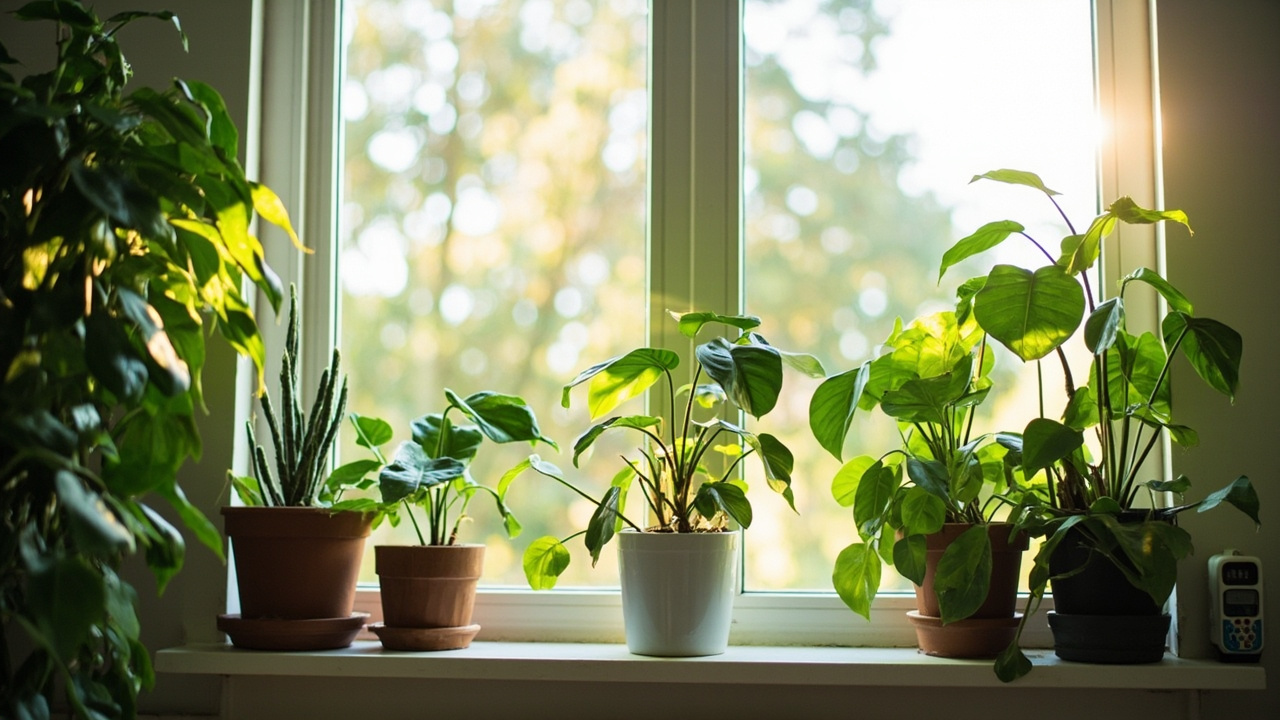
Distance from any window matters more than most people realize. Light intensity drops by approximately 50% just 3 feet from a window and continues declining sharply beyond that. A plant placed 6 feet from a window in a dim corner is receiving roughly the same light as a plant in a room with no windows at all.
Using Grow Lights Effectively
Grow lights supplement natural light for any plants that aren’t getting enough from windows alone. The two most practical types for home gardeners are fluorescent T5 or T8 tubes (good coverage, moderate cost, some heat) and full-spectrum LED grow lights (energy efficient, low heat, higher upfront cost but cheaper long-term). For most houseplant applications, an LED panel or bulb setup in the 400–700nm wavelength range — the photosynthetically active radiation (PAR) spectrum — covers everything your plants need.
Placement matters as much as light type. Position grow lights 12–24 inches above plant canopy. Closer produces faster results but risks light burn; farther reduces effectiveness significantly. Most plants need 12–16 hours of supplemental light per day to replicate natural growing conditions. Critically, plants also need a dark period — approximately 6–8 hours of uninterrupted darkness daily. Continuous light disrupts plant circadian rhythms and can cause the same symptoms as light deficiency.
Seasonal Adjustments
Natural light availability changes dramatically with the seasons, and your plant care should adjust accordingly. Winter months bring shorter days and a sun angle that delivers less light through every window orientation. Plants measurably slow their growth or stop entirely — this is normal, not a problem. Reduce watering frequency to match the slower metabolic rate, and consider moving plants closer to windows or adding supplemental grow lights during the darkest months of November through February.
Summer reverses this pattern. Longer days and stronger sun angles mean more light through every window, which means faster growth, higher water consumption, and the risk of light burn for shade-tolerant species. Move sensitive plants back from south and west windows in late spring, or use sheer curtains to diffuse intense afternoon sun. Watch for the same scorched leaf symptoms described earlier, particularly in June and July when sun intensity peaks.
Matching Plants to Your Space
The practical starting point for matching plants to your space is measuring the actual light in each location using a free light meter smartphone app. These apps use the phone’s ambient light sensor to give approximate foot-candle readings that, while not laboratory-precise, are accurate enough to categorize your spaces as low, medium, or high light. Walk through your home at different times of day and record readings for each spot where you’d like to keep plants.
Once you know your light levels, choose plants that genuinely match. Don’t force a shade-lover into a bright south window — it will burn. Don’t put a citrus tree in a north-facing room — it will decline. The goal is alignment between plant origin, plant needs, and your actual light environment. For more recommendations, see our guide to easiest houseplants that tolerate a range of conditions without demanding precise light management.
Getting indoor plant light right is a skill that compounds over time. Once you start measuring your actual light levels rather than estimating them, every plant decision becomes easier and every plant performs better. The plants on our list of best low light indoor plants and low maintenance indoor plants will thank you for paying attention to this most fundamental of growing requirements.
From PDF to Excel in one click
Forget retyping line by line. Upload any bank statement, get a spreadsheet you can actually use. Your files are never stored, and you can test the converter with 3 free conversions.
Try it free