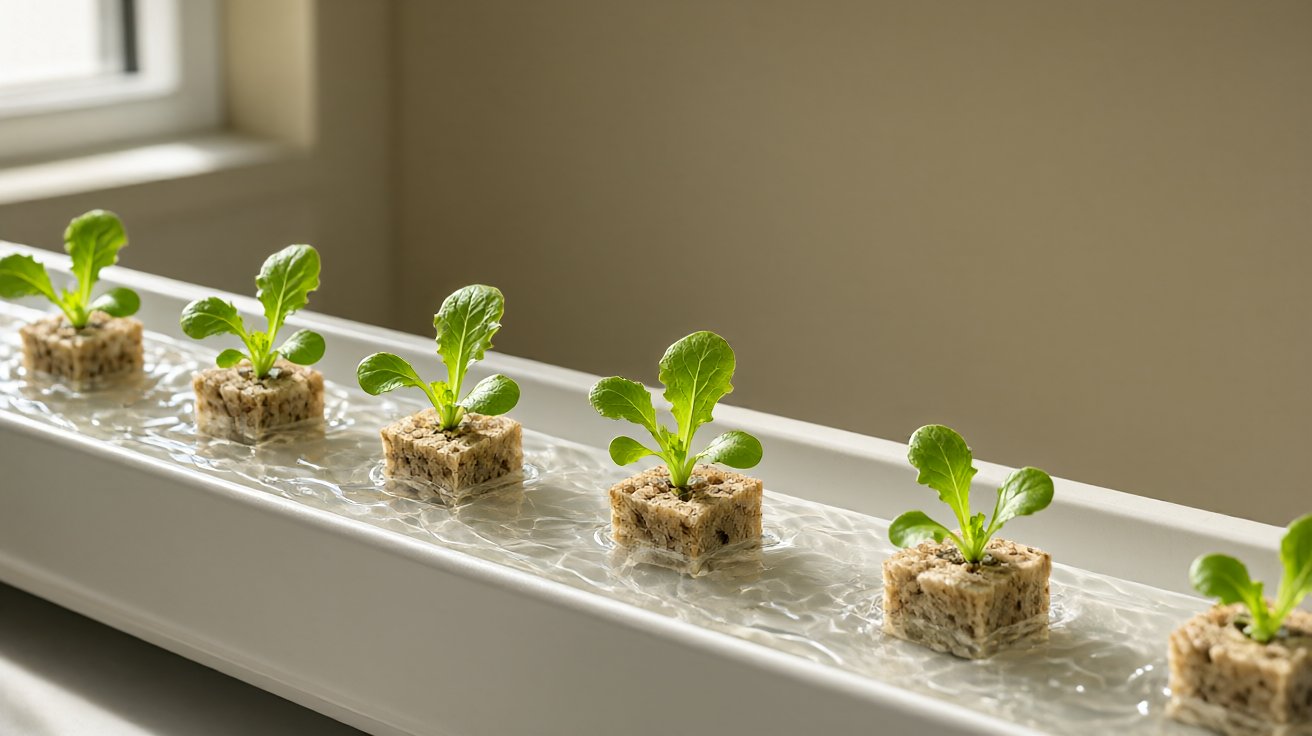

NFT uses minimal medium: rockwool cubes or net pots with clay pebbles in channels. The film of nutrient solution does the work, not the medium. In a nutrient film technique system, the roots sit in a shallow, continuously flowing stream of nutrient solution that is only a few millimeters deep. That thin film delivers water, oxygen, and dissolved nutrients directly to the root surface, which means the growing medium’s job is reduced to anchoring the seedling during establishment and holding the plant upright in the channel. A block of rockwool the size of a sugar cube, or a small basket of clay pebbles, is all that is required. Anything larger, denser, or more water-retentive than that is not helping the system; it is working against the thin film that makes NFT efficient in the first place.
This guide is written for growers who are either building their first NFT channel system or troubleshooting an existing one. It draws on established hydroponic practice, peer-reviewed horticultural literature on nutrient film technique, and the practical experience of commercial growers running NFT on a range of scales from kitchen-window channels to greenhouse gutters. The focus is specifically on the growing medium question inside NFT, which is one of the most commonly misunderstood parts of the system. Growers coming from media-based systems like drip or ebb-and-flow often assume NFT needs a substantial root zone medium, and that assumption leads to the mistakes covered in the later sections. If you are new to the broader topic, our overview of types of hydroponic systems is a useful starting point before diving into NFT specifics.
How NFT Works and Why Medium Matters Less
NFT stands for nutrient film technique, a hydroponic method developed in the late 1960s by Dr. Allen Cooper at the Glasshouse Crops Research Institute in England. The core idea is elegant: a thin film of nutrient solution, roughly one to three millimeters deep, flows continuously over the roots of plants growing in a shallow channel or gully. The channel is set at a slight slope, typically around one to two percent, so gravity pulls the solution downhill and back to a reservoir. A pump returns the solution to the top of the channel, and the cycle repeats. The roots are never fully submerged; they sit in air with their lower portions bathed in the flowing film.
Because the film is so thin, the root zone is dominated by air rather than water. Oxygen availability is high, which is one of the reasons NFT can produce rapid, healthy growth. The film also means that water retention in the growing medium is almost irrelevant. In a media-based system, the medium must hold enough water between irrigations to keep roots from drying out. In NFT, water is delivered continuously, so the medium never needs to store it. What matters instead is drainage: the medium must let the film pass through and around it without pooling or blocking flow. This is why the growing medium properties that matter most in NFT are porosity and drainage, not water retention or cation exchange capacity.
Capillary action, the force that draws water upward through small pores, is actually a liability in NFT. A medium with strong capillary action pulls solution up out of the film and holds it in the root zone, which can waterlog the upper roots and reduce oxygen. The ideal NFT medium has low capillary action, high drainage, and just enough structure to hold a seedling upright until the roots anchor into the channel. That is a very different specification from what you would choose for a drip or wick system, where water retention is a desirable trait.
Rockwool Cubes in NFT
Rockwool cubes are the most common starting medium in NFT, and for good reason. A standard rockwool cube, often twenty-five millimeters on a side, provides a stable, inert plug that holds a germinated seed or a rooted cutting firmly. The cube sits in a net pot or directly in a hole cut in the channel lid, and the roots grow out of the cube and into the flowing film below. Rockwool has excellent aeration when it is not saturated, and its fibrous structure allows roots to penetrate easily. It is also pH-neutral once conditioned, and it does not decompose over a single crop cycle.
The key to using rockwool in NFT is preparation. Fresh rockwool is alkaline and contains dust that can clog channels and irritate lungs, so it must be soaked and rinsed before use. Over-soaking is a common error: a rockwool cube that is fully saturated holds too much water and takes time to drain, which defeats the purpose in a system where the film is already delivering water. The cube should be moist but not dripping when it goes into the channel. For a detailed walkthrough of conditioning, soaking times, and pH adjustment, see our rockwool preparation guide.
Clay Pebbles in NFT Channels
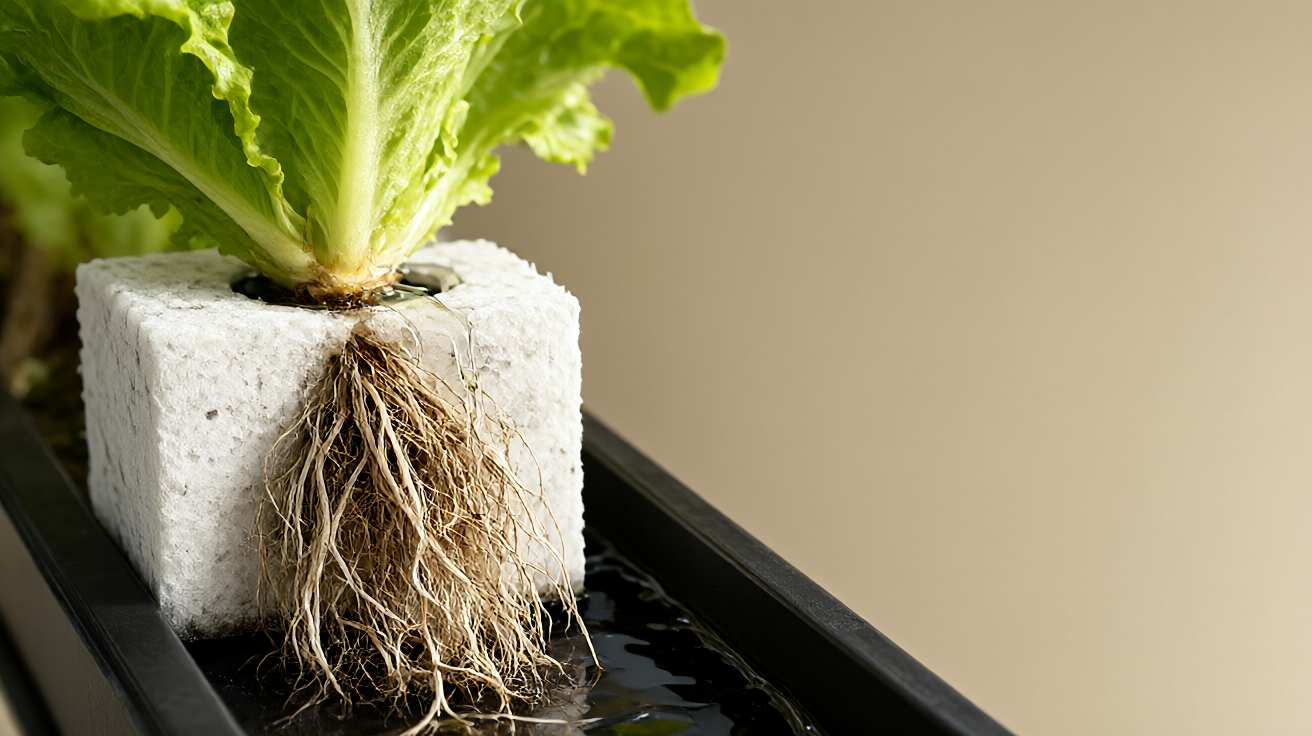
Expanded clay pebbles, also called LECA or hydroton, are the second standard medium in NFT. They are used in net pots that sit in holes cut along the channel lid. The pebbles provide physical support and allow roots to grow through the gaps between them and down into the film. Clay pebbles are inert, reusable, and have very low water retention, which makes them well suited to NFT. They do not break down, they do not affect pH significantly, and they can be washed and sterilized between crops.
Sizing matters. Pebbles that are too small can fall through the net pot mesh or pack too tightly, reducing aeration. Pebbles that are too large leave gaps that let seedlings wobble. A medium grade, roughly eight to sixteen millimeters, is the usual choice for NFT net pots. The pebbles should be rinsed before first use to remove dust, and some growers pre-soak them to remove any residual alkalinity from the manufacturing process. Once in the channel, the pebbles should sit above the film level so that only the roots and the lower portion of the pot are in contact with the solution. If the pebbles themselves are submerged, they add unnecessary resistance to flow and can create stagnant pockets.
Clay pebbles are particularly useful for plants that will be in the system for a long time, such as fruiting crops, because they provide durable support that rockwool cubes cannot match over months of growth. They are also the medium of choice for transplanting seedlings started in rockwool: the seedling and its cube are placed into a net pot filled with pebbles, and the roots grow through both. This combination, rockwool for germination and clay pebbles for channel support, is the most common and reliable medium strategy in commercial NFT.
Media That Fail in NFT (coco coir, vermiculite)
Not all growing media work in NFT, and the ones that fail usually fail for the same reason: they hold too much water and have too much capillary action. Coco coir is a good example. It is an excellent medium in drip and ebb-and-flow systems because it retains moisture and has good aeration, but in NFT it acts like a sponge. Coir placed in a channel soaks up the film, holds it in the root zone, and creates a waterlogged environment that reduces oxygen. The roots sit in saturated coir rather than in the thin film, and the benefits of NFT are lost. Coir also breaks down over time, releasing particles that can clog pumps and channels.
Vermiculite is even worse. It is highly absorbent and has strong capillary action, so it pulls solution out of the film and holds it in a dense, wet mass around the roots. Vermiculite also compacts easily, which further reduces aeration. In an NFT channel, vermiculite can swell and block flow entirely, causing backups and uneven distribution. Perlite, while better than vermiculite, is still problematic in NFT because its light weight makes it prone to floating and washing away in the flowing film. Fine perlite particles can also clog emitters and channels.
The general rule is that any medium with high water retention, high capillary action, or a tendency to break down or compact should be kept out of NFT channels. If you need a medium that holds water, NFT is the wrong system for that crop. NFT is designed for the opposite condition: minimal medium, maximum film contact. For a broader comparison of media and their properties across all hydroponic systems, our guide to compare hydroponic growing media covers the full range.
Channel Design and Medium Interaction
The channel and the medium interact in ways that are easy to overlook. The channel slope determines how fast the film moves, and the medium affects how the film distributes across the channel width. A channel that is too flat produces a film that is too slow, which can lead to uneven wetting and anaerobic spots. A channel that is too steep produces a film that moves too fast, which can wash lightweight media like perlite out of net pots and reduce contact time between roots and solution. The standard slope of one to two percent is a compromise that works well with rockwool cubes and clay pebbles.
Root Exposure and Oxygen
Oxygen in the Film
One of the defining features of NFT is that the roots are exposed to air for much of their length. Only the lower portion of the root mass sits in the film; the upper roots hang in the humid air inside the channel. This exposure is essential for oxygen uptake, and it is one of the reasons NFT can support high growth rates without the root rot problems that plague submerged systems. The growing medium must not interfere with this exposure. A medium that wraps around the roots and stays wet, like coir or vermiculite, blocks air contact and creates the anaerobic conditions that lead to root rot. NFT’s thin film (1-3mm) provides oxygen directly to roots, which is why air-filled porosity matters less than in DWC or media-bed systems , the medium is secondary to the film.
Root Health Indicators
Rockwool cubes and clay pebbles both allow root exposure because they are porous and drain freely. Roots grow out of the cube or through the pebbles and into the air space of the channel, where they can absorb oxygen directly. The film provides water and nutrients, but the air provides oxygen, and both are needed. This is why NFT channels are usually enclosed or covered: the enclosure maintains humidity around the exposed roots so they do not dry out, while still allowing air circulation. An open channel in a dry environment can desiccate exposed roots even with a film running beneath them.
Common NFT Medium Mistakes
Over-Mediuming
The most common mistake is using too much medium. Growers who are used to drip systems or dutch buckets often fill NFT net pots to the top with clay pebbles, or use rockwool blocks instead of cubes. This adds weight, blocks flow, and does nothing for the plant because the film is already delivering everything the roots need. The medium should be minimal: just enough to hold the seedling and keep it upright.
The second common mistake is choosing a medium with high water retention. Coir, vermiculite, and even over-saturated rockwool all create waterlogged root zones in NFT. The fix is to switch to a low-retention medium and to prepare rockwool so it is moist but not dripping.
Channel Slope Errors
The third mistake is ignoring channel slope and flow rate in relation to the medium. A lightweight medium like perlite washes away in a steep channel, while a heavy medium like saturated rockwool can dam a flat one. Matching the medium to the channel design prevents both problems. Optimal NFT channel slope is 1:30 to 1:40 (1 cm drop per 30-40 cm run); steeper slopes dry roots, shallower slopes waterlog them.
Finally, many growers forget that the medium is only part of the system: the film must be clean, the pump must be reliable, and the slope must be correct. A perfect medium in a poorly designed channel will still fail.
Medium Selection by NFT System Scale
At small scale, such as a kitchen-window NFT kit or a single-channel home system, rockwool cubes in net pots are the simplest and most reliable choice. They are easy to handle, they germinate seeds well, and they require no washing or sterilization. A home grower running a few channels with lettuce or herbs can use cubes for the entire crop cycle without any medium-related problems, as long as the cubes are prepared correctly and the channel slope is right.
At medium scale, such as a hobby greenhouse or a small commercial setup with multiple channels, the rockwool-to-clay-pebble combination becomes the standard. Seeds are started in rockwool cubes, and at transplant the cubes are placed into net pots filled with clay pebbles. This gives the durability needed for longer crop cycles and the support needed for larger plants like tomatoes or cucumbers. The pebbles are washed and reused between crops, which keeps costs down as the system scales up.
Regardless of scale, the principle is the same: in NFT, the medium is a support structure, not a water reservoir. The film does the work. Choosing a medium that respects that principle is the single most important decision a grower makes when setting up or troubleshooting an NFT system.
Reviewed: November 2026. Sources: Cooper, A.J. (1979) The ABC of NFT; Resh, H.M. (2013) Hydroponic Food Production; Jones, J.B. Jr. (2014) Complete Guide for Growing Plants Hydroponically; commercial NFT grower practice notes.
Last reviewed on 3 November 2026. Updated as new evidence and extension guidance are checked.
Sources and further reading
The claims in this guide come from extension services, plant science references, and hydroponic practice.
Johnny’s Selected Seeds , Choosing your hydroponic grow medium.
Oklahoma State University Extension , Soilless growing media.
Premier Tech Horticulture , Hydroponic growing media guide.
Turn PDF Bank Statements Into Workable Spreadsheets
Your bank statement is a mess of numbers, but your books shouldn't be. Use our converter to get Excel, CSV, or QBO files — ready for QuickBooks.
Try It Free Now