
Fruit trees are the one crop where “more fertilizer equals more fruit” runs backwards. Feed an apple or peach tree the way you feed tomatoes and you get a lush, leafy canopy with almost no fruit. The reason sits in how a perennial tree budgets nutrients across years, and in the specific trade-off between nitrogen and flower bud formation. This guide explains that trade-off and gives timing, ratio, and rate guidance by tree age and fruit type, so you can feed an orchard deliberately instead of by habit. The numbers on the bag matter less than the decision about when and how much to apply.
Why fruit trees need different feeding
Fruit trees are perennials. A tomato spends one season and dies; a pear tree lives for decades and stores nutrients in its wood, roots, and bark. That changes everything about feeding. Nutrients accumulate over years, and a single season’s application builds on what the tree already holds. Fruit removal also depletes the tree in a way leafy crops never experience: every apple, peach, or cherry carries nitrogen, phosphorus, potassium, calcium, and magnesium out of the orchard. A heavy crop year can strip the tree’s reserves, which then shows up as weak growth the following spring.
Because of this, fruit trees are fed to support a multi-year cycle, not a single harvest. The goal is steady, moderate nutrition that keeps vegetative growth and fruiting in balance. Push either side too far and the tree pays for it the next year. Feeding should also follow a soil test rather than a calendar, because two orchards on the same street can have very different baseline fertility. For background on how the label numbers work, see how to read an NPK ratio.
Another difference: fruit trees root deeply and broadly. A mature apple can draw water and nutrients from well beyond the canopy edge, which means surface feeding under the canopy still reaches a large share of the root system. It also means that a single application spreads slowly and predictably, unlike the sharp spikes a vegetable garden can experience. This slow, steady uptake is exactly why fruit trees respond to moderate, well-timed feeding and punish heavy, late, or mistimed doses. Patience and consistency beat intensity.
The nitrogen-fruit trade-off
Nitrogen drives leaf and shoot growth. That sounds desirable, but in a fruit tree it competes directly with fruiting. When nitrogen is abundant, the tree pours energy into new wood and foliage. Flower bud formation, which happens the previous season for many species, gets shortchanged. The result is a tree that looks healthy and green yet sets little fruit.
This is why the “more fruit means more fertilizer” idea fails. More nitrogen does not mean more fruit; past a modest point it means more leaves. Phosphorus and potassium support flowering, fruit set, and fruit quality, so a fruit tree’s feeding should lean toward those rather than toward nitrogen. The practical rule: nitrogen is the nutrient to ration, not the one to maximize. If you are unsure what nitrogen actually does in plants, this breakdown of nitrogen’s role covers it.
Over-fertilization also softens new growth, making it more susceptible to fire blight, aphids, and winter injury. A slightly hungry fruit tree often outproduces a well-fed one. The effect is visible in the orchard: overfed trees produce water sprouts, long unproductive shoots that shade the canopy and never bear fruit, while moderately fed trees set fruit on shorter, sturdier wood. Pruning cannot fully fix a nitrogen problem; the feeding has to change first. If a tree is already too vigorous, skip a season of feeding entirely and let it settle before resuming.
Potassium deserves special mention for fruit quality. It governs sugar movement and fruit size, so a potassium-short tree sets small, bland fruit even when nitrogen and phosphorus are adequate. This is another reason a fruit-tree formula leans toward phosphorus and potassium rather than nitrogen alone.
Best ratios for fruit trees
Three ratios cover most home orchard situations:
- 10-10-10: a balanced maintenance feed for established trees in average soil. Safe default when you have not tested.
- 12-12-12: similar to 10-10-10 but slightly stronger; useful for larger mature trees or poorer soils.
- 5-10-10: lower nitrogen, higher phosphorus. The better choice when a tree is vegetative and shy to fruit, or when you want to push flowering and fruit set.
The pattern is clear: fruit trees rarely need high nitrogen. A ratio with nitrogen equal to or lower than phosphorus and potassium suits them better than a lawn or vegetable formula. Remember that label numbers are N, P2O5, and K2O, not elemental nutrients, so a 5-10-10 is 5% nitrogen and 10% phosphate equivalent. For the conversion to elemental phosphorus and potassium, see the NPK ratio explainer. When in doubt between two ratios, choose the lower nitrogen option; it is easier to add nitrogen later than to undo an overfed tree.
If your soil is acidic, nutrients may be locked up regardless of ratio. In that case, feeding more will not help until pH is corrected. Soil pH and nutrient availability explains why. A soil test should include pH; if it comes back below about 6.0 for most fruit trees, lime is the first amendment, not more fertilizer.
Organic options such as composted manure or fruit-tree blends release nitrogen more slowly, which can be an advantage for trees that already run vigorous. Synthetic granular products act faster and are easier to meter. Either works; the ratio and timing matter more than the source. Compost is best treated as a soil conditioner that supports the biology around the roots, while a measured NPK product supplies the specific quantities a tree needs in a given season.
When to fertilize fruit trees
Two windows matter:
- Early spring, before bloom: the main feeding. Apply as buds begin to swell but before flowers open. The tree is waking up and can use nutrients for the coming season’s growth and fruit set.
- Post-harvest: a lighter feeding after fruit is picked. This supports the next year’s flower bud development, which for many species is set in late summer and fall.
Avoid mid-summer feeding. Late nitrogen pushes tender new growth that will not harden off before winter and can reduce cold hardiness. If a tree is already vigorous and fruiting well, skip the post-harvest round entirely. In cold climates, the spring window is short, so aim to apply as soon as the soil is workable and before bud swell rather than waiting for bloom.
Timing also interacts with rainfall. Apply before a gentle rain or irrigate afterward so granules dissolve and move into the root zone. Avoid applying before heavy rain, which can wash fertilizer off the surface and into runoff before the tree takes it up. In dry climates, always water in deliberately.
How to apply fertilizer to fruit trees
Placement matters as much as timing. Fruit tree roots spread well beyond the canopy, and the feeder roots concentrate in the top few inches of soil.
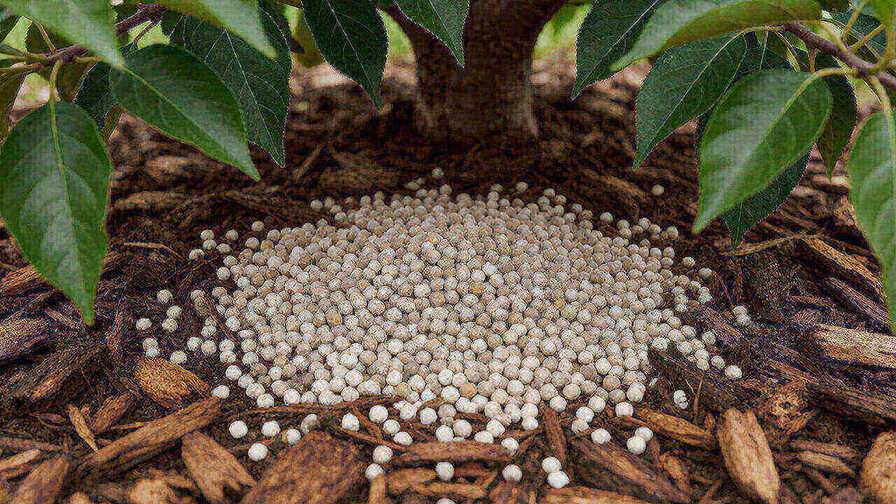
- Broadcast granular fertilizer evenly under the canopy, starting a foot or two out from the trunk and extending slightly past the drip line.
- Keep fertilizer off the trunk. Piling it against the bark causes burn and invites disease.
- Water it in thoroughly. Dry granules sitting on the surface do little.
- For drip or micro-sprinkler systems, fertigation is an option, but split applications into smaller doses.
Do not dig fertilizer into the root zone of an established tree. You will cut roots and create uneven pockets. Surface broadcast plus water is the standard, effective method. For the math behind how much to spread, application rate calculations walk through it step by step.
Container-grown fruit trees are a different case entirely. Their small root volume and frequent watering leach nutrients quickly, so they need more frequent, lighter feeding in smaller doses throughout the growing season rather than one or two heavy applications.
Young vs mature trees
Rate scales with age and size, not with enthusiasm.
| Tree age | Approach | Notes |
|---|---|---|
| Year 1-2 (newly planted) | Light feed or none | Let roots establish; excess nitrogen delays fruiting |
| Year 3-5 (young, not yet bearing) | Moderate, balanced | Build structure; do not push vegetative growth |
| Mature, bearing | Annual spring feed | Adjust by crop load and vigor |
| Old or declining | Conservative | Test soil first; avoid forcing new growth |
Young trees especially suffer from over-feeding. A tree that grows too fast in its first years produces weak wood and delays the shift from vegetative growth to flowering. Patience in the early years pays off in earlier, heavier bearing. If a young tree is growing more than about two to three feet of new shoot per year, cut back on nitrogen regardless of what the label suggests. Training and pruning shape the tree; fertilizer should not be used to force size.
Stone fruit vs pome fruit
Stone fruits (peach, plum, cherry, apricot) and pome fruits (apple, pear) differ in vigor and sensitivity.
- Stone fruit: generally more vigorous and more prone to over-fertilization problems. Peaches in particular push water sprouts with excess nitrogen. Keep nitrogen modest and favor 5-10-10 or light 10-10-10.
- Pome fruit: somewhat more tolerant of moderate feeding, but still subject to the same nitrogen-fruit trade-off. Apples on vigorous rootstocks especially need restraint.
Both groups benefit from the same timing: spring before bloom, optional light post-harvest. Both suffer from the same excess: nitrogen-driven leaf growth at the expense of fruit. The difference is mainly in vigor, so a peach usually needs less nitrogen than an apple of the same age.
Signs of deficiency in fruit trees
Read the tree before reaching for fertilizer. Common signals:
- Pale or yellowing leaves, especially older ones: nitrogen shortage.
- Poor flowering or fruit set despite adequate bloom: possible phosphorus shortage.
- Leaf scorch, weak fruit, or small fruit size: possible potassium shortage.
- General poor vigor with normal color: often not a nutrient problem at all; check water, drainage, or root health.
Always confirm with a soil test before treating a suspected deficiency. Guessing leads to over-application, which is the more common orchard mistake. How to read a soil test report is a useful companion. A test also reveals whether the problem is a true shortage or simply a pH lock-up, which saves money and prevents unnecessary feeding. Remember that visual symptoms can lag behind the actual deficiency by weeks, so treat the test, not just the leaf color.
Last updated: October 28, 2026.
Sources
- Penn State Extension, “Fruit Tree Fertilization.”
- Purdue Extension, “Fruit Tree Nutrition.”
- University of Minnesota Extension, “Fruit Tree Fertilization.”
- Washington State University Extension, “Tree Fruit Fertilization.”
- Cornell Cooperative Extension, “Fruit Tree Care.”
- UF/IFAS, “Fruit Tree Fertilization.”
The actual number is the decision.
Turn PDF Bank Statements Into Workable Spreadsheets
Your bank statement is a mess of numbers, but your books shouldn't be. Use our converter to get Excel, CSV, or QBO files — ready for QuickBooks.
Try It Free Now