
Nitrogen is the nutrient you can see working, or failing, within days. A pale lawn after a rainy week, yellowing lower leaves on a tomato, a burst of dark green growth after a feeding: these are nitrogen acting in real time. No other fertilizer element announces itself so quickly. This article explains the mechanism behind that visible response, how plants absorb nitrogen, what deficiency and excess look like, where nitrogen comes from, when to apply it, how it is lost, and how to convert a nitrogen recommendation into pounds of product.
Because nitrogen cycles through soil, plant, and air, managing it well means understanding both the biology and the bookkeeping. The sections below move from mechanism to practice.
What nitrogen actually does inside a plant
Nitrogen is a building block of amino acids, which link into proteins, which in turn carry out nearly every function a plant performs. Enzymes, structural proteins in cell walls, and the proteins that move nutrients through the plant all depend on a steady nitrogen supply. When nitrogen is scarce, protein synthesis slows and growth stalls.
Nitrogen is also a core component of chlorophyll, the green pigment that captures light for photosynthesis. Each chlorophyll molecule contains four nitrogen atoms. Without enough nitrogen, the plant cannot build chlorophyll, and leaves lose their green color. This is why nitrogen shortage shows up first as a color change rather than as a structural failure.
Because nitrogen drives cell division and the production of new tissue, it fuels vegetative growth: leaves, stems, and roots. Shoots and leaf area expand when nitrogen is adequate. Reproductive growth, flowering and fruiting, tends to follow later and depends on other nutrients as well. Nitrogen sets the size of the plant’s photosynthetic engine.
Nitrogen also appears in nucleic acids, DNA and RNA, which carry the genetic instructions for every cell division. A nitrogen shortage therefore limits not just how big cells get but how many cells the plant can produce. This is why stunting is often the first visible effect in seedlings and young transplants, before leaf color changes.
For a deeper look at how the three label numbers relate, see what the NPK ratio numbers actually mean.
How plants absorb nitrogen (and why form matters)
Plants do not take up nitrogen in its elemental form. Roots absorb two ionic forms: ammonium (NH4+) and nitrate (NO3-). Both are usable, but they behave differently in soil and in the plant.
Nitrate is highly mobile in soil water and moves quickly to roots. It is the dominant form in most well-aerated soils because soil bacteria convert ammonium to nitrate through nitrification. Ammonium, by contrast, binds to soil particles and resists leaching, but most plants take it up more slowly. Some crops, such as blueberries and conifers, prefer ammonium.
The form matters for timing and loss. Nitrate can wash out with heavy rain or irrigation before roots reach it. Ammonium is more stable but can convert to nitrate within days in warm, moist soil. The practical takeaway is that nitrogen applied in either form becomes nitrate in short order in most garden soils, so water management matters as much as the product choice.
Roots take up nitrogen most efficiently when soil moisture is adequate but not saturated. Dry soil slows uptake and can cause salt stress with concentrated synthetic products. A light watering before application and a thorough watering after keeps nitrogen moving into the root zone without washing it past.
Soil pH strongly affects how well roots can access nitrogen and other nutrients, which is covered in soil pH and nutrient availability.
Signs of nitrogen deficiency
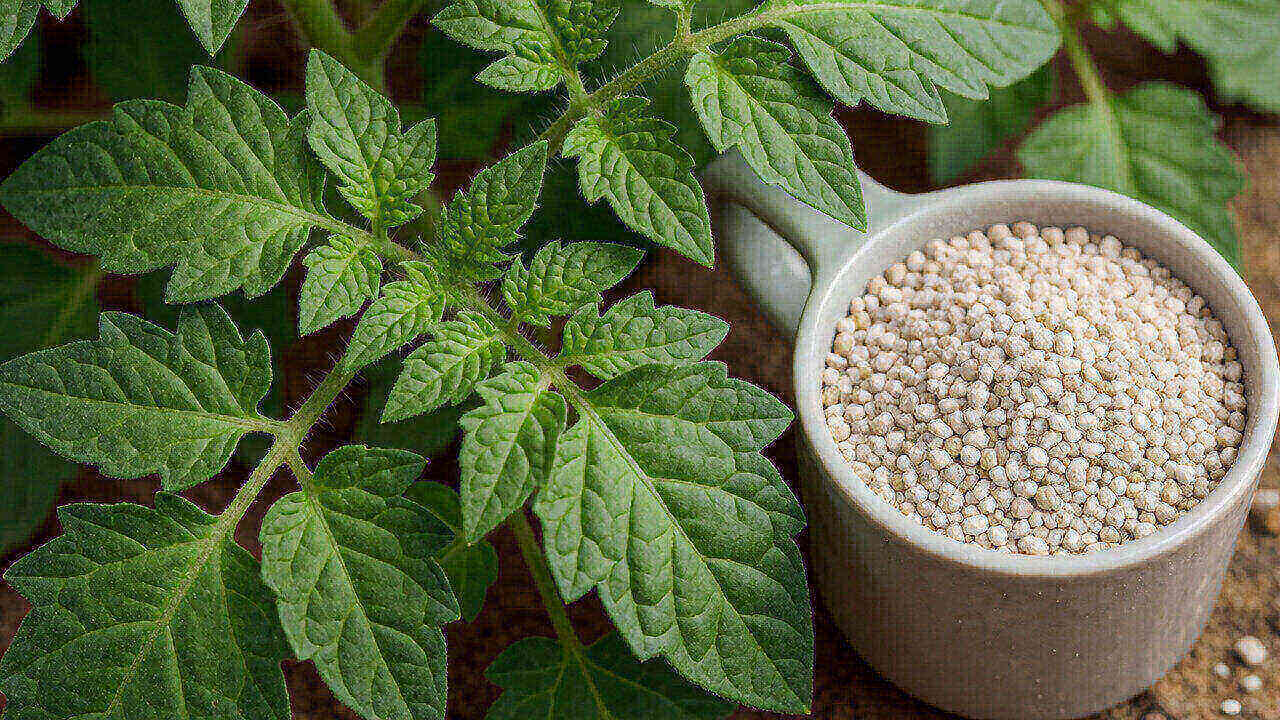
Nitrogen is mobile within the plant, meaning the plant can move it from older tissue to newer growth. For that reason, deficiency symptoms appear first on older, lower leaves. The classic sign is a uniform yellowing, called chlorosis, that starts at the leaf tip and moves down the midrib, while newer leaves at the top stay green. Growth is stunted and plants look pale overall.
Other clues include thin stems, reduced branching, and smaller leaves. In lawns, nitrogen deficiency shows as a light green to yellow color and slow recovery after mowing. In vegetables, older leaves yellow and drop early, and yield falls because the plant lacks the leaf area to feed itself.
Nitrogen deficiency can look like other problems, so confirm before treating. Iron deficiency also causes yellowing but appears on young leaves first. Sulfur deficiency resembles nitrogen deficiency but is less common in gardens. A soil test removes the guesswork; see how to read a soil test report for interpreting results.
Because nitrogen moves freely inside the plant, a deficiency develops gradually as older leaves feed new growth. By the time symptoms are obvious, the plant has already lost productive capacity. Correcting early, before severe yellowing spreads, restores growth faster than waiting for dramatic signs.
Signs of too much nitrogen
Excess nitrogen produces the opposite picture: dark green, lush, soft growth. Leaves are large and thick, stems are weak and may lodge or fall over, and the plant delays flowering and fruiting. The plant looks vigorous but performs poorly.
Soft, succulent tissue is also more attractive to aphids and other sucking insects, and disease pressure can rise. In lawns, excess nitrogen leads to rapid growth, shallow roots, and thatch buildup. In fruiting crops such as tomatoes and peppers, too much nitrogen during flowering reduces fruit set because the plant keeps investing in leaves.
The goal is enough nitrogen for healthy vegetative growth, then a reduction as the crop shifts to reproduction. Timing and rate matter more than total amount.
If you have already overapplied, the fix is usually water and time. Stop further nitrogen, water deeply to leach excess from the root zone, and wait for new growth to firm up. In containers, flushing with several volumes of water can help, though it may carry other nutrients with it.
Where nitrogen comes from (synthetic vs organic sources)
Synthetic sources deliver nitrogen quickly and predictably. Common ones include urea (46-0-0), ammonium nitrate (34-0-0), and ammonium sulfate (21-0-0-24S). These are salts that dissolve and become available to roots within days. They suit situations where a rapid response is needed, such as a yellowing lawn or a crop entering peak growth.
Organic sources release nitrogen more slowly because microbes must break down the material first. Blood meal runs about 12 to 13 percent nitrogen and acts relatively fast for an organic product. Fish emulsion is lower, around 4 to 5 percent nitrogen, and also feeds soil biology. Compost is lower still, often 1 to 2 percent nitrogen, and releases it gradually over months. Organic sources also add organic matter and improve soil structure.
The tradeoff is speed versus soil health. Synthetic nitrogen feeds the plant now; organic nitrogen feeds the plant and the soil over time. Many gardeners use a combination: a quick synthetic boost early, then organic amendments to build long-term fertility. For a fuller comparison, read compost versus NPK fertilizer.
Choosing among products and formulations is covered in the fertilizer buying guide.
One caution with organics: because release depends on microbial activity, cold or dry soils slow it dramatically. A fall application of compost may not release much nitrogen until spring, which is fine for soil building but not for an immediate nitrogen need.
When and how to apply nitrogen
Apply nitrogen when the plant is actively growing and can use it. For lawns, that means spring and early fall in cool-season regions, and late spring through summer for warm-season grasses. For vegetables, apply at planting and again during vegetative growth, then ease off as flowering begins.
Soil temperature matters because microbial activity and root uptake both slow in cold soil. In early spring, nitrogen applied to cold soil may sit unused and leach away with spring rains. Wait until soil temperatures reach roughly 50 to 55 degrees Fahrenheit before heavy nitrogen applications.
Crop type matters too. Leafy greens and lawns are heavy nitrogen users. Fruit-bearing crops need moderate nitrogen early, then less. Legumes such as beans and peas fix their own nitrogen through root nodules and rarely need supplemental nitrogen.
Application method affects efficiency. Broadcast and water in, or use a liquid feed for faster uptake. Split applications, two or three smaller doses rather than one large dose, reduce loss and match supply to demand. Always water after applying to move nitrogen into the root zone.
For established perennials and shrubs, a single spring application is usually enough. Heavy feeders such as corn, leafy greens, and turf benefit from a second dose midseason. Avoid late-season nitrogen on woody plants, which can push tender growth that winter kills.
Nitrogen loss: leaching, volatilization, and timing
Nitrogen is the most mobile of the major nutrients, and a significant share of applied nitrogen never reaches the plant. Three loss pathways dominate.
Leaching occurs when nitrate dissolves in water and moves below the root zone. Sandy soils and heavy rainfall or irrigation accelerate it. On sandy ground, split applications and slow-release forms reduce loss.
Volatilization happens when urea or ammonium-based fertilizers sit on the soil surface and convert to ammonia gas, which escapes to the air. Warm, dry, alkaline conditions increase volatilization. Watering in within a day or two, or incorporating fertilizer into soil, prevents most of it.
Denitrification occurs in waterlogged, oxygen-poor soils, where bacteria convert nitrate to nitrogen gas. Poorly drained beds and overwatering create these conditions. Good drainage and avoiding saturated soils protect nitrogen.
Timing is the simplest control. Apply when plants are growing and uptake is high, avoid applications before heavy rain, and match the form to the season. Slow-release products, discussed in slow-release versus quick-release fertilizer, stretch availability and reduce peak losses.
Testing soil nitrogen before applying prevents both waste and overapplication. A soil test also reveals organic matter level, which indicates how much nitrogen the soil will release naturally through the season.
A worked example: from recommendation to pounds of product
Suppose a soil test recommends 1 pound of nitrogen per 1,000 square feet for a lawn. You have a 20-5-10 fertilizer, meaning 20 percent nitrogen by weight. To find pounds of product, divide the nitrogen needed by the nitrogen percentage: 1 divided by 0.20 equals 5 pounds of product per 1,000 square feet.
For a 5,000 square foot lawn, multiply by five: 25 pounds of 20-5-10. That delivers 5 pounds of actual nitrogen across the whole lawn.
If you prefer an organic source, the math is the same but the product weight rises. Blood meal at 12 percent nitrogen requires 1 divided by 0.12, or about 8.3 pounds per 1,000 square feet, to deliver the same 1 pound of nitrogen. The lower concentration means more material and more frequent applications.
For a deeper treatment of rate calculations, including calibration and spreader settings, see fertilizer application rate math. For crop-specific nitrogen targets, consult the NPK ratio chart for vegetable crops.
Always double-check the label, since nitrogen percentage is the first number in the NPK ratio. A 10-10-10 product at 10 percent nitrogen requires 10 pounds per 1,000 square feet to deliver the same 1 pound of nitrogen, five times more product than the 20-5-10 example above.
Last updated: October 28, 2026.
Sources
- IRRI Knowledge Bank, “Nitrogen” (International Rice Research Institute)
- University of Hawaii CTAHR, “Nitrogen” (College of Tropical Agriculture and Human Resources)
- UF/IFAS AG462, “Plant Essential Nutrients and Their Role”
- Penn State Extension, “Nitrogen”
- University of Minnesota Extension, “Nitrogen for Crop Production”
- Purdue Extension, “Nitrogen Management”
The actual number is the decision.
From PDF to Excel in one click
Forget retyping line by line. Upload any bank statement, get a spreadsheet you can actually use. Your files are never stored, and you can test the converter with 3 free conversions.
Try it free