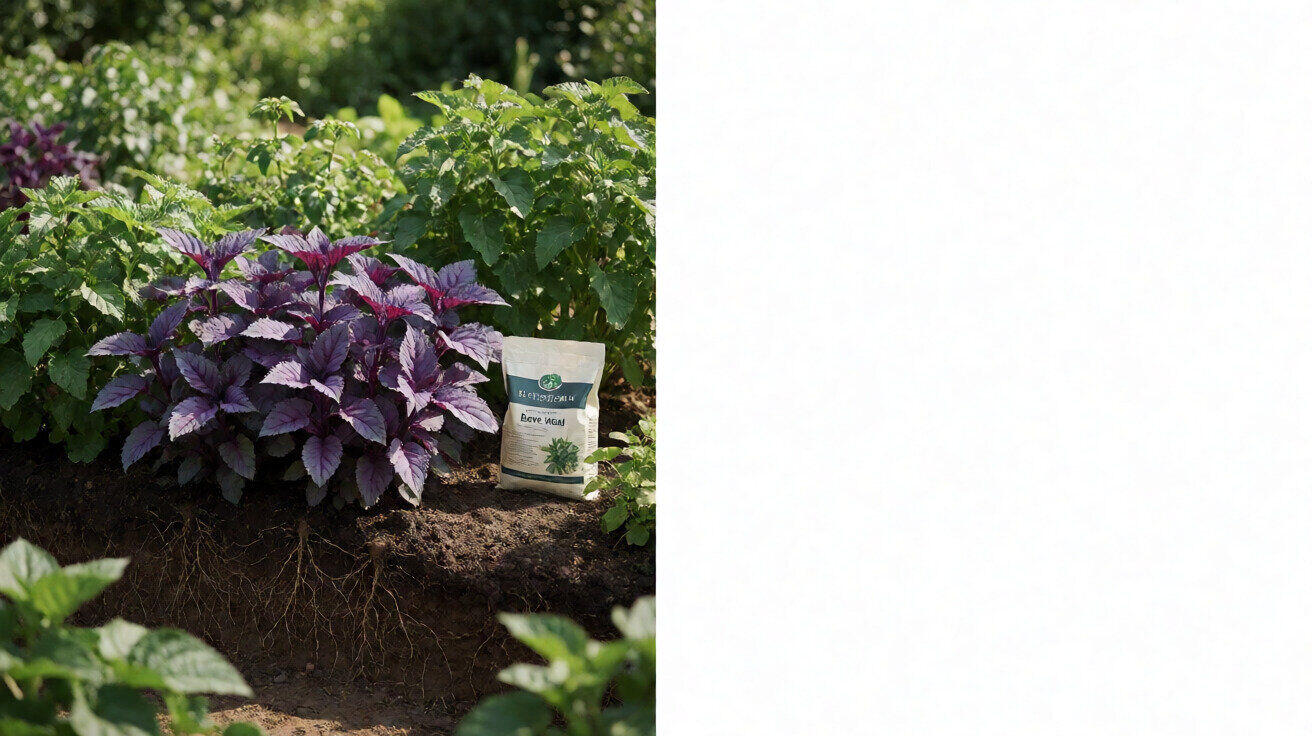

Phosphorus is the nutrient most home gardeners over-apply and under-understand. It sits in the middle of every fertilizer bag label, yet its job inside the plant is rarely explained beyond “roots and flowers.” The reality is more interesting. Phosphorus is the currency of energy in plant cells. Without it, roots stall, flowers refuse to set, and the whole plant runs out of fuel even when nitrogen and water are plentiful.
This guide walks through what phosphorus actually does, how plants absorb it, how to read deficiency symptoms, and why a soil test matters more than any bag of bone meal. If you want the label numbers decoded first, see what the NPK ratio on a fertilizer label means.
By the end, you should be able to look at a struggling plant and decide whether phosphorus is the suspect, and you should know when to leave it alone.
What phosphorus actually does inside a plant
Phosphorus enters the plant as phosphate ions and is built into adenosine triphosphate, or ATP. ATP is the molecule that carries usable energy from where it is made, in the leaves during photosynthesis, to where it is spent, in roots, flowers, seeds, and growing tips. Every cell division, every root hair, every grain of pollen requires ATP. Phosphorus is not optional fuel. It is the fuel itself.
Think of ATP as a rechargeable battery. A phosphate group is added to ADP to store energy, then removed to release it. That transfer happens millions of times per second in an active root tip. When phosphorus is scarce, the battery cannot recharge fast enough, and growth slows before any visible symptom appears. This is why a phosphorus-starved plant can look fine for weeks, then suddenly stall.
That energy role explains the three classic phosphorus jobs gardeners hear about:
- Root development. Root tips are among the most energy-hungry tissues in a plant. New root cells need ATP for elongation and for the cell division that produces root hairs. A phosphorus-starved plant makes a small, shallow root system.
- Flowering and fruiting. Flower initiation, pollination, and seed fill are high-energy phases. Phosphorus deficiency often shows up first as delayed or absent flowering, even when the plant looks otherwise healthy.
- DNA and RNA synthesis. Phosphorus is part of the backbone of every nucleic acid. Without it, the plant cannot copy genetic instructions for new growth.
Phosphorus also helps move sugars and starches around the plant and plays a role in nitrogen fixation in legumes. The point is that “roots and flowers” is a side effect of the deeper mechanism. The deeper mechanism is energy transfer.
Phosphorus is also a structural component of cell membranes, as phospholipids, and of the genetic material that directs every new cell. A deficiency therefore limits not just energy but the physical machinery of growth. That is why phosphorus-starved plants stay small in every dimension, not just in roots.
How plants absorb phosphorus (and why pH matters)
Plants do not absorb phosphorus as the element P. They absorb phosphate ions, mostly H2PO4- in acidic soils and HPO4^2- in neutral to alkaline soils. The form available to the plant depends heavily on soil pH, which is why pH and phosphorus are tightly linked. In very acidic soils, phosphorus binds to aluminum and iron. In alkaline soils, it binds to calcium. Either way, it becomes locked up and unavailable even when the soil test shows plenty.
The practical window is roughly pH 6.0 to 7.0, where phosphorus is most available. Outside that window, availability drops sharply even when total phosphorus is high. That is why a pH correction sometimes fixes a phosphorus problem without any phosphorus fertilizer at all.
There is a second mechanism worth knowing. Many plants, especially in low-phosphorus soils, form partnerships with mycorrhizal fungi. The fungal network extends far beyond the root zone and mines phosphorus the plant cannot reach. Tilling, over-fertilizing with phosphorus, and some fungicides can suppress this partnership. A garden that feeds its soil biology often needs less phosphorus fertilizer than a garden that does not.
Soil temperature matters too. Phosphorus uptake slows in cold soil, which is why early spring transplants often show purple leaves that fade as the soil warms. That is a temporary uptake problem, not always a true deficiency.
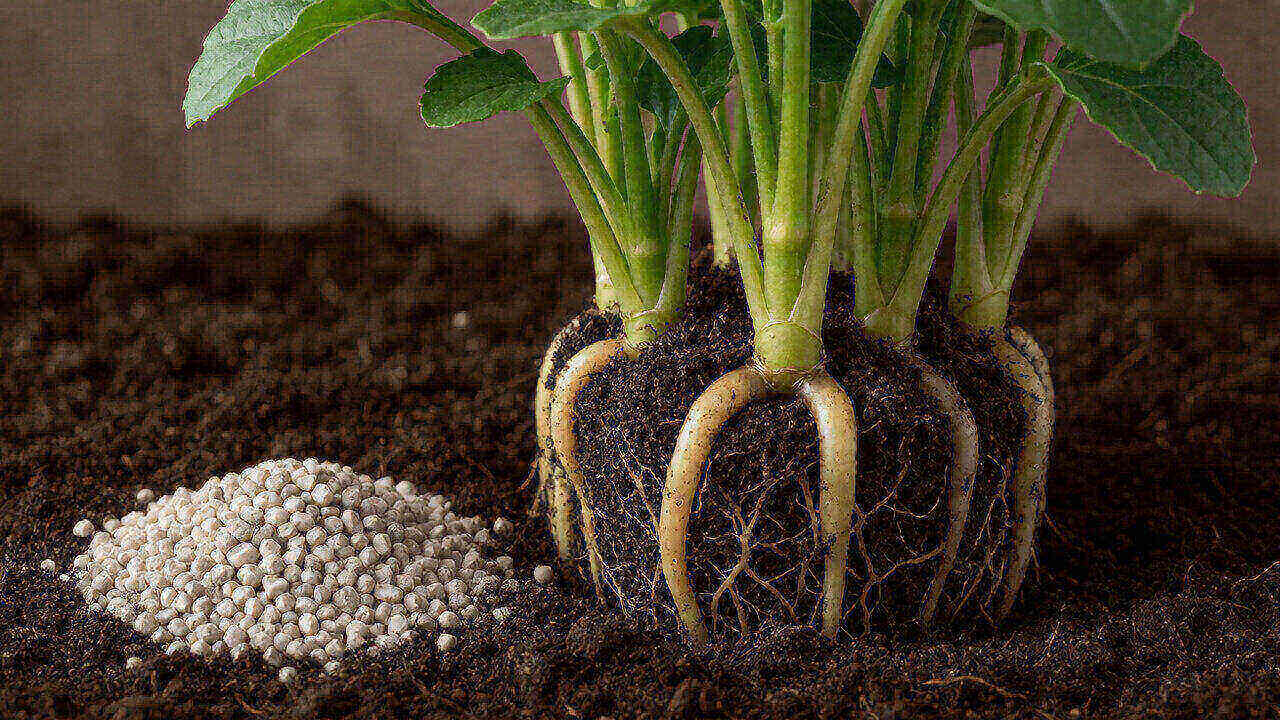
Placement matters as much as pH. Phosphorus does not move far through soil, so broadcasting it across a bed wastes most of it. Banding or placing it in the root zone puts it where roots can reach it. This is why starter fertilizers are often placed in or near the seed row.
If you want the full mechanism, see how soil pH controls nutrient availability.
Signs of phosphorus deficiency
Phosphorus deficiency is less common in garden soils than nitrogen deficiency, but it is harder to spot early. The classic signs:
- A dark green to bluish-green leaf color, often with a purple or reddish tint on the underside of leaves and on stems.
- Stunted overall growth and a small, underdeveloped root system.
- Delayed flowering and fruit set, or flowers that abort early.
- Older leaves affected first, because phosphorus is mobile in the plant and moves to new growth.
- In severe cases, leaves may turn bronze or purplish and drop prematurely.
Purple leaves are the signature, but they are not unique to phosphorus. Cool temperatures, genetic variety traits, and some viruses can also cause purpling. The pattern matters more than the color.
Deficiency progresses in stages. First, growth slows while color stays dark green. Then purpling appears on older leaves. Finally, leaves may bronze and drop. By the time symptoms are obvious, yield has already been lost, which is why soil testing before planting is more reliable than watching leaves.
Phosphorus deficiency vs nitrogen deficiency (the diagnostic key)
This is the skill that separates a confident gardener from a confused one. Nitrogen and phosphorus deficiencies can both stunt a plant, but the leaf-color pattern is different:
| Symptom | Phosphorus deficiency | Nitrogen deficiency |
|---|---|---|
| Leaf color | Dark green to bluish, often purple or red tint | Light green to yellow |
| Which leaves first | Older leaves (nutrient is mobile) | Older leaves first, then spreading upward |
| Growth habit | Stunted, compact, small roots | Thin, spindly, weak stems |
| Flowering | Delayed or absent | May flower early but poorly |
| Common trigger | Cold soil, locked-up phosphorus, low organic matter | Leaching, heavy rain, sandy soil |
The quick test: if the plant is pale yellow and spindly, suspect nitrogen. If it is dark green with purple undertones and stocky but small, suspect phosphorus. When in doubt, test the soil. Guessing costs more than a test.
For a full walkthrough of reading results, see how to read a soil test report.
Why phosphorus is over-applied (and what the soil test says)
Phosphorus moves very little in soil. It does not leach the way nitrogen does. Once applied, it tends to stay put, binding to soil particles and accumulating year after year. That is why most established garden soils already test high or very high in phosphorus, especially where compost, manure, or balanced fertilizers have been used for years.
Applying more phosphorus to a soil that already has enough does not help the plant. It can harm water quality, because excess phosphorus runs off into streams and lakes and fuels algal blooms. Many regions now restrict phosphorus in lawn fertilizers for exactly this reason.
The environmental cost is real. Phosphorus that leaves a garden bed often ends up in waterways, where it drives eutrophication. Blooms deplete oxygen, fish die, and recovery takes years. Gardeners who test first and apply only what is needed are doing more for water quality than any single product choice.
The honest answer to “does my garden need phosphorus” is almost always “check the soil test.” A soil test measures available phosphorus and gives a recommendation. If the level is already high, skip the phosphorus entirely and use a nitrogen-only or low-phosphorus product. Where nutrients come from and why soil testing comes first covers the broader picture.
Many soil tests report phosphorus as “low,” “medium,” “high,” or “very high,” sometimes with a numeric index. Treat “high” or above as a signal to stop adding phosphorus for several seasons. Phosphorus applied to a high-testing soil does not raise yield. It only raises risk.
Where phosphorus comes from (sources)
Phosphorus fertilizers differ in solubility and speed. The right choice depends on the soil test and the crop:
Match the source to the timeline. If a test shows a real deficiency and the crop needs a fast response, use a soluble source. If the goal is long-term soil building and the soil is acidic, rock phosphate is the patient choice. For most home gardens, compost plus a targeted soluble source when a test calls for it covers nearly every situation.
- Bone meal. Slow-release, organic, roughly 3-15-0. Good for transplant holes and establishing perennials. Needs soil microbes to break it down, so it is slow in cold soil.
- Rock phosphate. Very slow, mined mineral. Best for long-term soil building in acidic soils, where it dissolves over years.
- Superphosphate (0-20-0). Quick-release, water-soluble. Useful when a soil test shows a real deficiency and a fast response is needed.
- Triple superphosphate (0-45-0). Concentrated, quick-release. Use only when a test calls for it.
- Compost. Moderate, slow-release phosphorus plus organic matter that improves uptake. A good default for most gardens.
One convention note. Fertilizer labels list phosphorus as P2O5, phosphate, not as elemental phosphorus. A bag labeled 10-10-10 contains 10 percent nitrogen, 10 percent phosphate equivalent, and 10 percent potash equivalent. To convert P2O5 to elemental phosphorus, multiply by 0.44. The label numbers are not equal parts of N, P, and K. If you want the full breakdown, see the NPK ratio explained.
When choosing a product, match the analysis to the test result rather than defaulting to a balanced bag. A fertilizer buying guide for NPK decisions walks through that.
When to apply phosphorus
Timing follows the plant’s biology. Phosphorus is most useful when roots are being built:
- At planting or transplanting, mixed into the root zone or placed in the planting hole.
- During root establishment in seedlings and transplants.
- Before or at flowering for crops where fruit set is the goal, but only if a soil test supports it.
Do not broadcast phosphorus across an established lawn or garden bed as a routine. It does not move to where roots are, and excess simply accumulates. Fall or spring application both work when a test calls for it; the key is placement near roots, not timing alone.
One more caution. Starter fertilizers sold for lawns and gardens often contain phosphorus. If your soil test is already high, choose a starter with little or no phosphorus, or skip it and use a nitrogen-only product. The label tells you; check the middle number.
If you are weighing slow versus fast release, slow-release versus quick-release fertilizer compares the tradeoffs.
Last updated: October 28, 2026.
Sources
- USDA NRCS, “Phosphorus Basics”
- University of Alberta, “Phosphorus Management in Crops”
- Auburn Extension, “Phosphorus Basics: Deficiency Symptoms”
- PMC, “Phosphorus Plays Key Roles in Regulating Plants”
- Teagasc, “Phosphorus”
- Penn State Extension, “Phosphorus”
The actual number is the decision.
Turn any PDF statement into a clean sheet
Skip the typos and the hours of copying. Our converter handles any bank statement format and outputs Excel, CSV, or QBO for QuickBooks. No file retention, free to try.
Convert your statement