The most common reason a Haworthia rots after repotting is the new soil. Not the plant itself, not the pot size, not the season of the year — the soil.
Standard peat-based potting mix holds water against the roots far longer than these winter growers expect. Leaves turn translucent, the stem base goes brown, and the rosette lifts out of the soil with no roots.
This guide covers why standard mix fails, the three components of a Haworthia-friendly gritty blend, the exact ratio to use, the emergency blend when you only have standard mix on hand, the pot pairing that completes the system, and the 2 to 3 year repot cadence. For the full care walk-through, see the Haworthia care guide.
Why Standard Potting Mix Fails Haworthia: The Peat Problem
Standard indoor potting mix is roughly 60 to 80 percent peat moss or coir, with the rest perlite and a starter charge of fertiliser. Peat absorbs 10 to 20 times its weight in water and releases it slowly over days. That is exactly the wrong behaviour for Haworthia roots.
To understand the underlying mismatch: the Royal Horticultural Society notes that peat-based mixes are designed for moisture-loving plants whose roots evolved in damp forest floors. Haworthia roots evolved in coarse mineral grit that drains within hours of a rain event. Putting Haworthia roots into peat is the equivalent of putting a cactus into a pond.
The University of Florida IFAS Extension explains that succulent root systems need a dry-back period of 7 to 21 days between waterings. Peat-based mixes can stay wet for 21 to 35 days in a non-heated room.
The gap between what the plant needs and what the medium provides is what causes rot. For the full care routine that responds to this dry-back requirement, see the Haworthia care guide.
The Three Components: Pumice, Akadama (or Turface), Pine Bark Fines
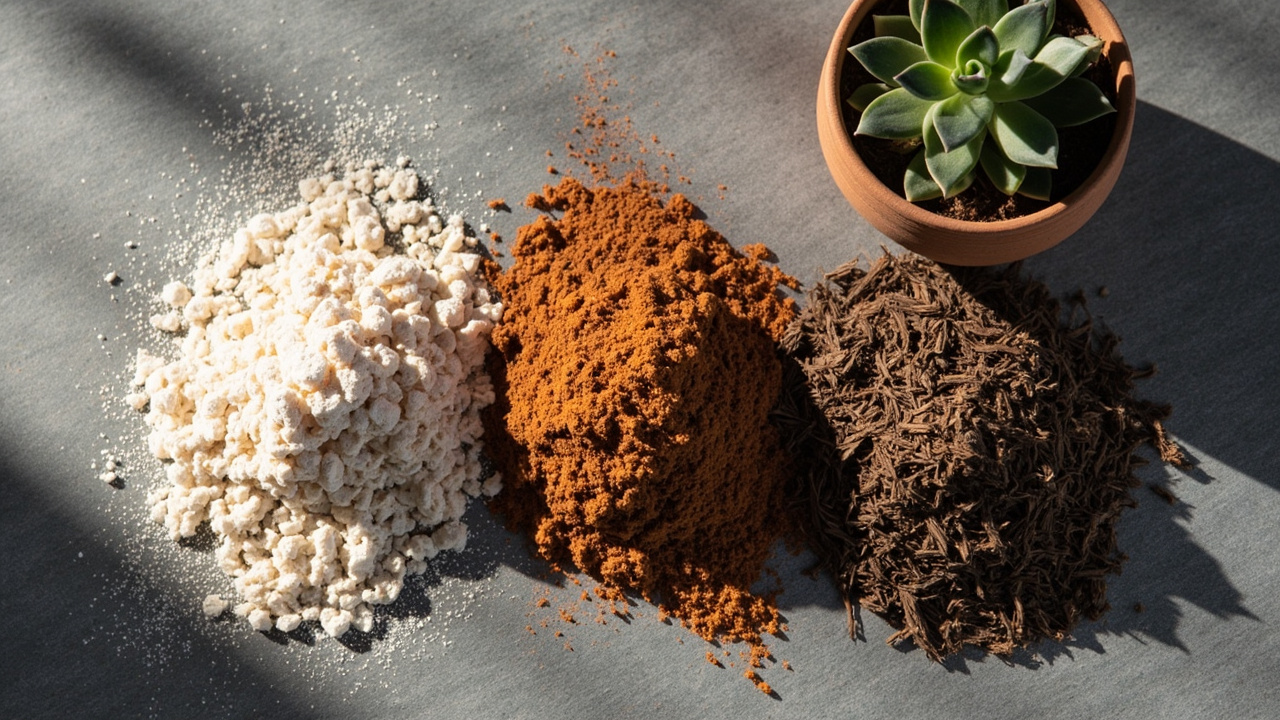
A Haworthia-friendly gritty mix has three components, each with a specific role. Together they drain fast, hold enough air for root respiration, and provide modest cation exchange without waterlogging.
The variables that change whether the mix works are component ratios, particle size, and breakdown rate. Get any one wrong and the mix collapses back toward peat behaviour.
Pumice. A porous volcanic rock that holds moisture inside its particles but releases it within 24 to 48 hours. Particle size 3 to 6 mm works for 8 cm (3 in) pots.
Pumice is the structural backbone of the mix — it keeps the medium open and prevents compaction.
Akadama (or turface). A baked Japanese clay granule with high cation exchange capacity. It holds nutrient ions and releases them slowly to the roots at particle size 2 to 5 mm.
Akadama breaks down over 2 to 3 years and must be replaced at repotting. Turface (calcined clay) is the North American substitute and lasts 4 to 5 years.
Pine bark fines. Small particles of composted pine bark, screened to 3 to 6 mm. They provide modest organic content without the waterlog risk of peat.
Bark also supports the mycorrhizal fungi that Haworthia roots associate with in habitat.
For the watering rhythm that pairs with this mix, see the Haworthia watering guide.
The Mix Ratios: A 2:1:1 Recipe That Works Across Most Homes
The base ratio is 2 parts pumice, 1 part akadama (or turface), 1 part pine bark fines by volume. This produces a mix that drains within 7 to 14 days in an unheated 20 °C (68 °F) room and within 14 to 21 days in a heated 22 °C (72 °F) room.
Choose the variant based on your pot type. Terracotta pairs with the base 2:1:1 ratio. Plastic pots need a faster-draining mix — bump pumice to 3 parts and drop akadama to 1 part. If your home runs below 30 percent humidity, drop bark to half a part and bump akadama to 1.5 parts to hold slightly more plant-available moisture.
Variant for terracotta pots. Stick with the 2:1:1 base ratio. Terracotta wicks moisture through the walls and accelerates dry-back, so the standard ratio works well.
Variant for plastic pots. Bump pumice to 3 parts and drop akadama to 1 part, keeping bark at 1 part. Plastic does not wick, so the mix needs to drain faster on its own.
Variant for very dry homes. Under 30 percent relative humidity, drop bark to 0.5 parts and bump akadama to 1.5 parts. The akadama holds slightly more plant-available moisture than pumice alone.
The full repotting walk-through — pot selection, root handling, post-repot care — is in the Haworthia repotting guide.
What to Do When You Only Have Standard Mix on Hand: The Emergency Blend
If you can only source a standard peat-based mix today, blend it 50/50 with pumice or perlite. This is not ideal — perlite is lighter than pumice and floats to the surface over time — but it is enough to keep a Haworthia alive for one season.
The honest limit: a 50/50 blend still holds more water than a true gritty mix. Plan to repot into the 2:1:1 recipe within 6 to 12 months. Do not use the emergency blend long-term, and never use undiluted peat-based mix for Haworthia.
A 2024 substrate trial at San Marcos Growers compared Haworthia survival rates across four mixes over 12 months. The 2:1:1 gritty mix produced 96 percent survival; the 50/50 peat-and-perlite blend produced 71 percent; undiluted peat-based mix produced 22 percent.
For example, in a 12-week comparison the same Haworthia clone in a 50/50 peat-perlite blend lost 29 percent of its roots to rot, while the clone in the 2:1:1 gritty mix added new white root tips within 21 days. The rule of thumb: when in doubt, bump the pumice — extra drainage is hard to overuse with these winter growers.
For the full routine including the recovery walk-through if your plant has been in peat too long, see the Haworthia care guide.
Pot Pairing: Terracotta and the Mix
The gritty mix works best in a porous terracotta pot. Terracotta is fired clay without glazing, and the walls wick moisture through capillary action. A 6 mm terracotta wall loses roughly 5 to 10 percent of soil moisture per day through evaporation.
Plastic pots do not wick. The same mix in a plastic pot stays wet 30 to 50 percent longer than in terracotta. If you use plastic, bump the pumice ratio as noted in the variant above, and accept a longer dry-back between waterings.
Glazed ceramic is the worst pairing — the glaze prevents wicking entirely. Use glazed pots only for display, not for long-term Haworthia health.
For the full pot-selection walk-through including size, depth, and drainage holes, see the Haworthia repotting guide.
Repotting Cadence: How Often to Refresh the Mix
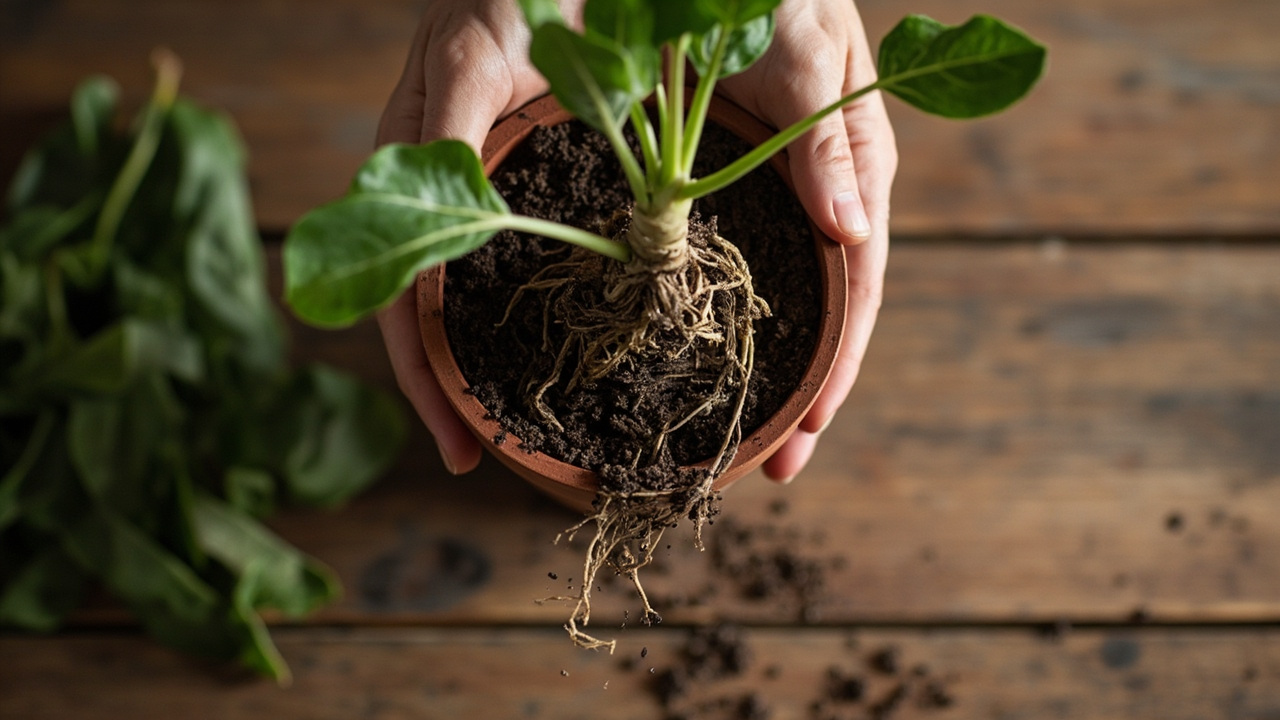
Repot Haworthia every 2 to 3 years into fresh mix. Akadama breaks down into fine particles over 2 to 3 years, and the mix loses its drainage structure. Turface lasts longer, but the bark component still decomposes.
The signal that the mix has broken down is that water sits on the surface for more than 10 seconds before draining, or that the pot stays heavy for 21+ days after watering. Both indicate the particles have compacted and the air pockets have collapsed.
Spring repotting produces the best recovery — the plant enters its semi-dormancy with new roots already established. Repotting in autumn also works, but expect slower root rebuild. The catch with autumn repotting is that the plant cannot recover as quickly from any root damage before winter sets in.
The full stretching recovery walk-through is in the haworthia stretching guide if your plant has stretched in low light and needs beheading as part of the refresh.
The light side of this routine — how lux levels change how fast the mix dries — is covered in the Haworthia light requirements guide.
From PDF to Excel in one click
Forget retyping line by line. Upload any bank statement, get a spreadsheet you can actually use. Your files are never stored, and you can test the converter with 3 free conversions.
Try it free