A windowsill delivers enough light to keep a strawberry plant alive but not enough to set fruit, so the moment a gardener wants berries in February the answer is a real grow light setup, not a sunnier window. This page walks through the four pieces that turn a strawberry plant into a year-round indoor producer under full-spectrum LED panels and a 14-hour timer: the light specifications that actually move fruit, the mounting distance and safety that prevent leaf bleaching, and the pollination and maintenance routine that hand-pollination replaces bees for in an indoor environment.
Why a Windowsill Is Not Enough and What a Grow Light Replaces
A bright south-facing windowsill delivers 3 to 4 hours of usable direct light in winter, enough to keep a strawberry plant’s leaves green and the crown alive, but not enough to drive the carbohydrate budget past the threshold for flower production. The plant conserves energy, runners spread slowly, and no fruit forms. The biology is direct: strawberries are photoperiod-sensitive, and below 6 hours of direct sun photosynthesis drops below the level that funds flower bud initiation, fruit set, and sugar loading in developing berries.
A full-spectrum grow light replaces the missing solar energy with photon flux density across the 400 to 700 nanometer PAR range that plants actually use. The right LED panel delivers 200 to 400 micromoles per square meter per second at the leaf surface, which Cornell Cooperative Extension research shows matches the photosynthetic output of roughly 8 hours of late-spring sun, even at 4 to 6 inches from the canopy. That is enough light for a day-neutral variety to flower and fruit continuously through winter.
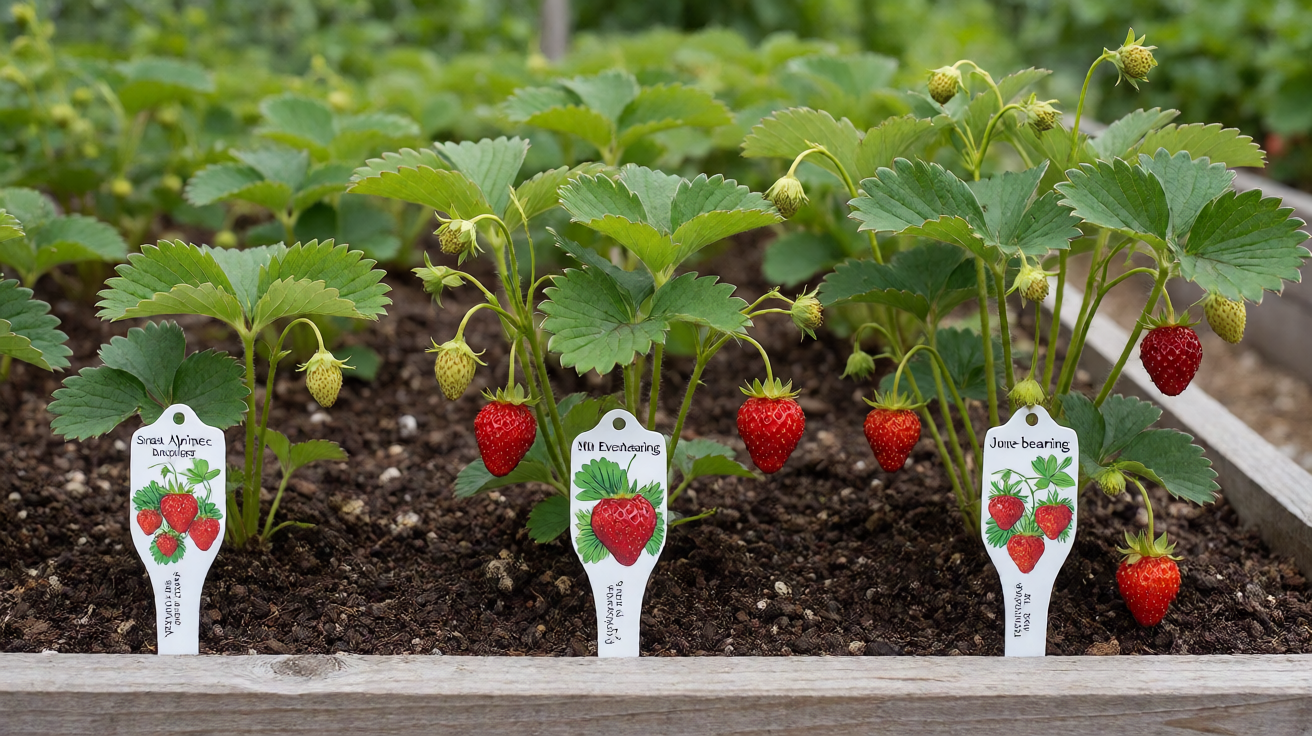
The other piece is photoperiod, the length of uninterrupted light each day. June-bearing and everbearing strawberries need at least 8 to 12 hours of light to initiate and break flower buds; day-neutral varieties flower regardless of day length but still need 14 to 16 hours to accumulate the energy for ripening fruit. A timer-driven 14-hour photoperiod is the single most reliable pattern for indoor fruiting because it gives plants enough energy for fruit while keeping a clear dark period for respiration and root recovery.
The honest limit before buying gear: indoor setups typically produce 50 to 70% of the fruit an outdoor plant would in full summer sun. The gap comes from spectral completeness and intensity, not from the timer or the variety. A grow light is the difference between a living plant and a fruiting plant, not between an indoor plant and an outdoor plant.
Light Specifications That Actually Matter for Strawberries
Three specs matter in order: PAR rating, kelvin temperature, and wattage. PAR rating is the photosynthetic photon flux density delivered to the leaf surface and it correlates directly with how much energy the plant receives per second; for strawberries the target is 200 to 400 micromoles per square meter per second at the canopy. Cheaper panels publish lumens, which measure human-perceived brightness, not photons plants can use; a 5,000-lumen bulb can deliver 60 micromoles at the leaf and starve the plant of usable light. The PAR spec is the only one that maps directly to fruit.
Kelvin temperature is the second spec. Strawberries respond best to full-spectrum white light in the 5,000 to 6,500 kelvin range because that mix includes enough blue to keep leaves compact and prevent etiolation while including enough red and far-red to drive flowering and fruit set. Lights skewed below 4,000 kelvin lean warm and grow leggy plants; lights above 7,000 kelvin lean blue and emphasize leaves over fruit. A panel advertised as “daylight white” or “full-spectrum” in the 5,000 to 6,500 K range covers both jobs without needing separate vegetative and flowering bulbs.
Wattage matters less than the previous two specs but still useful as a sizing guide. A 40 to 60 watt full-spectrum LED panel covers roughly a 2 by 2 foot area of canopy, which fits a single large container or a tray of 4 to 6 strawberry pots. For a smaller windowsill with one plant, a 20 to 30 watt panel is enough; for a 4 by 4 foot dedicated grow tent, scale up to 200 watts across two or three panels. Higher wattage without the right PAR rating wastes electricity on heat rather than photosynthesis; lower PAR rating at high wattage grows stretched leaves and no fruit.
The cheap-but-wrong option is a standard household bulb or a grow bulb marketed as “for houseplants.” These emit mostly yellow and green wavelengths that plants cannot use efficiently, deliver a fraction of the PAR rating of a true full-spectrum LED, and create visible etiolation within 10 to 14 days. If a panel does not publish its PAR output in micromoles per square meter per second at 6 inches or 12 inches, it is not the right tool for fruiting strawberries.
Mounting, Distance, and Light Safety
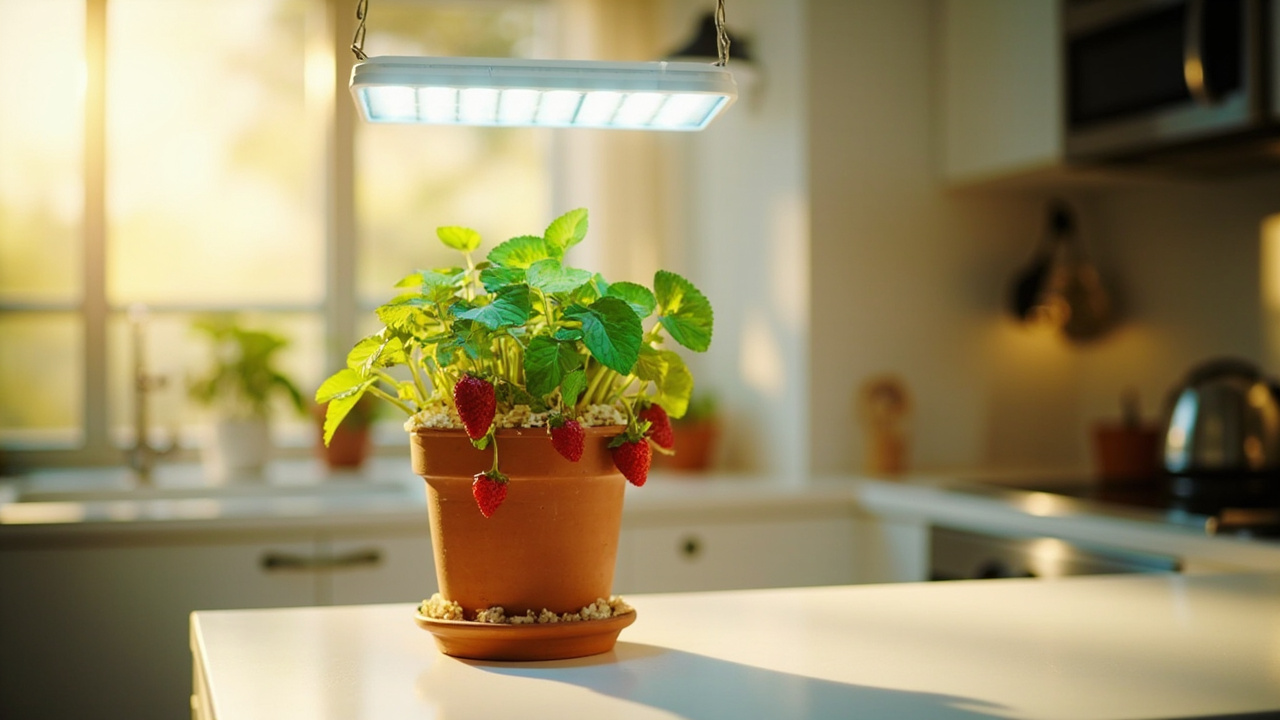
Distance from canopy is the highest-leverage setup decision after panel choice. Mount the light 6 to 12 inches above the tallest leaf and adjust upward as the plant grows; closer than 6 inches risks leaf bleaching and heat stress, farther than 14 inches drops PAR below the fruiting threshold. The mounting pattern that works in most home setups is a hanging kit with adjustable ropes or chains anchored to a ceiling hook, a shelf above the plants, or a free-standing grow tent frame. Clamp-on desk lamps rarely hold a panel at the right angle or the right height and tend to slide, so they are a setup failure waiting to happen.
Heat management is the second safety decision. Full-spectrum LEDs run cooler than HPS or metal halide bulbs but still radiate heat from the diode array; good panels include a heat sink that pulls thermal load away from the diodes. Position the light 6 inches above the leaf, not 2 inches, and ensure at least 2 inches of clearance between the panel and any enclosure wall. In a grow tent, add a small 4-inch exhaust fan to pull heat out of the canopy; in an open room, leave 18 inches between the panel and any heat-sensitive surface like a wood cabinet or a shelf above.
Reflective surfaces multiply usable light. A white-painted wall behind the plants returns roughly 80% of photons to the canopy; a mylar tent liner returns 90 to 95% and concentrates light without raising wattage. Avoid mirrored surfaces because the focused reflection can bleach leaves at the hotspots. A simple frame of white poster board or a foil-backed shelf liner costs nothing and lifts effective PAR by 15 to 20% in trial measurements, which is the difference between a stressed plant and a fruiting one.
Electrical safety is the part most indoor growers skip. Plug the panel into a GFCI-protected outlet, run the timer off a separate low-voltage circuit if possible, and keep all wiring above the canopy where water from watering or condensation cannot reach it. Strawberry plants need consistent watering, which means water is always near the canopy. A drip tray beneath the pots and a light mounted well above the drip zone is the safest combination for a kitchen or living-room setup.
Pollination, Pruning, and Year-Round Maintenance
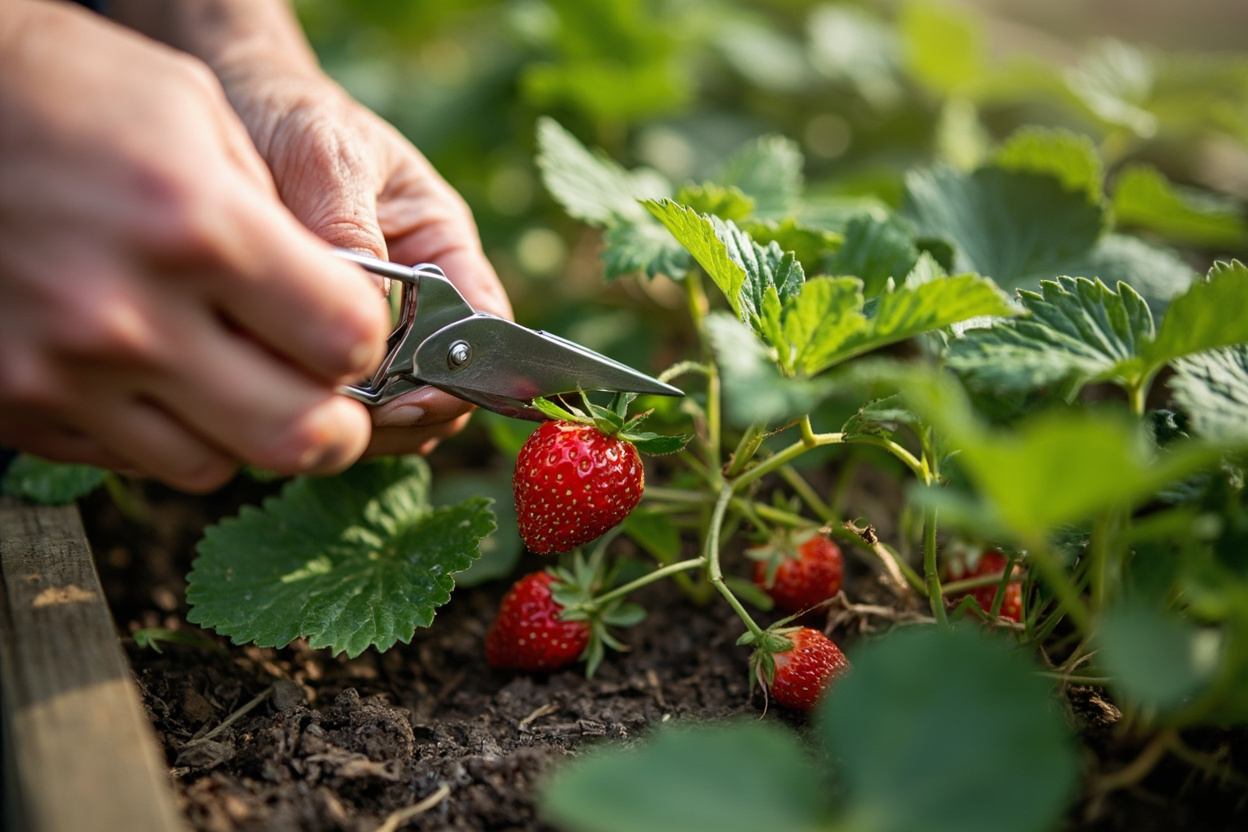
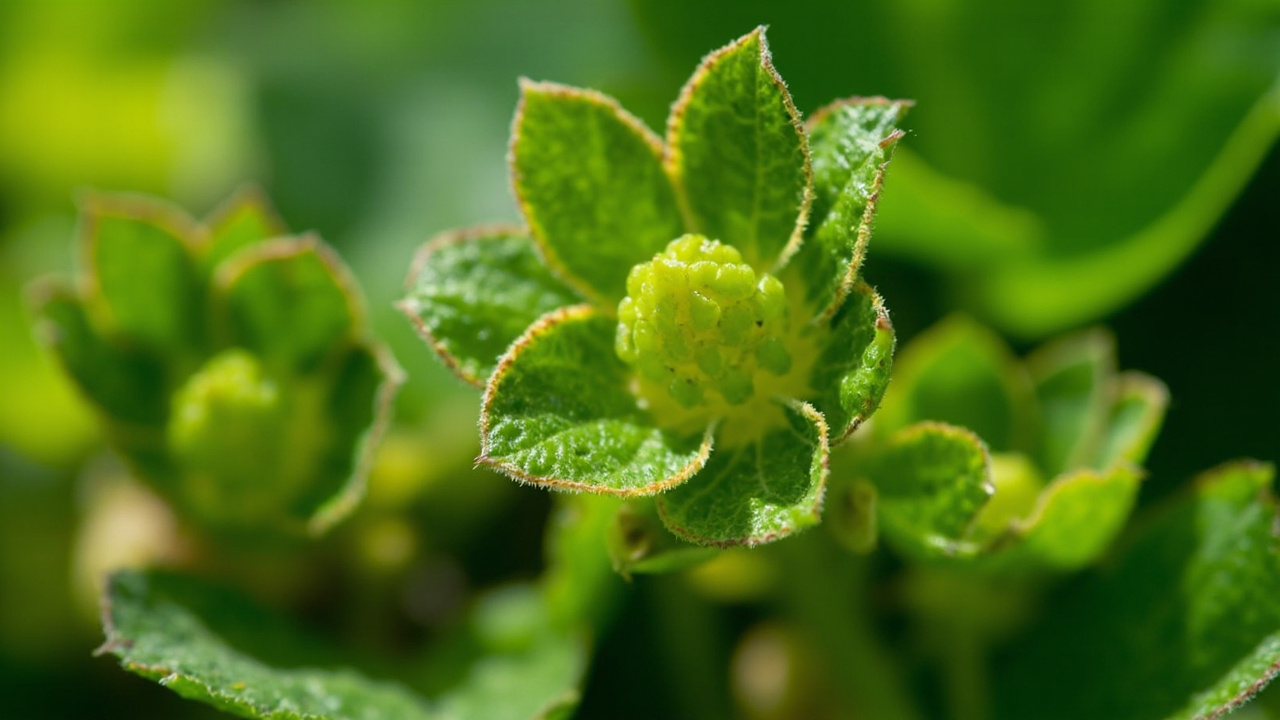
Indoor strawberry plants need hand-pollination because there are no bees or wind inside a home. The flower of a strawberry contains both male and female parts, so pollen from one flower can fertilize another on the same plant, but the transfer still needs a mechanical nudge. The two simplest tools are a small electric toothbrush held behind an open flower for 2 seconds, which vibrates pollen loose, or a soft brush like a clean watercolor brush swept from the outer ring of one flower to the center of the next. Run the pollination pass once a day during peak bloom and you will get fruit set on 60 to 80% of flowers, versus 10 to 20% with no intervention.
Container and medium choice matter even under a perfect light. Strawberries under indoor grow lights do best in a peat moss and perlite soilless mix with composted bark added at 10 to 20% by volume; the mix stays light, drains well through the drainage holes at the base of the pot, and holds the moisture and nutrient availability that flowering plants need. A 6 to 8 inch deep container with drainage holes is enough for day-neutral varieties; deeper containers waste soil and stay wet at the bottom, which invites root rot and crown rot through anaerobic conditions. Avoid garden soil in indoor pots because it compacts, holds too much water, and brings in pathogens that thrive under constant moisture.
Pruning under grow lights follows the same logic as outdoor pruning but is more aggressive. Pinch off runners as they form because the plant cannot support fruit production and runner expansion at the same time under indoor light; one runner per month is the practical max for a plant you want to keep fruiting year-round. Renovate the crown once per year by trimming foliage back to 2 inches above the crown in early spring, which forces fresh leaves and stronger flower buds. Container-grown strawberry plants also become root-bound after 12 to 18 months, so transplant into fresh mix and a slightly larger pot each spring to keep flower production strong.
Year-round maintenance comes down to a simple weekly routine. Check moisture in the top inch of the medium and water when dry, but not on a fixed schedule because the plant’s water needs change with temperature and growth phase. Apply a balanced fertilizer at half the outdoor rate every 2 weeks during active growth, then pause during the 6-week dormancy window that day-neutral varieties need after 9 to 12 months of continuous fruiting. Move the dormant container to a cooler room with the light on a 10-hour timer, withhold fertilizer, and resume normal light and feeding once new leaves emerge.
For the full strawberry care cycle including dormancy, soil pH, and variety selection, see our strawberry care guide. For variety profiles and bare-root transplant timing that determines the strongest indoor day-neutral choice, see our strawberry varieties guide.
Turn any PDF statement into a clean sheet
Skip the typos and the hours of copying. Our converter handles any bank statement format and outputs Excel, CSV, or QBO for QuickBooks. No file retention, free to try.
Convert your statement