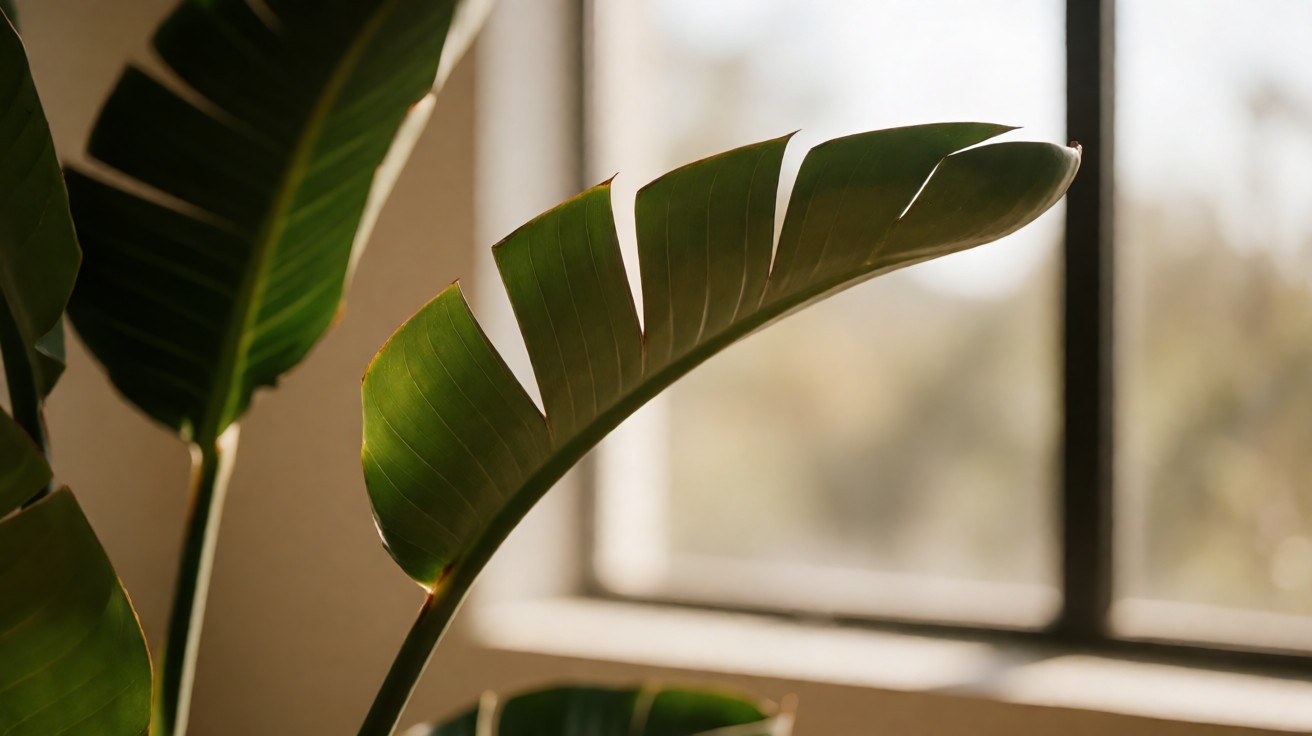

Bird of paradise leaf splitting happens because the plant tears its own foliage on purpose, and the trigger is not damage, it is humidity differential. Strelitzia reginae evolved in the coastal scrub of South Africa where coastal fog and rain saturate the air around the foliage most mornings, then dry out under direct sun by afternoon. The leaves learned to do something elegant: unfurl whole, then rip along pre-formed fracture lines so that strong gusts pass through the gaps instead of snapping the petiole. Indoors, that adaptation backfires. Dry winter air makes the blade lose moisture faster than the roots can replace it, turgor pressure drops unevenly across the lamina, and the leaf splits along its own weak seams.
Two failure modes follow from that one mechanism. The first is the cosmetic complaint: glossy leaves arrive intact, then a network of slits fans out from the midrib within weeks of moving the plant into a centrally heated room. The second is the overcorrection: growers see the splits, assume the plant is thirsty, and water more, which compounds the problem because wet soil plus low ambient humidity creates a vapor pressure deficit that pulls moisture out of the leaf faster than the roots can catch up. Neither failure is a sign of a dying plant. Both are signs that the indoor atmosphere is not what the leaf was built for. Both belong to the Strelitziaceae family of monocot perennials native to southern Africa.
What most growers get wrong is reaching for the watering can when the symptom is actually about the air. The split leaves are not asking for more water in the soil. They are asking for more water in the air around them. That distinction is the entire article, and once you see it, the rest is just measuring and adjusting.
Why Bird of Paradise Leaves Split Indoors
Bird of paradise leaf splitting indoors is the most common complaint from people who keep Strelitzia reginae or Strelitzia nicolai as houseplants, and it is also the most predictable. The leaves of mature Strelitzia are enormous. A single blade on a healthy S. nicolai can reach 3 to 5 feet long and 12 to 18 inches wide, and even on the more compact S. reginae, mature leaves routinely exceed 18 inches. That is a huge surface area exposed to indoor air that is, in most homes in winter, 20% to 30% relative humidity.
Now compare that to the plant’s native coastal habitat, where morning humidity sits between 70% and 90% and afternoon humidity rarely drops below 50%. The air around a wild bird of paradise is closer to saturated for a meaningful portion of every day. The indoor range in a heated North American or European home is closer to desert conditions by comparison.
The pattern matters for diagnosis. If the splits are running parallel to the midrib and radiating outward toward the leaf edge, that is humidity-driven splitting and is normal. If the splits are jagged, irregular, or near the petiole, that is mechanical damage from handling, a pet, a child, or the plant brushing a wall..
The Mechanism: Turgor Pressure and the Physics of Leaf Tearing
Every plant cell is a pressurized balloon. Water inside the central vacuole pushes the cell membrane outward against the cell wall, and that outward pressure is called turgor. When a leaf has full turgor, every cell is rigid, the blade is held flat, and the leaf is mechanically strong. As a leaf loses water through transpiration and the roots do not replace it fast enough, turgor drops, the cells soften, and the leaf becomes pliable, then limp.
The interesting physics happens in the middle range, when turgor is partially reduced. The cells in the leaf blade lose water at slightly different rates depending on their position, their age, and the local humidity. Cells along the leaf edge, exposed to dry air, lose water faster than cells near the midrib, which are sheltered by the layers of cells above them.
The vapor pressure deficit is the underlying number to understand. VPD is the difference between the amount of moisture the air can hold at a given temperature and the amount it actually holds..
The split is irreversible once it forms. The cell walls along the fracture line have already separated. But new leaves that emerge after you raise the ambient humidity will unfurl and stay intact, because they will develop in a vapor pressure environment that does not stress the tissue enough to trigger tearing. The plant is not damaged.
What Actually Works to Stop the Tearing
Five interventions reliably reduce indoor bird of paradise leaf splitting. They are ranked by how much each one actually moves the needle on ambient humidity around the plant.
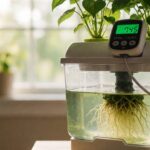
- Run a humidifier near the plant. A cool-mist humidifier rated for your room size, with at least 1 gallon per day of output for a typical living room, is the single most effective tool. Place it within 3 to 5 feet of the plant and run it on a hygrometer-controlled outlet so it cycles to maintain your target. Set the target between 50% and 60% relative humidity. That range drops VPD into the zone where new leaves stop tearing. Expect to see the next new leaf come in noticeably less split within 3 to 6 weeks.
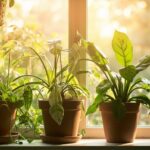
- Group the plant with other tropicals. A cluster of plants transpires collectively and creates a humid microclimate that is 5% to 10% higher in relative humidity than the surrounding room air. The effect is real and measurable with a cheap hygrometer, and it costs nothing. The indoor humidity guide walks through the grouping, tray, and humidifier options in more detail.
- Use a pebble tray as a backup. A wide saucer filled with gravel, with water kept just below the top of the gravel so the pot sits above the waterline, adds a continuous 5% to 10% relative humidity immediately above the tray. It is not enough on its own in a dry winter home, but stacked with grouping and a humidifier, it pushes the local environment into the safe range.
- Move the plant away from heating vents and exterior walls. Forced-air heating vents drop local humidity sharply in the path of the airflow, and cold exterior walls in winter chill the air immediately adjacent to them, which lowers its capacity to hold moisture and drops the local relative humidity. Both effects concentrate leaf splitting in the leaves facing the heat or the wall. Move the plant at least 3 feet from vents and 2 to 3 feet from uninsulated exterior walls.
- Stop misting as a primary strategy. Misting raises humidity for minutes, not hours, and can encourage fungal leaf-spot problems if water sits on foliage in low light. Use it only as a brief refresh during the day, not as the main intervention. If you want to see what misting actually does, time it: mist the leaf, watch the humidity reading on your hygrometer spike, then watch it crash back down within 20 minutes.
Common Mistakes When Trying to Stop Leaf Splitting
Five interventions reliably reduce indoor bird of paradise leaf splitting. They are ranked by how much each one actually moves the needle on ambient humidity around the plant.
- Run a humidifier near the plant. A cool-mist humidifier rated for your room size, with at least 1 gallon per day of output for a typical living room, is the single most effective tool. Place it within 3 to 5 feet of the plant and run it on a hygrometer-controlled outlet so it cycles to maintain your target. Set the target between 50% and 60% relative humidity. That range drops VPD into the zone where new leaves stop tearing. Expect to see the next new leaf come in noticeably less split within 3 to 6 weeks.
- Group the plant with other tropicals. A cluster of plants transpires collectively and creates a humid microclimate that is 5% to 10% higher in relative humidity than the surrounding room air. The effect is real and measurable with a cheap hygrometer, and it costs nothing.
- Use a pebble tray as a backup. A wide saucer filled with gravel, with water kept just below the top of the gravel so the pot sits above the waterline, adds a continuous 5% to 10% relative humidity immediately above the tray. It is not enough on its own in a dry winter home, but stacked with grouping and a humidifier, it pushes the local environment into the safe range.
- Move the plant away from heating vents and exterior walls. Forced-air heating vents drop local humidity sharply in the path of the airflow, and cold exterior walls in winter chill the air immediately adjacent to them, which lowers its capacity to hold moisture and drops the local relative humidity. Both effects concentrate leaf splitting in the leaves facing the heat or the wall. Move the plant at least 3 feet from vents and 2 to 3 feet from uninsulated exterior walls.
- Stop misting as a primary strategy. Misting raises humidity for minutes, not hours, and can encourage fungal leaf-spot problems if water sits on foliage in low light. Use it only as a brief refresh during the day, not as the main intervention. If you want to see what misting actually does, time it: mist the leaf, watch the humidity reading on your hygrometer spike, then watch it crash back down within 20 minutes.
The honest limit here: in a home with forced-air heating running for months at 20% ambient humidity, you can reduce leaf splitting significantly but you may not eliminate it. Some tearing on the largest, oldest leaves is the price of growing a South African coastal plant in a continental-climate living room..
For a deeper look at how humidity interacts with watering rhythm indoors, the watering guide for bird of paradise walks through the soil-side of the same equation. And if the splits are accompanied by brown leaf edges, yellowing, or stunted new growth, the common problems diagnostic covers the patterns that look like humidity damage but are actually something else.
How Long Until Leaf Splitting Stops Showing on New Growth
The most common mistake is treating leaf splitting as a watering problem. It is not. The leaf is dry at the surface because the air is dry, not because the soil is dry..
The second mistake is cutting the split leaves off. The torn leaf is still photosynthesizing. It is still feeding the plant. It is not pretty, but it is functional, and removing it forces the plant to push energy into replacing a leaf it did not need to replace. Leave the torn leaves in place. They are doing their job. The new leaf coming in will be the proof that your humidity fix is working, and the old torn leaves can be removed once the new one is fully open and hardened off.
The third mistake is moving the plant to a bathroom or kitchen for “humidity.” A steamy bathroom after a shower is briefly humid, but for the 23 hours between showers, it is as dry as the rest of the house. Unless the bathroom has a window and the plant lives there full-time with consistent moisture, the daily humidity swing is worse for the plant than staying in one stable location.
What New Leaves Look Like Once the Air Is Right
Once you hold ambient humidity around 50% to 60% for 4 to 6 weeks, the next emerging leaf on your Strelitzia reginae or Strelitzia nicolai will unfurl in a noticeably different way. Watch for the tightly furled spear emerging from the crown, then opening slowly over 24 to 48 hours. If the air is right, the new blade will open with intact margins, the natural fracture lines visible as faint translucent seams but not as actual tears. That single new leaf is your proof that the diagnosis was correct and the intervention is working.
Do not be discouraged if the first new leaf after you fix the humidity still shows some splitting. The leaf was already developing in the dry air before you raised humidity, and the cells along the fracture lines were already stressed. The leaf after that one is the real test. By the second or third new leaf produced under stable 50% to 60% humidity, the splits will be minimal or absent, and the plant will look the way it was meant to look indoors.
The torn leaves on the plant today are the record of the air it has been living in. The leaves it produces next month are the record of the air you are giving it now. Buy a hygrometer, set a target of 50% to 60% relative humidity, run a humidifier, and let the next new leaf show you what your bird of paradise looks like when it is not at war with the air. It is a satisfying thing to watch.
Turn That PDF Into a Spreadsheet in Minutes
You've seen how to do it manually — now let the tool handle the heavy lifting. Upload your bank statement and get Excel, CSV, or QBO in a few clicks.
Try It Free