Picking an aquaponic fish species comes down to three things: your climate, whether you want edible fish or ornamental fish, and how much heating you can afford. There are five species that dominate home aquaponic systems worldwide, and the right choice for a 100-gallon tank in Minnesota is not the same as the right choice for a 100-gallon tank in Manila. Most “best fish” lists stop at a ranking; this article names the temperature band each species needs, what each one eats, and what trade-offs you accept when you pick it.
Even the most forgiving aquaponic fish dies when its temperature band is violated. Tilapia — the default pick for warm climates — does not survive a winter in an unheated outdoor tank once the water drops below 50°F (10°C). Goldfish and koi survive that cold but stay ornamental and slow to harvest. Trout thrive in cold water but expire in summer when the tank crosses 65°F (18°C) without chill. Picking an aquaponic fish is picking a temperature band first, growth rate second, and edibility third.
This guide ranks the five most-stocked species, names the climate each one fits, and gives the stocking ratio that keeps the system alive. By the end, you will know which fish belongs in your tank, how many to stock, and what to expect through the first six months of cycling.
How Aquaponic Fish Species Power the System (Mechanism)
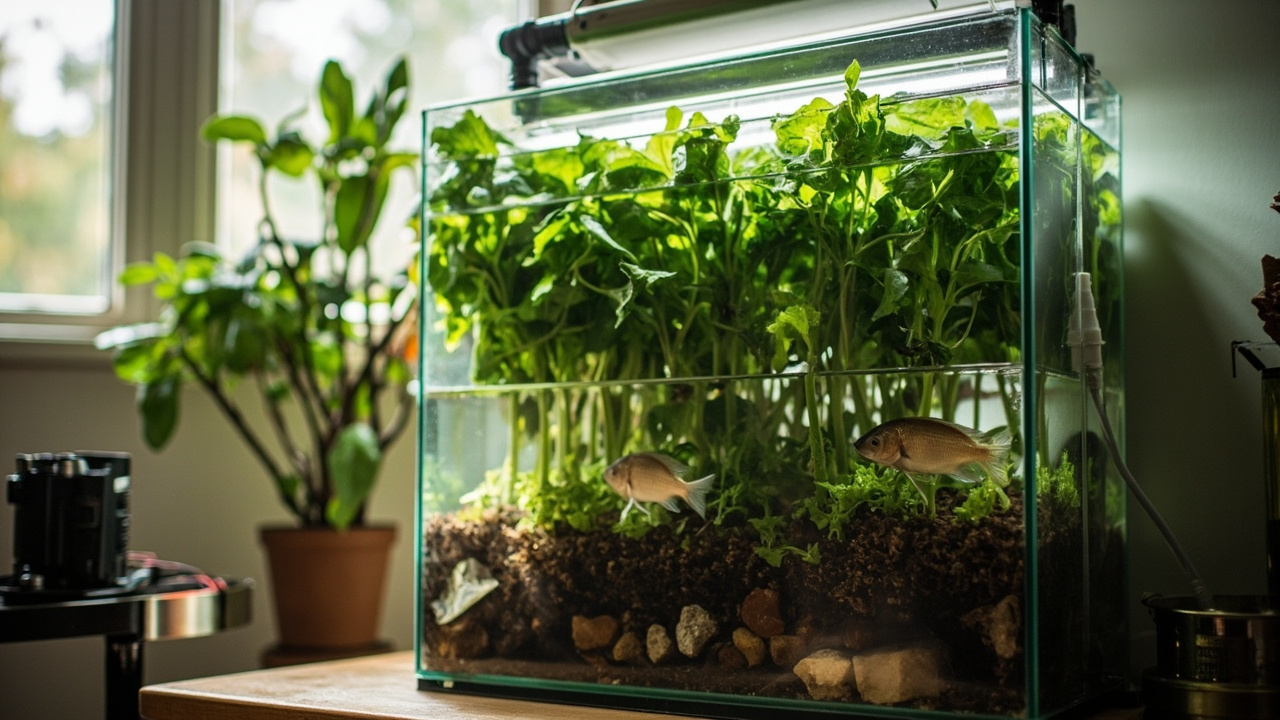
Every aquaponic loop has three living components working together — fish, nitrifying bacteria, and plants — and the fish is the upstream driver. The fish excrete ammonia through their gills and waste; Nitrosomonas bacteria convert that ammonia to nitrite; Nitrobacter bacteria convert nitrite to nitrate; the plants take up the nitrate. The complete aquaponics guide covers this loop in detail, but the practical point is that the fish in your tank is doing two jobs at once: feeding the biofilter and finishing as a harvest or a display.
Choose the wrong aquaponic fish species and the system cannot recover. A fish whose temperature tolerance does not match your climate produces stress waste — high ammonia, low feeding, suppressed immune response — that overwhelms the bacteria during cycling. A fish that outgrows the tank produces the same crash through sheer biomass. The choice of fish is not aesthetic. It is the upstream knob on every other parameter in the loop.
| Fish | Temperature band | Edible? | Cold-hardy? |
|---|---|---|---|
| Tilapia | 72–86°F (22–30°C) | Yes | No (dies below 50°F) |
| Catfish (channel) | 55–86°F (13–30°C) | Yes | Tolerant |
| Koi | 59–77°F (15–25°C) | No | Yes |
| Goldfish | 55–82°F (13–28°C) | No | Yes |
| Trout (rainbow) | 50–65°F (10–18°C) | Yes | Yes (cold specialist) |
Two numbers belong in your head before you pick a fish: how cold your tank gets in the coldest week of the year, and how hot it gets in the hottest week. If your water swings past either end of a species’ band, that fish will not survive a single season in your system.
Tilapia: the Warm-Water Aquaponic Fish Default
Tilapia is the most-stocked aquaponic fish in the world and the default pick for any heated system, tropical climate, or indoor setup with a stable year-round temperature. They tolerate ammonia swings better than almost any other food fish because they evolved in slow-moving tropical water where oxygen and waste fluctuate. According to Texas A&M RWFM Extension, blue tilapia can tolerate water down to 48°F (9°C) for short stretches, but they stop feeding below about 65°F (18°C) and die when the temperature holds below 50°F (10°C).
The trade-offs of picking tilapia are real. First, growth: they reach plate size — about 1 pound (450 g) — in 6 to 9 months under good feeding and warm water. Second, breeding: tilapia breed readily in captivity, so a small system can become overstocked within a year. Third, regulation: in several US states (Texas, Florida, Alabama, Louisiana, Mississippi, Arkansas, Missouri, North Carolina, South Carolina) tilapia are regulated, and selling them for food can require a permit. Home growers in those states usually keep tilapia for personal consumption or for plant-growing only and never sell the fish.
If your climate is tropical, your system is indoors with a heater, or your water holds 70°F (21°C) year-round, tilapia is the highest-yielding pick — fast growth, hardy feeding, premium water-cleaning work, and an edible harvest. The honest limitation is that you must commit to keeping the water above 65°F (18°C). If your tank drops below that for more than a day or two, expect fish stress and probably mortality.
Catfish: Low-Oxygen Aquaponic Fish with High Yield
Channel catfish are the practical alternative when tilapia are restricted or unavailable. Catfish handle very low dissolved oxygen — as low as 2 to 3 ppm compared to the 5+ ppm tilapia demand — because they evolved in slow, warm, sometimes muddy bottom-water. They are bottom feeders, eating what drops to the substrate, which makes them useful cleaners that reduce solid waste settling in the tank.
The trade-off against tilapia is maturation speed. Catfish do not mature as quickly; the overproduction problem common with tilapia is much less pronounced because they breed less readily in captivity. They grow well on prepared pellets and tolerate a wider temperature range than tilapia — roughly 55–86°F (13–30°C) — though growth slows below about 70°F (21°C). According to a study published via the National Institutes of Health on catfish–pumpkin aquaponics, channel catfish perform well in media-bed systems when stocked at moderate density.
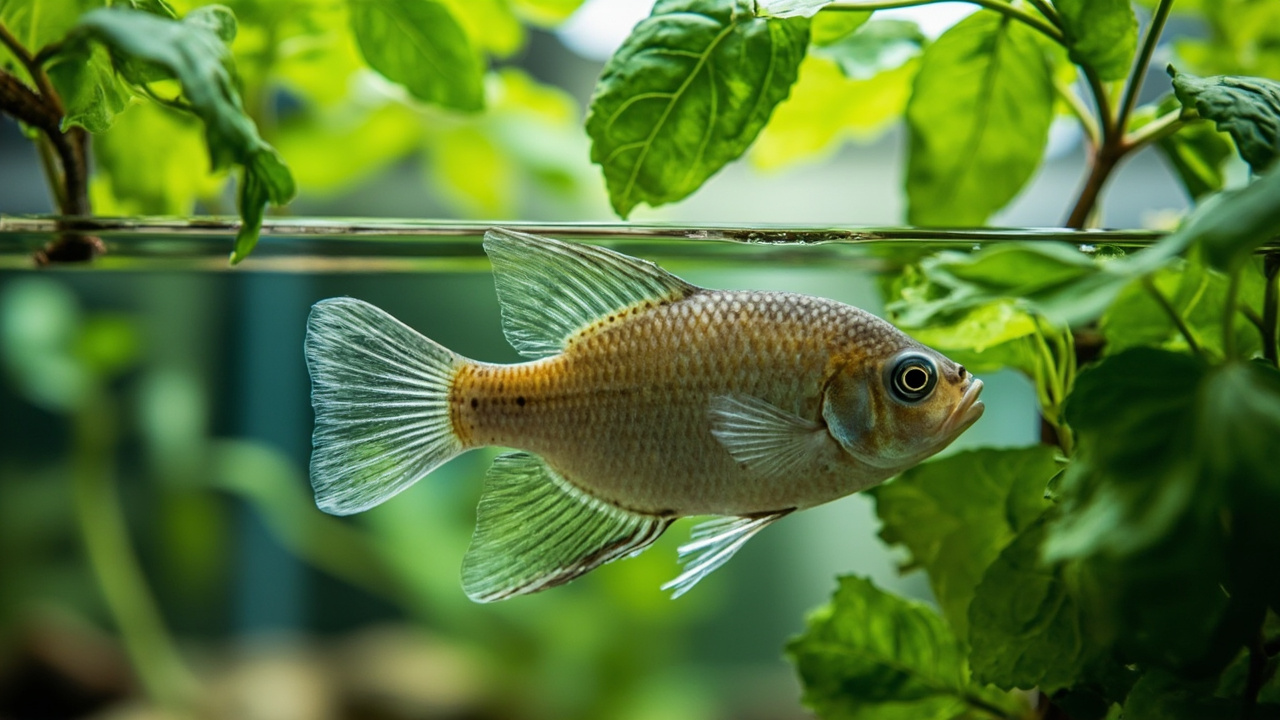
For a beginner in a temperate climate with a heated indoor setup, catfish is a forgiving choice — they out-tolerate tilapia on cold snaps (they stay alive in water as cool as 55°F (13°C) without active feeding) and produce a clean white-flesh harvest in roughly 12 to 18 months. The practical caveat: catfish grow larger than tilapia (commonly 2 to 5 lb / 0.9 to 2.3 kg at harvest) and need more tank volume per fish.
Koi and Goldfish: Cold-Tolerant Ornamental Fish Picks
For growers who do not want to eat their fish, koi and goldfish are the dominant ornamental picks. Both tolerate cold water well: koi survive down to 59°F (15°C) and active down to 77°F (25°C), and goldfish tolerate 55–82°F (13–28°C). Both species are stress-hardy, both feed readily on standard pellets, and both breed in captivity if the conditions hold steady.
The trade-off against food fish is edibility — neither koi nor goldfish are eaten in Western cultures, and both accumulate compounds over their lifetime that make them poor candidates for the table. Goldfish in particular store fat-soluble compounds from their diet in muscle tissue over years.
Pick koi if your system is at least 200 gallons and you want a showpiece fish. Koi grow large — 12 to 24 inches (30 to 60 cm) in a backyard setup — and produce a striking display above a planted grow bed. Pick goldfish if your system is smaller — a 20-gallon indoor tank can stock two or three goldfish — or if you want a fast-maturing species (goldfish reach full size in roughly 12 to 18 months versus koi’s 3 to 5 years). Goldfish also come in dozens of morphs (common, comet, fantail, oranda) that add visual variety.
Both ornamental fish are good for plant growers who do not want to manage breeding or harvest. The honest limitation is that you do not get a meal out of the system — your harvest is plants only, and the fish are an ongoing cost rather than a closing crop.
Trout: Cold-Water Aquaponic Fish for Premium Plates
Rainbow trout are the cold-water specialty pick — premium food fish, fast growth, and a temperature band that no warm-water species can match. According to multiple extension sources, trout thrive in 50–65°F (10–18°C) water with dissolved oxygen above 6 ppm. Below 50°F (10°C) growth stalls; above 65°F (18°C) stress begins and mortality rises sharply. Trout in summer is a heat-management job, not a fish-management job.
Trout is the right choice for a grower in a cool climate — the Pacific Northwest, the UK, New Zealand, coastal Canada, mountain elevations, or any climate where summer highs stay below 70°F (21°C). In those conditions, rainbow trout reach harvest size — 8 to 12 inches (20 to 30 cm) — in 9 to 12 months on prepared feed and produce a fillet that sells premium.
Trout is the wrong choice for a heated tropical system or a warm summer climate without active chilling. If your tank crosses 70°F (21°C) for sustained stretches, expect a die-off within a week or two. The honest limitation is that trout demand more attention to oxygen than any other species on this list — a single summer power outage can wipe a tank — and the cool-water requirement puts them out of reach for most beginners outside cool climates.
Picking the Right Aquaponic Fish for Your Climate
The decision comes down to climate first, goal second, scale third. Use this four-row match as your starting point before looking at growth rates or species-specific care.
Warm climate, food fish
Tilapia if your state allows them, catfish otherwise. Both grow fast in 72–86°F (22–30°C) water, both produce an edible harvest, and both tolerate beginner ammonia swings. Tilapia grows faster; catfish tolerates wider temperature variation.
Cold climate, food fish
Rainbow trout, full stop. No other food fish on this list handles 50–65°F (10–18°C) water. Plan for cooling or a basement/lake-fed source if your summer rises above 70°F (21°C).
Ornamental only
Koi for 200-gallon-plus systems, goldfish for anything smaller. Both are cold-tolerant, both are inexpensive to source, and both produce excellent plant growth without the regulatory complications of food fish.
Small indoor system (under 50 gallons)
Goldfish — they tolerate the smallest water volume of any species here. Tilapia and catfish outgrow 50 gallons within a year; koi outgrow it within six months. Goldfish held under 50 gallons stay small (4 to 8 inches / 10 to 20 cm) and produce decent waste for a small media bed.
| If your situation is… | Pick | Why |
|---|---|---|
| Tropical or heated indoor, food | Tilapia (or catfish) | Highest feed conversion, fastest growth |
| Temperate, state-regulated, food | Catfish | Same warm-water band, no regulation |
| Cold climate, food | Rainbow trout | Only species that thrives below 65°F (18°C) |
| Ornamental, large system | Koi | Showpiece fish, cold-hardy |
| Ornamental, small tank | Goldfish | Compact, hardy, cheap |
| Apartment / under 50 gal | Goldfish | Only realistic pick at small scale |
One mixing rule to internalize: do not combine warm-water and cold-water species. Tilapia and trout cannot share a tank because their temperature bands do not overlap. Tilapia also pick on smaller, slower fish — a 1-lb tilapia will harass or eat a 2-inch goldfish within days. If your system holds more than one species, all fish must share a temperature band and the largest fish must not be much bigger than the smallest.
Aquaponic Fish Stocking Density and Cycling Readiness
Stocking density is the second-most-failed decision after species choice. The rule used across university-extension aquaponics literature is conservative: 1 lb of fish for every 8 to 10 gallons of water in the tank. According to NMSU Circular 680 (Important Water Quality Parameters in Aquaponics Systems), beginners should run on the lighter end of that scale — half the theoretical density — to keep ammonia in range during the cycling window.
How many fish per gallon
For a 100-gallon tank at the conservative 10-lb-fish-per-100-gallon rate, plan on roughly 10 to 15 small fish at ½ to 1 lb each. For a 50-gallon bedroom system, plan on 5 goldfish or 3 juvenile tilapia at most. Stocking beyond those rates creates a chronic ammonia problem that the biofilter cannot absorb once water temperature rises.
| Tank size (gallons) | Conservative stocking (lb) | Typical fish count at ¾ lb each |
|---|---|---|
| 20 | ~2 lb | 2–3 goldfish |
| 50 | ~5 lb | 5–7 small tilapia |
| 100 | ~10 lb | 10–15 juvenile tilapia or catfish |
| 200 | ~20 lb | 20–30 fish at early growth |
Why systems crash in week 2 to 3
The most common aquarium-failure moment in a new aquaponic system is the second or third week of cycling. Ammonia spikes as fish begin feeding actively, but the nitrifying bacteria have not yet colonized the biofilter. According to Oklahoma State Extension’s nitrification fact sheet, the nitrite-to-nitrate transition typically settles between week 3 and week 6 of cycling; until then, ammonia can run above 1 ppm and nitrate is near zero. Once ammonia falls below 1 ppm and nitrite disappears, expect nitrate to climb toward the 60–70 ppm target range that plants actively consume.
Add fish only after the tank has cycled — a fishless cycle using ammonia chloride takes 4 to 6 weeks. Add fish at 20% of the planned final stocking density per the Texas A&M RWFM Extension guide, and ramp up to full density over the next 4 to 8 weeks. This gentler ramp gives the bacteria time to keep pace with the rising waste load.
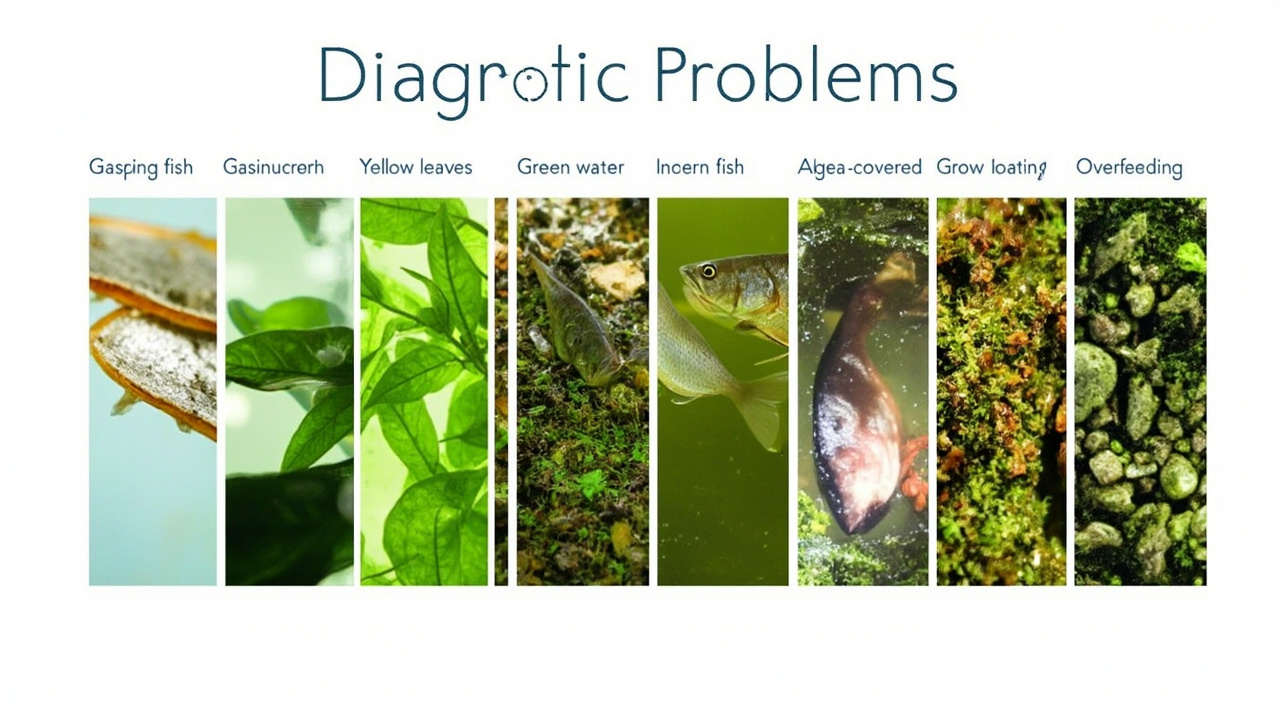
If you are mid-cycle and an aquaponic fish is gasping at the surface or hanging near a pump output, your ammonia is too high. Stop feeding for 24 to 48 hours, do a 20% water change with dechlorinated water of the same temperature, and re-test in 12 hours. For an in-depth walk through aquaponic system cycling and what each parameter should read, see the Pillar guide’s cycling section.
Aquaponic Fish Species to Skip as a Beginner
Three species show up on listicle “best fish” articles but do not belong in a beginner’s home loop. Pacu — a large South American cousin of the piranha — outgrow a 200-gallon tank within 12 to 18 months and require water above 75°F (24°C) to thrive. They are technically edible and technically aquaponic-compatible, but the tank size required to hold a 3-lb pacu is outside what most home systems deliver.
Largemouth bass are aggressive, require live or frozen feed to grow well, and are regulated as a sport fish in most US states. Small-scale growers end up with stunted, cannibalistic fish that damage plant roots and disrupt the biofilter. Bluegill are technically tolerant and technically aquaponic-friendly, but they grow slowly — over 24 months to plate — and require warm, slow-moving water with submerged cover to breed. None of these three gives the beginner a clean first-year result.
The honest limit is that picking an aquaponic fish outside this list’s tested five requires research beyond this article. Once your system has cycled successfully with one of the five species above and you have a full season of operation behind you, you can branch out. For a first-year system, sticking to the five species named here gives the highest chance of keeping the loop alive through its most fragile months.
Turn That PDF Into a Spreadsheet in Minutes
You've seen how to do it manually — now let the tool handle the heavy lifting. Upload your bank statement and get Excel, CSV, or QBO in a few clicks.
Try It Free