Fiddle leaf figs need 40–60% humidity to stay healthy and grow well. Below 30%, the edges of their large leaves turn brown and crispy. Above 70%, fungal issues start to appear. Getting this range right is one of the most important things you can do for a fiddle leaf fig, and it is easier than most people expect.
As tropical understory plants from West African rainforests, fiddle leaf figs evolved in consistently moist air. They absorb water through their roots and release it through their leaves in a process called transpiration. Humidity controls how fast that water escapes. In a dry home — especially with central heating or air conditioning — the air pulls moisture from the leaves faster than the roots can replace it. That is why brown edges and crispy tips are so common, even when the watering schedule is correct.
Why Humidity Matters for Fiddle Leaf Figs
Humidity is not a luxury for fiddle leaf figs — it is a core part of how they function. Each large leaf has thousands of stomata, tiny pores on its surface that open to release water vapor and draw in carbon dioxide. When the surrounding air is dry, those stomata close down to conserve water, which slows photosynthesis and limits growth. The plant is not being difficult; it is protecting itself from a mismatch between its biology and its environment.
In practical terms, this means that a fiddle leaf fig in a home with 20–30% relative humidity — common in heated winter rooms — is constantly under stress even if the soil moisture is perfect. The roots may be hydrated, but the leaves are losing water faster than the plant can replace it. The result is the brown, crispy look that fiddle leaf fig owners know well. For more on the overall care this plant needs, see the fiddle leaf fig care guide.
The Ideal Humidity Range for Fiddle Leaf Figs
The sweet spot for fiddle leaf figs is 40–60% relative humidity. Within this range, the stomata stay active, the leaves hold their color, and new growth emerges without the characteristic brown edges that plague plants in drier conditions.
A few thresholds are worth knowing:
- Below 30% — the stress threshold. Brown edges appear within days on new growth. Older leaves may yellow.
- 30–40% — marginal. The plant survives but new leaves often emerge with crispy tips.
- 40–60% — the target range. Healthy color, active growth, no humidity-related stress symptoms.
- Above 70% — fungal risk increases, especially if air circulation is poor. Leaves can develop brown spotting from botrytis or anthracnose.
Most homes sit between 30–50% humidity in normal conditions, which means most fiddle leaf figs benefit from a modest humidity boost, particularly in winter and in air-conditioned rooms.
Signs Your Fiddle Leaf Fig Is Suffering from Humidity Stress
Humidity stress shows up in two distinct patterns depending on whether the air is too dry or too moist.
Low humidity symptoms:
- Brown, crispy edges on new leaves — the most common early sign
- Entire leaf margins turning brown and dry
- Crispy tips even when the plant is watered regularly
- Slow or stunted new growth
- Leaves curling inward slightly to reduce surface area exposed to dry air
High humidity symptoms:
- Brown or black spots on leaves, often with a yellow halo
- Soft, mushy leaf edges
- Fungal growth on leaves or soil surface
- Leaf drop in otherwise healthy-looking plants
If you see brown spots or leaf drop on your fiddle leaf fig, check the brown spots or leaf drop guide for a full diagnosis. Humidity is only one cause of leaf issues — root rot from overwatering can produce similar symptoms.
How to Measure Humidity for Your Fiddle Leaf Fig
You cannot manage what you do not measure. A hygrometer is the only reliable way to know the humidity your plant is actually experiencing.
Choosing a hygrometer: Digital hygrometers are affordable and accurate. Look for a model that reads both temperature and humidity. Place it at leaf level next to your plant, not mounted high on a wall — hot air rises, so wall-mounted readings tend to be higher than the actual conditions at the foliage.
What to watch: Take readings at different times of day. Humidity drops during the day as heating or air conditioning runs, and can spike at night in enclosed rooms. The morning reading after the heating or cooling system has been off for a few hours gives you the baseline. The late-afternoon reading shows the worst case during active use of the room.
How often to check: Once a week is sufficient once you understand your home’s patterns. In winter, when heating is running constantly, check twice a week — humidity can drop sharply overnight.
How to Raise or Lower Humidity for Your Fiddle Leaf Fig
The practical steps for managing humidity depend on whether you need to add moisture or reduce it.
Raising humidity
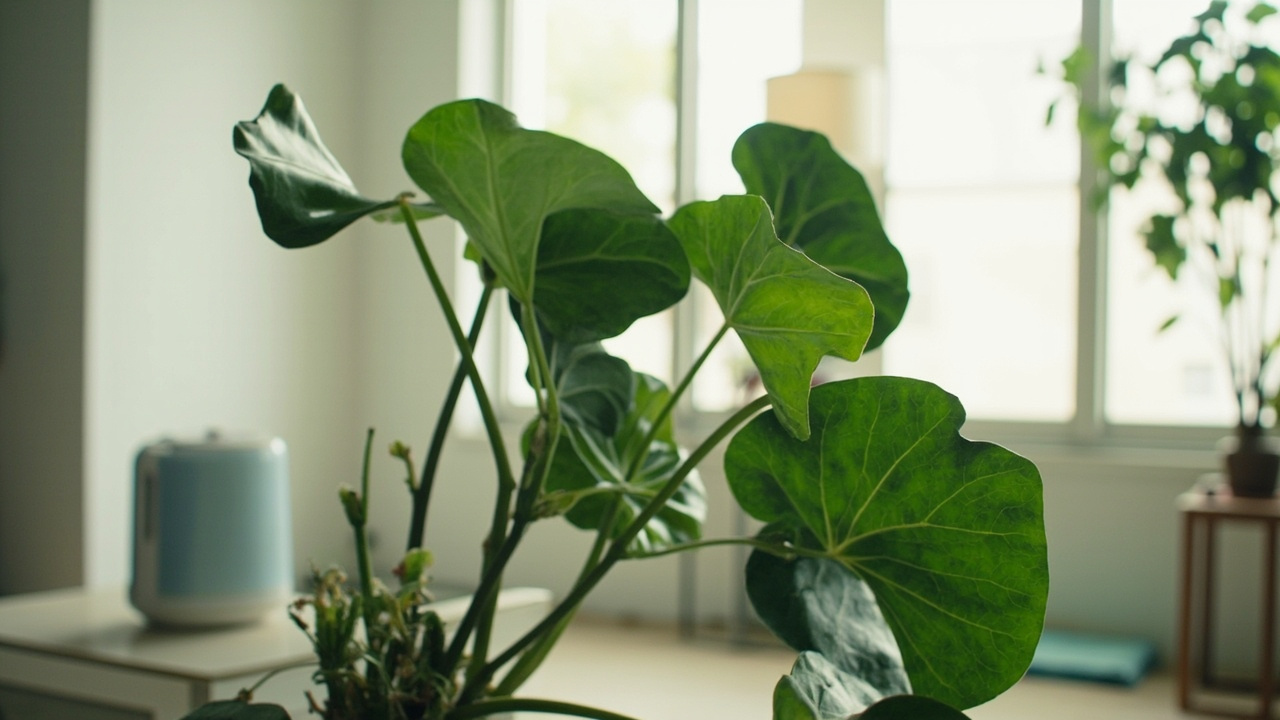
Humidifier (most reliable): A small cool-mist humidifier near the plant is the single most effective way to raise and maintain humidity. Run it during the day when the plant is transpiring actively. Clean it weekly to prevent mold and bacteria from dispersing into the air around the plant.
Pebble tray: Place the pot on a tray of pebbles and add water until it just reaches the top of the pebbles — the bottom of the pot should sit above the waterline. As the water evaporates, it raises humidity immediately around the plant. This method adds roughly 5–10% relative humidity in still air, enough to help in mildly dry conditions but insufficient for heavily heated rooms.
Grouping plants: Plants release water vapor through their leaves. Grouping several plants together creates a localized humid microclimate that benefits all of them. A cluster of three or more plants can raise local humidity by 10–15% compared to an isolated plant. This works especially well in a bathroom or conservatory where air changes are slower.
Misting: Spraying the leaves provides temporary relief but evaporates within an hour. It is not a reliable primary strategy, though it can help as a supplement between humidifier sessions. For a complete watering schedule that accounts for humidity levels, see the dedicated guide.
Lowering humidity
If your space runs consistently above 70% humidity, increase air circulation with a small oscillating fan and make sure the plant is not crowded against other foliage. Moving the plant to a room with better ventilation or a lower temperature range will help, since cooler air holds less moisture. Reducing how often you water also lowers ambient humidity, since wet soil surface evaporates continuously.
The honest trade-off is that a good humidifier costs $30–80 and requires weekly cleaning, but it is the only method that reliably maintains 40–60% humidity in a heated home through winter. Pebble trays and grouping help but have diminishing returns in very dry conditions. Misting alone is not effective as a primary strategy.
The most common mistake is assuming that because a fiddle leaf fig is tropical, it needs rainforest-level humidity. In practice, a well-maintained home at 40–60% is entirely suitable — the plant adapts well to the conditions humans find comfortable. The real problem is not the tropical origin per se, but the sudden swings in humidity that occur when heating or air conditioning switches on or off. A stable 45% is better for the plant than swinging between 25% and 65% each day.
By maintaining a consistent humidity level in the 40–60% range, you give your fiddle leaf fig the moisture it needs to transpire normally, absorb nutrients through its roots effectively, and produce the large, undamaged leaves that make it such a striking indoor plant.
Turn PDF Bank Statements Into Workable Spreadsheets
Your bank statement is a mess of numbers, but your books shouldn't be. Use our converter to get Excel, CSV, or QBO files — ready for QuickBooks.
Try It Free Now