Orchid light requirements come down to bright indirect light — enough light to read a book by comfortably at midday, with no direct sun on the leaves. An east-facing window is the ideal placement for most homes, a south or west window works with a sheer curtain, and a north-facing window usually needs supplemental light or a brighter room.
The reason the rule exists is the orchid’s biology. Phalaenopsis orchids are native to the tropical understory in Southeast Asia, where they grow on the bark of trees under a multi-layered canopy. The leaves evolved for dappled light that is bright but never direct. Direct sun burns the leaves within days because the leaf tissue is not built to dissipate the heat load. Dim light keeps the plant alive but produces leaves only — no flowers — because the light level never crosses the threshold that triggers a flower spike.
That second point is the part most beginner orchid care misses: the seasonal light drop in autumn is the natural rebloom trigger, and an orchid that has been in a too-dim corner for a year has not received the signal it needs. The rest of this article walks through what bright indirect actually means, the window-by-window guide, the leaf-color signals, the seasonal rebloom trigger, and the simple grow light fallback for dim homes. For the broader care context, our orchid care for beginners guide covers the full set of decisions.
What “Bright Indirect Light” Actually Means For An Orchid
Bright indirect light is the light level you would find three to five feet back from a bright south or west window, right in front of an unobstructed east window, or in a room where you can read a book comfortably at midday without turning on a lamp. The key word is “indirect” — the sun is not on the leaves, but the room is well-lit. Most orchids grown as houseplants want roughly 1,000 to 1,500 foot-candles for 12 to 14 hours a day during active growth, which is what a bright window produces for most of the year.
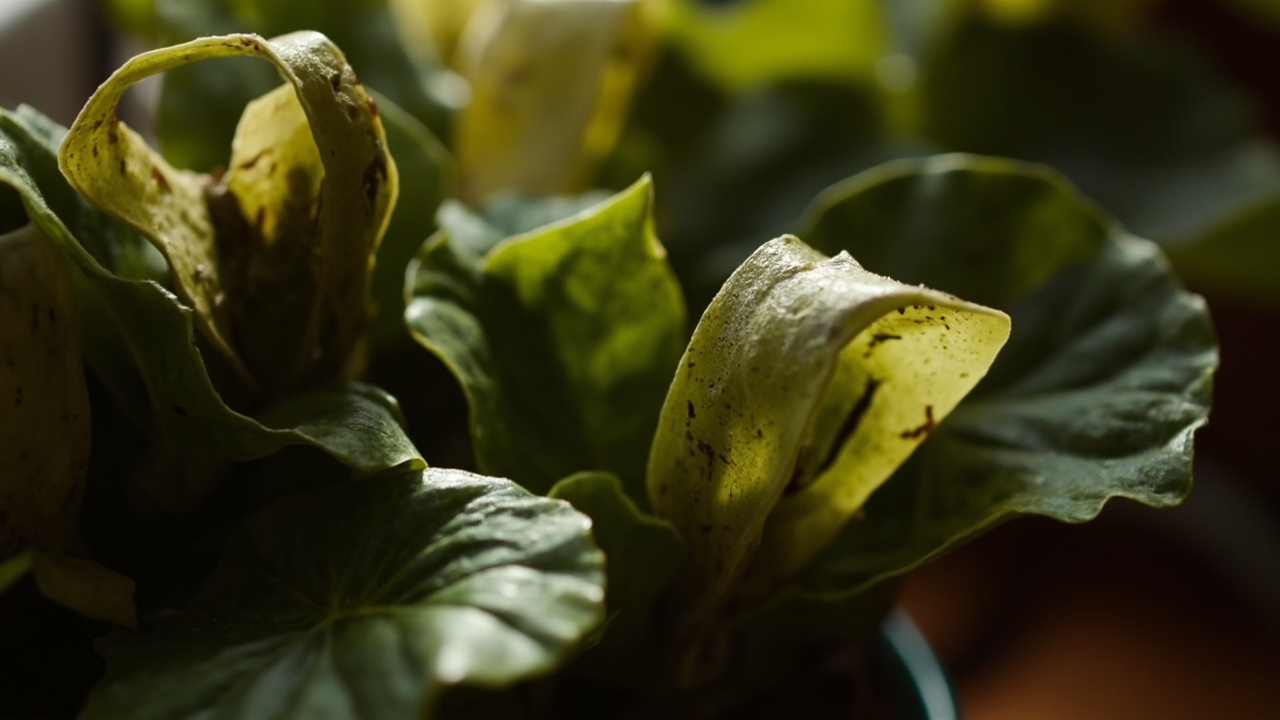
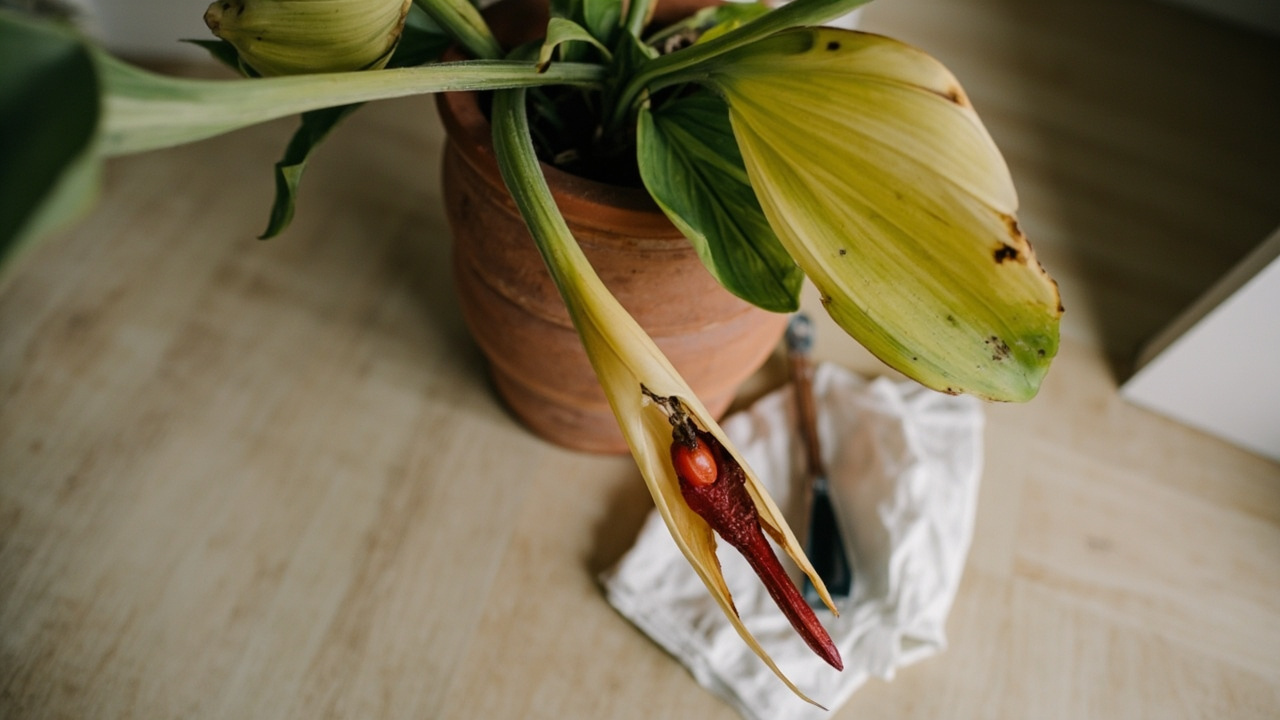
Direct sun on the leaves is the failure mode to avoid. A Phalaenopsis leaf in direct sun for a few hours will develop pale yellow or brown patches that do not recover. The damage is not fatal but it is permanent on the affected leaves, and it is a clear signal the plant needs to move further from the window. The right move is to position the orchid where it gets the light of the room but not the sunbeam itself.
A simple test: stand where the orchid sits at midday and look at the floor. If your shadow is sharp-edged and dark, the sun is hitting that spot directly and the orchid will burn. If your shadow is soft-edged or non-existent, the light is indirect and the orchid is fine.
The Window-By-Window Guide
East-facing windows are the ideal placement for Phalaenopsis orchids. The morning sun is bright but not hot, and the indirect light holds through the rest of the day. The plant sits right on the windowsill or within a foot of it, and the leaves stay a healthy medium green without burning.
South-facing windows work but require a sheer curtain or a five-to-eight-foot setback from the glass. The afternoon sun through a south window can burn the leaves, but filtered light or set-back placement makes the light usable. The advantage of a south window is consistent light through the day and through the winter, which is what an orchid needs to maintain active growth.
West-facing windows are workable with care. The afternoon sun is the strongest of the day and the most likely to burn leaves, so the orchid needs a sheer curtain or a setback of three to six feet from the glass. A west window that gets too much sun is the most common cause of yellowing leaves in summer.
North-facing windows are usually too dim, especially in winter at northern latitudes. The plant survives and may even grow new leaves, but it almost never blooms because the light never crosses the spike-trigger threshold. The fix is a grow light setup (covered below) or moving the orchid to a brighter room for the autumn-winter window. A north-facing window in a basement apartment almost always needs supplemental light.
Reading The Leaves: Too Little, Just Right, Too Much
The leaf color is the visual signal for the light level, and reading it well takes a minute. Dark green leaves with no blooms for more than a year mean the light is too dim. Medium green leaves with steady growth and, in season, a flower spike, mean the light is right. Pale green leaves, yellowing leaves, or leaves with brown sunburn patches mean the light is too much.
The corrective move for each signal is straightforward. Too little: move the orchid closer to the window, switch to a brighter room, or add a grow light. The plant will produce a new leaf within a few months, and a spike within eight to twelve. Too much: move the orchid further from the window, add a sheer curtain, or shift it to a less exposed position. New leaves will come in medium green once the placement is corrected; burned leaves will not recover but can be left in place until they yellow naturally.
The honest trade-off is that the leaf-color signal is lagging, not leading. By the time the leaves turn yellow or the plant stops blooming, the light level has been wrong for weeks or months. The weekly check is the right cadence: stand where the orchid sits, look at the floor for a soft shadow, and trust the plant’s overall posture (compact, firm, green) over any single color reading. For the broader yellow-leaf diagnostic, our orchid yellow leaves guide walks through the watering and temperature causes alongside the light cause.
The Seasonal Light Drop And The Rebloom Trigger
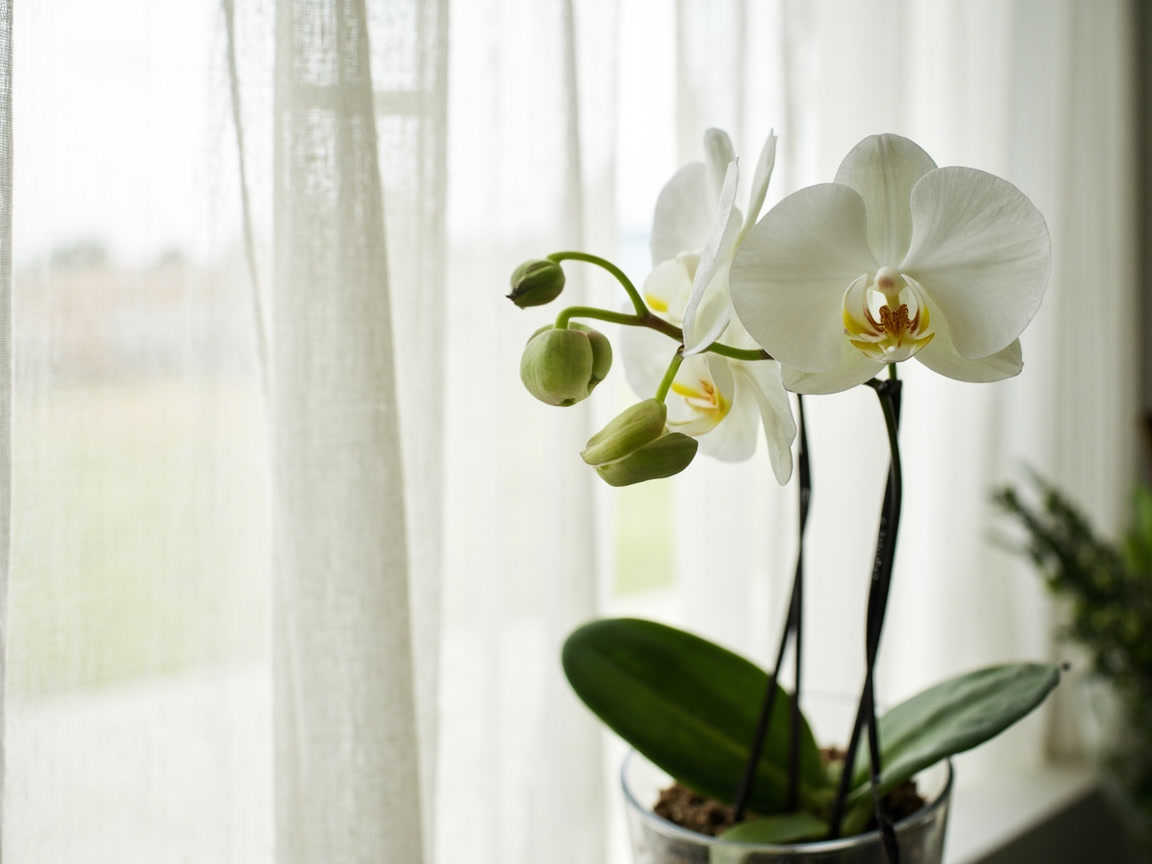
The seasonal light drop in autumn is the natural rebloom trigger for Phalaenopsis orchids, and it is the part of orchid care that most beginners miss. In their native range, the day length shortens and the light intensity drops in late autumn, and the plant senses the change through phytochrome receptors in the leaves. The signal tells the plant to push out a flower spike from the base, and the spike emerges six to eight weeks later.
Indoor orchids respond to the same trigger, but the signal needs to be clear. A plant that has been in a bright, even-lit room all year may not receive a strong enough seasonal shift. The fix is to either move the orchid to a brighter spot in summer and a slightly cooler, less-bright spot in autumn, or simply leave it in place and trust that the natural light shift through a window is enough. Most windows produce a measurable drop in late autumn as the sun angle changes, and that is usually sufficient.
The spike appears eight to twelve weeks after the trigger. It grows slowly for two to three months before the buds form, and the flowers last another three to four months once they open. The realistic rebloom timeline from the last bloom is eight to twelve months, which is also how long the seasonal trigger takes to fire again. For the spike-cut and after-bloom reset, the orchid after bloom care guide walks through the timing.
The light drop is also why a north-facing window rarely produces blooms. The light is too dim to begin with, and the seasonal shift is too small to fire the trigger. Moving the orchid to a brighter room for the autumn window, even temporarily, is sometimes enough to push a stubborn plant into bloom.
When The Home Is Too Dim: Grow Lights And Honest Trade-Offs
A simple full-spectrum LED grow light on a timer is the cleanest fix for a dim home. The setup is one panel or bulb rated 20 to 40 watts, color temperature 5,000 to 6,500 kelvin (daylight white), positioned 12 to 18 inches above the orchid on a 12 to 14 hour timer. The light is on from morning to evening, and the plant receives the same daily light integral it would get in a bright window.
The honest trade-off is that grow lights are not as good as natural light, even when they are well-tuned. The spectrum of a daylight LED is close to the sun but not identical, and the intensity drops quickly with distance, so a small adjustment in height changes the dose significantly. The fix is to keep the light 12 to 18 inches above the orchid, set the timer to 12 to 14 hours, and watch the leaves for the same color signals (medium green, no burns, no stretching). A plant that produces a flower spike under a grow light is well-tuned; a plant that produces only leaves needs more intensity or longer hours.
For most homes, a grow light is a supplement, not a replacement. A bright east window with a grow light on the dim side of the plant produces more blooms than either alone. The setup is worth the cost for a serious orchid owner; for a beginner with a single Phalaenopsis, moving the plant to a brighter room for the autumn window is usually enough.
Light And Water: Why A Move Means A Schedule Shift
A move to a brighter spot pulls more moisture out of the bark, which means the watering schedule shifts. An orchid that was on a once-a-week rhythm in a north-facing window may need a once-every-five-days rhythm after a move to a south-facing window with a sheer curtain. The roots visible through the clear pot are the diagnostic — silver roots ready to water every five days instead of every seven.
The full watering procedure is in the orchid watering guide, but the practical point for a light move is that the schedule is downstream of the light level. Bright light means faster moisture loss, dimmer light means slower. After any move, watch the roots for two to three cycles to find the new rhythm, then trust it.
When The Plant Is In Real Trouble: The Light-Failure Pattern
The most severe light failure is sudden sun exposure after a move. An orchid that has been in a dim corner for a year, then moved directly to a south-facing window, will burn its leaves within a few days. The leaves turn pale yellow or develop brown patches, and the damage is permanent. The plant is not dead, but the affected leaves will not recover.
The rescue path is to move the orchid back to a more protected position, leave the burned leaves in place until they yellow and drop naturally, and resume the normal care rhythm. The plant will push out new leaves within a few months, and the new growth will be a healthier color once the placement is corrected. For the broader rescue protocol when the plant is in worse shape — overwatered roots, crown rot, or a stem that has collapsed — the full procedure is in our save a dying orchid guide.
Turn any PDF statement into a clean sheet
Skip the typos and the hours of copying. Our converter handles any bank statement format and outputs Excel, CSV, or QBO for QuickBooks. No file retention, free to try.
Convert your statement