Every Monstera owner eventually wants more Monsteras. The good news: Monstera deliciosa propagates reliably from stem cuttings, and doing it yourself is far more satisfying than buying a new plant. The process takes patience — a new cutting can take two to three months to establish and begin producing new leaves — but it is straightforward if you follow a few key rules about what makes a good cutting, how to root it, and when to move it to soil.
This guide covers the complete propagation process: selecting the right stem, cutting and preparing the cutting, rooting in water or sphagnum moss, and transferring to soil. It also covers how to propagate from the corms (underground structures) and how to time your propagation for the best success rate.
When to Propagate Monstera
The best time to propagate Monstera is during the active growing season — spring and summer. The plant is growing vigorously during these months and will root and establish faster than in autumn or winter, when growth slows significantly. A cutting taken in late spring or early summer may produce new roots within four to six weeks and a new leaf within three to four months. A cutting taken in autumn may not root for three to four months and may not produce a new leaf until the following spring.
If you are propagating in winter because that is when you have a suitable cutting, do not expect fast results. Keep the cutting in a warm, bright position and be patient.
How to Select a Monstera Stem Cutting
The cutting must include at least one node — the slightly swollen bump on the stem where leaves and aerial roots emerge. Without a node, the stem will not produce roots. A good Monstera cutting for propagation includes: a section of stem 4–6 inches long, at least one node (ideally two), one or more aerial roots if available, and one to three leaves.
A cutting with aerial roots already present is ideal — these roots establish quickly once transferred to water or moss, and the cutting is generally more vigorous. A cutting with two or three nodes is better than a single-node cutting because it provides more root-growing sites and a larger energy reserve.
Do not take cuttings from unhealthy or pest-infested sections of the plant. A cutting taken from a stressed Monstera roots poorly and may introduce problems to the new plant.
Water Propagation
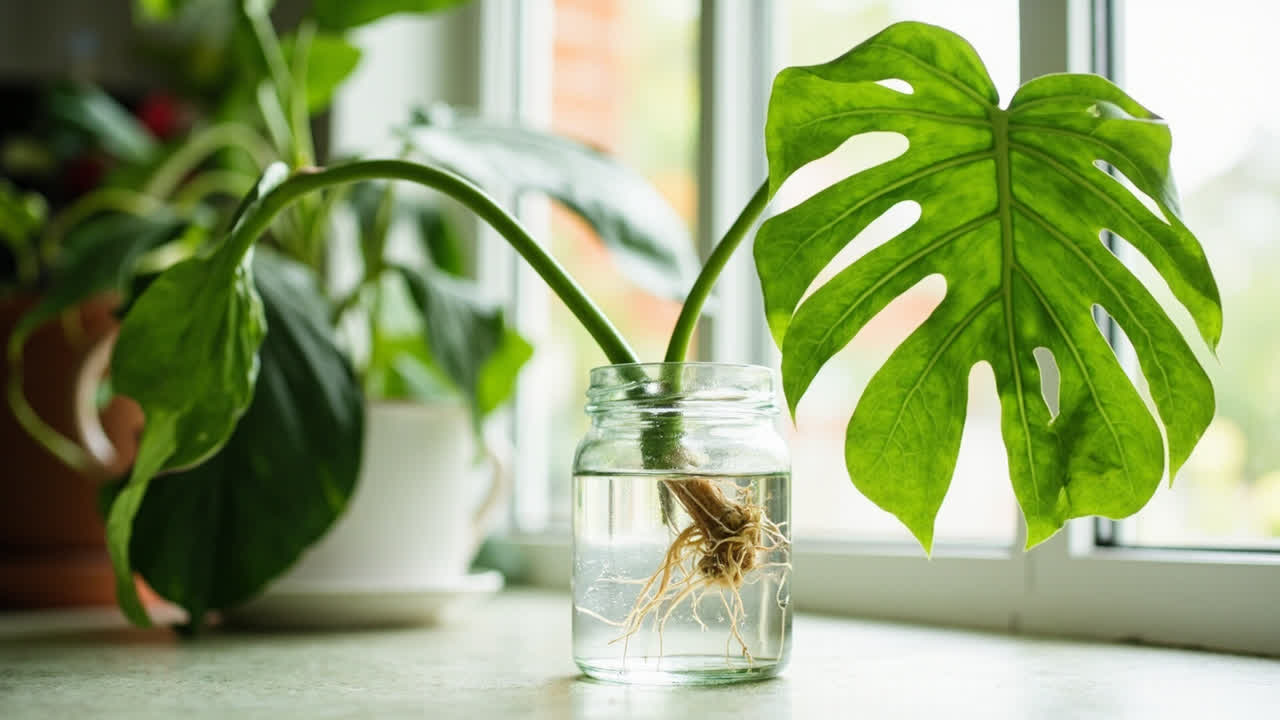
Water propagation is the most popular method because it is visual — you can watch the roots grow. To propagate in water: place the prepared cutting in a clean glass jar filled with room-temperature water, ensuring the node is submerged but the leaves are above the waterline. Change the water every three to five days to prevent bacterial buildup.
Position the jar in bright, indirect light — direct sun overheats the water and encourages algae. Room temperature is fine; cold water slows rooting significantly.
Roots typically appear within four to six weeks in good conditions. The roots should be at least 3 inches long before transferring to soil — shorter roots have difficulty establishing in soil and the plant may experience transplant shock. In some cases, roots can take eight to twelve weeks to reach this length, particularly in winter or low light.
Transfer the rooted cutting to a small pot (4–6 inches) with well-draining aroid or Monstera potting mix. Keep the soil consistently moist for the first two to three weeks as the plant adjusts from water to soil — this is the critical establishment period. After that, transition to normal Monstera watering routines.
Sphagnum Moss Propagation
Sphagnum moss propagation produces more robust roots than water propagation and reduces transplant shock because the roots grow in a soil-like medium rather than in water. To propagate in sphagnum moss: dampen long-fiber sphagnum moss until it is moist but not dripping wet. Wrap the node section of the cutting loosely in the moss, keeping the leaves exposed. Place in a container or plastic bag to retain humidity and position in bright, indirect light.
Check every few days that the moss remains moist — it should feel like a wrung-out sponge. Mist if it begins to dry out. Roots typically develop within six to eight weeks. Once roots are 2–3 inches long, transfer to potting mix using the same approach as for water-propagated cuttings.
Common Propagation Mistakes
Taking a cutting without a node is the most common mistake. The node is where the growth hormone concentration is highest and where roots will emerge. A leaf-only cutting — no matter how large and healthy the leaf — will not produce roots from the petiole. It may look healthy for weeks but will eventually decline.
Transferring to soil too early is the second most common mistake. Roots less than 3 inches long have not developed sufficient root hairs to absorb water and nutrients in soil. A cutting with short, fragile roots placed directly in soil will often fail to establish and may rot entirely. Be patient and wait for substantial root development.
Using a pot that is too large for a new cutting is a subtle but common error. A cutting in a large pot has excess soil that stays wet too long around the limited root system, leading to root rot. Use a small pot — 4 to 6 inches — and repot as the plant grows.
Giving the cutting direct sun accelerates water loss from leaves before roots are established to compensate. Keep new cuttings in bright indirect light only.
Propagating Monstera Corms
Monsteras also produce corms — small, dark, bulb-like structures — at the base of the stem and among the roots. These contain concentrated growth hormones and can be propagated separately from the main plant. To propagate from corms: carefully separate the corms from the root mass, keeping them intact and undamaged. Plant them just below the surface of damp sphagnum moss in a small container. Keep in a warm, bright position and maintain moisture.
Corm propagation is slower than stem cutting propagation — corms can take several months to produce visible growth. However, corm-grown plants tend to establish very vigorously once they start, producing multiple growth points from a single corm.
How Long Does Monstera Propagation Take?
From cutting to a plant with several established leaves typically takes six to twelve months under good conditions. The timeline breaks down roughly as follows: roots appear in four to eight weeks; first new leaf in soil appears in three to six months after rooting; a mature-looking plant with multiple large leaves takes twelve to eighteen months. Patience is essential — Monsteras are not fast growers, and a cutting that looks slow in its first year will surprise you in its second.
Turn PDF Bank Statements Into Workable Spreadsheets
Your bank statement is a mess of numbers, but your books shouldn't be. Use our converter to get Excel, CSV, or QBO files — ready for QuickBooks.
Try It Free Now