
Hydroponic onions are one of the easier crops to run in a closed system, and one of the harder ones to grow well. Onion is a light-triggered bulbing plant, so it will not make a bulb no matter how good your nutrient solution is unless the day length matches the variety. The numbers below decide the outcome, whether you are after green tops in three weeks or a full bulb in about 90 days.
This guide covers the EC and pH bands, why solution temperature is the failure point most growers miss, which system type measurably yields the most, and how to read a plant that has stopped bulbing. It is written for a home or small commercial deep water culture setup, and every figure comes from extension services or peer reviewed trials.
What Hydroponic Onions Need Before You Start
Onion is a light feeder with a narrow demand curve, and getting the order right matters more than any equipment choice. Start with day length, because that decides whether you grow green tops or bulbs.
- Day length: short day varieties bulb at 11 to 12 hours of light, intermediate and day neutral types at 12 to 14 hours, long day types need 14 hours or more.
- pH: 6.0 to 6.8.
- EC: about 2.0 mS/cm at establishment, rising to roughly 2.6 mS/cm once the root system is working.
- Solution temperature: 18 to 20C, with the root zone kept cool.
- Spacing: 3 to 4 inches (8 to 10 cm) for green tops, wider for bulbs.
- Timeline: green tops around 21 days from sets, bulbs 80 to 90 days.
Read the day length line first. It is the one number that decides the shape of the whole run, and it is the one most growers never check before they plant.
Two of those numbers are load bearing in a way that is not obvious. EC sets the osmotic potential of the solution, which sets the water uptake gradient, which sets turgor and leaf expansion. Too high and the gradient inverts, so the plant cannot draw water even though it sits in water. Day length is the second: bulbing is a photoperiod response, not a nutrient response, which is why a fed plant can still refuse to bulb.
Sets or Seed
Sets are small immature bulbs, and for a first run they are the sensible choice. You skip germination, you know the variety, and you place them at a consistent height so the root plate sits at the same depth across the raft. Even root depth keeps oxygen exposure consistent, and uneven oxygen is what drives root rot.
Seed works too: germinate, then transplant once established. The trade is time and uniformity, and sets give you an even stand you can plan a harvest date around.
Whichever you use, get the root plate clean. Sets from a garden centre carry soil, and soil carries the Fusarium basal rot pathogen that UMass Extension calls the most economically important disease of onion and garlic. In a soilless system you have removed that inoculum, so do not put it back.
Building the Nutrient Solution
The solution is where most of the physics happens, and the order of operations matters more than the products. Establish at a lower EC, then raise it. Adjust pH last, because adding acid or base changes the reading you just set.
Onion performs in perlite, rockwool, or composite plugs, and controlled environment literature calls it a relatively light feeder. For bulbs, a lower nitrogen formula is preferred. Higher nitrogen pushes leaf growth, and while that gives a better green harvest, it costs you a developed bulb.
That trade is the most useful thing to understand about feeding onions. Nitrogen and bulb size compete for the same carbon, because a leaf is carbon invested in photosynthesis and a bulb is carbon invested in storage. You cannot maximise both in the same plant at the same time.
Randle’s work at the University of Georgia showed that nitrogen concentration in the hydroponic solution changes both flavour and bulb quality. More nitrogen means more leaf and less bulb, and the compounds that make an onion taste like an onion depend on how that nitrogen was allocated.
- Fill the reservoir and set EC at about 2.0 mS/cm.
- Set pH to 6.0 to 6.8 and confirm it holds for 24 hours before adding plants.
- Hold the solution at 18 to 20C and confirm the root zone stays cool.
- Raise EC to roughly 2.6 mS/cm once roots are established and visibly growing.
- Reduce nitrogen as bulbing begins, and hold it there until harvest.
For the pH work itself, the EC and pH calibration guide is worth reading in full, because pH drift is what turns a healthy crop chlorotic over about a week. The ppm conversion table is the other one worth having open, since most meters report in ppm and every recipe is written in mS/cm.
EC and pH are not independent numbers. pH governs the solubility of iron and phosphorus, which is why an unadjusted solution produces iron chlorosis in seven to ten days rather than gradually. EC governs the osmotic gradient, which is why salt build up looks like wilting while the plant stands in water.
| Parameter | Onion | Lettuce | Why the difference matters |
|---|---|---|---|
| pH range | 6.0 to 6.8 | 6.0 to 7.0 | Both near neutral, so one method covers both |
| EC at establishment | 2.0 mS/cm | 1.8 to 2.2 mS/cm | Onion establishes higher because it builds bulb tissue |
| EC at full growth | 2.6 mS/cm | 1.8 to 2.2 mS/cm | Bulbing plants draw down the reservoir faster |
| Solution temperature | 18 to 20C | 18 to 21C | Onion is more sensitive to a warm root zone |
| Day length for bulbing | 11 to 14 hours or more, by variety | Not required | Onion has a hard light trigger, lettuce does not |
| Harvest time | 21 days for tops, 80 to 90 days for bulbs | 28 to 35 days | Onion is a two cycle crop, lettuce a single cut |
| Nitrogen priority | Reduce at bulbing | Steady feed | Extra nitrogen makes soft lettuce and small onion bulbs |
If you run a mixed system, the breakdown of the main system types is worth reading before you commit, because the system you pick determines how hard you work on the root zone later.
Day Length Decides Bulb or Top
This is what makes onion different from every other crop in this family. Bulbing is triggered by day length, and a short day variety grown under 16 hours of light will grow leaves and refuse to bulb.
Extension services classify onion varieties into three light response groups. Short day onions initiate bulbs at roughly 11 to 12 hours of light, intermediate and day neutral types at 12 to 14 hours, and long day types at 14 hours or more, which is why they are grown in northern latitudes.
Khosa and colleagues at the University of Otago, with Plant and Food Research in New Zealand, spent two decades developing a controlled environment protocol for onion. Their bulbing response experiment is the cleanest demonstration of the trigger: plants grown under 8 hours of light were transferred to 16 hours of light, and that switch moved them into bulbing.
The practical consequence is that the lighting schedule is part of the recipe, not a detail you adjust to taste. Your photoperiod has to match the variety, and it has to be matched before the plant reaches the size where it can respond.
Two failure modes follow. A long photoperiod on a short day variety gives an enormous plant with no bulb. A short photoperiod on a long day variety gives a small plant that never commits. Neither is a nutrient problem. A second trigger confuses growers constantly: stress can induce bulbing in onions that are not photoperiod ready, making a small bulb at a size where the plant should still be building leaf. That bulb is a stress symptom, not a harvest.
What Triggers Bulbing and What Does Not
Day length initiates bulbing and temperature modifies the rate. Nutrient level changes the size of the bulb that forms once the switch is thrown, but it does not throw it. Neither does nitrogen, and that is where most growers burn a season.
| Light response group | Hours of light to initiate bulbing | Typical market type | Fit for a home rig |
|---|---|---|---|
| Short day | 11 to 12 hours | Sweet and Spanish types | If your rig runs lights 16 hours it will never bulb |
| Intermediate and day neutral | 12 to 14 hours | Many storage types | The most forgiving group, safest for a first run |
| Long day | 14 hours or more | Northern storage types | Needs a long photoperiod and a cool climate |
Why Solution Temperature Decides Whether You Keep the Crop
If you take one variable seriously from this guide, make it the root zone temperature. Solution temperature sets dissolved oxygen, dissolved oxygen sets root respiration rate, and root respiration rate sets how fast the root mat consumes the oxygen that water moulds need to establish.
Controlled environment protocols for onion keep the root zone cool for exactly this reason. UMass Extension puts the optimum for Fusarium basal rot, the disease that ends more onion crops than any other, at 25 to 29C, not far above what many indoor reservoirs reach in summer.
Salt concentration is the other half. A warm, saline root zone is one where water moves the wrong way, so the plant droops in a way that looks like drought and gets misdiagnosed as an EC problem, when the real fault is temperature driving evaporation and concentrating the salt.
The tell is a droop that appears on a hot afternoon and partially recovers overnight. If that is your pattern, check reservoir temperature before you touch the fertilizer.
Crop-by-crop temperature ranges matter when you run more than one species, since a lettuce-friendly warm reservoir is exactly wrong for onion. The reservoir temperature ranges by crop cover the spread.
Which System Actually Yields the Most
The counterintuitive result in the literature is that the simplest system wins. In a glasshouse comparison of four soilless systems growing the same Greek sweet onion landrace, floating and aggregate culture produced the highest yields, aeroponic came next, nutrient film technique the lowest.
- Floating culture (DWC): 7.87 kg per square metre
- Aggregate culture: 7.57 kg per square metre
- Aeroponic culture: 6.22 kg per square metre
- Nutrient film technique: 5.20 kg per square metre
Measured at 31, 62 and 95 days after transplanting, with mean solution consumption of 16.87 litres per plant. NFT plants consumed the least solution, the efficiency argument for the method, and they also produced the least bulb.
The mechanism is root density. In NFT the film is thin and the root mat is short, so the plant draws less water and takes up less of everything. The study reported that reduced nutrient uptake tracked reduced water consumption directly, which is why the yield gap exists at all.
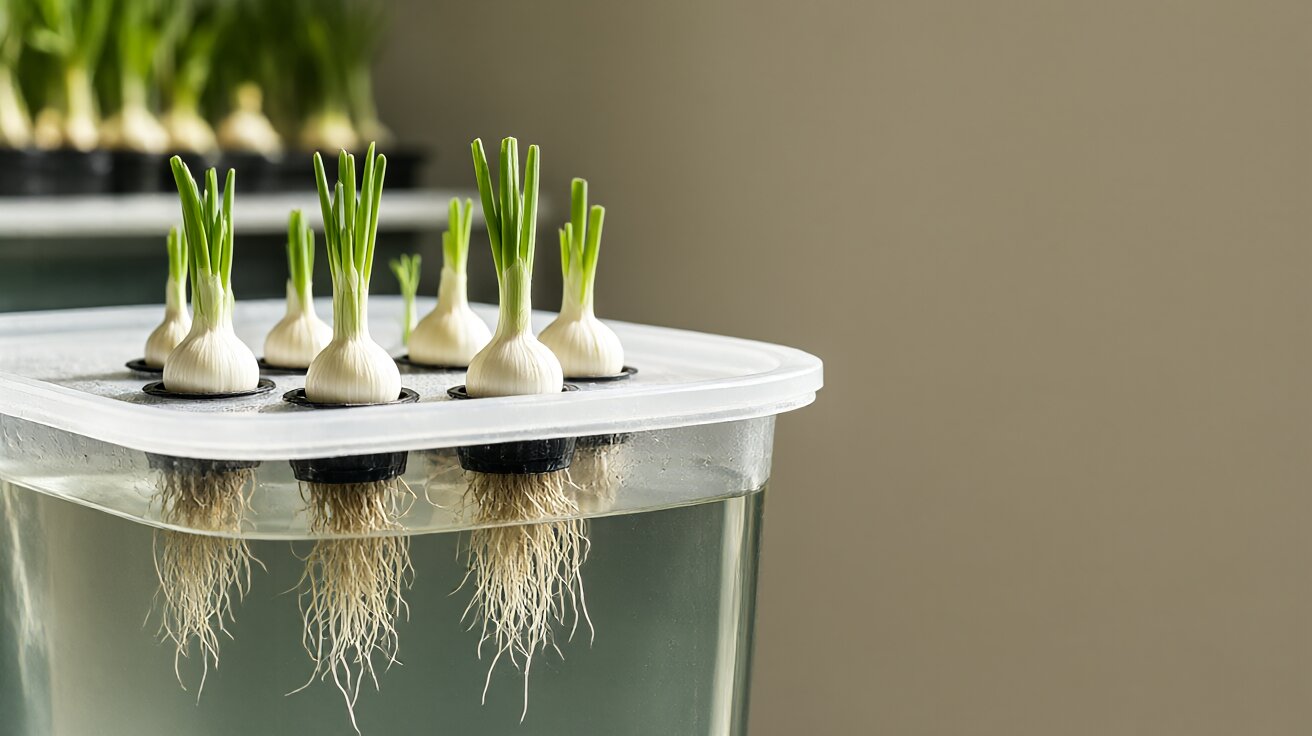
In floating culture the roots sit in volume and can explore it, which makes floating the easier system to hold at a stable temperature and the safest default for a home rig. How each system handles water and root oxygen is covered in the systems explained guide.
NFT is right for a different reason: it is more forgiving on oxygen, because a thin film recharges with air continuously. If your room runs warm and you cannot hold a reservoir at 18 to 20C, a nutrient film approach handles heat better than a still reservoir, even at a lower yield per square metre.
Two alternatives sit outside the hydroponic box entirely. Aquaponics couples the same soilless culture to a fish system, and onions appear on its standard crop list in the aquaponics guide. Growing the same crop in soil instead of water has its own depth and spacing rules, covered in the container vegetable gardening guide, and those rules do not transfer to a raft.
Planting Depth, Spacing, and the Root Zone
Onion is shallow rooted and unforgiving of being buried. Set the basal plate at the level of the medium, not under it, and keep the sets level across the raft. Inconsistent height means inconsistent oxygen at the root plate, and that is where rot starts.
For green tops, 3 to 4 inches (8 to 10 cm) between plants works, roughly 18 plants per square foot. For bulbs you need closer to 9 per square foot, because bulb swelling needs light interception and air movement around the foliage. The logic for density per system type is in the hydroponic plant spacing guide.
Whatever the spacing, keep the root zone the priority. Alliums share the Fusarium susceptibility, so the chives and other allium herbs in the same system need the same temperature discipline, and one warm reservoir takes out all of them at once.
What Goes Wrong and What It Looks Like
Onion fails in a few recognisable ways, and each has a signature. Reading the signature beats running through a checklist.
Yellowing leaves from the tip down, with reddish brown at the basal plate. That is Fusarium basal rot, and UMass Extension notes it can develop during storage even when nothing looked wrong in the system. Root temperature above 25C is the main risk factor.
Stunted plants with pink or yellow roots. That is pink root, caused by Phoma terrestris, and Utah State Extension puts its active range at 75 to 85F with symptoms 7 to 21 days after infection. There is no cure, so prevention is the whole strategy.
Plants that grow and never bulb. Photoperiod mismatch, or stress induced bulbing at the wrong size. Check the light hours before you change anything else.
Bulbs that form but taste like nothing. Too much nitrogen during bulbing. The allocation went to the leaf instead of the bulb, and the flavour compounds never accumulated. Entirely a feeding decision, and entirely preventable.
Seedlings that stretch and flop. Light intensity. Onions reach hard for light early, and a stunted, leaning stand at two weeks is a light problem, not a feeding problem.
A general diagnostic sequence is worth setting up before you need it, because the difference between a leaf symptom and a root symptom decides which of these five you are looking at. Where you are not sure what a symptom means, the hydroponic lettuce guide covers the matching deficiency patterns on a crop you likely already run.

Harvesting Green Tops and Bulbs
Green tops come first and they do not stop the bulb. Cut the larger outer leaves, leave a few centimetres of growth above the medium, and take no more than a third of the foliage at a time. Cutting harder costs bulb size, because the leaves are still doing the work.
Green tops are ready roughly 21 days after planting sets. From seed, allow for germination at about 10 days, then transplant, then two weeks of leaf growth.
Bulbs take 80 to 90 days from sets. Maturity shows as yellowing foliage, stems falling over, or a flower stalk appearing, and all three mean the same thing: stop feeding and prepare to pull.
Pull the whole plant, leave the roots attached, and let the tops dry back before storing. UMass Extension gives 4C as the storage temperature that minimises post harvest losses, and notes a bulb that looked healthy can still develop rot in storage. That is the argument for curing properly first.
Harvest the moment the tops fall, not after. A bulb left standing past full maturity in a wet reservoir is a bulb that starts losing the sugars you grew it for.
The whole run comes back to two numbers: the day length your variety needs, and the temperature of your root zone. Set both correctly and the rest hold together. Get one wrong and no amount of feeding brings the crop back.
Sources and further reading
- Khosa et al. (2018), HortScience 53(12):1746-1749, University of Otago and Plant and Food Research: A Guide for the Cultivation of Onion under Controlled Environment Conditions, covering propagation media, nutrition, temperature, light and the bulbing trigger.
- Mouroutoglou, Kotsiras, Ntatsi and Savvas (2021), Horticulturae 7(11):432: Impact of the Hydroponic Cropping System on Growth, Yield, and Nutrition of a Greek Sweet Onion (Allium cepa L.) Landrace, with yields of 7.87, 7.57, 6.22 and 5.20 kg per square metre for floating, aggregate, aeroponic and nutrient film systems.
- Randle (2000), Journal of the American Society for Horticultural Science 125(2):254-259, University of Georgia: nitrogen concentration in hydroponic solution and its effect on onion flavour and bulb quality.
- Iowa State University Extension and Horticulture: onion photoperiod response groups, with short day at 11 to 12 hours, intermediate and day neutral at 12 to 14 hours, and long day at 14 hours or more.
- Ohio State University Extension, HYG-1616: Growing Onions in the Garden, giving a preferred pH of 6.0 to 6.8 and the three light requirement classifications.
- UMass Extension Vegetable Program: Alliums, Fusarium Basal Rot, with optimum pathogen activity at 25 to 29C and storage of bulbs at 4C.
- Utah State University Extension, Utah Pests: Pink Root of Onion, caused by Phoma terrestris, most active at 75 to 85F with symptoms 7 to 21 days after infection.
Last reviewed on November 24, 2026