
How to Clean and Reuse Clay Pebbles (LECA) for Hydroponics
LECA (Lightweight Expanded Clay Aggregate) can be cleaned, sterilized, and reused for 5 to 10 grow cycles or more if you remove organic debris, salts, and biofilm between harvests. The process involves rinsing, soaking in a cleaning solution, sterilizing, and drying before storage or replanting. Done correctly, reused clay pebbles perform almost identically to new ones at a fraction of the cost.
At Aqualogi, we’ve helped hundreds of home growers stretch their media budget without sacrificing yield, and the single biggest lever is treating LECA as a reusable asset rather than a consumable. The protocol below is the one we recommend to every new grower setting up their first flood-and-drain or DWC system, refined through years of hands-on testing and grower feedback.
What LECA / Clay Pebbles Are
LECA stands for Lightweight Expanded Clay Aggregate. Manufacturers heat clay to roughly 1,100-1,200 degrees Celsius in a rotary kiln. The clay expands and forms a porous, round pellet with a hard outer shell and a honeycomb-like interior. Each pellet is mostly air and water-filled pores, which gives LECA its signature properties: high drainage, excellent aeration, and low water retention compared to coco coir or rockwool. To understand how these growing medium properties shape plant performance, see our guide to growing medium properties.
Expanded clay is chemically inert. It does not alter pH or EC on its own, and it contains no nutrients. That neutrality is why growers prize it for systems where they want full control over the nutrient solution. The porous structure supports root oxygenation while the gaps between pellets let water drain freely, reducing the risk of waterlogged roots and root rot.
Porosity in LECA works on two levels. Macro-pores between pellets handle drainage and aeration. Micro-pores inside each pellet hold a small film of water and nutrients, which feeds roots through capillary action. Over time, these micro-pores trap organic matter, mineral salts, and microbial biofilm, which is exactly why cleaning between grows is essential. LECA’s large interconnected pores (typically 40-60% porosity) keep drainage high, which is why it suits flood-and-drain and DWC; if pores clog with biofilm, waterlogging follows. LECA’s 40-60% porosity means 40-60% of the pebble volume is air and water space; when biofilm fills those pores, waterlogging follows within 1-2 grow cycles.
Why Reuse Matters (Cost + Sustainability)
LECA is not cheap. A 50-liter bag can cost significantly more than an equivalent volume of perlite or coco coir. For a home grower running a 5-gallon bucket DWC or a small ebb-and-flow table, media costs add up across multiple harvests per year. Choosing among hydroponic system types early on helps you size your media investment correctly. Reusing clay pebbles across 5 to 10 cycles cuts media spend by 80 percent or more.
Sustainability matters too. Expanded clay is mined, kiln-fired, and shipped. Each reuse cycle defers that environmental cost. Unlike rockwool, which is difficult to recycle and often ends up in landfill, LECA can be cycled almost indefinitely as long as it is properly maintained. For growers coming from rockwool, our rockwool preparation guide covers the prep steps for that media. For growers who care about footprint, reuse is the single biggest lever available.
There is also a practical consistency benefit. After a few cycles, LECA stabilizes. Its pH drifts less, its physical structure is known, and you avoid the settling and channeling that fresh pellets sometimes cause. Many experienced growers actually prefer second-cycle LECA over brand-new material.
Step-by-Step: Cleaning Clay Pebbles
Clean LECA as soon as possible after harvest. Letting organic debris dry and harden makes the job much harder. The full process takes about an hour of active work plus soaking time.
Step 1: Remove Roots and Debris
Pull the plants out and shake off as much root material as you can by hand. Use a stiff brush or a garden hose with a jet nozzle to blast remaining roots off the pellets. For stubborn root mats, soak the LECA in warm water for 30 minutes to soften them before scrubbing. Work in a bucket or colander so pellets do not scatter.
Rinse
Step 2: Rinse Thoroughly
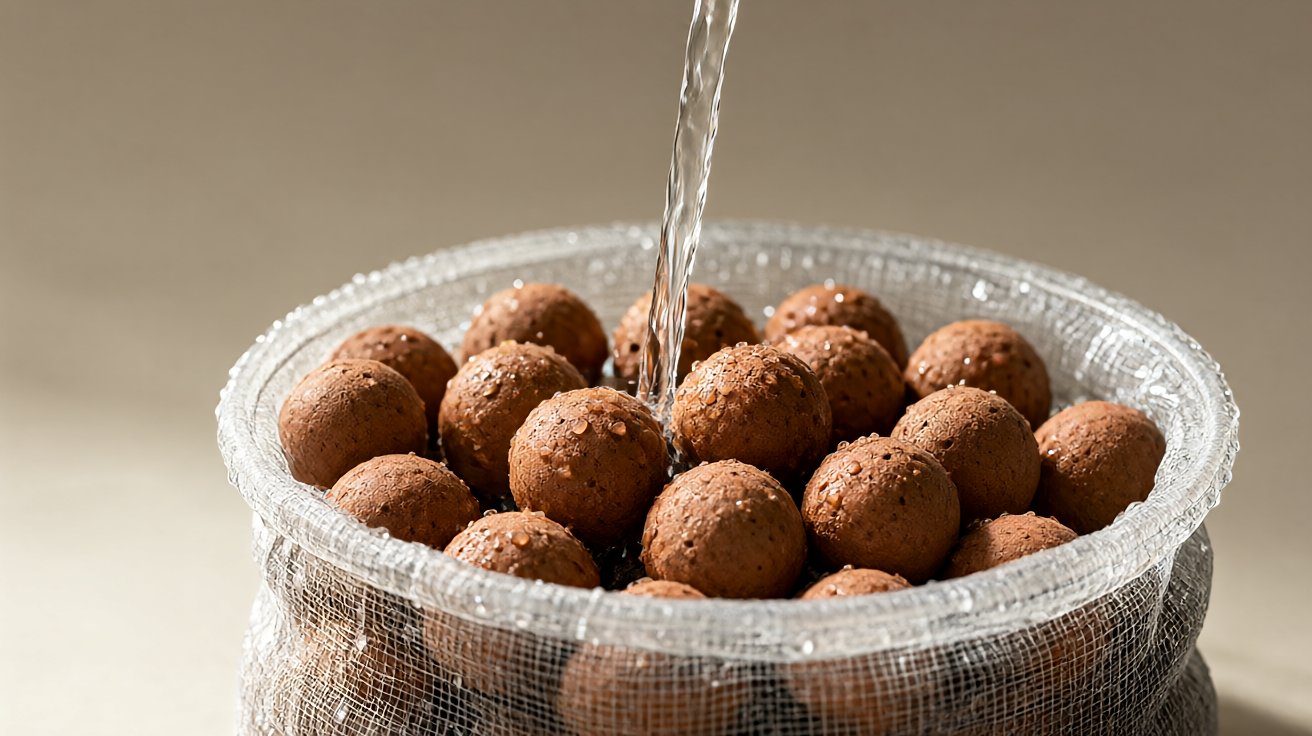
Place the LECA in a mesh bag or colander and rinse under running water until the runoff runs clear. Agitate the pellets with your hand to dislodge trapped particles. This step removes loose organic matter and most of the bulk salt load.
Soak
Step 3: Soak in Cleaning Solution
Fill a bucket with warm water and add your chosen cleaner. Soak the LECA for 12 to 24 hours. Common options include hydrogen peroxide, bleach, or an enzyme cleaner. The soak dissolves biofilm and kills pathogens hiding in micro-pores. Stir or agitate the pellets a few times during soaking.
Step 4: Final Rinse
Drain and rinse the LECA thoroughly, at least three times, until no smell of cleaner remains. For bleach, rinse until you cannot detect chlorine odor. For hydrogen peroxide, a single thorough rinse is usually enough since it breaks down into water and oxygen.
Dry
Step 5: Dry and Inspect
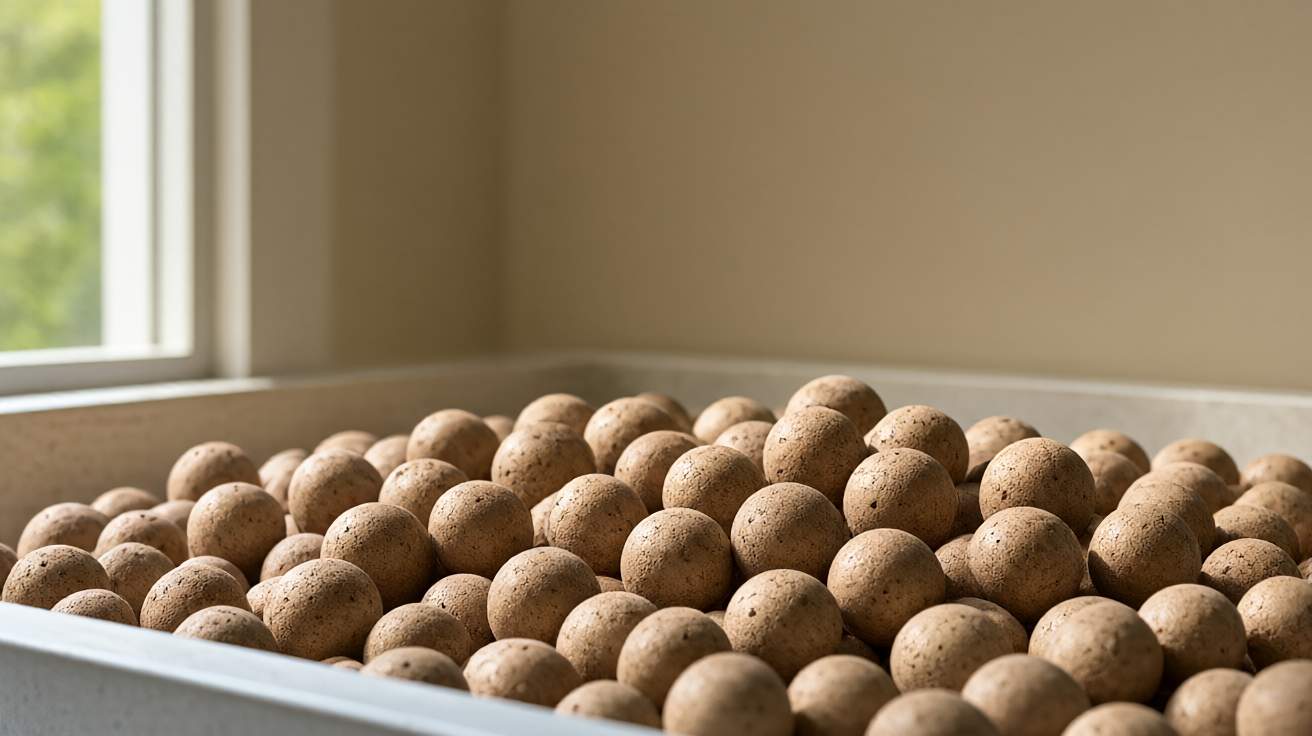
Spread the pellets on a tarp or screen in a well-ventilated area. Let them dry completely, which takes 24 to 48 hours depending on humidity. Drying prevents mold and makes storage safe. While drying, inspect for pellets that have cracked, crumbled, or become soft. Discard damaged ones.
Sterilize
Sterilize cleaned LECA using one of the methods compared in the next section before reuse.
Store
Store cleaned, dried LECA in a sealed container in a cool, dry place.
Sterilization Methods Compared
After cleaning, sterilization kills remaining pathogens. The three common methods differ in effectiveness, safety, and impact on the media.
| Method | Concentration | Contact Time | Pros | Cons |
|---|---|---|---|---|
| Hydrogen peroxide | 3% (drugstore) or 10-15 mL of 35% per liter | 30-60 min soak | Breaks down to water and oxygen; safe for plants | Less effective on heavy biofilm |
| Bleach (sodium hypochlorite) | 1:9 bleach to water (about 0.5% sodium hypochlorite) | 30 min soak | Strong disinfectant; cheap | Requires thorough rinsing; can raise pH if residue remains |
| Boiling water | 100 C water pour-over or 10 min simmer | 5-10 min | No chemicals; kills most pathogens | Labor intensive for large volumes; does not remove salts |
| Enzyme cleaner | Per label (typically 5-10 mL per liter) | 12-24 hr soak | Breaks down organic matter; gentle | Slow; not a true sterilant alone |
For home growers, hydrogen peroxide is the best all-around choice. It is effective, leaves no residue, and does not require the aggressive rinsing that bleach demands. Use bleach only when you suspect serious disease like Pythium or Fusarium. Always rinse bleach-treated LECA until no chlorine smell remains, then soak in clean water with a small amount of pH-down to neutralize any residual alkalinity. Use these soak parameters: 3% hydrogen peroxide for 30 minutes at room temperature, bleach at 1:10 dilution for 15 minutes, and rinse until runoff EC is below 0.5 mS/cm.
Boiling water is a good chemical-free option for small batches. Pour boiling water over the LECA in a colander or simmer pellets for 10 minutes. It will not remove mineral buildup, so combine it with a vinegar soak if salts are present.
Salt Buildup and How to Prevent It
Salt buildup is the number one enemy of reused LECA. As nutrient solution evaporates from pellet surfaces, minerals crystallize inside micro-pores and on outer shells. Over cycles, this raises EC, shifts pH, and can lock out nutrients or burn roots. LECA’s low CEC (1-5 meq/100g) means it doesn’t buffer nutrients, so EC in the root zone tracks your nutrient solution directly , any salt buildup on the pebbles adds to that EC.
Prevention starts with monitoring. Check the EC and pH of your runoff or reservoir weekly. If runoff EC climbs more than 0.3-0.5 above your input EC, salts are accumulating. Flush the system with pH-adjusted plain water every 2 to 3 weeks to push salts out. Numeric rule: flush when runoff EC exceeds 1.5 mS/cm, and target below 0.5 mS/cm after cleaning.
If you skip cleaning, consequences follow a timeline: biofilm buildup leads to root rot within 2-3 cycles, and salt crust drives EC creep that ends in nutrient lockout.
For cleaning between grows, a vinegar soak dissolves mineral deposits. Mix 1 part white vinegar to 4 parts water and soak LECA for 12 to 24 hours. The acetic acid reacts with calcium and magnesium carbonates, breaking them down so they rinse away. After the vinegar soak, rinse thoroughly and follow with a hydrogen peroxide sterilization step.
If you grow in hard water areas, salt buildup accelerates. Consider using reverse osmosis water or adding a small amount of citric acid to your nutrient solution to keep minerals in solution longer. Avoid letting the reservoir run dry between top-ups, since evaporation concentrates salts.
Storage Between Grows
Store cleaned, dried LECA in a sealed container or heavy-duty bag in a cool, dry place. Moisture invites mold and algae. Label the container with the cycle count and date so you can track reuse history.
If you plan to reuse within a few weeks, you can skip full drying and store damp in a sealed bag, but add a splash of hydrogen peroxide to prevent microbial growth. For longer storage, full drying is mandatory.
One often overlooked step is pre-wetting new LECA before first use. Dry pellets float and can displace roots. Soak new LECA for 24 hours in pH-adjusted water before planting. For reused LECA, the same pre-soak applies and doubles as a final salt and pH check. This habit alone prevents many early-cycle problems that growers blame on nutrients.
Before reusing stored LECA, give it a quick rinse and check pH. Stored pellets can pick up dust or develop a slight pH drift. A 24-hour soak in pH-adjusted water (target 5.5-6.0) before planting rehydrates micro-pores and stabilizes chemistry.
When transplanting into reused LECA, inspect root contact. Pellets that have lost their round shape can create air pockets that dry roots. Tamp gently and top up with a mix of old and new pellets if needed. Consistent pellet size matters more than pellet age for root health.
When to Replace Instead of Reuse
LECA does not last forever. Replace pellets when you see any of the following:
- Cracking, crumbling, or softening of the outer shell
- Persistent white or yellow mineral crusting that does not dissolve with vinegar soaking
- Recurring root rot or disease in successive grows despite proper sterilization
- EC that stays elevated after multiple flush and clean cycles
- Pellets that have shrunk or lost their round shape, reducing drainage and aeration
As a rule of thumb, most home growers get 5 to 10 cycles from a batch of LECA. Commercial operations with rigorous cleaning protocols can push 15 or more. If a batch is more than 3 years old or has been through a serious disease outbreak, retire it regardless of appearance.
LECA vs Other Media
LECA sits at one end of the media spectrum: high drainage, low water retention, excellent aeration, neutral pH. That makes it ideal for flood-and-drain systems, DWC, and growers who want precise nutrient control. For a deeper look at how clay pebbles compare to coco coir, rockwool, perlite, and other options, see our guide to compare clay pebbles with other hydroponic growing media.
Last reviewed on 3 November 2026
Sources and further reading
- University of Minnesota Extension – Hydroponic Growing Media
- Premier Tech Horticulture – Hydroponic Growing Media Guide
- Hydrofarm Learning Center
From Bank Statement to QuickBooks-Ready File
That manual cleanup you just read about? This tool skips it. Turn your PDF into QBO for QuickBooks without storing your data anywhere.
Start Converting