Yellow oregano leaves almost always mean you’re giving the plant too much water, not too little — and adding fertilizer to “fix” the yellowing will make it worse. Oregano (Origanum vulgare) evolved in the dry, rocky hillsides of the Mediterranean, where roots bake between infrequent rains. When we water on a schedule instead of checking the soil, we create the one condition oregano cannot tolerate: wet feet.
The most likely cause is overwatering, followed by root rot, nutrient excess, and finally — the one nobody worries about enough — normal seasonal dormancy. The difference matters because each cause demands the opposite response from the others. Water more for root rot and you’ll kill the plant. Ignore dormancy and you’ll panic-prune a perfectly healthy perennial. Understanding oregano’s light and watering requirements is the foundation for getting this right. Start with the simplest test: push your finger two inches into the soil right now. Whatever you find there determines everything that follows.
The Overwatering Problem — Why More Water Makes Oregano Yellow
Oregano’s root system evolved to cycle between thorough soaking and complete drying — the rhythm of Mediterranean rainfall. In waterlogged soil, those fine root hairs suffocate. Without oxygen, the roots can’t absorb nitrogen efficiently, and the oldest leaves (lowest on the stem) break down chlorophyll first, turning pale yellow while the stem stays upright. The plant looks thirsty but the soil is wet — that’s the signature.
The mechanism is straightforward: saturated soil displaces air pockets. Oregano roots need oxygen as much as they need water. When oxygen drops, nitrogen uptake falls within 48-72 hours. The plant cannibalizes nitrogen from older leaves to fuel new growth, and those older leaves yellow from the base upward. Penn State Extension notes that container herb yellowing is overwatering-related roughly 80% of the time, with oregano among the most sensitive herbs.
The diagnostic takes ten seconds. Push your finger two inches into the soil at the pot’s edge. If it feels damp or cool, overwatering is your answer — stop watering immediately. If the soil is bone dry at depth and the leaves are yellow but crisp, you may actually have underwatering (rare for oregano, but possible in terracotta pots in full summer sun). The texture tells you everything.
One correction is usually enough: extend the interval between waterings by 3-5 days and let the top two inches dry completely. Most growers water oregano the way they water basil — every other day — and oregano pays for basil’s thirst with yellow leaves.
Root Rot — When Yellow Leaves Signal a Bigger Problem
If overwatering continues for more than a week, root rot takes hold. The progression is predictable: yellow leaves appear, then the plant wilts despite wet soil, then the stems soften at the base. By the time you smell the sour, earthy odor from the root ball, the damage is advanced. Early root rot is reversible. Late root rot is not — and the window between the two is about five to seven days.
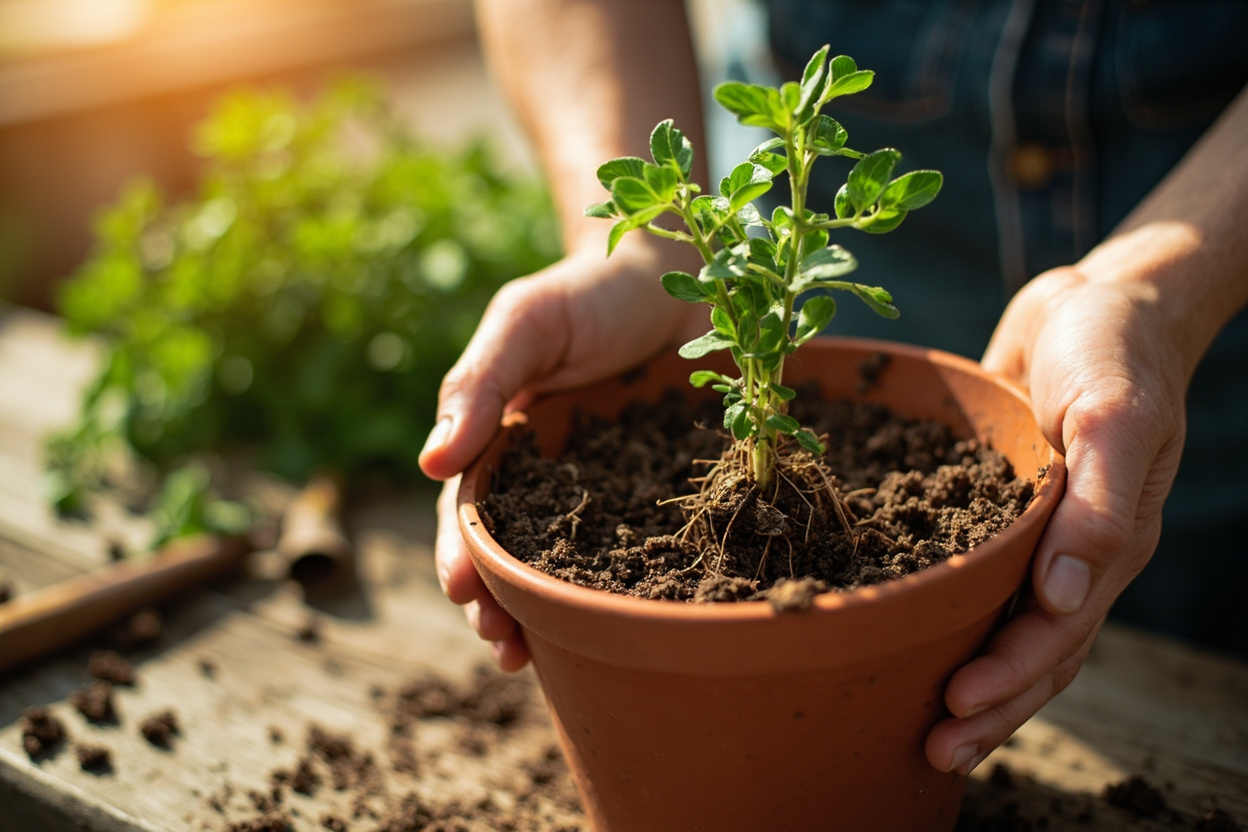
Inspect the roots by sliding the plant out of its pot. Healthy oregano roots are pale tan or white, firm to the touch, and branch finely. Rotting roots are brown to black, mushy, and pull away from the root ball with zero resistance. The smell is distinct — sour and anaerobic, nothing like healthy soil. If more than half the root system is affected, recovery is unlikely; take stem cuttings from healthy top growth and start fresh.
For early-stage rot — yellowing with some healthy white roots still visible — act immediately. Unpot the plant, wash the old soil away, and trim every darkened root with sterile scissors. Repot in a gritty mix: 50% potting soil, 30% perlite, 20% coarse sand. The right soil mix and container drainage are critical for recovery. Water once to settle the mix, then do not water again until the top two inches are dry. UC IPM notes that improving drainage is more effective than fungicide for herb root rot prevention.
Honest limit: if the entire root ball is black and the stems are soft at the base, the plant is beyond saving. Don’t waste two weeks hoping — take 4-inch stem cuttings from any firm green growth, root them in moist perlite, and you’ll have a new plant in three weeks. The oregano propagation guide covers stem cutting technique in detail, including the best time of year to take cuttings and how to maximize rooting success.
Nutrient Excess — Why Fertilizing Yellow Oregano Backfires
Oregano is a lean-soil specialist. In its native habitat — the calcareous hillsides of Greece, Turkey, and Italy — it grows in thin, alkaline, nutrient-poor ground. Rich soil doesn’t produce better oregano; it produces tall, floppy, pale oregano with weak flavor. If your oregano leaves are yellowing and you’ve fertilized in the last month, the feeding is likely the cause.
Excess nitrogen forces rapid cell division in new leaves, but chlorophyll production can’t keep pace — the result is chlorotic (yellow) new growth. Simultaneously, abundant soil nitrogen suppresses the drought-stress response that triggers carvacrol and thymol synthesis. You get yellow leaves and weaker flavor. RHS guidance is explicit: oregano needs no supplemental feeding in garden soil and at most one half-strength application per year in containers.
If you’ve fed recently, flush the soil: place the pot in a sink or outdoors, and slowly run three pot-volumes of plain water through the soil to leach out accumulated salts. Let it drain completely. Do not fertilize again for the rest of the growing season. The plant will recover on its own once the nutrient load drops.
The irony is that most growers fertilize yellow oregano thinking it’s a nutrient deficiency. In oregano, yellowing from deficiency is rare — it almost always signals too much of something, not too little. If you’re unsure which variety you’re growing or whether your plant is a culinary type, the oregano varieties guide can help identify whether flavor issues are genetic rather than cultural.
Seasonal Dormancy — When Yellow Leaves Are Completely Normal
Oregano is a hardy perennial in USDA zones 4-9. When autumn daylight drops below ten hours and nighttime temperatures consistently fall below 10°C (50°F), the plant enters dormancy. It stops producing new leaves, redirects energy to the root system, and allows older foliage to yellow and drop. This is not a problem. It is the plant surviving winter.
Do not water more. Do not fertilize. Do not prune. Every one of those interventions forces the plant to break dormancy at the wrong time, wasting stored energy. The yellowing will progress from the outer leaves inward, and by midwinter the plant may look half-dead. It is not. The root system is alive and waiting for spring.
When daytime temperatures consistently exceed 15°C (60°F) in spring, new green shoots emerge from the woody base. At that point, cut back all dead stems to 2 inches above the soil line to encourage dense, fresh growth. Container oregano in zones 4-6 is more vulnerable to winter kill: move pots against a south-facing wall, mulch the top with an inch of gravel, or bring them to a bright windowsill indoors.
Dormancy yellowing is the one cause that requires zero action. If your oregano yellows in October and you’re in a temperate climate, step away from the watering can. For a full seasonal care calendar including winter dormancy management, see the complete oregano care guide.
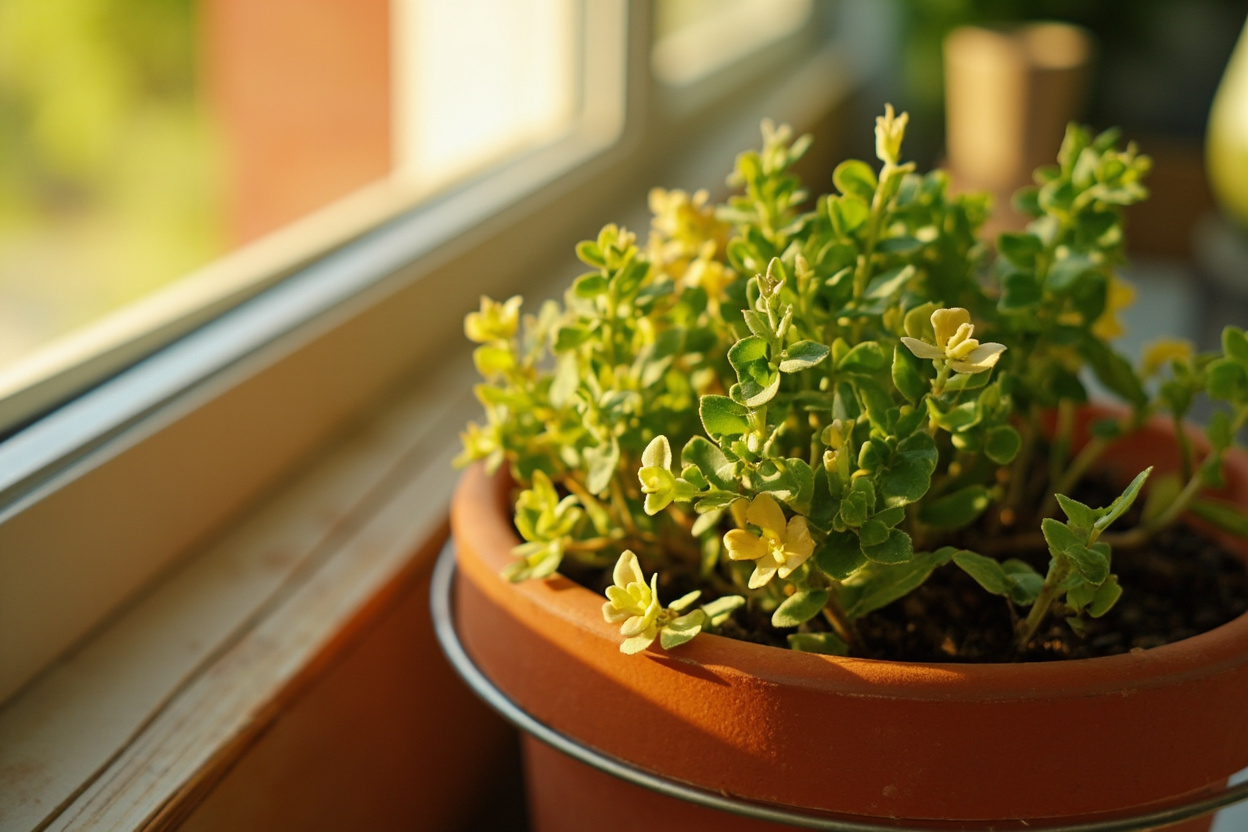
How to Fix Yellow Oregano — A Step-by-Step Recovery Plan
Start with the soil test: push your finger two inches deep at the pot’s edge. If wet, stop watering until the top two inches are bone-dry. If the plant wilts despite wet soil and the roots are dark when you unpot, perform root surgery — trim all rotted roots, repot in a 50/30/20 soil/perlite/sand mix, and water once. Confirm the pot has drainage holes; oregano in a saucer-trapped pot will yellow regardless of how carefully you water.
Move the plant to the sunniest location you have. Oregano needs eight or more hours of direct sun — not bright indirect light, not a bright windowsill, but direct sun on the leaves. Full sun accelerates soil drying, suppresses fungal growth, and triggers the volatile-oil production that makes oregano worth growing. A south-facing bed or balcony is ideal; a west-facing spot is acceptable; an east-facing window is the minimum.
Wait seven to fourteen days. New green growth at the stem tips means recovery is underway. If yellowing persists after two weeks of correct watering and full sun, consider a genuine nutrient deficiency — apply one half-strength liquid feed and observe for another week. But in nine out of ten cases, the fix is simply: water less, sun more.
Prevention is simpler than cure. Water oregano only when the top two inches of soil are completely dry. In terracotta pots in full sun, this may mean every seven to ten days in summer and every fourteen to twenty-one days in winter. In plastic pots or garden beds, the interval is longer. When in doubt, wait another two days. Oregano tolerates drought; it tolerates nothing else as poorly as wet soil. Once your plant recovers and resumes healthy growth, the pruning and harvesting guide shows how to maintain compact shape and maximize flavor through regular cutting — which also prevents the woody, open growth that makes oregano more susceptible to overwatering stress.
Turn any PDF statement into a clean sheet
Skip the typos and the hours of copying. Our converter handles any bank statement format and outputs Excel, CSV, or QBO for QuickBooks. No file retention, free to try.
Convert your statement