Monstera diseases are fewer than the internet makes them sound. In an indoor Monstera, almost every leaf problem traces back to one of six causes: bacterial leaf spot, fungal leaf spot, rust, powdery mildew, mosaic virus, or root rot. Start with bacterial versus fungal, because the treatment for one can make the other worse. Then rule out mosaic virus, because no spray will fix a virus, and your response changes from treat to isolate and decide. This guide walks you through the six Monstera diseases, what they look like on Monstera leaves, what causes them, and what to do.
How to Tell If Your Monstera Has a Disease (Not a Pest or a Problem)
Most owners who search monstera diseases are staring at a brown spot, a yellow halo, or a leaf that went speckled overnight. Three things cause that look: a pathogen, a pest, or a physiological problem. If you have not ruled out pests, see our pest guide and problems guide. Anything left is almost certainly one of the six diseases below.
Two signals push a spot from “problem” to “disease.” First, the spot is spreading across multiple leaves. Second, it has features a physiological problem cannot produce: a defined yellow halo, raised orange pustules, water-soaked edges, a mosaic pattern, or white powder you can wipe off.
What happens next: confirm the category, then jump to the matching H3 below. Each disease lists what to look for on Monstera leaves specifically, what causes it, and what to do in the right order.
The 6 Monstera Diseases Owners Actually See
Across houseplant forums and university extension reports, the same six diseases account for nearly every confirmed case on indoor Monsteras:
- Bacterial leaf spot (often Xanthomonas)
- Fungal leaf spot (Cercospora, Phyllosticta, Alternaria)
- Rust (Puccinia species)
- Powdery mildew (Podosphaera species)
- Mosaic virus (Dasheen mosaic virus, or DMV)
- Root and stem rot (Pythium, Phytophthora, Rhizoctonia)
Anthracnose (Colletotrichum) is grouped under fungal leaf spot because the home treatment is the same. Root rot has its own full guide at monstera root rot; we summarize it here.
What happens next: skim the H3 descriptions. Stop at the one whose signs match your plant. Do not treat until you have read the cause section, because a wrong treatment can keep the disease going.
Bacterial vs Fungal Leaf Spot: The Distinction That Decides Treatment
This is the most important fork in this article. Bacterial and fungal leaf spots can look almost identical on a Monstera, but they need opposite treatments.
Bacterial Leaf Spot (Xanthomonas)
What it looks like on a Monstera: small, water-soaked dark spots, often with a bright yellow halo. Spots are angular, limited by the leaf veins, and feel slightly greasy. They start on the lower, older leaves and work upward, especially where water sits for hours on the surface.
What causes it: Xanthomonas campestris pv. dieffenbachiae is the usual aroid culprit. It enters through stomata or tiny wounds and multiplies in warm, wet tissue, traveling in splash water, unsterilized shears, and on hands.
Why Monstera leaves are vulnerable: the broad, fenestrated leaves hold water along the midrib. In still indoor air that water sits for six to twelve hours, the exact window Xanthomonas needs.
Conditions that favor it: leaf wetness over four hours, temperatures 70 to 85°F (21 to 29°C), high humidity with poor air movement, and any history of overhead watering.
What goes wrong if misdiagnosed: copper fungicide and neem oil are the home treatments most owners reach for first. Both are useless on a true bacterial infection, and copper applied to wet leaves in direct sun will scorch the leaf. Treating bacterial as fungal wastes one to two weeks while the bacterium spreads.
Treatment: isolate the plant, stop misting, switch to bottom watering, remove severely affected leaves with sterilized shears, and apply a copper-based bactericide (not a fungicide) at the label rate in low light. Rinse the leaf surfaces with plain water 24 hours after application. There is no reliable home cure for a heavy Xanthomonas infection; isolation and leaf removal are often the only honest options.
Is it contagious to other houseplants: yes, very. Xanthomonas spreads to philodendrons, anthuriums, pothos, alocasia, and dieffenbachia. Keep the infected Monstera at least one meter from any other aroid until new leaves come in clean.
Fungal Leaf Spot (Cercospora, Phyllosticta, Alternaria, Colletotrichum)
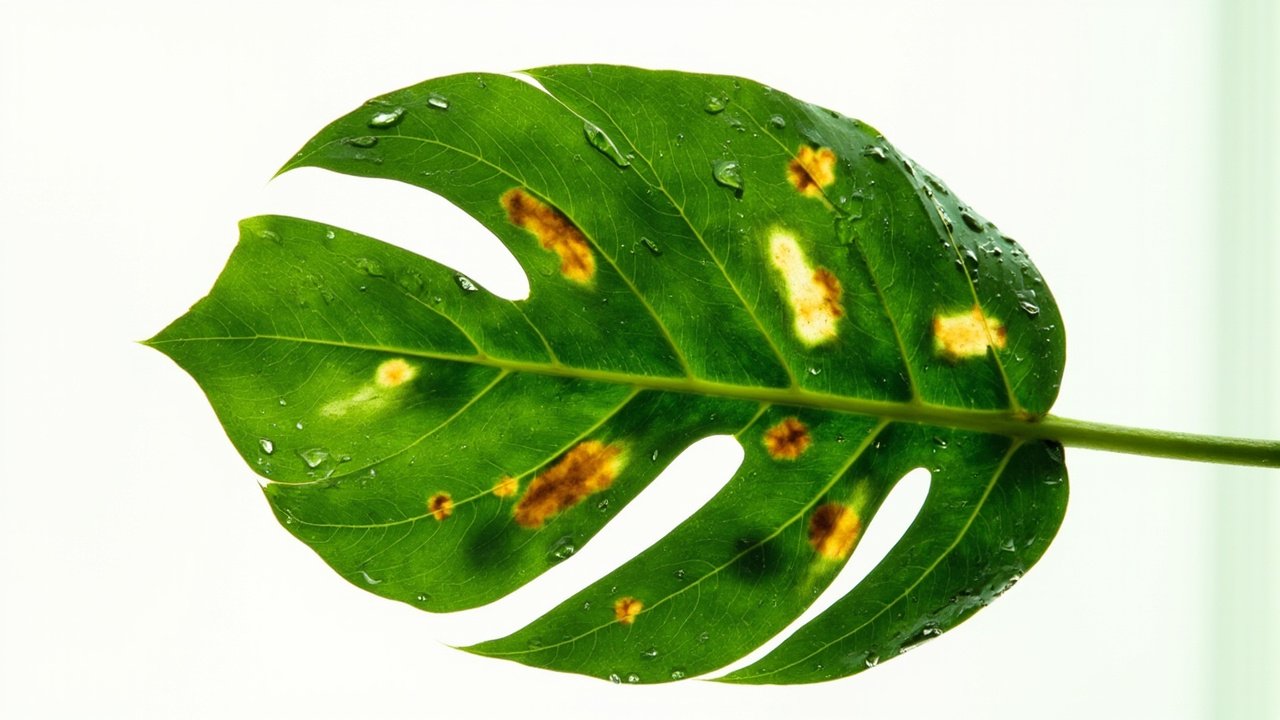
What it looks like on a Monstera: dry, round to oval spots, brown with a darker border and a tan or gray center. Spots are not limited by veins the way bacterial spots are, so they cross freely. The yellow halo is wider and softer than the bacterial one, and tiny black dots inside the spot are fruiting bodies.
What causes it: Cercospora is the most common indoor culprit with light brown centers and a dark ring. Alternaria starts at the leaf edge and works inward. Colletotrichum (anthracnose) creates sunken, papery lesions. All share the same drivers.
Why Monstera leaves are vulnerable: dense canopy, low airflow, and broad leaves that hold water. Fungal spores need a wet leaf for six or more hours to germinate, and a Monstera in a corner with a humidifier pointed at it provides that.
Conditions that favor it: overhead watering, humidity above 70 percent with no airflow, and leaf debris on the soil. Low light plus high humidity is the exact fungal invitation; our Monstera light guide covers the range that keeps the canopy dry.
What goes wrong if misdiagnosed: applying a bactericide to a fungal spot is harmless but useless. Pick the product by the pathogen, not by what is on the shelf.
Treatment: remove affected leaves, improve airflow with a small fan, water at the soil level, then apply a copper-based or neem-based fungicide. Trade-off: copper fungicide can burn Monstera leaves in direct sun, so apply in low light and rinse in 24 hours. Neem is gentler but slower, two to three weeks before new leaves come in clean. Severe cases may need a systemic fungicide; rotate active ingredients to prevent resistance.
Is it contagious to other houseplants: yes, through splash and air movement. Isolate the plant and sanitize shears between cuts.
Is It Mosaic Virus? How to Know Before You Panic
This is the one Monstera disease that no spray will fix, and the panic is reasonable. The pattern is the only reliable home test.
Dasheen Mosaic Virus (DMV) on Monstera
What it looks like on a Monstera: a mosaic of light and dark green patches, sometimes yellow, following the veins. New leaves may come in distorted. Unlike leaf spot, there is no defined border or halo; the discoloration is inside the leaf.
What causes it: Dasheen mosaic virus, a potyvirus spread by aphids, by mechanical contact, and by infected propagation. It is not airborne, but it is permanent.
Why Monstera is vulnerable: it is a host, and any cutting from an infected mother plant carries the virus for life. There is no cure.
Conditions that favor it: aphids present, and propagation from unverified cuttings. A Monstera with steady spring aphid pressure is the classic setup.
What goes wrong if misdiagnosed: owners often throw out a healthy plant with a nutritional deficiency that mimics mosaic. Iron or manganese deficiency can produce similar interveinal chlorosis. If new leaves are still growing normally in shape, the plant almost certainly does not have DMV.
Treatment: there is none. The decision is isolation, donation to a research collection, or discard. Most owners keep a DMV-positive Monstera in a separate room indefinitely.
Is it contagious to other houseplants: yes, mechanically, to other aroids. It does not infect cats, dogs, or people. Wash hands, sterilize shears, and do not propagate from a DMV-positive plant. Aphid control on the whole collection is the strongest defense.
What to Do After You Identify the Disease
The first 24 hours decide the outcome.
- Isolate. Move the Monstera at least one meter from any other aroid.
- Stop misting and overhead watering. Switch to bottom watering or a long-spout can that targets the soil only.
- Remove affected leaves with sterilized shears. Wipe blades with 70 percent isopropyl alcohol between every cut. Bag the leaves in plastic.
- Check the roots. Slide the plant out of the pot. Healthy roots are white to tan and firm. Black, mushy, or smelly roots mean rot, and recovery is more involved. The full process is in our root rot guide, with repotting steps in the Monstera repotting guide.
- Apply the right product, in the right light. Copper for bacterial, copper or neem for fungal, nothing for viral. Apply in low light and rinse 24 hours later if you used copper.
- Reassess at 14 days. New growth from the node should come in clean. If new leaves still show the same pattern, escalate.
What happens next: in 70 to 80 percent of fungal leaf spot cases, new leaves come in clean after one round of treatment. Bacterial leaf spot is harder; a quarter of cases end in plant loss. Mosaic virus is a management case.
How to Prevent Monstera Diseases From Coming Back
Prevention is the same checklist for every disease, because every disease on this list shares the same underlying conditions: leaf wetness, low airflow, and stressed roots.
- Water at the soil, not over the leaf. Bottom watering keeps the canopy dry and prevents most fungal and bacterial leaf spot.
- Keep humidity 50 to 60 percent with airflow. A small oscillating fan on low for a few hours a day is enough.
- Give the plant bright indirect light. Faster drying and stronger immune response. See our light guide.
- Use a well-draining mix. Coarse aroid mix keeps the root zone oxygenated, with a pot that has drainage holes.
- Sterilize shears between plants. Seventy percent isopropyl alcohol, or a 1:10 bleach solution. One swipe, one cut.
- Quarantine new plants for two weeks. This catches most latent infections and pests before they spread.
- Inspect the top inch of soil and leaf undersides weekly. A 2 mm spot is easier than a 20 mm one.
The full care baseline lives in our Monstera deliciosa care guide. Treat the care guide as the umbrella and this article as the troubleshooting layer.
When to Isolate, When to Treat, When to Throw the Plant Out
Three questions answer this. First, is it viral? If yes, the plant is not curable; the decision is isolation or discard. Second, is the infection in the stems or roots as well as the leaves? If yes, the plant needs aggressive intervention, including unpotting, root work, and a fresh start in a sterile mix. Third, are new leaves still coming in clean after two weeks of correct treatment? If no, escalate.
Throw the plant out when it is DMV-positive and you cannot isolate it, when more than 70 percent of leaves are affected by bacterial leaf spot, or when the root system is more than half rotted. In every other case, treatment is worth the two-week trial. Most Monstera diseases that get caught early end with a healthy plant and a better watering habit. The leaf you found today is the lesson your plant is teaching you about airflow, light, and water; the next leaf is the proof you learned it.
Turn any PDF statement into a clean sheet
Skip the typos and the hours of copying. Our converter handles any bank statement format and outputs Excel, CSV, or QBO for QuickBooks. No file retention, free to try.
Convert your statement