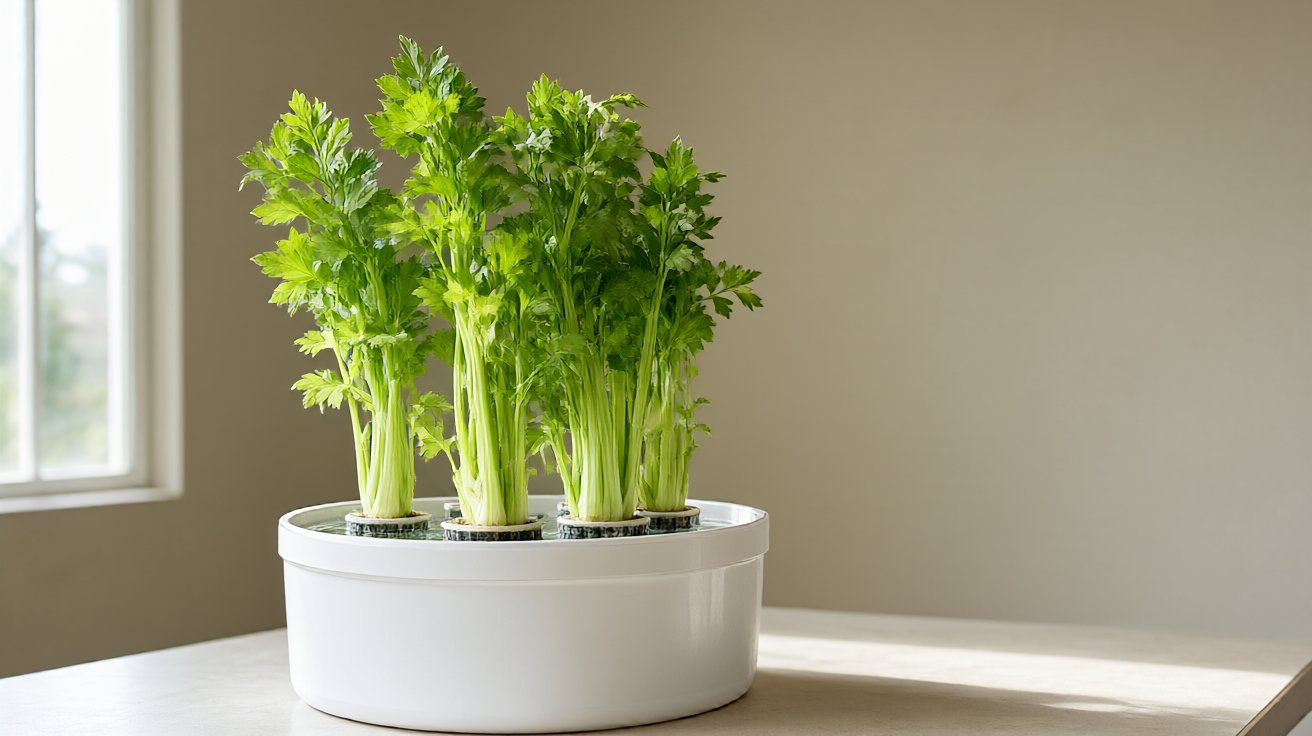

Celery is the one crop in the hydroponic series that cannot be grown by keeping a number steady. Celery (Apium graveolens) is a biennial, and its first year has two phases that need opposite conditions. A vegetative phase wants warmth and steady feed. A cold-triggered phase is required before the plant will build the ribbed stalks you eat. Grow it without the cold and you get a handsome rosette at the 120 day mark and no stalks. Give it the cold at the wrong moment and it bolts.
That is why most hydroponic celery guides get the numbers right and the crop wrong. EC, pH and reservoir temperature are well documented, every one of them is necessary, and none of them is sufficient. This guide covers what a home setup needs, and it covers vernalization first, because skipping it wastes four months rather than four days.
What Hydroponic Celery Needs Before You Start
Four parameters decide whether a celery crop succeeds: nutrient concentration, pH, temperature, and light. What makes celery different from every other crop in this series is the fifth parameter, cold, and it sits behind the other four in the sequence rather than alongside them. Celery is a two-stage crop, and the second stage is a cold one.
Greenhouse reference figures agree across sources. Celery grows fastest and produces the best quality at moderately cool temperatures, between 55 and 75 F (13 to 24 C), with good moisture and relatively high humidity. The transplant stage runs warmer at the front: 70 to 75 F (21 to 24 C) until emergence, then 65 to 70 F (18 to 21 C) once seedlings are up.
That early heat is not for the plant. It is for the seed, and the reason is a light requirement you will not find on a seed packet.
Seed That Will Not Germinate in the Dark
Celery seed is small, slow, and unusually demanding about one thing: light. United States federal seed testing regulations at 7 CFR 201.58 specify light as a required condition for celery germination, at 15 to 25 C with a 21 day test duration and an optimum of 20 C. Peat-based propagation media at 70 to 75 F until emergence is the commercial recommendation, and it serves this requirement rather than speeding the crop along.
The mechanism is photomorphogenesis. Celery fruit carries a morphologically dormant seed with an underdeveloped embryo inside abundant endosperm, and that embryo must grow to roughly two and a half times its initial length before the radicle can emerge. Continuous white light drives that growth, darkness blocks it, and gibberellin cannot substitute for the light signal.
Above 18 C the light requirement tightens. Celery germinates more completely under alternating temperatures with a light phase than under constant warmth, so a propagator held at 24 C underperforms the same tray on a 15 to 25 C cycle. A dark propagator at 24 C is the most common reason a home celery crop never starts.
Pre-chilling the fruit at 4 C in darkness before moving it into the light at 20 C breaks the residual dormancy. That is why refrigerating the seed packet for two weeks before sowing is not folklore.
The Timeline You Are Committing To
From sowing to a full stalk is 120 to 150 days, and roughly the first 10 to 12 weeks of that are the transplant stage. Seed to harvest for a cutting type is 50 to 70 days after transplant. A home grower who expects a month gets a bad surprise, and one who expects five months often abandons a crop that was two weeks from harvest.
| Stage | Days | Temperature | What you are watching for |
|---|---|---|---|
| Germination | 14 to 21 days | 20 C optimum, 15 to 25 C range, light required | Radicle emergence; constant warmth without light stalls here |
| Seedling to transplant | 70 to 84 days | 18 to 21 C after emergence | 3 to 4 true leaves, roots visible and white |
| Vegetative phase | 21 to 42 days | 13 to 24 C | Rosette of leaves, root mass building |
| Vernalization | 7 to 63 days | 5 to 9 C (41 to 48 F) | Plant must carry 6 to 20 leaves first |
| Stalk fill | 42 to 70 days | 15 to 21 C | Petioles thickening and lengthening |
| Harvest | 50 to 70 days after transplant for cutting types | 13 to 18 C | Stalks 30 to 40 cm tall, crisp, not hollow |
That vernalization row decides your crop. Michigan State University Extension publishes the requirement in detail: celery becomes receptive between 6 and 20 leaves of age, vernalizes at 41 to 48 F (5 to 9 C) over 1 to 9 weeks, and devernalizes above 68 F. Celery needs a larger plant and a longer exposure than celeriac, so a small seedling put in the cold too early will sit there without changing. A seedling under 6 leaves cannot be vernalized, however cold you make it.
Building the Nutrient Solution
Celery is a moderately heavy feeder for a stem crop, needing more calcium and potassium than a leafy green. FAO greenhouse hydroponic reference values put it at an EC of 2.4 mS/cm and pH 6.5, with a much higher potassium level than other crops: 8.4 mS/cm of potassium against 4.9 of calcium, 2.4 of phosphorus, and 6.5 of magnesium.
For a home reservoir, which is smaller and less buffered than a commercial one, the practical band is EC 1.8 to 2.4 mS/cm and pH 6.0 to 6.5. Use the low end for seedlings and the high end for the final stalk fill.
Potassium drives crispness in the petiole while calcium builds the cell wall structure, so a plant fed heavily on nitrogen grows soft, hollow stalks that taste of nothing. Nitrogen belongs to the vegetative phase, potassium belongs to the stalk fill, and the switch between them is a decision you make rather than a stage the plant announces. Push nitrogen too far into the cycle and you buy leaves you cannot eat.
| Growth stage | EC (mS/cm) | pH | Dominant demand |
|---|---|---|---|
| Germination | 0.5 to 0.8 | 6.0 to 7.0 | Almost none; plain water is enough |
| Seedling | 0.8 to 1.4 | 6.0 to 7.0 | Nitrogen for leaf area |
| Vegetative rosette | 1.4 to 2.0 | 6.0 to 6.8 | Nitrogen, then calcium begins to matter |
| Post-vernalization stalk fill | 2.0 to 2.6 | 6.3 to 6.8 | Potassium and calcium, nitrogen reduced |
| Commercial greenhouse reference | 2.4 | 6.5 | FAO greenhouse reference values |
Calcium deserves its own explanation, because the standard supply advice is wrong in an instructive way. Blackheart, the disorder that turns the inner leaves of a celery heart brown and then black, is not caused by a shortage of calcium in the solution. Calcium is immobile in the plant and follows the transpiration stream, so it moves preferentially to the older outer leaves losing the most water.
The heart leaves, sheltered and transpiring least, receive the least calcium, and their expanding tissue dies. Supplying more calcium to the reservoir does not fix this, because the problem is where the calcium goes, not whether it is present. Blackheart is a distribution problem, so a richer solution does not solve it.
What does reduce it is steadier moisture and a slower growth rate, because both lower the transpiration gradient driving calcium away from the heart. University of Maryland Extension and Rutgers University describe the same mechanism in their commercial recommendations, and note that wide swings between wet and dry promote it.
Drenching the crown with a soluble calcium solution helps after the fact, but consistent reservoir temperature and a measured feed rate are cheaper than treating it.
If you mix from parts rather than premixed nutrients, read how ppm and EC convert before calculating a recipe, and keep the reservoir temperature inside the range that the crop-by-crop guide sets out. A warm reservoir in a closed bucket holds far less dissolved oxygen than the same bucket in a cool room.
The Cold Period That Makes Celery a Harvest
Vernalization is the switch that converts a leafy rosette into a stalk-forming plant. Celery is grown commercially as an annual, but it keeps the biennial life cycle of its species, and in year one it must experience cold before it will commit to stalk development.
No cold period means no stalks, regardless of how well the plant has been fed or how much light it received. No cold, no stalks. Four months of good feeding will not substitute for it.
The trap is that the same cold that makes stalks also triggers bolting. A vernalized plant, once back in warmth under long days, produces a flower stalk and stops producing a harvestable one. The compound word is devernalization, and it happens above 68 F, so the window between applying cold and the plant bolting is not generous.
Long photoperiods make it worse. Research in the Journal of Experimental Botany established that celery is a short-long day plant: long days interrupt the vernalizing cold and reduce bolting, but once vernalization is complete, long days actively promote flowering and flower stalk elongation. While you cold-treat the plant you want short days, and the moment you finish you want the opposite.
For a home grower, a refrigerator is a plausible substitute for a field cold period, because the mechanism only requires a sustained drop into the 5 to 9 C range for a plant already large enough to respond. What has not been established for home systems is the exact duration for a given cultivar in a given container. Treat it as an experiment, check for bolting signs by taking the plant out for a day at a time, and expect to lose a plant or two.
Which System Actually Works
Celery fits systems differently than lettuce does, and the reason is physical. Lettuce is harvested in 30 to 40 days, so it never fills the horizontal space it occupies. Celery is tall, narrow, and in the ground for five months, which makes the limiting factor height and crown ventilation rather than footprint.
One plant per 5 gallon bucket is the practical home configuration, because celery forms a dense rosette of petioles from a single basal plate, and crowding that plate reduces airflow into the centre where blackheart begins. The spacing number for celery is set by the crown, not by the seed.
In nutrient film technique, celery works only in channels wide enough to take the root mass without clogging, because clogging is the standard failure mode of older plants in a channel. That constraint is shared with the system comparison, and it is why NFT is the standard for short-cycle greens and herbs rather than long-cycle stalk crops. A stopped pump in week nine is a dead crop.
Deep water culture handles the long cycle better, and for the same reason it handles lettuce well: the reservoir is a buffer. The large water volume holds temperature and EC steady through a day, which matters more for celery because the feed strength changes as the plant moves from vegetative phase into stalk fill.
Whatever the system, spacing is set by the mature crown rather than the seedling. Commercial guidance puts full-sized celery at 30,000 to 35,000 plants per acre, which works out to 6 to 8 inches (15 to 20 cm) between plants in rows 30 to 34 inches apart. British Columbia Ministry of Agriculture guidance gives the same density from 20 cm spacing within the row.
The spacing guide explains why density is set by system type rather than preference. For celery the short version is that one plant per bucket or one plant per 20 cm of channel is the ceiling, not the starting point.
Harvesting: Full Stalks or Cutting Celery
There are two ways to harvest celery hydroponically and they are not the same crop, so decide which one you are growing before you sow. A full-stalk crop takes 120 to 150 days from sowing and gives you the ribbed, blanched petioles you recognise as celery. A cutting crop takes 50 to 70 days from transplant and keeps producing side shoots for months.
For most home setups the cutting crop is the realistic one, and the reason is not effort, it is the vernalization requirement plus light height. A plant that needs 5 to 9 C for a week to 9 weeks and then 42 to 70 days of stalk fill under good light is asking for a room with a cold spot and a 40 cm tall plant under a lamp. Most home growers should start with the cutting type, not the full stalk.
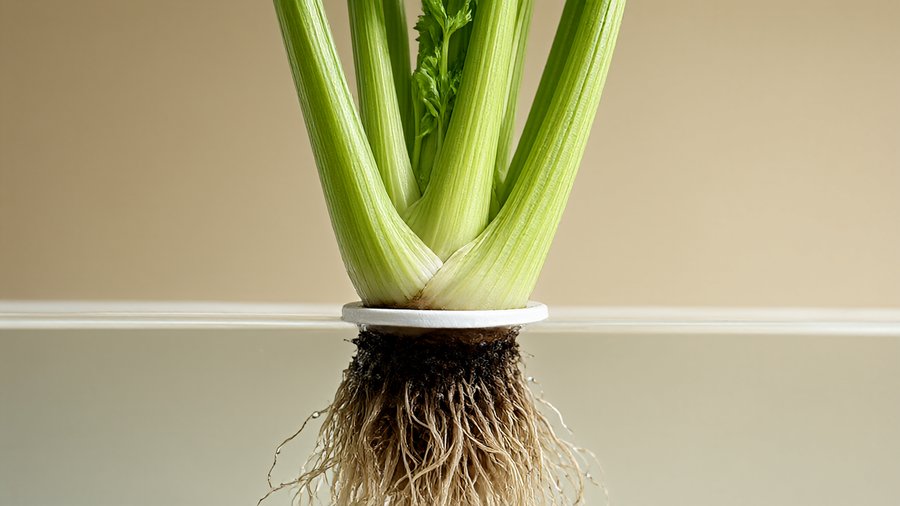
There is a third route that takes two weeks and gives you greens rather than stalks: cut the base off a store-bought celery bunch, place it in a shallow container of nutrient solution, and let the basal plate regrow. The basal plate holds the growing point, the same structure a cutting-type plant uses to produce side shoots. What you get is leaf and tender stem growth in two to three weeks, not a full stalk.
Cutting a crop instead of pulling it is the same logic that hydroponic herbs follow, where the plant keeps sending up new growth from the cut crown rather than spending energy on a second head.
Whichever route you take, harvest in the morning when the petioles are hydrated, and cut rather than pull where you can, because celery roots are shallow and a pulled stalk takes the crown with it. For a full-stalk crop, cut at the base once stalks reach 30 to 40 cm and the petioles feel solid rather than hollow when you bend one. The plant then keeps producing for another 4 to 6 months if conditions hold.
What Goes Wrong and What It Looks Like
Leaves that stay small and floppy with no stalk after 120 days mean the plant never vernalized. It sat at the right size, you fed it correctly, and it still will not build a stalk because the cold switch never fired. This is the most common outcome for a home celery crop, and it is not a nutrient problem, so adding feed to a plant that will not bolt is the wrong move. A rosette at harvest means you skipped the cold, not the fertilizer.
A flower stalk shooting up from the centre means the opposite happened. The plant was vernalized, usually too early or for too long, and it has switched from stalk production to flowering. The petioles around it turn bitter and hollow as the plant redirects energy into the seed stem. The foliage stays green for weeks, so the collapse is easy to miss until the stalks are inedible.
Brown and black tissue in the centre of the crown while the outer leaves look healthy is blackheart, a calcium distribution problem rather than a supply problem. The fix after the fact is a calcium drench into the crown and steadier moisture, but affected tissue does not recover. Prevention is consistent reservoir temperature, a measured feed rate, and enough space around each crown that air moves through the centre.
Petioles that are soft, hollow, and taste of nothing point at nitrogen rather than disease. Excess nitrogen in the vegetative phase produces lush, soft growth that resists flowering and does not build crisp structure. Hold potassium up and nitrogen down once the cold treatment is done, and the stalks firm up over the following two or three weeks. Soft stalks in the wrong phase are a feeding decision, not a disease.
Seed that never sprouts, or sprouts unevenly across a tray, is almost always light and temperature rather than seed age. Celery genuinely requires light to germinate, and above 18 C it requires it more than most guides admit. Move the tray under a light source, drop the temperature toward 20 C, and give it the full 21 days before deciding the seed was dead.

What Celery Changes About Your System
Celery is not the crop to learn on, and it is worth saying so before you spend four months finding out. It asks for the longest wait in this series, the most demanding seed, a temperature excursion most home setups have no place for, and a feed that changes mid-cycle. It is also the crop that most rewards the effort once it works. The crop is hard. The result is worth it.
What it teaches you is the thing every long crop teaches you. Your reservoir’s real behaviour under a slow, heavy feed. Your room’s temperature swings. Whether your pH meter and your EC meter agree with each other. Those are the same lessons hydroponic farming teaches at any scale, and they are why a crop that takes five months can be a good investment for a setup that has never grown a full-stalk crop before.
Start with the cutting type if this is your first cycle, keep one plant per bucket, and hold the temperature steady. The cold period is the part you plan for rather than the part you figure out as you go. That is the whole difference between a four month crop and a five month one.
Sources and further reading
- United States Code of Federal Regulations, 7 CFR 201.58, specifying light as a required condition for celery germination at 15 to 25 C with a 21 day duration and 20 C optimum.
- Michigan State University Extension, “Bolting in spring vegetables,” for the vernalization table: celery receptive between 6 and 20 leaves, vernalizing temperature 41 to 48 F over 1 to 9 weeks, devernalization above 68 F, and celery requiring a larger plant and longer exposure than celeriac.
- University of Florida IFAS Extension, EDIS BUL313, for the mechanism of celery blackheart: calcium follows the transpiration stream to the outer leaves at the expense of the heart.
- University of Maryland Extension and Rutgers University, Mid-Atlantic Commercial Vegetable Production Recommendations 2026/2027, for optimal growth at 55 to 75 F (13 to 24 C), transplant production at 70 to 75 F until emergence and 65 to 70 F after, and blackheart risk from wide moisture fluctuations with high nitrogen and potassium.
- Michigan State University Extension, Bulletin E1308, for plant populations of 30,000 to 35,000 per acre at 6 to 8 inches between plants in rows 30 to 34 inches apart, and for drenching calcium into the plant hearts during hot dry periods.
- Food and Agriculture Organization of the United Nations, Good Agricultural Practices for greenhouse vegetable crops, for greenhouse hydroponic reference values of EC 2.4 mS/cm and pH 6.5 for celery, with potassium at 8.4 mS/cm and calcium at 4.9 mS/cm.
- British Columbia Ministry of Agriculture, Celery production guide, for spacing at 20 cm within the row giving 31,000 plants per hectare, and for holding greenhouse temperatures at 16 to 21 C while raising your own plants.
- Virginia Tech Extension, Vegetable Seed Production: Celery, for the biennial life cycle of Apium graveolens, vernalization below 50 F after the juvenile phase, and the statement that bolting ruins the economic value of the crop.
- Journal of Experimental Botany, “The Effect of Day Length on the Response of Celery to Vernalization,” for celery as a short-long day plant: long days during vernalization reduce bolting, while long days after vernalization promote flowering and flower stalk elongation.
- Proceedings of the Florida State Horticultural Society, “Seed treatments to improve rate and uniformity of celery seed germination,” for the observation that above 18 C celery seed germinates poorly without light, and for 15 C priming giving the most uniform emergence.
Last reviewed on November 26, 2026