
You water your Hoya on schedule. The potting mix drains cleanly. The leaves still crisp at the edges — tan, dry margins creeping inward from the tip. If the soil is right and the leaves still burn, the problem is not in the pot. It is in the air.
A Hoya in its native tropical canopy lives in 60–80% relative humidity. A heated home in winter averages 30–40%. That gap is what the waxy cuticle on Hoya leaves cannot bridge without help.
The plant loses moisture through its leaves faster than its epiphytic aerial roots can replace it, and the margins die back first because they are the oldest, furthest point from the stem. This guide covers the humidity and temperature range that keeps Hoya leaves waxed, how to measure what is actually happening at the leaf level, what fails when you mist instead of humidify, and the cold threshold beyond which no Hoya recovers.
Hoya Humidity Needs: Why Your House Air Is Too Dry for Wax Plant Leaves
The Hoya leaf is a water-conservation structure. Its thick waxy cuticle slows transpiration in humid air, but that same cuticle becomes a liability when relative humidity drops below 50%.
The plant continues to lose water through stomata it cannot seal fully, and the oldest tissue — the leaf margins — desiccates first. By the time the browning reaches mid-leaf, the Hoya has been running a moisture deficit for weeks.
A healthy Hoya in 55–70% RH pushes out thick, turgid leaves with a visible sheen. Below 45% RH, new growth arrives thinner and smaller, and the plant diverts energy from peduncle production to survival.
See our guide to hoya light needs for the light side of this same energy equation.
The visible signal is specific: browning starts at the tip and edges, never the center. If the whole leaf yellows uniformly, the cause is usually underwatering or root rot, not humidity.
Crispy margins on otherwise firm, green leaves equal dry air.
The Hoya Temperature Range: How Three Variables Interact on One Leaf
A Hoya’s response to temperature is not just about the thermometer reading. Three measurable variables interact: air temperature, relative humidity, and airflow. The components of this system are broken down below — change any one without adjusting the others and the leaf pays the price.
Air temperature drives metabolic speed. Between 65°F and 85°F (18–29°C), cellular metabolism runs at full rate: new leaves unfurl in 10–14 days, roots extend visibly into the mix, and established peduncles push out spadix umbels on a predictable seasonal schedule.
Move above 90°F (32°C) and the plant slows transpiration to protect itself. Growth stalls for weeks because the Hoya cannot cool its leaves fast enough.
At 55–60°F (13–16°C), a Hoya enters early dormancy. Leaves may lighten slightly, and the plant stops accepting fertilizer.
Below 50°F (10°C), cell walls begin to rupture. The damage is invisible for the first 24 hours — leaves look firm, stems feel solid — then the tissue turns mushy and translucent.
The Royal Horticultural Society (RHS) recommends Hoyas not be exposed to temperatures below 50°F (10°C) for more than 2 consecutive hours. Most homes in temperate zones dip into the danger zone overnight in winter, especially near single-pane windows, poorly insulated walls, and unheated spare rooms.
A Hoya sitting 6 inches from a window that reads 68°F (20°C) at the glass surface may be experiencing 48–52°F (9–11°C) on the leeward side where the leaves touch the cold frame. If that exposure lasts more than 3–4 hours, the outermost leaves will show damage within 48 hours.
Airflow compounds the problem because moving air strips the boundary layer of humid air around each leaf faster than still air does. A ceiling fan on low in a 70°F (21°C) room with 45% RH can pull the effective leaf-level humidity down to 38%.
For example, a Hoya carnosa in a bright bathroom at 75°F (24°C) with a small fan running 3 hours a day maintains stable leaf turgor at 55% RH. The same variety in a still bedroom at 72°F (22°C) and 48% RH develops crispy margins within 10 days because the boundary layer sits undisturbed.
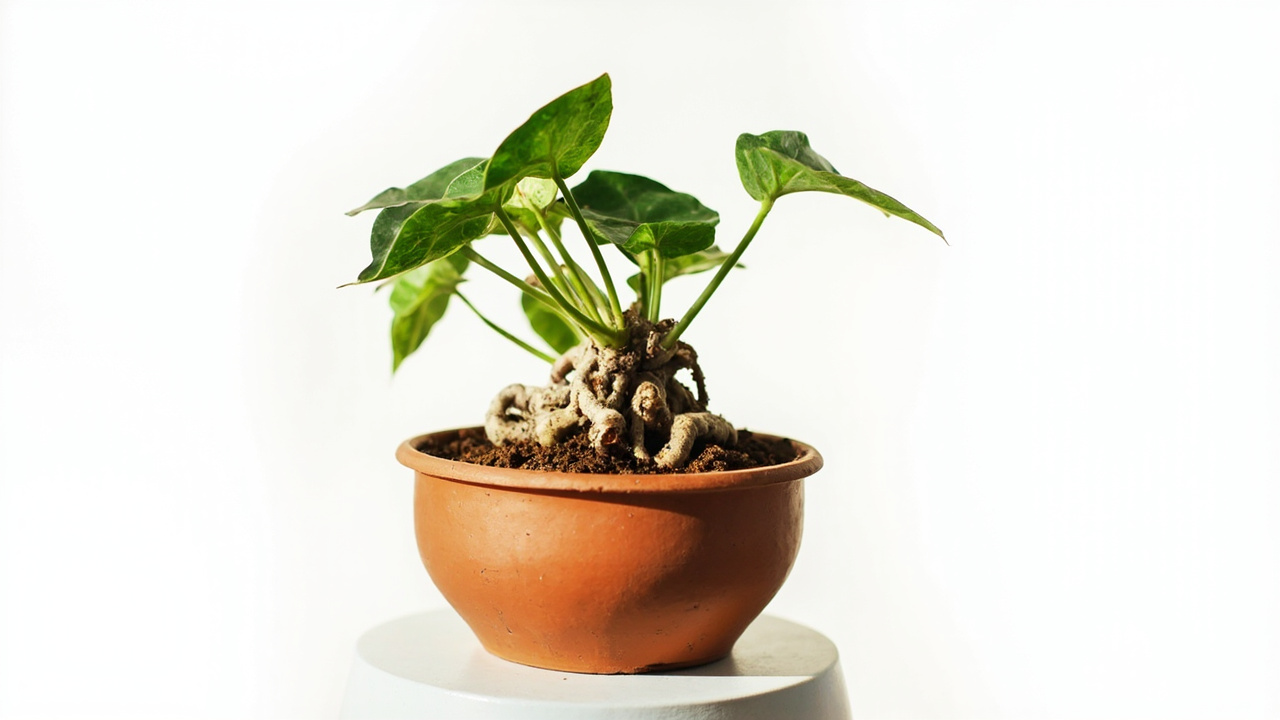
How Winter Heating Traps Your Hoya: Warm Air, Cold Drafts, and Falling Humidity
Central heating creates a trap that looks like safety. A room at 72°F (22°C) feels comfortable to a Hoya, but the same heating system strips moisture from the air.
For every 10°F (6°C) rise in indoor temperature during winter, relative humidity drops by roughly 20%. A room at 40% RH in September becomes a room at 20% RH in January.
The warm air tells the Hoya’s metabolism to grow; the dry air tells its leaves to conserve. The plant cannot do both.
The compromise shows up as stunted new growth, leaves that unfurl half-size, and peduncle abortion — the plant drops its flower buds before they open because it cannot support both vegetative growth and reproduction in dry air.
Cold drafts compound the problem. A Hoya on a windowsill receives warm radiant heat from the room during the day, then a cold draft from the window frame at night.
The alternating stress weakens cell walls faster than steady low temperatures. Within 2–3 weeks of nightly drafts, the oldest leaves yellow and drop — the Hoya is sacrificing tissue to protect new growth.
This is why the hoya watering guide pairs humidity checks with watering frequency: a Hoya in dry winter air needs less water, not more, even though the air feels harsh.
Measuring Room Humidity: Where to Place a Hygrometer and What the Numbers Mean
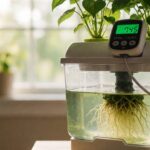
A $8–12 digital hygrometer placed at the Hoya’s leaf level tells you more than any rule of thumb. The humidity 3 feet off the ground near a plant’s crown is not the same as the humidity at floor level near a heating vent.
Measure where the plant lives, not where you walk. The University of Florida IFAS Extension recommends taking readings at the plant’s mid-height, at least 6 inches away from walls or furniture.
The three danger zones: below 40% RH, the Hoya enters water stress within days. Between 40–50%, the plant survives but does not thrive — leaf tips brown slowly over weeks.
Above 55%, the waxy cuticle functions as designed, and the Hoya can regulate its own transpiration. The sweet spot for active growth is 60–70%.
Expect daily variation. A room at 60% RH at 2 p.m. may drop to 42% by 6 a.m. Log readings at three points — morning, midday, and evening — for a full week before deciding whether intervention is needed.
If the average across the whole day lands below 48%, the plant experiences stress even if your once-a-day reading looks fine.
Four Ways to Raise Humidity for Hoya: Grouping, Pebble Trays, Humidifiers, and Enclosures
Plant grouping is the lowest-effort option and the one most Hoya owners try first. Three or four houseplants placed within 12 inches of each other create a shared transpire microclimate that raises local RH by 5–10%.
For a Hoya already at 48% RH, that bump to 53–58% can stop margin browning. The limitation is ceiling: grouping will not push a room below 35% RH above 50%.
Pebble trays add another 3–5% RH within 6 inches of the tray surface. Fill a shallow tray with pebbles, add water to just below the pebble surface, and set the Hoya pot on top — the pot must never sit in the water or the roots rot.
This works only in small, enclosed spaces like bathrooms or terrariums. In an open living room, the water evaporates into the volume and the effect is negligible.
A cool-mist humidifier is the only tool that reliably holds a Hoya above 55% RH in a standard room. Place it 3–6 feet from the plant, set to 60%, and run it on a cycle — continuous operation risks powdery mildew on nearby foliage.
The trade-off is maintenance: humidifiers need weekly cleaning with white vinegar to prevent bacterial buildup. Cornell University Cooperative Extension warns that dirty humidifiers disperse airborne bacteria, which can settle on Hoya leaves and contribute to fungal leaf spot.
Enclosures — glass cloches, propagation cases, or partially sealed display cabinets — offer the highest control. A Hoya in a clear enclosure with a small vent at the top holds 70–80% RH with minimal intervention.
The risk is stagnant air: without a small computer fan running 2–3 hours a day, fungal leaf spot appears within 2 weeks.
Choose based on your starting point. Below 35% RH in the room: humidifier or enclosure. Between 35–50%: grouping plus a pebble tray can hold the line. Above 50%: monitor and adjust only if the Hoya shows symptoms.
See our hoya varieties guide for the species that tolerate drier air — Hoya carnosa and Hoya pubicalyx handle 40–50% RH better than Hoya kerrii or Hoya obovata.
What Cold Does to a Hoya: Leaf Drop, Stem Dieback, and the 50°F Threshold
Cold damage in a Hoya follows a predictable sequence. Stage 1: the outermost, oldest leaves lose turgor and hang limp despite adequate soil moisture.
This is reversible if the tissue has not frozen — move the plant to a warmer room (65–70°F / 18–21°C) and wait 48 hours.
Stage 2: leaves develop water-soaked, translucent patches that turn black within 24 hours. The cell walls have ruptured; these leaves will not recover.
Stage 3: stems soften and collapse from the tips downward. If more than 30% of the stem length is affected, the plant may not survive even if the roots test firm.
The hard limit is freezing. A Hoya exposed to 32°F (0°C) for more than 1 hour cannot be revived. The water inside the leaf and stem cells expands as it freezes, shredding the cell membranes.
If your Hoya has been exposed to temperatures below 40°F (4°C) and shows Stage 1 symptoms, move it immediately to a warm room with bright indirect light. Do not fertilize, repot, or overwater.
The plant needs stability, not stimulation. It will either push out new growth from dormant nodes within 3–4 weeks, or it will continue to decline — and decline means compromised roots that no intervention can rescue.
What to Read Next: The Complete Hoya Care Seasonal Guide
Humidity and temperature are the foundation, but they interact with light, watering, and the flowering trigger in ways that shift across the year.
For the full picture — including how to read the root-bound flowering signal and why winter dormancy matters — the hoya plant care guide covers the seasonal cycle that builds on the humidity and temperature baseline established here.
When humidity or temperature swings produce leaf curl, the four-pattern diagnosis at Aqualogi walks through underwatering, root rot, salt, and systemic wilt. See the Hoya leaves curling and wilting guide.
Turn That PDF Into a Spreadsheet in Minutes
You've seen how to do it manually — now let the tool handle the heavy lifting. Upload your bank statement and get Excel, CSV, or QBO in a few clicks.
Try It Free