The Hoya vine on your shelf is lush, healthy, and fully leafed. Three years from a cutting, it has never produced a single star-shaped bloom. You have tried more light, more fertilizer, less water — and every season, the vine sends out more leaves instead of flowers.
A Hoya not flowering is the most common complaint in Hoya ownership, and the answer almost never involves fertilizer.
Flowering in Hoya plants is a maturity response triggered by three conditions: the plant must be old enough, the light must be bright enough, and the roots must receive a mild stress signal that shifts the plant from vegetative growth into reproductive mode. Remove any one of those three conditions and the Hoya stays in leaf-production mode indefinitely. This guide walks through the seven most common causes, the visual diagnostics for each, and the fixes that produce peduncles within one growing season.
Maturity First: The Juvenile Hoya Reality Check
Most Hoya varieties require 2–4 years from cutting before the plant can produce flowers. Hoya carnosa, the most commonly grown variety, typically blooms in year 3. Hoya kerrii, Hoya obovata, and Hoya pubicalyx follow a similar timeline.
Hoya lacunosa and Hoya multiflora — the faster-maturing species — may bloom in year 2. A vegetative plant under 2 years old with no flowers is not failing; it is following its developmental program.
Patience is the first requirement. No amount of light, fertilizer, or water manipulation forces a juvenile Hoya into bloom. The hormonal cascade that triggers peduncle initiation — a shift in the auxin-to-cytokinin ratio combined with gibberellin signaling — requires a threshold of vascular maturity that a young plant simply has not built.
If your Hoya arrived as a 4-inch rooted cutting 18 months ago, bookmark this guide and return in a year.
The Three Maturity Indicators: Is Your Hoya Old Enough to Bloom?
Three visible signs confirm a Hoya has reached flowering maturity. First, vine length: a mature Hoya has at least one vine longer than 18 inches bearing 15+ leaves. The energy cost of a flower cluster demands a photosynthetic base that a 6-inch cutting cannot sustain.
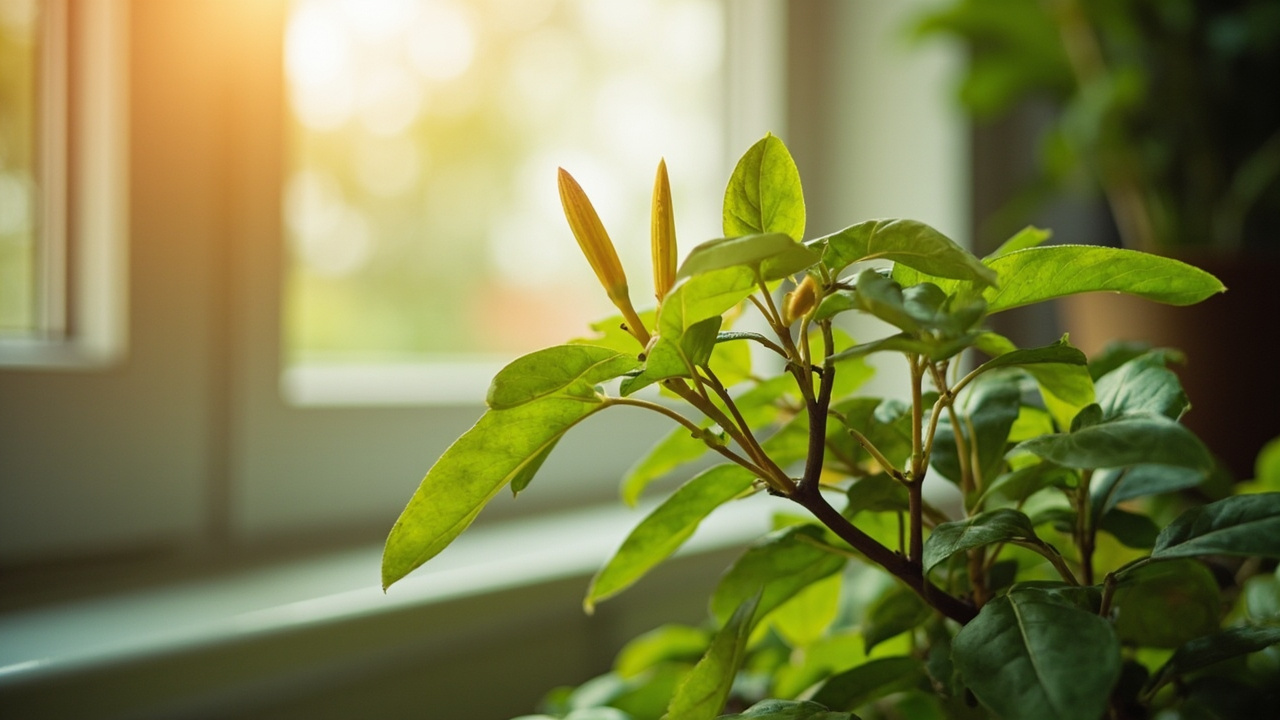
Second, stem woodiness: the lower portion of mature vines turns brown and woody — a sign of lignified vascular tissue capable of supporting peduncle formation. Third, peduncle-site appearance: tiny brown nubs at nodes along the upper vine, even if they have not yet elongated into flowering spurs. These nubs are the promise that the plant can bloom in the coming season.
The Hoya propagation guide covers taking cuttings from mature vines. A cutting taken from a blooming mother plant does not bloom faster — the cutting resets its developmental clock and must rebuild vascular maturity from scratch. A plant grown from tissue culture, sold as a “blooming size” 4-inch pot, may take 2 additional years to flower in home conditions regardless of its size at purchase.
Light Deficiency: The Number One Fixable Cause
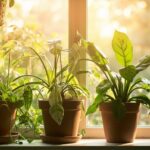
Light is the single most common cause of a Hoya not flowering once maturity is confirmed. The threshold is 3000+ lux for 10–12 hours daily — roughly the light level at an east or unobstructed south window with a sheer curtain. A west window with direct afternoon sun delivers 4000+ lux but risks leaf scorch above 85°F leaf surface temperature; the Hoya light requirements page maps the safe range for each window orientation.
Below 2000 lux, a Hoya produces leaves but does not initiate peduncles. The phytochrome system — the plant’s light-quality sensor — detects the ratio of red to far-red light, and a low ratio (indicative of deep shade or canopy cover) signals the plant to keep growing upward rather than flowering. Below 1000 lux, the plant diverts all resources to etiolated leaf and stem growth; peduncle initiation never triggers.
The fix: move the Hoya to a window delivering 3000+ lux and wait 4–6 weeks. Peduncle formation is not instantaneous; the plant needs a full adjustment cycle to recalibrate its photosynthetic machinery. Supplemental LED lighting positioned 12–18 inches above the canopy, running 12 hours daily, can push a borderline situation (2000 lux ambient) over the flowering threshold.
Over-Fertilization: The Nitrogen Trap That Delays Blooming
A common mistake: feeding a Hoya with a high-nitrogen fertilizer (e.g., 24-8-16 or 30-10-10) in hopes of pushing bloom production. Nitrogen drives leaf and stem growth — vegetative growth. Phosphorus and potassium drive root development and flowering — reproductive growth.
A Hoya fed high nitrogen grows long, lush vines and stays firmly in leaf-production mode.
The fix: switch to a bloom-focused fertilizer with a ratio of 10-30-20 or 5-15-10, applied at half strength every 4 weeks from March through September. Skip all fertilizer from October through February. Hoya watering guide notes that over-fertilization also causes salt buildup in the mix, which stresses roots and can burn leaf margins — another reason the plant diverts energy to leaf repair instead of flowering.
Root Constraint and the Stress-Flowering Link
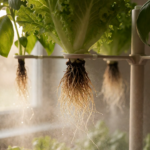
A Hoya that has not been repotted in 2–3 years and is mildly root-bound is more likely to flower than a Hoya in fresh, spacious mix. The mechanism is hormonal: mild root constraint reduces cytokinin transport to the shoots and increases abscisic acid concentration, signaling the plant that resources are becoming limited. In response, the Hoya shifts from vegetative growth into reproductive mode — producing flowers as a survival mechanism.
The constraint has limits. A severely_root-bound plant — roots circling twice, no visible mix, water running straight through — is in survival mode, not reproductive mode. The Hoya potting guide covers the threshold: repot when roots have circled once but not yet twice to restore a healthy root environment without resetting the flowering clock.
Water Stress: The Dry-Season Signal
In their native tropical habitat, Hoya plants experience a distinct dry season — 4–8 weeks of reduced rainfall that triggers bloom initiation. The mechanism is similar to root constraint: controlled water stress raises abscisic acid levels and signals the plant to reproduce before conditions worsen. Replicating this at home — allowing the mix to dry to 3 inches below the surface before rewatering during active growth — can push a mature, well-lit Hoya into bloom.
The stress must be controlled. The Hoya leaves turning yellow page maps the diagnostic difference between a Hoya in controlled dry stress (firm leaves, gradual drying) and a Hoya in drought stress (limp leaves, leaf drop, peduncle abortion). If the Hoya drops a peduncle after forming it, the water stress was too severe; resume normal watering and wait 6 weeks for the plant to recover before re-attempting.
The Wrong Season: Peduncle Drop and Forced Rest
Hoya plants have an internal seasonal clock driven by temperature and photoperiod. Peduncles form in late spring (March–April in the Northern Hemisphere), flowers open in summer (June–August), and the plant requires a cool winter rest (55–65°F, reduced watering) to reset for the next blooming cycle. A Hoya kept at 75°F under 14 hours of artificial light year-round — common in heated homes with grow lights — often skips blooming because the plant never receives the winter dormancy signal.
The Hoya humidity temperature page maps the rest-season protocol: October through February, reduce watering to half the summer frequency and move the Hoya to a cooler room (60–65°F) if available. Resume normal watering in March, and the plant typically produces peduncles within 4–6 weeks as days lengthen.
The honest limit: no Hoya blooms year-round. Even under ideal conditions, a Hoya carnosa produces one blooming flush per season, typically lasting 2–4 weeks. A plant that bloomed last June and shows no peduncles in November is following its natural cycle, not failing.
Wait for spring.
Sources and the limits of the seven-reason checklist
The Royal Horticultural Society (RHS) Hoya carnosa entry confirms that maturity, light intensity, and winter dormancy are the three dominant bloom triggers in temperate indoor cultivation. The University of Florida IFAS Extension notes that Hoya carnosa typically requires 2–4 years from cutting to first flowering, and that peduncles form only on wood that is at least one season old. For example, a Hoya carnosa “Krimson Queen” grown for three years at 60% relative humidity and 800 lux will flower; the same cultivar under 30% humidity and 200 lux will not.
If you see peduncle spurs along the vine but no flowers, the problem is light, not age. However, the seven reasons above do not cover every case: some Hoyas bloom only on old wood several years into maturity, and removing a single long vine can suppress flowering for the next season. Use the checklist to identify the most likely cause, then verify by changing one variable at a time over a 6–8 week window.
The underlying mechanism behind the seven reasons is a hormonal signal: Hoyas require a brief period of cool nights (60–65°F) and shorter days to trigger florigen production in the leaves.
If you see active growth but no peduncles after spring, the most likely missing signal is a true winter rest period, not a nutrient deficiency. Choose a rest protocol that fits your climate: a north-facing window in winter, with watering reduced by half from October through February, will produce peduncles within 4–6 weeks as days lengthen in March.
If you see a healthy Hoya with no peduncles in early spring, expect new growth within 4 weeks of restoring a true winter rest. After the rest ends in early March, increase watering gradually and the plant typically initiates peduncles within 4 to 6 weeks. If no peduncles appear within 8 weeks, the missing signal is more likely light intensity than the rest period. Maintain the rest room at 55–60°F (13–16°C) and keep day temperatures below 70°F (21°C) until the new growth begins.
Turn PDF Bank Statements Into Workable Spreadsheets
Your bank statement is a mess of numbers, but your books shouldn't be. Use our converter to get Excel, CSV, or QBO files — ready for QuickBooks.
Try It Free Now