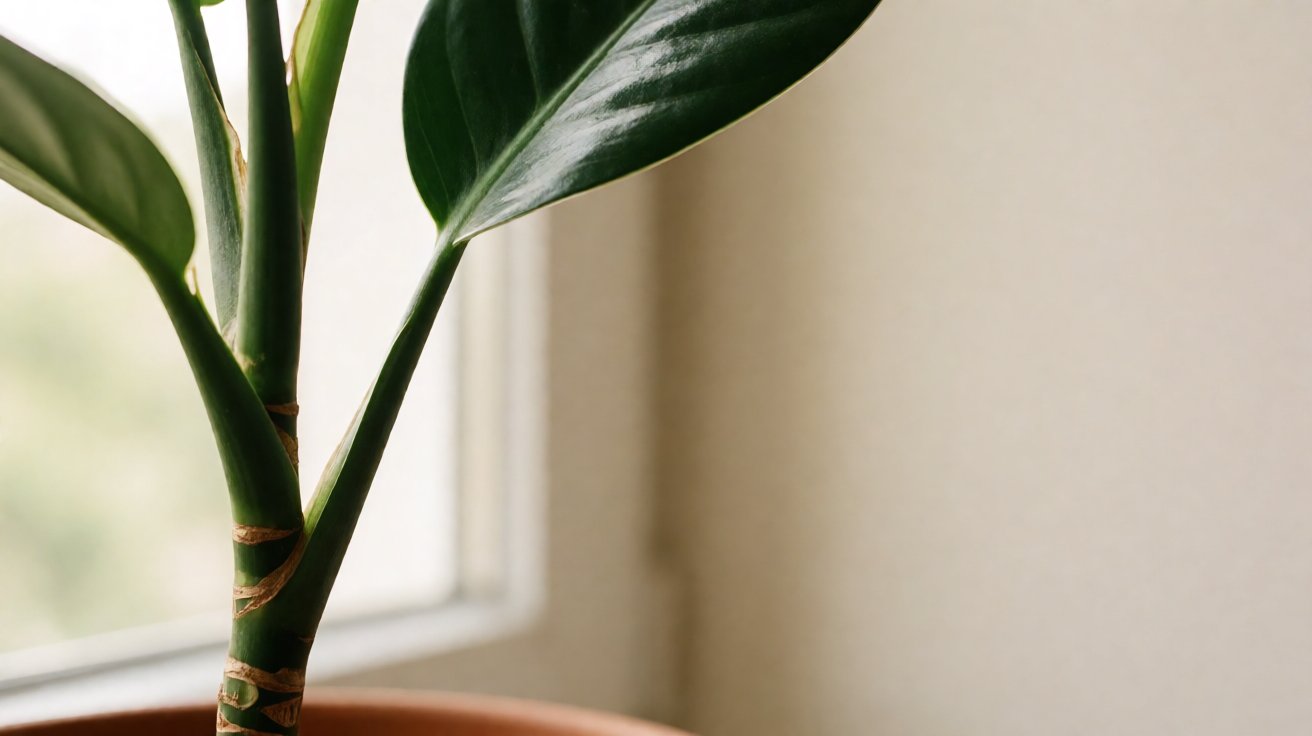

Every leaf you sweep off the floor this week was detached by a mechanism the plant built into the joint at the base of its stalk, and that mechanism only opens when a specific set of chemical signals arrive. The layer of cells that does the detaching is called the abscission zone, and it is not a tear. It is a planned seam, sealed off in advance, held shut by cell walls that stay intact until enzymes arrive to dissolve them. A leaf falls because the plant decided it should, and the decision was made days earlier.
Here is the part that catches people out. The leaf on your floor is a delayed reading of a condition that has already changed. The signal that opened the seam travels through the xylem, and the response is not instant. By the time you see the leaf down, the water, light, or temperature that caused the shutdown is often already different. So the instinct to look at the pile and guess what happened in the last day is looking at the wrong window.
Most growers reach for the nearest cause they remember. They water again, or move the plant back to the window, or trim the bare stems and wait. Sometimes that is exactly right. Often it is the reason the next handful of leaves went too, because the plant is being moved and watered while its abscission zones are still primed and half open. Learning to read the fallen leaf, and to accept the delay, is the difference between a plant that drops one leaf and a plant that goes bald in a month.
The pile on the floor is a reading, not an event
Leaf drop is the visible half of a two-part process. The invisible half happened inside the stem, at a seam most people could not point to on their own plant if you asked them to. So people treat the leaf as an event. Something happened today, and the leaf is the evidence. The mental model that works better is closer to a delayed receipt: the cause arrived first, the plant shut something down to survive it, and the seam opened later as the last step of that shutdown.
Two failure modes follow from that model, and they need opposite responses. The first is a plant shedding leaves as part of a planned transition, where the leaf was always going to go and the plant is not in trouble at all. The second is a plant discarding leaves it cannot afford to lose, which means something upstream, usually the roots, is failing. In the first case your job is to do nothing. In the second case the leaf is the last honest signal you get before the crown starts dying too.
The frustrating part is that both look identical from across the room. A green leaf on the floor is a green leaf on the floor. What separates them is the condition of the leaf itself, whether it came off clean at the joint, and what the rest of the plant is doing right now. That is a set of things you can check tonight, with the leaf already in your hand.
What the falling leaf is made of, and what made it fall
The joint at the base of a petiole is built from a small, layered structure. The abscission zone is a band of cells a few millimetres wide sitting between the leaf stem and the shoot. Above it, the leaf is connected. Below it, the twig is connected. The zone in between is the seam, and it stays intact for most of the leaf’s life because the cells there are held together by a glue-like layer of material between them, the middle lamella, that is largely insoluble.
When the signal arrives, the plant secretes cell-wall hydrolases, enzymes including cellulase and polygalacturonase, straight into that zone. These enzymes cut the middle lamella apart. The cells stop holding each other, the leaf separates from the shoot at the seam, and a layer of protective tissue forms underneath to close the wound on the plant side. Nothing ripped. The plant disassembled the connection on purpose and then sealed the stub.
Species differ in how loudly they do this. Alocasia macrorrhizos is the clearest case of planned shedding, where a partly dry rest period is part of the normal cycle rather than a symptom of anything, and the process on those rhizomes runs closer to the dormancy a deciduous tree enters in autumn.
The signal that commands all of this is ethylene, a gaseous hormone the plant makes itself and that also arrives from the outside. Ethylene is the primary trigger for abscission. Its production is sensitive to stress, shade, mechanical disturbance, and flooding.
A second hormone sits upstream. Auxin, made largely in the growing shoot tip and young leaves, travels down and holds the abscission zone closed. Remove or starve the auxin supply and the zone becomes sensitive to the ethylene that is already present at low levels. That is why light matters so much to leaf retention. A plant in a dark corner is not producing enough young growth to send auxin down, the zones lose their resistance, and ordinary background ethylene becomes enough to open them. The plant is not being poisoned. It is running out of the hormone that keeps the seam shut.
Why watering can be the thing that makes a plant drop leaves
Here is the counterintuitive part, and it is the single most useful thing to understand about leaf drop. When soil dries out, the roots respond by producing abscisic acid, or ABA. ABA is the drought hormone. It moves up through the xylem with the water stream and reaches the leaves, where it closes the stomata to limit further water loss. That part is protective and correct.
But ABA does something else on the way. It primes the abscission zones, making them sensitive to ethylene. The zones are now loaded. And here is the trap: when you finally water the plant, the recovering root system produces a burst of ethylene. In water-stressed plants this surge has been measured at several times the plant’s normal output. The zones were primed by the drought, and the ethylene surge on rewatering fires them. The leaf falls in the hours or days after you watered.
This is why the well-meant response to a dropping plant makes it worse. The leaves go down, you conclude the plant is dry, you water it thoroughly, and the ethylene response takes out another set. The watering was correct. The timing read it as the cause is wrong.
The practical version: if a plant has been dry for a while and then drops leaves shortly after a deep watering, that sequence is consistent with drought priming followed by the ethylene surge, and it does not by itself mean the roots are rotten. Check the soil before you act on it. Root rot and drought priming can look similar from the floor and they need opposite treatment, one of wet and one of dry. Drooping leaves have their own diagnostic because posture separates these two causes faster than colour does, and a plant that droops and then drops is usually telling you about water rather than light.
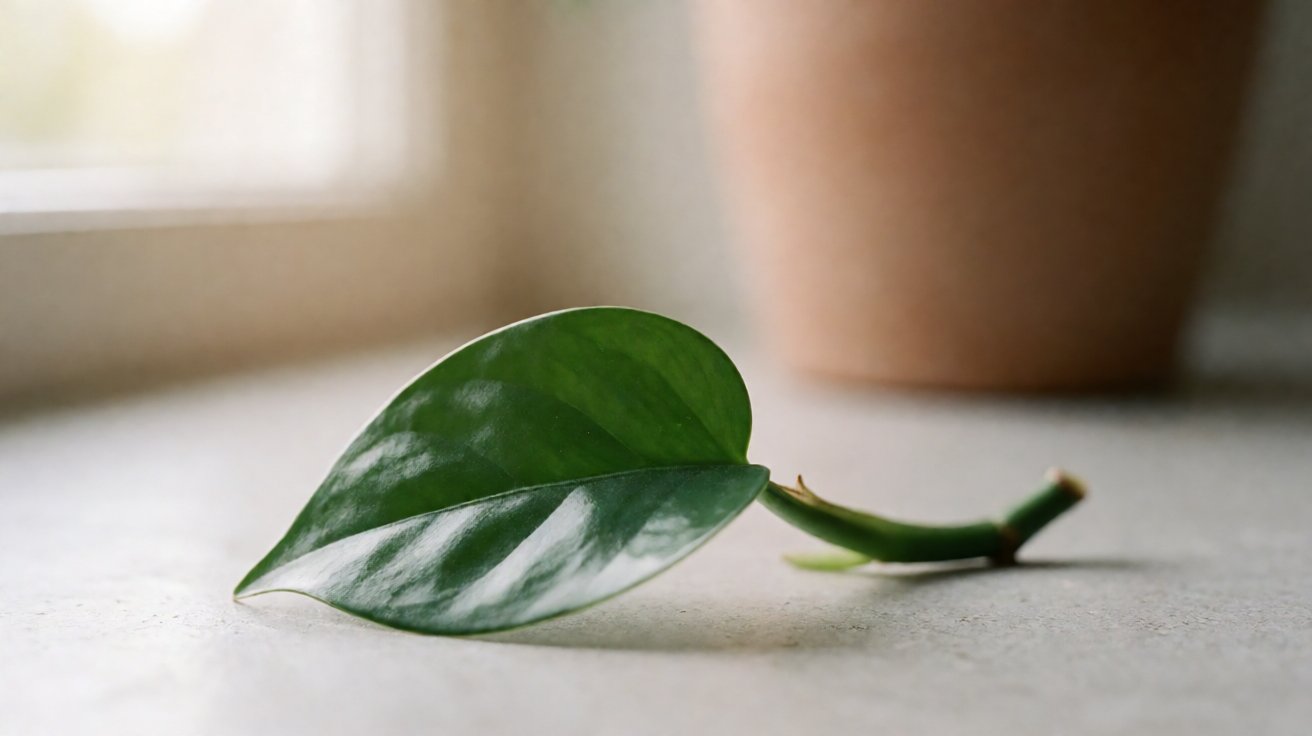
Read the leaf that fell
The leaf in your hand is a sample from a specific moment, and it carries more information than the colour table most people work from. Colour tells you roughly where the damage was. Texture, attachment, and position tell you what the plant was doing. Work through these in order.
Green, smooth, and still firm. This is the classic. A healthy-looking leaf that has finished its job, or one taken by a short shock. If the leaf is fully green but came off easily or with almost no resistance at the joint, that is auxin-driven abscission, the zone opening on schedule or after a light-triggered shutdown. Look for a whole-plant pattern rather than a single loss.
Yellow before it fell, uniformly. The leaf aged out. This links directly to why houseplant leaves turn yellow, because chlorophyll breakdown comes first and detachment follows. If the yellowing was even across the blade including near the veins, check light and watering rhythm. If it started between the veins on older leaves, that is a different mechanism and a different fix.
Yellow or pale with dark speckling, crisp. Water left the tissue faster than the roots could replace it, and the margin went first. That edge death has its own page in brown leaf tips on houseplants, and the same dry-air logic explains the fall. Tip necrosis plus leaf drop together usually means the air is drier than the roots can support, not that the soil is wet.
Soft, limp, translucent, or dark at the base. Now stop reading the leaf and read the soil. Tissue that was submerged or sitting in cold wet soil loses structure, and leaves that come off in that state came off because the roots could not hold them up. This is the case where the fallen leaf is a root problem in disguise, and it needs a different diagnostic entirely.
The petiole is still attached to the leaf. An abscission zone cuts cleanly at the seam, so a properly dropped leaf usually comes away without its stalk, leaving a small scar on the twig. If you find the petiole still attached to the blade and a torn stub on the plant, the zone never opened. That leaf was pulled off, damaged, or torn rather than shed, and whatever caused the damage is a mechanical or pest event rather than a chemical decision.
Where on the plant. Loss concentrated at the bottom, near the soil line, points at the roots or the crown. Loss concentrated at the outside of the canopy points at light and air. Loss on the newest growth points at water delivery, the opposite of the old assumption, because the newest leaves are furthest from the older plumbing and suffer first when conductance drops.
Programmed drop, or a plant in trouble
Before you change anything, answer two questions. Both can be answered from the plant and the floor, in under a minute.
Is the growth new and the plant otherwise stable? New leaves coming in at the tips, existing leaves firm and correctly coloured, and a steady trickle of old leaves at the bottom is a plant in transition, not a plant in decline. Some houseplants shed on a rhythm that has nothing to do with your care. Alocasia leaf drop is the clearest example, where a resting period and a leaf lost are the same event. The honest limit of any leaf-based read is that it cannot tell you whether the roots are healthy. Only the soil can.
Is more than one condition changing at once? Yellowing and softening in the same week, or a drop that came with a wilt, means the plant is losing a fight it is not winning. Single-cause, single-symptom losses are usually recoverable on their own. Compounding signals are not, and they escalate faster than one leaf at a time suggests.
If the first answer is yes and the second is no, do less than you want to. Do not repot, do not fertilise, do not move the plant. Watch it for a week. If the first answer is no, the leaf is the least important thing on the plant right now and the root system is the thing to examine. Outdoor-to-indoor transitions carry their own signature, and why indoor citrus drops leaves covers what a plant does when the light it was acclimated to on a patio is simply not there in a living room.
What actually works, cause by cause
If the loss followed a light or temperature swing. Moving a plant from a dim room to a bright window in one step is the most common self-inflicted cause. Photosystems respond to photon density far faster than the plant’s acclimation can track, and the shock shows up in the leaves days later as loss that has no obvious cause. Change light in stages, or hold the plant where it is for ten days before judging it. Heating vents and air conditioning units are the other half of this: a plant sitting in a steady draft loses water from the leaf surface faster than the roots resupply it.
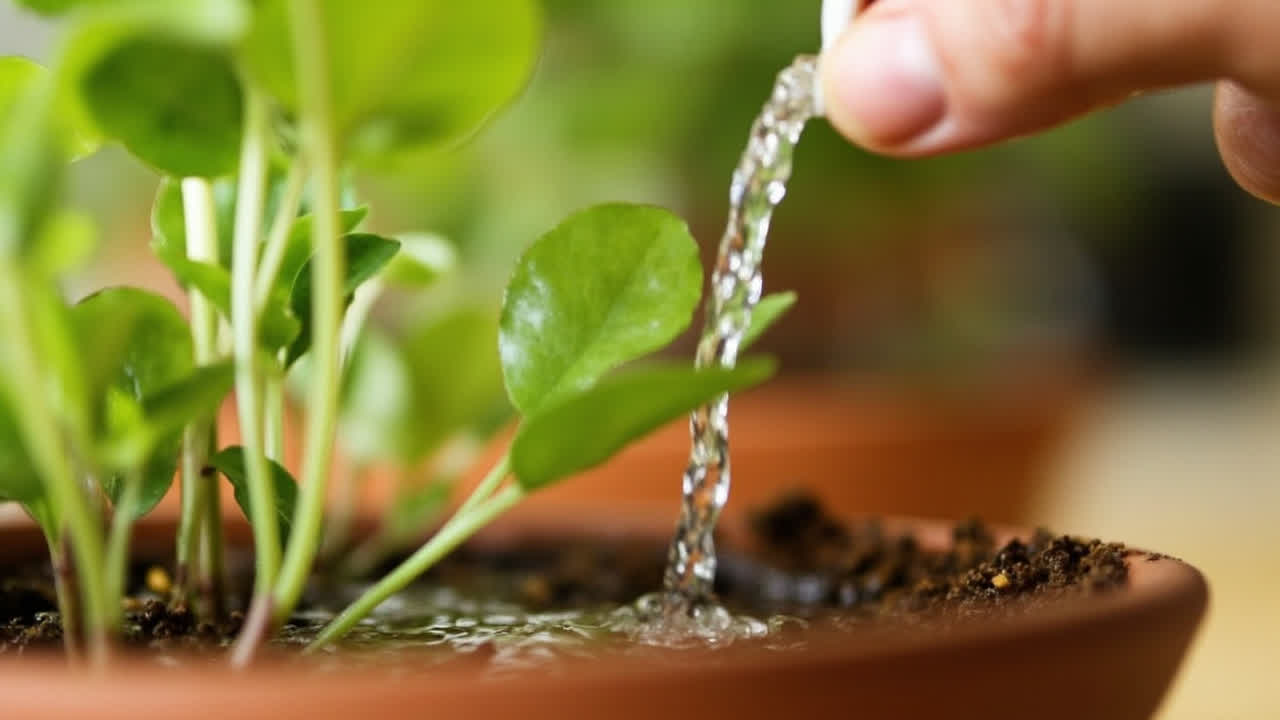
If the loss followed a dry spell and a watering. Expect it, do not chase it. Water thoroughly and evenly, then hold the rhythm steady. Moving a dry plant to a wet one repeatedly produces the priming-and-surge cycle on a loop, and the plant drops a fresh set each time you rescue it. The fix is consistency, not attention.
If the loss is at the bottom and near the soil. Dig. A finger pushed to the second knuckle tells you more than any leaf. Sour, compacted, waterlogged soil means oxygen has left the root zone, roots cannot hold the plant, and the leaves above are being shed to reduce demand. That repair is a repot into a substrate with air in it, and the watering intervals that go with it are covered in the watering schedule by species. Species behaviour differs enough here that a single calendar is the wrong tool.
If the loss is scattered and the leaves went soft. Treat it as root rot until proven otherwise, and check the roots rather than the leaves. Pull the plant, look at the colour and firmness of the roots, and smell the soil. Healthy roots are firm and pale. This is the one branch of the decision tree where reading the leaf has run out of information and you need the other end of the plant.
If the loss is one plant in a group. A single affected plant next to healthy neighbours points at that pot, not the room. Check for pests on the leaf undersides at the same time, because thrips and spider mites cause stippling and leaf loss together and the fallen leaf is often the first place you see the damage pattern.
Species behave differently enough to be worth their own pages. Fiddle leaf fig problems cover the classic case of Ficus lyrata, a plant that drops leaves after any change at all. Hibiscus leaf drop is tied to light and to temperature swings, and Hibiscus rosa-sinensis will shed a heavy flush after a cold night near an open window. Orchid yellowing and croton leaves dropping both show how far the same mechanism stretches across species, from Phalaenopsis hybrids that hold every leaf for years to Codiaeum variegatum, which can drop a dozen leaves after a single cold commute from the shop.
What most people get wrong
The wrongest move is treating each leaf as its own event. Ten leaves over ten days is a pattern. One leaf a week is a rhythm. The reader who reacts to each single loss makes ten interventions where zero were needed, and each intervention is a change the plant has to absorb.
The second error is reading leaf colour as a diagnosis. Colour is one variable among four, and the most quoted version of the colour table, yellow means overwatering and crisp means underwatering, is a shorthand that fails constantly. It fails on the plant that is overwatered and acid enough to pull both minerals and water. It fails on the plant in a dry room with wet soil. It fails on every plant that has two things wrong at once, which is most plants that are actually struggling.
The third is watering a drooping plant out of habit. A drooping leaf means turgor has failed, which has two very different causes with opposite remedies, and the posture is the evidence. Watering on reflex when the roots are the problem adds the second failure to the first.
The fourth is blaming the newest leaves for the oldest ones’ problems. Age runs backwards in a plant. Old leaves go first when the plant is shutting down to protect new growth, which is why the loss that starts at the bottom is the one worth taking seriously.
The next seven days will tell you which one it was
Record which leaves fall and what condition they were in. Four or five leaves over a week tells you whether the pattern has stopped. A fresh cluster of loss in the same week, after you changed nothing, means the cause is still active and the plant is still under the condition that started this, not a new one.
If the soil is draining and the new growth is firm, the seam opened once and closed behind it. That is the whole mechanism working as intended, and the plant is fine.
If the soil stays wet and the new growth is soft, the leaf was never the problem and the leaf was the messenger. Go to the roots.
Your plant isn’t dying. It’s telling you where it was hurt two days ago, and the leaves it dropped are the only free evidence you will get. Keep them.
Turn That PDF Into a Spreadsheet in Minutes
You've seen how to do it manually — now let the tool handle the heavy lifting. Upload your bank statement and get Excel, CSV, or QBO in a few clicks.
Try It Free