
The watering interval doesn’t live in the plant. It lives in the leaf area, the pot wall, the humidity in your room, and the species’ native climate. Two species in the same room with the same pot can sit two weeks apart on the same watering day. The reason is physics, not gardening intuition.
A watering schedule that treats every houseplant as one bucket, watering every Sunday, kills tropical foliage within a month and never quite threatens a snake plant. The species know it. The roots know it first. The leaves are the message, and the message is delayed.
One honest limit up front. A schedule cannot tell you when to water. It can only narrow the search. The plant in your specific pot, in your specific humidity, on your specific windowsill, will land somewhere inside a range. The schedule is the box. The finger test is the answer inside the box.
Why Intervals Differ: The Physics Behind the Number
Plants lose water through their leaves. That water loss is called transpiration. The plant replaces it by pulling fresh water up through the roots. The faster the transpiration rate, the faster the soil dries, the shorter the interval between waterings.
Transpiration rate depends on four variables the plant can’t fully control and the room fully sets: temperature, humidity, light intensity, and air movement. A Sansevieria trifasciata (snake plant) on a dry windowsill in Phoenix transpires faster than the same snake plant on a humid bathroom shelf in Seattle. Same plant. Different interval.
On top of the room, the species sets its own transpiration ceiling. That ceiling is what the schedule is actually measuring. Three species-level variables matter most:
- Stomatal density and behavior. Ferns and calatheas have hundreds of stomata per square millimeter of leaf and they stay open during the day. Succulents and cacti open them at night and store CO₂ as malic acid until morning (Crassulacean acid metabolism, CAM). The CAM plants lose a fraction of the water a fern loses for the same CO₂ gain.
- Leaf area to volume ratio. A monstera with broad, thin leaves has a huge surface relative to its stem water storage. A cactus with no leaves and a fat trunk has almost none. Same soil, same pot, the cactus will outlast the monstera three to one on a dry-down.
- Succulence and rhizome water storage. Zamioculcas zamiifolia (ZZ plant) stores water underground in potato-like rhizomes. Sansevieria trifasciata stores it in its leaves. Crassula ovata (jade plant) does both. These plants can lose 30–50% of their tissue water before any leaf wilts. Tropical foliage has none of this buffer.
That’s why the intervals in the schedule below span 2 days to 8 weeks. The plant at the dry end is photosynthesizing on CAM, holding the rest in storage, and losing almost nothing. The plant at the wet end is running full-tilt C3 photosynthesis through thin leaves that don’t hold reserves and can’t close their stomata fast enough to save themselves.
What the Table Actually Means
The numbers below are baselines for a normal room at 18–22 °C in a plastic pot. Terracotta dries roughly twice as fast, so halve the interval. A root-bound plant in a small container dries faster than the same species in a big one with fresh substrate. Every range assumes you confirm with the finger test first. The numbers tell you when to go and check, not when to pour.
| Species | Summer interval | Winter interval | How it tells you it is thirsty |
|---|---|---|---|
| Snake plant (Sansevieria trifasciata) | Every 2–3 weeks | Every 6–8 weeks | Leaves soften and start to lean outward |
| ZZ plant (Zamioculcas zamiifolia) | Every 2–3 weeks | Every 4–8 weeks | Leaflets curl inward slightly |
| Aloe vera | Every 2–3 weeks | Every 4–6 weeks | Leaves thin and dimple along the sides |
| Jade plant (Crassula ovata) | Every 2–3 weeks | Every 4–6 weeks | Leaves lose firmness, wrinkle at the base |
| Cacti (desert types) | Every 3 weeks | Every 6–8 weeks | Body shrinks slightly, ribs deepen |
| Rubber tree (Ficus elastica) | Every 7–10 days | Every 14 days | Oldest leaves yellow and drop first |
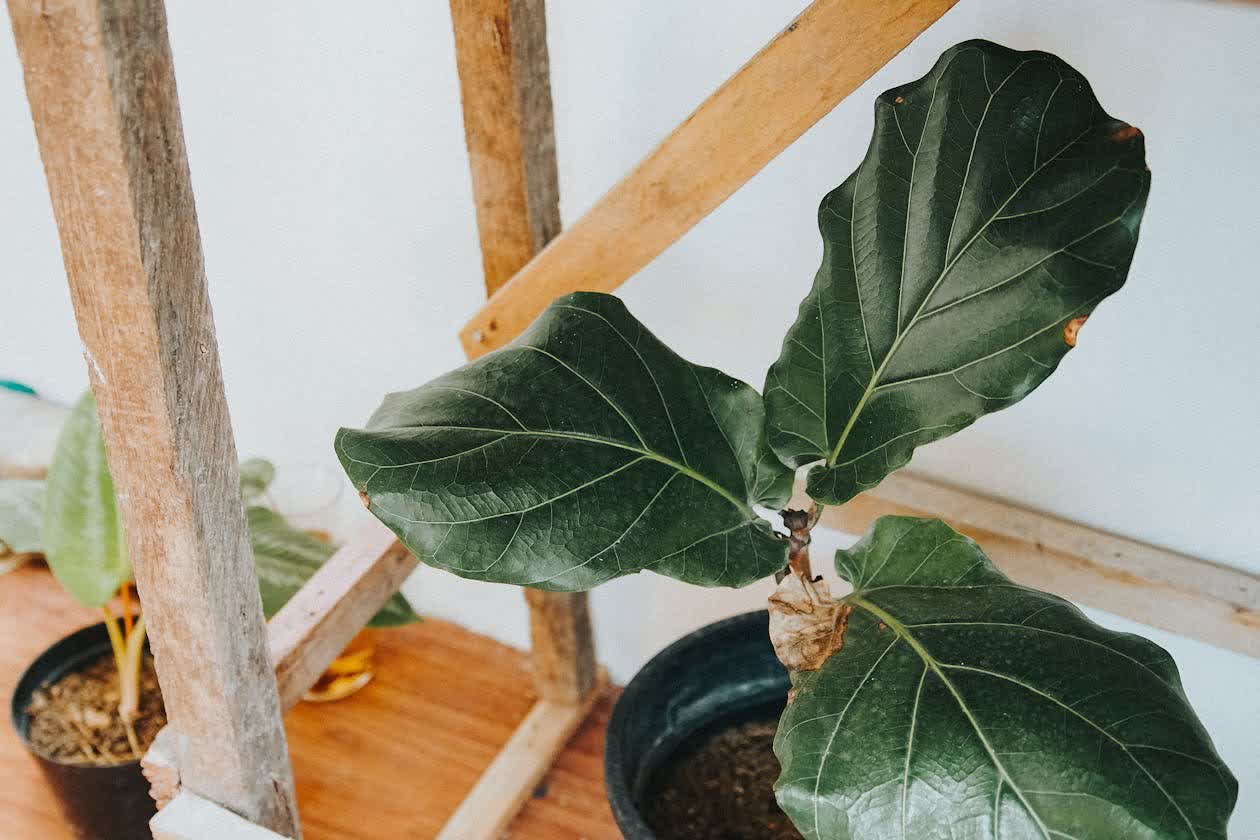
| Fiddle leaf fig (Ficus lyrata) | Every 7–10 days | Every 14 days | Leaf edges brown before the plant droops |
| Monstera (Monstera deliciosa) | Every 7–10 days | Every 10–14 days | Stems droop from the outside in |
| Philodendron | Every 7–10 days | Every 10–14 days | Leaves lose gloss, then droop |
| Pothos (Epipremnum aureum) | Every 7–10 days | Every 12–16 days | Vines go limp and recover fast after watering |
| Spider plant (Chlorophytum comosum) | Every 5–7 days | Every 10 days | Leaf tips brown (often from tap water, not thirst) |
| Peace lily (Spathiphyllum) | Every 5–7 days | Every 7–10 days | Collapses dramatically, recovers within hours |
| Dieffenbachia | Every 5–7 days | Every 10 days | Lower leaves yellow and hang |
| Dracaena | Every 7–10 days | Every 14 days | Tips brown, often a water-quality signal |
| Parlour palm (Chamaedorea elegans) | Every 5–7 days | Every 10–12 days | Fronds pale before they crisp |
| Yucca | Every 10–14 days | Every 21 days | Leaf colour fades toward grey-green |
| Boston fern (Nephrolepis exaltata) | Every 2–3 days | Every 4–5 days | Fronds crisp from the tip within a day |
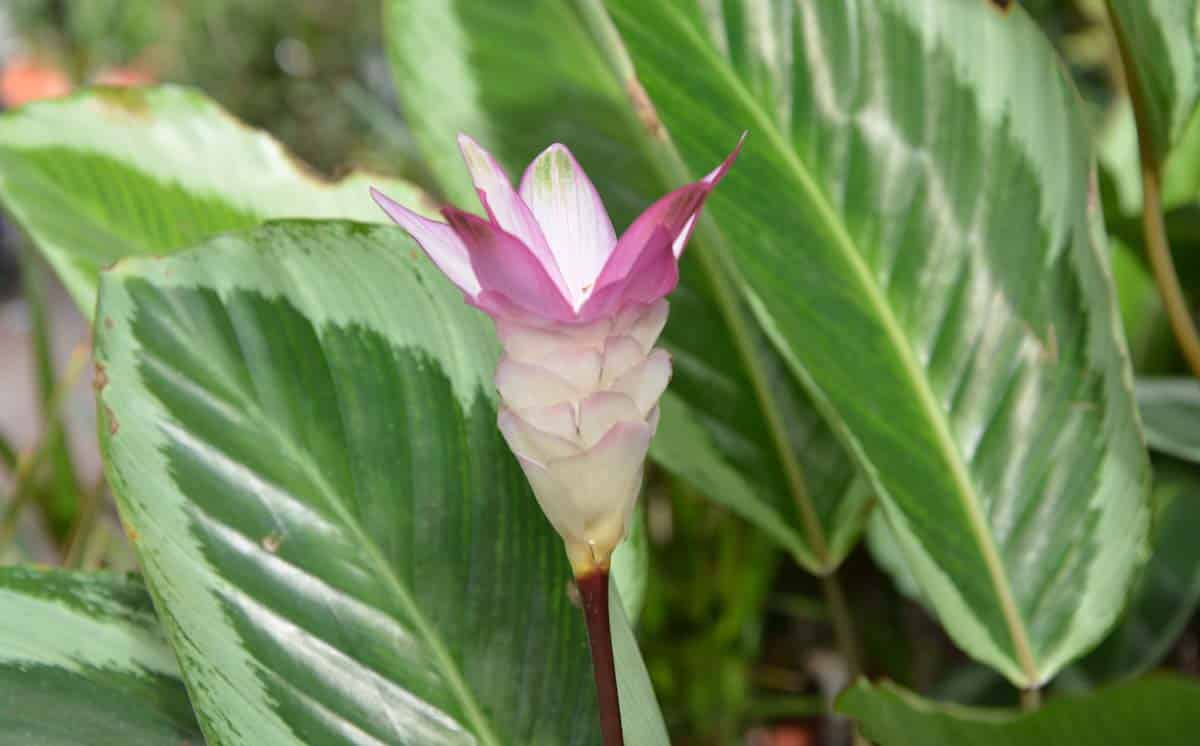
| Calathea / Maranta | Every 2–3 days | Every 4–5 days | Edges curl and crisp; hates hard water |
| Alocasia | Every 3–4 days | Every 7 days | Leaf edges droop before the stem does |
| Phalaenopsis orchid | Soak every 7–10 days | Soak every 10–14 days | Roots turn from green to silver-grey |
| Money tree (Pachira aquatica) | Every 7–10 days | Every 14–21 days | Trunk softens; leaves drop from the bottom up |
| Mass cane (Dracaena fragrans) | Every 7–10 days | Every 14–21 days | Leaf tips crisp; lower cane leaves yellow first |
How to Actually Water: Three Rules the Schedule Won’t Tell You
The interval is one half of watering. The other half is what happens when you pick up the watering can. Three rules cover most of what the schedule leaves out.
- Water until it runs freely from the drainage hole. That runoff is the point. It proves the water reached the bottom of the root ball and it carries accumulated fertiliser salts out with it. A plant watered with a quarter-cup every Sunday has wet topsoil and bone-dry roots two inches down. The plant stays thirsty in soil that looks wet.
- Wait 15 minutes, then empty the saucer. Roots sitting in standing water are the single most common route to root rot. The plant wants a drink, not a bath.
- Water the soil, not the leaves. Wet foliage in still indoor air invites fungal leaf spot. Misting does almost nothing for soil moisture regardless of what it does for humidity. If humidity is the problem, the plant needs a humidifier, not a spray bottle.
The Finger Test, and Why It Beats Any Schedule
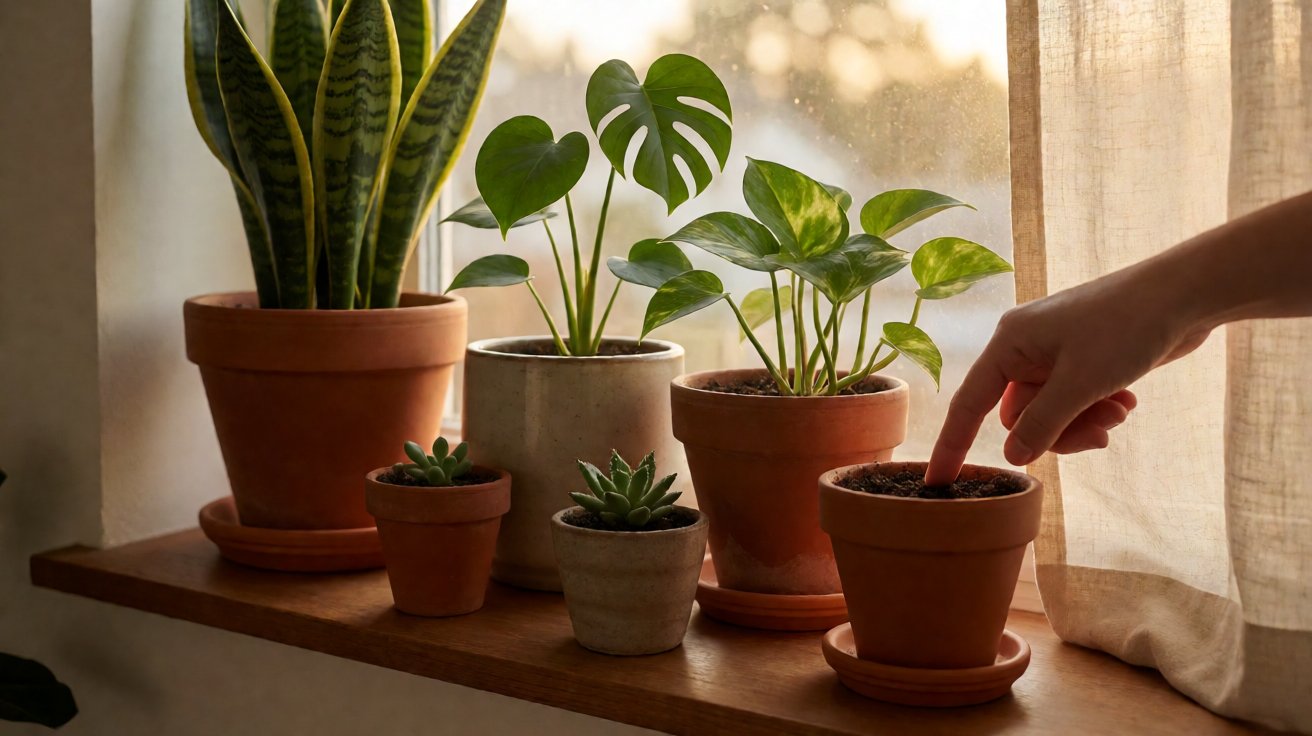
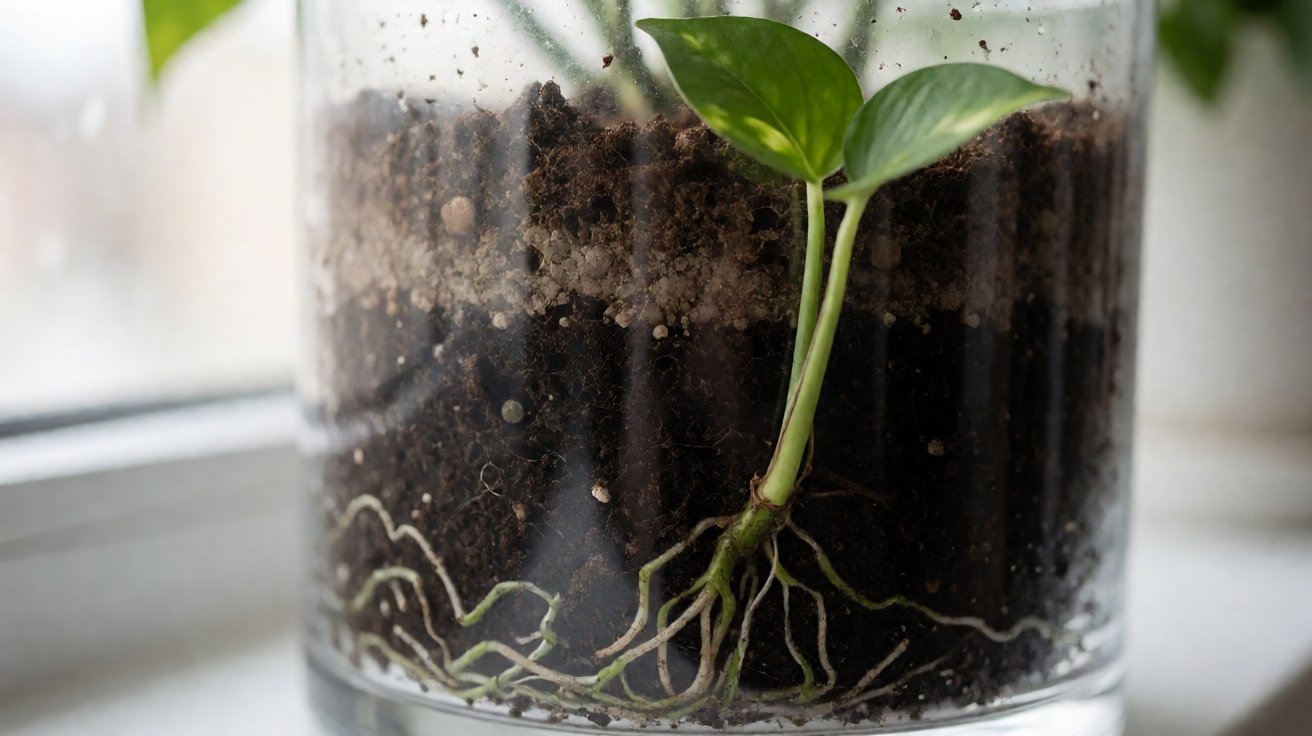
The finger test exists because every plant lives in a slightly different microclimate than the schedule assumed. Stick your finger into the soil up to the second knuckle. What you feel decides whether you water today.
- Wet to the second knuckle: do not water. Check again in 2–3 days. If still wet after a week the pot is too dense, the drainage is blocked, or the roots are rotting. Read the rescue plan.
- Moist at the surface, dry at the second knuckle: this is the target for most tropical foliage. Water thoroughly.
- Bone dry all the way down: water now. If the soil has shrunk away from the pot wall, water runs straight down the gap and out. Bottom-water by standing the pot in a few centimetres of water for 20 to 30 minutes until the surface darkens.
Use water at room temperature. Cold water straight from the tap is a genuine shock to tropical roots, and it’s a common trigger for sudden leaf drop on Ficus. If your tap water is very hard (high in calcium and magnesium), switch to filtered. Leaf-tip burn on spider plants and calatheas is usually a tap-water problem before it’s a watering-frequency problem.
Pot, Substrate, and Room: The Variables the Schedule Doesn’t Include
Three variables change the interval independent of the species. Treat them as multipliers on the table above.
- Pot material. Terracotta is porous. Water moves out through the wall, so the soil dries roughly twice as fast as the same plant in a plastic pot. A snake plant in a terracotta pot may want water every 10 days in summer, not every 2–3 weeks. Glazed ceramic behaves like plastic.
- Pot size. A root-bound plant in a small pot dries much faster than the same species in a larger pot with fresh substrate. The schedule assumes a moderately root-bound plant in a normal-sized pot. Up-potting stretches the interval. Severe root-bound conditions halve it.
- Substrate. A peat-based mix holds water longer than a coir-based mix, which holds longer than a gritty cactus mix with perlite. The same Sansevieria trifasciata in a peat-based mix and the same plant in a cactus mix with 50% perlite can sit three weeks apart on the same schedule. Match the substrate to the species, not the species to the substrate.
Winter Isn’t a Different Plant, Just a Slower One
Light intensity drops, day length shortens, indoor humidity rises. All three lower the plant’s transpiration rate. The Royal Horticultural Society recommends reducing watering by 30–50% from late autumn through early spring for most indoor species. The plant isn’t dormant, it is metabolising slower.
The failure mode in calendar winter is overwatering. The soil stays wet longer, the plant drinks less, and the watering schedule from July doesn’t know it. The finger test catches this. The schedule won’t.
What Most People Get Wrong
Two failure modes account for most houseplant deaths. Both come from using the schedule as a rule instead of a baseline.
- Watering on a calendar day instead of a soil condition. Sunday watering is the most common cause of tropical foliage collapse. The plant’s soil is still wet from Sunday’s pour when next Sunday arrives. By the third Sunday the roots are sitting in anaerobic soil and root rot begins. The schedule was designed to narrow the search. The finger test inside the schedule decides.
- Treating every plant as one plant. A shelf of succulents next to a shelf of calatheas on the same watering day will kill the calatheas inside two weeks. The transpiration difference between a CAM plant and a thin-leaf C3 tropical is roughly ten to one. Same room, same humidity, same pot. Two-week watering interval versus two-day interval. The species is the variable the schedule was designed to capture.
What to Read Next
If your plant is yellowing, dropping, or sitting in a swamp despite the schedule, the answer is in the seven-day rescue protocol. It picks up where this article stops and walks through what the leaves are actually telling you when the schedule isn’t enough.
For the deep mechanics: why light intensity drives water demand, how humidity changes the interval, and how to read a moisture meter without lying to yourself. The complete indoor plant care guide is the parent page this article feeds.
And if your plant is a specific species (money tree, calathea, pothos, mass cane). The per-species watering deep dives go further on the variables this article didn’t have room for: money tree watering, calathea watering, mass cane watering, and pothos watering.
The schedule is a starting point. The plant is the answer. Stick your finger in the soil tonight and let it tell you when to come back.
From Bank Statement to QuickBooks-Ready File
That manual cleanup you just read about? This tool skips it. Turn your PDF into QBO for QuickBooks without storing your data anywhere.
Start Converting