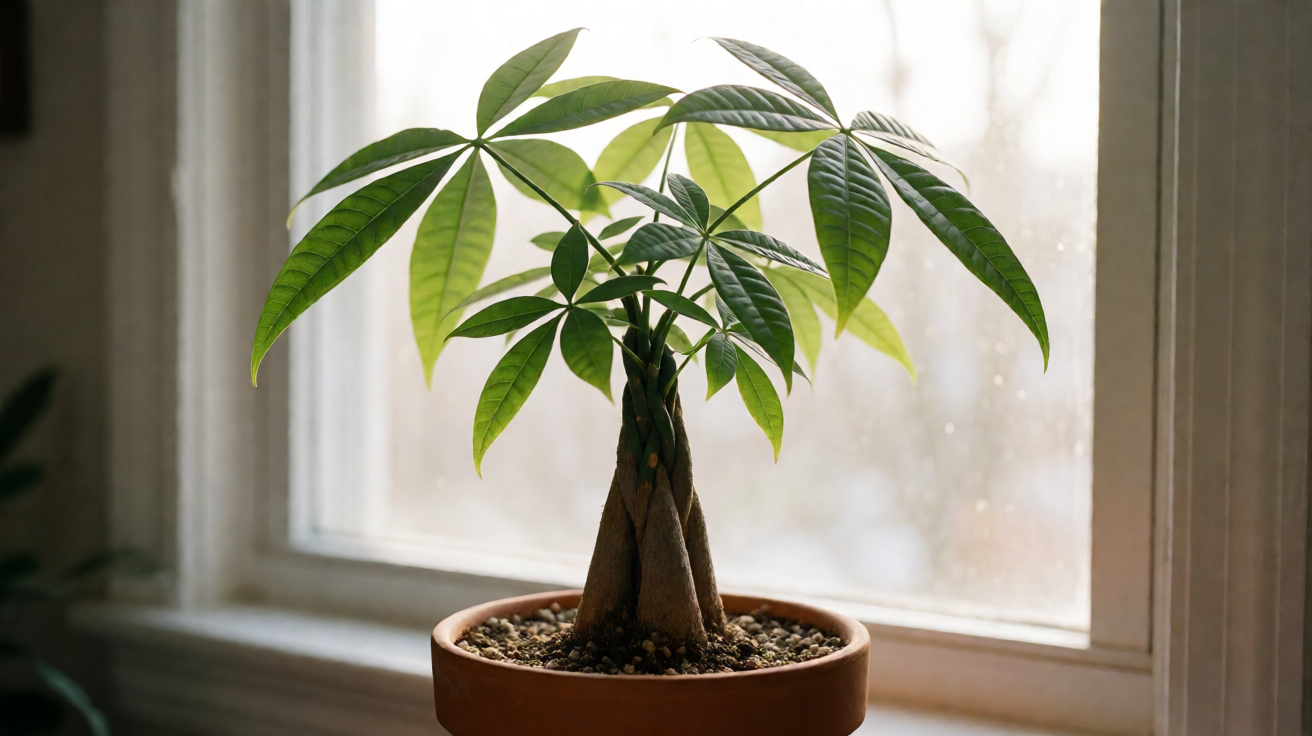

A money tree (Pachira aquatica) should be watered when the top 1 inch of soil dries out, not on a fixed weekly schedule, because the braided trunk stores water between drinks and the fine roots suffocate in soil that stays wet past day five. The gift-shop tag that says “low maintenance tropical” is half true.
Pachira tolerates a missed watering because the trunk is a reservoir, but it does not tolerate soil that stays wet day after day. The trunk does the job of a few missed waterings; it does not protect the fine roots from chronic overwatering.
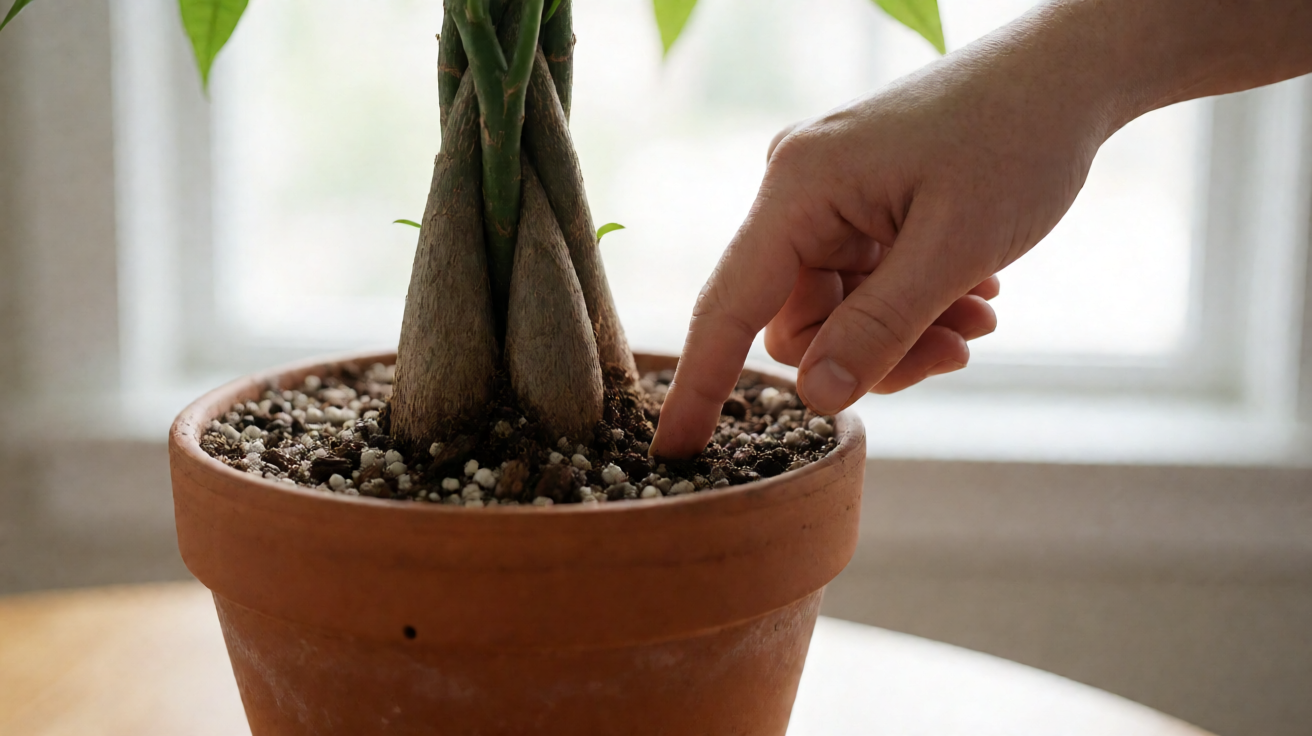
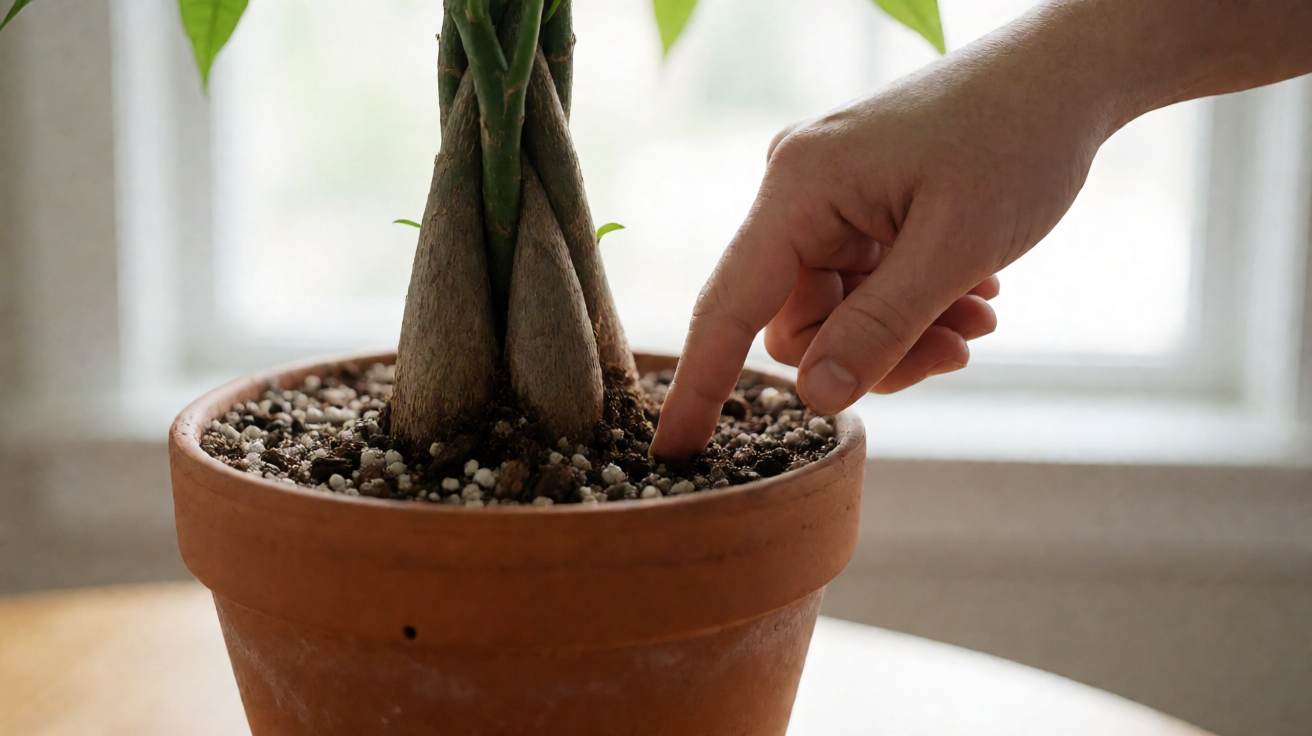
The dryness test takes five seconds and replaces every watering schedule ever written. Stick a finger into the soil up to the first knuckle. If soil clings to the finger, wait three days and check again. If the finger comes up dry, water. That single rule covers most indoor money tree situations, regardless of pot size or humidity.
This page covers the four watering mechanics: the dryness test, the seasonal rhythm, how much water to apply, and the overwatering and underwatering symptoms. Sunlight sets the transpiration rate that the dryness test reads. Root rot, crown rot, nitrogen decline, and propagation from stem cuttings are covered on their own pages. Treat this Attribute as the rulebook; treat the Problem page as the recovery protocol.
The Dryness Test, Not the Calendar
Calendar watering fails because the soil does not dry on a schedule. Light, temperature, humidity, pot size, and root mass all change how fast the soil loses moisture. A 6-inch pot in bright indirect light in a 70 degree Fahrenheit room dries out faster than a 10-inch pot in a dim corner at 65 degrees. A weekly schedule treats both situations the same and rots one of them.
The dryness test normalizes all of those variables. Insert a finger into the soil up to the first knuckle, which is about 1 inch deep. Pull it out and look at it. If damp soil clings to the skin, the soil is still wet below the surface and you can wait two to three days.
If the finger comes up dry or with only a few dry crumbs, it is time to water. The whole test takes five seconds and replaces every watering schedule ever written.
For readers who do not want to use their finger, an unglazed wooden chopstick works the same way. Push it into the soil to the same depth and pull it out. Wet soil darkens the wood; dry soil leaves it the same color.
A moisture meter set to read at the 2-inch depth is the cleanest tool for repeat accuracy, but the finger test is good enough for most situations. The chopstick falls between the two.
One important caveat: the test fails if the soil has pulled away from the inside edge of the pot. In that case, water runs down the gap without wetting the rootball, and the finger test will say dry even though the roots are still wet. The bottom-watering recovery method below handles this case by rehydrating the soil mass from below.
Do not water “a little” every day to keep the surface moist. That approach wets the top 1 inch and leaves the bottom 3 inches dry, which trains the roots to grow up toward the surface where they are vulnerable to dry air and transplant shock. Soak the soil thoroughly each time you water, then let it dry to the first knuckle before watering again.
Seasonal Rhythm: 7 to 10 Days in Summer, 14 to 21 Days in Winter
During the active growing season from March through September, a money tree in 65 to 75 degree Fahrenheit room conditions with bright indirect light typically needs water every 7 to 10 days. The window is wide because pot size, root mass, and humidity all shift the timing by a few days. Run the dryness test, do not count days.
From October through February the tree enters a semi-dormant state. Transpiration slows, the canopy stops pushing new leaves, and the soil stays wet longer between waterings. In the same room conditions, the rhythm stretches to every 14 to 21 days.
Watering on the summer schedule through winter is the second most common cause of crown rot, because the soil stays wet past day five when the roots are not actively drinking. Dial back and let the dryness test drive every session.
Watering on the summer schedule through winter is the second most common cause of crown rot, because the soil stays wet past day five when the roots are not actively drinking. Dial back and let the dryness test drive every session.
Below 60 degrees Fahrenheit the rhythm stretches further, to every 18 to 25 days in some rooms. Trees near drafty windows or air-conditioning vents slow down faster than trees in a heated interior corner. Always test the soil rather than trusting the season alone. If the soil is dry at the first knuckle in mid-January, water; do not wait for the calendar to say it is time.
Above 75 degrees Fahrenheit, especially with low humidity, the rhythm can shorten to every 5 to 7 days in summer. The hot, dry conditions evaporate moisture faster than the roots can replace it. This is where the moisture meter is most useful, because the surface can look dry on a 95 degree day while the rootball is still wet 2 inches down.
How Much Water and How to Apply It
Water thoroughly until the excess drains from the bottom of the pot. The water should flow through the soil mass and exit through the drainage holes within 30 to 60 seconds. If the water sits on top of the soil and channels down the inside edge of the pot without wetting the rootball, the soil has dried and shrunk; switch to the bottom-watering recovery method below before resuming top-watering.
Top-watering is the standard method. Pour slowly over the soil surface, not over the trunk. Water that pools at the crown of the braided trunk sits against the bark and starts the rot that kills the tree.
Aim for the soil around the perimeter of the pot, where the fine roots are densest. Pour in stages: one-third of the volume, pause 10 seconds for the soil to absorb, then the next third, then the rest. Staged pouring prevents channeling.
Bottom-watering works for rehydrating dry soil or for trees that have pulled away from the pot edges. Set the entire pot in a tray of tepid water so the water level reaches about halfway up the side of the pot. Leave it for 30 minutes.
The soil absorbs water from below through the drainage holes. Lift the pot out, let it drain for 5 minutes, and return it to its saucer or decorative pot. The bottom-water method leaves no standing water at the crown.
Whichever method you use, drain the pot completely. A money tree never sits in standing water; even 30 minutes of saturated bottom can suffocate roots after the third or fourth repeat.
If the saucer collects water after watering, empty it within 10 minutes. If the decorative pot has no drainage holes, keep the tree in a plastic nursery pot and set that inside the decorative pot, removing it for every watering. Drainage holes are the single most important pot feature.
Overwatering Signs and What to Do About Them
Overwatering is the most common cause of money tree death and it arrives in two stages. Early: yellow leaves at the bottom of the canopy with soil that feels wet to the first knuckle. The leaves drop over a few days.
Late: soft trunk base, sour soil smell, leaf drop within 48 hours. By the time the trunk base compresses with light finger pressure, the crown rot is past the care-routine phase and needs the surgical recovery protocol on the money tree revival page.
The recovery rate drops to 30 percent at the late stage. The scratch test on the trunk tells you which stage you are in. Green tissue under the bark means the tree is still worth the recovery effort. Brown, papery tissue means the scratch test has failed and the trunk is past the point where watering fixes the problem.
The single biggest overwatering mistake is watering on a calendar. The second is watering “a little” every day to keep the soil moist. The third is leaving the pot in a saucer of standing water.
All three cause the same problem: anaerobic soil that suffocates the fine roots, which then rot and stop sending water to the canopy. The trunk rots from the inside out, which is why the symptoms look sudden even though the cause has been building for weeks.
By the time the firm trunk test fails and the trunk base compresses with light finger pressure, the rot has already climbed from the crown into the main stem.
The tree is now in the recovery-or-discard window, and no amount of adjusted watering will reverse it. The only option at that point is the surgical protocol on the revival page.
If you catch the early stage, switch to the dryness test immediately and stop watering until the soil dries past the first knuckle. Move the tree to bright indirect light so transpiration pulls moisture out of the soil.
If the soil smells sour, unpot the tree and check the roots; black or hollow roots need to be cut away before the rot spreads up the trunk. The revival page covers the surgery in detail. The window between early and late is about 7 to 14 days.
If you catch the late stage, with a soft trunk base and full leaf drop, the recovery rate drops to about 30 percent even with the revival protocol. At that point, the surgery is the only option. Most trees in the late stage end up being discarded, which is why the dryness test is worth the five seconds it takes every week.
Underwatering Signs and Bottom-Watering Recovery
Underwatering produces a different fingerprint. A chronically dry money tree sheds leaves from the bottom up to conserve water for the crown. The trunk may feel slightly soft from dehydration rather than rot.
The distinction matters because a dehydrated trunk snaps cleanly when bent while a rotten trunk compresses without snapping. The soil pulls away from the inside edge of the pot, and water runs down the gap without wetting the rootball. Bottom-watering solves the channeling problem in a single 30-minute session.
Bottom-watering is the cleanest recovery method for an underwatered money tree. Set the entire pot in a tray of tepid water so the water level reaches halfway up the side of the pot. Leave it for 30 minutes.
The soil absorbs water from below through the drainage holes and rehydrates the dry mass evenly. Lift the pot out, let it drain for 5 minutes, and return it to its saucer. After the deep rehydration, resume the dryness-test rhythm.
After the first deep rehydration, resume the dryness-test rhythm. New growth appears within 4 to 6 weeks if the root system is still viable. In 70 degree Fahrenheit temperatures with bright indirect light, a dormant money tree typically leafs out within 28 days. After 60 days with zero new growth despite proper watering, the roots have likely failed and revival is unlikely.
If the trunk is firm but the canopy has dropped every leaf, the most common cause is underwatering. Bottom-water, then resume the dryness-test rhythm and the tree will recover within 4 to 6 weeks in bright indirect light.
If the trunk is soft, the cause is rot, not underwatering, and the recovery protocol on the revival page is the right next step. A firm trunk after rehydration means the recovery is on track.
A firm trunk with no new growth after 60 days means the root system has failed and no amount of bottom-watering will bring it back.
Before you restart, check for nitrogen deficiency in the potting mix and consider a repot into fresh well-draining soil so the new root system has room to grow.
If the tree has also taken cold damage from a draft, expect the recovery window to stretch to 6 to 8 weeks. Cold damage slows transpiration, so the soil stays wet longer and the dryness test needs to be run one day later than the summer schedule.
If the trunk is soft, the cause is rot, not underwatering, and the recovery protocol on the revival page is the right next step. A firm trunk after rehydration means the recovery is on track.
A firm trunk with no new growth after 60 days means the root system has failed and no amount of bottom-watering will bring it back. Before you restart, check for nitrogen deficiency in the potting mix and consider a repot into fresh well-draining soil so the new root system has room to grow.
If the tree has also taken cold damage from a draft, expect the recovery window to stretch to 6 to 8 weeks. Cold damage slows transpiration, so the soil stays wet longer and the dryness test needs to be run one day later than the summer schedule.
Quick Watering Decisions: Common Scenarios
A money tree in a bright corner of a warm room dries out faster than one in a shaded corner. The dryness test accounts for this because the finger reads the soil, not the calendar.
In a bright spot, run the test every three days in summer; in a dim spot, every five to seven days.
A pot with drainage holes but a decorative saucer underneath is the most common setup. Empty the saucer within 10 minutes of every watering.
Standing water in the saucer is not watering; it is a slow, invisible form of overwatering that suffocates the fine roots through the drainage holes and pulls water up into the soil from below.
A braided trunk that has dropped every leaf but still feels firm to the touch is in the recovery window. Bottom-water for 30 minutes, wait for the top inch to dry, then resume the dryness-test rhythm.
New growth in 4 to 6 weeks confirms the root system is still viable. No new growth after 60 days means the roots have failed and the tree needs the surgical recovery protocol on the revival page.
A tree that has not been repotted in over two years will hold soil that has compacted into a dense mass. The dryness test will say the soil is dry at the top while the roots are sitting in a wet, anaerobic pocket at the bottom.
Repot into fresh well-draining soil mix so the drainage holes and the root zone drain together. A compacted root ball holds water against the fine roots, which is the exact setup for crown rot.
A gift money tree that arrived with a decorative pot and no drainage holes is a setup for crown rot within 60 days. Move the tree to a nursery pot with drainage holes, keep the decorative pot for display, and water the nursery pot directly.
The decorative pot holds no water; the nursery pot does. That single change prevents the most common cause of money tree death.
From PDF to Excel in one click
Forget retyping line by line. Upload any bank statement, get a spreadsheet you can actually use. Your files are never stored, and you can test the converter with 3 free conversions.
Try it free