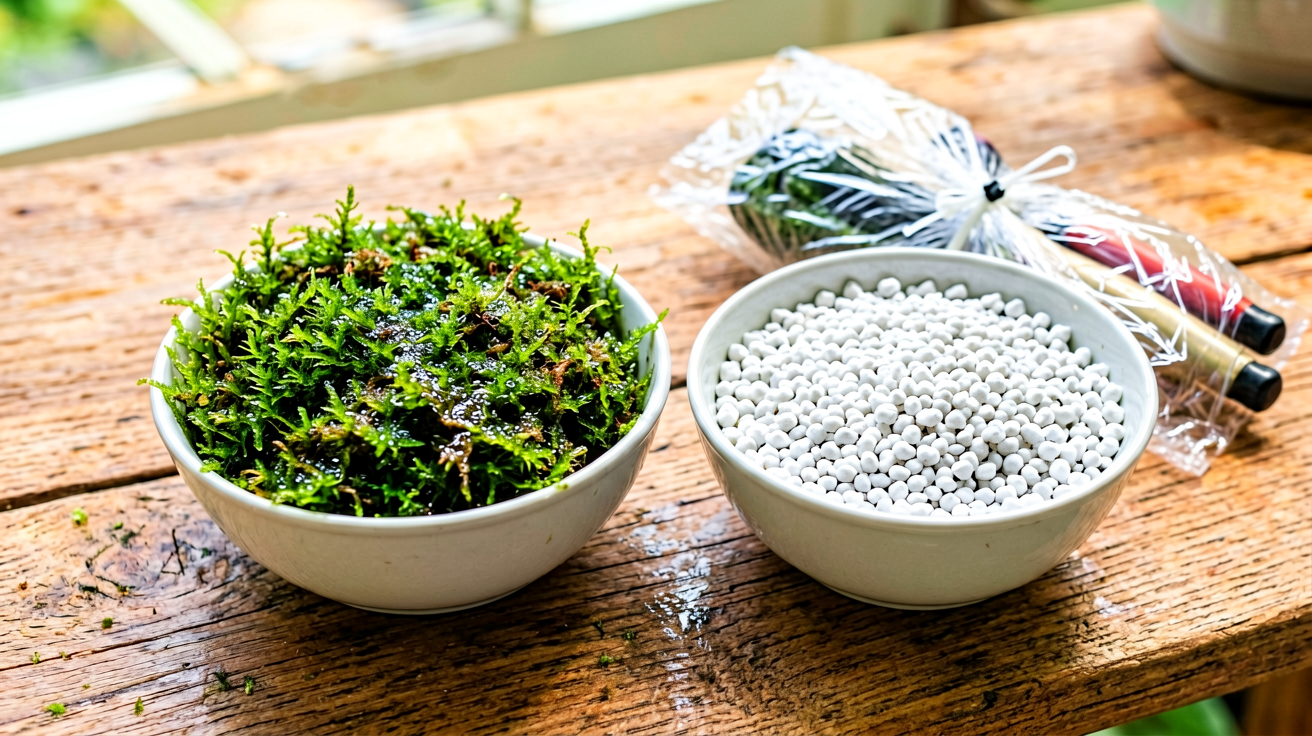

Sphagnum moss beats perlite for most air layers because the moss ball must stay damp against the girdled cambium for 8 to 12 weeks without daily watering, and only long fiber sphagnum holds that moisture curve inside a sealed wrap. Perlite drains fast, dries the callus in days, and suits only short windows or a moss plus perlite mix for slow woody species. Pick damp sphagnum moss for the standard wrap, add 20 to 30 percent perlite only when the species needs extra air across a 12 to 16 week window.
If you already bought both bags, the choice feels harder than it is. A jar cutting roots in perlite with fresh air and frequent misting, but an air layer seals the medium around a living branch in plastic wrap and aluminum foil for months. The sealed moss ball cannot be watered daily, so the medium must bank water on day one and release it slowly to the callus. This page compares the two media on moisture, rot risk, root handling, and cost, then gives the mix recipe and check schedule so the girdle never dries and never rots.
The short answer: pick moss, mix perlite only sometimes
Pack long fiber sphagnum moss, soaked 10 minutes and squeezed to damp but not dripping, for every standard indoor air layer on rubber plant, fiddle leaf fig, dracaena, schefflera, dieffenbachia, and money tree. The full air layering procedure assumes this moss baseline, and the week windows on the best plants ranking were measured with moss wraps. White roots show by week 8 to 10, the root mass fills the moss ball by week 12, and the cut transplants with moss still clinging to protect young roots.
Mix 20 to 30 percent coarse perlite into the moss only for slow outdoor layers on magnolia, camellia, azalea, and holly that seal for 12 to 16 weeks, or when your home runs humid enough that pure moss stays soggy past week 6. Perlite opens air pockets inside the moss ball, slows anaerobic rot, and keeps the cambium breathing across the long window. Straight perlite with no moss suits almost no air layer, because the granules fall away from the girdle, leave air gaps against the cambium, and dry within days inside a warm wrap.
When a layer stalls past week 12, the medium is only one suspect among five, so read the week 12 troubleshooting guide before blaming the bag. When the stem itself is the question, the method comparison settles whether the branch wanted a moss ball at all. The species specific rubber plant propagation guide shows both angles when you want cuttings and layers side by side.
How each medium behaves inside a sealed wrap
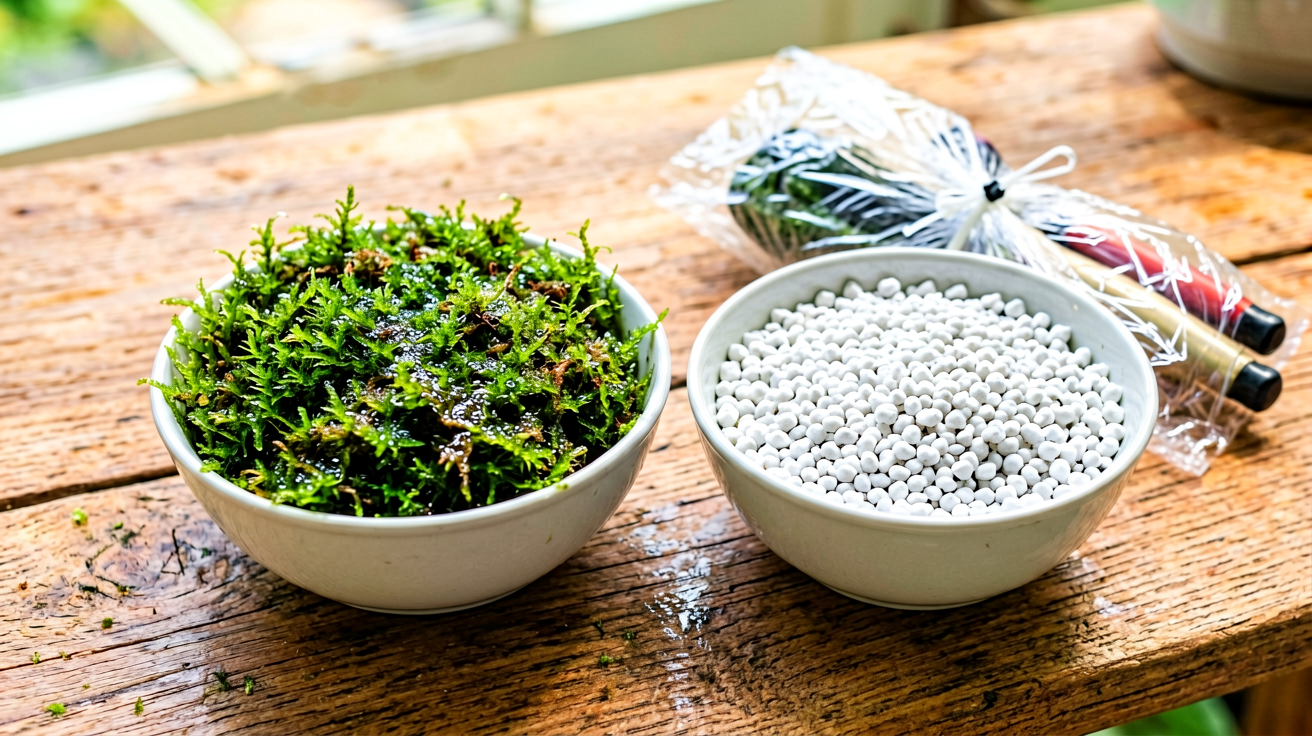
Long fiber sphagnum moss acts like a slow sponge that grips the girdle on all sides, holds 10 to 20 times its dry weight in water, and releases moisture to the callus across weeks instead of days. The fibers knit into a firm moss ball that keeps shape around woody stems, keeps the cambium in full contact with damp tissue, and cushions developing adventitious roots so they branch through the ball instead of circling. A well packed moss ball the size of a grapefruit carries enough banked water to survive 4 weeks sealed without a check, which is exactly the rhythm a working gardener can keep.
Perlite behaves the opposite way by design, since each expanded volcanic granule holds water only on its surface and drains everything else to the bottom of the wrap. In an open pot with drainage holes that trait prevents rot, but inside a sealed moss ball with no drainage the trait starves the callus. The granules shift when the branch sways, open gaps between medium and cambium, and let the wound dry in patches while water pools at the lower twist tie. Callus that dries in patches calluses unevenly, and uneven callus pushes partial roots on one side while the other side stalls.
The handling difference at cut time favors moss again for most readers. A moss grown root mass lifts as one coherent root ball, transplants with moss fibers still attached, and settles into a well-draining mix of peat, perlite, and orchid bark with almost no root tearing. A perlite grown mass falls apart when the wrap opens, exposes bare white roots to air, and forces the gardener to pot up naked roots under time pressure. Young adventitious roots dry in minutes once exposed, so the coherent moss ball buys the calm transplant that perlite denies.
From PDF to Excel in one click
Forget retyping line by line. Upload any bank statement, get a spreadsheet you can actually use. Your files are never stored, and you can test the converter with 3 free conversions.
Try it freeMoisture curve: why moss wins the 8 to 12 week window
The standard indoor window runs 8 to 12 weeks sealed, and moss is the only single medium whose moisture curve spans it without intervention. Soak long fiber sphagnum for 10 minutes, squeeze until no stream runs, pack firmly around the girdle, seal with plastic wrap or cling film, cover with aluminum foil, and tie both ends with twist ties. The moss reads dark brown and feels cool through the plastic at week 2, still cool at week 4, and only lightens toward tan near week 8 on fast species. One squeeze check at week 4 and one at week 8 is enough, and most spring wraps on active growth never need a mid window mist.
Straight perlite inside the same seal drops off the curve within the first 2 weeks because the granules cannot bank water and the warm wrap accelerates evaporation into the trapped air space. Condensation beads on the plastic while the girdle itself sits dry, which misleads beginners into reading wet plastic as a wet wound. By week 4 the callus stalls, by week 6 the cambium looks pale and shriveled, and by week 8 the layer reads as a failed air layer with no roots when the real failure was medium choice on day one. Rewetting perlite mid window helps for days, then drains again, so the gardener inherits a watering chore the sealed method was meant to remove.
Homes with dry winter heating tilt the comparison even further toward moss, since forced air pulls moisture through tiny wrap gaps and perlite has no reserve to cover the loss. Homes with humid greenhouse air narrow the gap slightly, because ambient high humidity slows evaporation and keeps perlite damp longer, but moss still wins on contact alone. The cambium needs touching damp fibers on every millimeter of the girdle ring, and only moss conforms to bark ridges, wound edges, and the branch curve without gaps. Perlite touches the wound at points, moss touches it as a sheet, and roots follow contact.
Rot risk: the one place perlite helps
Rot is the honest counterweight, because the same water banking that makes moss reliable can suffocate the cambium when the wrap runs too wet for too long. A moss ball packed dripping instead of damp, sealed without aluminum foil in a hot window, or left unchecked on a dormant mother plant through fall turns dark, soft, and sour by week 6. Anaerobic bacteria colonize the soggy fibers, the cambium turns black and soft, and the layer becomes the rotting moss case that no refresh can save. Perlite never rots this way because it never stays wet enough to host the bacteria.
The fix is rarely switching to straight perlite, and usually means packing moss correctly plus adding air for long windows. Squeeze soaked moss until only drops fall, never a stream, and the rot risk drops sharply while the moisture curve survives. For slow outdoor species sealing 12 to 16 weeks, blend 20 to 30 percent coarse perlite through the damp moss so air pockets persist after the fibers settle. The perlite granules hold the ball open, the moss still touches the full girdle ring, and the cambium gets both water and air across the whole season. Fast indoor species on rubber plant or schefflera need no perlite at all when the moss starts damp and the mother plant grows actively.
Sterile technique cuts the remaining rot risk regardless of medium. Cut with a sharp knife wiped with alcohol, use sterilized pruners for the final cut, and mix only fresh sphagnum with fresh perlite rather than reusing old moss from a failed wrap. Old moss carries bacteria into the new seal and repeats the rot on a fresh girdle. When rot symptoms show as dark soft moss with a sour smell and black soft cambium, cut below the rot line, discard the medium in the trash rather than compost, and restart on a fresh branch with fresh medium during active growth.
Mix recipes and check schedule for real homes
Use pure long fiber sphagnum for indoor layers on woody-stemmed and semi-woody houseplants from spring through late summer, and expect the simplest calendar. Soak 10 minutes, squeeze to damp, pack a grapefruit sized ball, seal airtight, and check by gentle squeeze at week 4 and week 8. Mist only when the ball feels light and the moss reads light tan through the plastic, and use a syringe through a pinhole at the top twist tie so the seal survives the watering. Most spring wraps need zero mid window water and root on the banked moisture alone.
Use the 70 to 80 percent moss plus 20 to 30 percent coarse perlite blend for outdoor magnolia, camellia, azalea, and holly, and for any indoor layer that must seal across fall into winter. Soak the moss first, squeeze, then fold the dry perlite through evenly so no pure perlite pocket touches the girdle alone. The blend checks on the same week 4 and week 8 rhythm, with one extra squeeze at week 12 for the 16 week species. When the ball feels heavy and dark at week 8, leave it sealed and skip the mist, since overwatering a healthy blend causes more harm than a light dry spell the moss can bridge.
After the cut, both media transplant the same way with one handling difference. Tease moss grown roots gently, keep moss fibers on the root mass, and seat the whole root ball into a well-draining mix with peat, perlite, and orchid bark so drainage holes run clear on first watering. Shake loose perlite from blend grown masses with care, keep the core moss intact, and pot up to the same mix. Hold every new clone in bright indirect light with high humidity under a plastic bag tent for 2 weeks, then remove the tent and follow normal recovery and aftercare. Clones that wilt on day 2 usually stand back up by day 7 once the root ball connects, and steady moisture beats early fertilizer while wound healing finishes and a lateral shoot often pushes where apical dominance was removed.
Cost, reuse, and the final pick
Perlite costs less per bag and tempts budget shoppers, but the comparison reverses per successful clone once failed wraps are counted. A small bag of long fiber sphagnum wraps 4 to 6 indoor layers at grapefruit size, and each wrap roots on schedule when the mother plant grows actively and the seal holds. A perlite first approach saves coins on day one and spends them again on refreshes, second girdles, and restarted branches after dry stalls. Moss is the cheaper medium per rooted clone across a season of vegetative propagation, and the blend adds only pennies of perlite per wrap.
Reuse rules are strict for both media and favor fresh moss every time. Never reuse moss from an unwrapped layer, since old fibers carry bacteria, hold depleted structure, and import the last failure into the next wrap. Perlite can be rinsed and reused in open potting mix, but not inside a fresh air layer seal where old dust clogs the air pockets the blend was added to create. Start each moss ball with fresh sphagnum, fresh perlite when blending, clean plastic wrap, and new twist ties, and the medium stops being a variable the gardener has to debug.
The final pick stays simple enough to act on today. Pack damp long fiber sphagnum for every first layer, blend in 20 to 30 percent perlite only for slow outdoor species or soggy homes, and never pack straight perlite against a girdle you want rooted. Choose a pencil thick branch on an actively growing parent plant, girdle through bark into cambium, dust lightly with rooting hormone with IBA, wrap the moss ball airtight, and let the sealed moisture do the work. When white roots fill the ball, cut below the root mass, pot up, tent for humidity, and keep the clone that the right medium made inevitable.